Chris Hladczuk - Tactical advice you need to know to build a fintech startup in stealth!
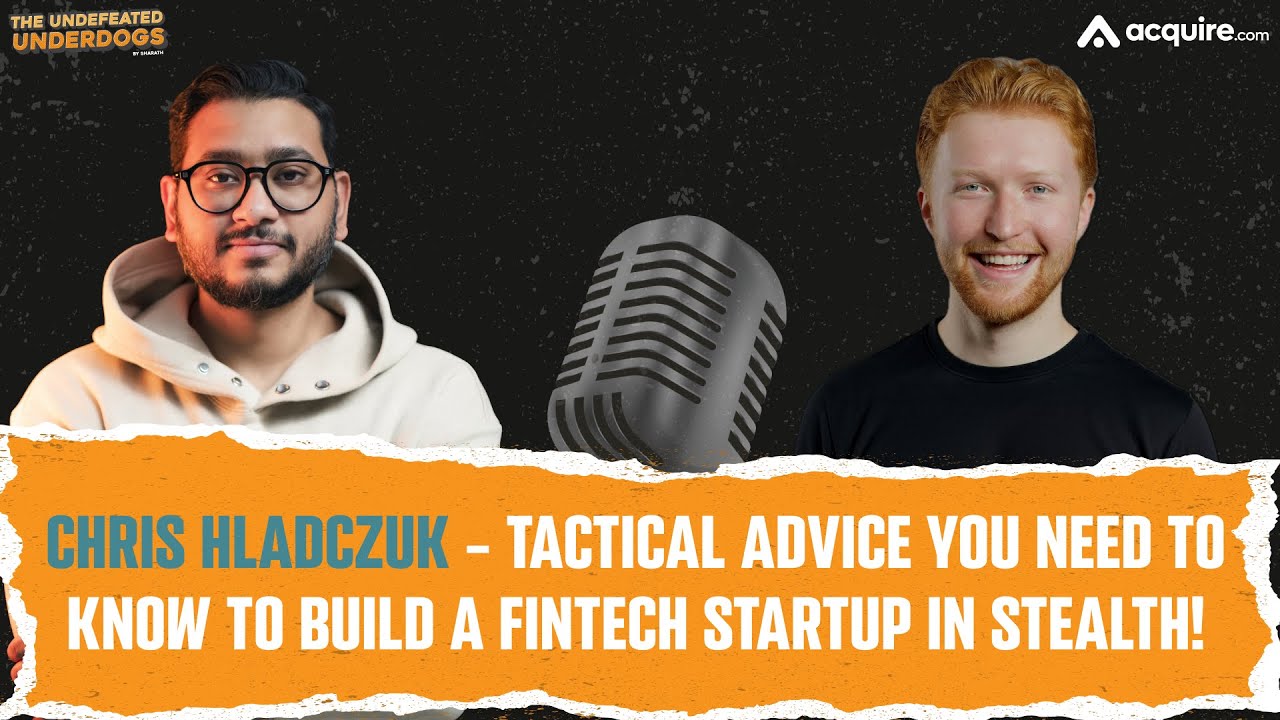
In this episode of the Undefeated Underdogs podcast, host 5harath interviews fintech founder Chris Hladczuk. Chris walks through his career—from studying at Yale and working at Goldman Sachs, to joining the early‑stage startup Meow, becoming its CRO, and eventually launching a stealth fintech venture. He shares concrete, tactical advice for founders and creators, covering how to generate and prioritize ideas, his disciplined writing and headline‑crafting workflow, and the importance of proof‑of‑work and rapid iteration. The conversation then shifts to operational excellence: Chris describes his ideal product week, using Linear to map high‑leverage tasks, setting a clear roadmap on Sundays, and acting as an unblocker by resolving accounting, audit, and other cross‑functional blockers. He also touches on sales process excellence, hiring criteria, and the mindset needed to tolerate pain and stay egoless while scaling. The episode ends with a brief wrap‑up and a plug for hanover.co.
Chapters
If you, if you never want to be early stage, like if you want to be a chief of staff at a Series B company and then maybe you want to be a COO of a company or CFO, great. That's totally fine. You're never going to go earlier stage than where you are right now. If you think I'm going to do chief of staff and then start a company, I think it's a terrible idea. Yeah. Because you basically like have no skills to actually add value in the most critical time, which is writing code, improving the product, or getting distribution. That's it. And so I think like if your goal is to maximize the potential— and look, most startups fail— but if your goal is to maximize the potential of winning, which is what my goal was, got to get a hard skill.
Welcome to the Undefeated Underdogs Podcast, where I unpack and narrate stories of ambitious people who turn obstacles into opportunities. My goal for this podcast is to create a platform to narrate underdog stories and maybe play a small, teeny tiny role in inspiring you. I intend to highlight the underdog mentality and make authentic conversations with people who play the long game, take action with a chip on their shoulder, and convert obstacles into opportunities. Buckle up as I'll be bringing some authentic founders, VCs, community builders, and content creators who got underestimated their whole lives, and yet they beat all the odds to become insanely successful. Now today I want to tell you a little bit about our awesome sponsor, acquire.com. Selling a business is as tough as building a business. As someone who went through this process once, selling my own startup, I know the pain it takes to get to the end zone. This is where our sponsor shines. Imagine this, you're a founder who's built a solid SaaS product, acquired customers, and generating consistent monthly revenue. The problem is you're not growing for, for whatever reason, lack of focus, lack of skill, or just plain lack of interest. And you feel stuck. What should you do? The story I'd like to hear is you buckle down, somehow reignited the fire, get past yourself and the clichés and start working on your business rather than just in the business. You start building an audience, move out of your comfort zone to do sales and marketing. And in six months you triple your revenue. The reality isn't as simple. Situations may be different from every founder facing these crossroads, but too many times the story ends up being one of inaction and stagnation until the become business the business becomes less valuable or worse worthless. If you find yourself here or your story is likely headed down a similar road. I offer you a third option. Consider selling your business on acquire.com. Capitalizing on the value of your time is a smart move. Acquire.com is free to list, and they've helped hundreds of founders already. Go to try.acquire.com/sharath and see for yourself if this is the right option for you. Now let's get into today's episode. My next guest went from being a Yale grad to working at Goldman Sachs and then quitting that job to join a startup where he got promoted to Chief Revenue Officer in 9 months from go-to-market lead. Now he's building a stealth startup we want to discuss on the podcast and dive deeper about. But all this happened in the last 4 years, by the way. It's not like a 20-year career. It's all just happened in the span of last 4 years. I'm so impressed. been impressed by Chris and his journey from afar, watching him creating content and everything else in between. I'm so stoked. Finally, we got a chance to do this, meet virtually like here. But I'm excited. Chris, welcome to the show. How are you feeling?
I'm fired up. This is like off the record. Imagine me and Sharath are unrecorded, just riffing right now. So it should be fun.
Yeah, we'll see how this goes. That's what I love. I love my podcast. I don't know about others, but I love just having conversations with people and see where it goes. But man, I have to tell a fun fact to listeners. I'm scrolling through our DMs and this is June 23rd, 2020. I got a DM from this random person saying, my name is Chris. I'm a rising senior at Yale. I'm new to Twitter, but just stumbled across your account. Super impressed, all that. Personally, I'm focused on tweeting about startups, angel investing and all. Do you have recommendations for a newbie like me? Wow, that was 4 years ago.
4 years ago. Wow, that's crazy. I forgot about that DM. That's pretty insane.
That DM, and I just shared some things which I learned. Be authentic, provide value and all that. And my God, let's circle back today. You have close to 200K followers, 15+K followers on LinkedIn, and you've been killing it like left, right, center. Every time I see your name when it comes to content, you always, always provide high-value content. And I'm so, so proud of you, man. I just want to put that out because in this last 4 years, I've seen many people grow, but the way you grew your personal brand is insane. So congrats on that. And yeah, I just want to say that out and we can start off from—
No, I appreciate that. I mean, it's been a fun journey. I would say I've changed substantially in terms of, and this might be useful for the audience too, in terms of the type of content I want to create. Now when I create content, given the ThreadBoy era of 2020 and 2021 is over, less like more and more people thought there was a playbook for creating content. And I would say like people are growing slower on places like Twitter. And so I've completely changed my strategy. For me, it's become, okay, I will only publish something if I am uniquely the only person in the world who could write this thing. Now, what that means tactically, and I don't always follow the rules, so I need to get better at this. What that means tactically is I will always inject some sort of personal story or personality arc. To whatever I'm trying to say. Because ultimately, no one else can talk about getting pneumonia 3 times and being sick and this happening and then winning a national championship and whatever. No one can talk about that in the context of whatever I'm trying to say. And so I've tried to escape competition and content by just being obsessed with what can I say that no one else can say? Because at the end of the day, anyone can use ChatGPT now to summarize an article and post a thread. And so it's pretty useless. And so the game, I think, has changed a lot.
Yeah, it changed a lot. That's one of the questions I have for you is how have you evolved? Because I've been, again, I've talked to many people and I think you described it pretty well. The thread boy era is over right now. I think everybody's right now, the trend is images and they're writing these big-ass essays, posting the essay in an image format, and that's something that's going viral. Either they're learning from their experience or they're posting something from someone else inspired from. So yeah, definitely. I think now that we're talking about content, I'm curious, 4 years ago, I still remember, I think you had like less than 100 followers if I'm not wrong.
Yeah, I started the account right when I DM'd you, literally.
Yeah, just like you're starting in, you know, and I saw you create like Again, so much content. Like, I have like some of the things in 2021, you've created like Googling tips from— you've interviewed like 5 founders, that's a popular thread you've created, a trend I remember if I'm not wrong. Like, you've interviewed these billion-dollar startup founders and these are the lessons people should learn. And these threads are viral, like 100K likes, 30K likes, so on and so forth. So now that you're in this new era of content creation using AI, what is something that you learned in person as a content creator, outside of being a founder, outside of being an operator, that you want to pass it on to our listeners?
Yeah, I think it's really important to understand the game you're playing. And this has changed. So we can talk tactical and then we can talk about strategic. And so the strategic point is What game am I playing? And what does winning look like? So for me, what changed is, I do not want to be a full-time content creator. And so, you know, number of followers, number of impressions are actually not the metrics I was optimizing for. And so like, you know, if that is the metrics that I was optimizing for, I would create a different style of content. And so I think it's like, step one is what does winning look like? And so I defined, I was like, I'm not trying to make money from this, I'm literally just trying to put something only I could say into the eyes or ears of the 1,000 people on the planet that I would find incredibly valuable for the business that we're building or what we're doing, which is right now venture capital funds, but also private equity, private credit funds. So it's like, okay, what does winning look like? It's not number of impressions, it's not number of followers anymore. It's not virality. It's getting in front of those people and then thinking about what do those people find valuable? Okay, great. Now that's what people find valuable. And then like thinking through the tactics, which we can get into of like how to write something that's compelling for people. But I think like it's really addicting and I was, we're both addicted to that, which is like, it's addicting to like have a post that go viral and you have a bunch of what I call empty calories, which is like a ton of engagement on something that they don't really care about you. They just like care about some nugget of information that you trend jacked off of. And I think that's useful for figuring out what viral writing looks like. But to me, it was like escape competition by playing a different game. And that game is not to be a content creator trying to make money. So that's kind of how I started.
I think it's just like how, if I'm not wrong, Naval put this long ago, you have to escape competition by being yourself. I think on those similar lines, you're escaping competition by being yourself that you can only say. From your own experience. I love that fact. And if you can walk me through the process of how Chris goes from an idea to the first draft to— let's talk about the tactical stuff— first draft to refinement, and then like, this is the ultimate version I want to ship. What does like the process look like?
Yeah, so it starts with a Google Doc called Content Ideas where I basically just have a bunch of bullet points. And I could literally, let me, let me pull this up live and literally talk through what it would look like. So, okay, I have a Google Doc with content ideas. One bucket is broken down by my core beliefs. And so like one of that is, you know, long-term excellence is about being a little less dumb every day, or work-life balance in your 20s is an easy way to guarantee a mediocre career. We could talk about that. Yeah. Business is war, you know, stop playing founder. Those are kind of core beliefs I had. And then I have like, that's one bucket or like a general topic bucket, which is like another. So there's kind of different buckets of content. ideas. And then as I'm doing things, as I'm doing, you know, calls with people like you, as I'm talking to customers, as I'm talking to our team, I might be like, my brain's kind of always tuned with like, oh, does that fall into this bucket? Or how should I think about that? And I just tossed it into the Google Doc. So that's kind of like step 1 is like, have kind of core ideas and core buckets with like very little structure and take that. Step 2 is, you know, every Sunday, typically for 4 or 5 hours, I'll do like the basic writing for the week. And so I will open up the Hemingway app, which is like, it's similar to like any sort of text editor like Google Docs, except for it ranks you by the reading level by which you're writing at. So it's like if you're writing at a 10th grade reading level, it's too mature. If you're writing at a 4th grade reading level, it's probably right for like digestible and understanding. That's kind of first piece. The next thing I'll do is I will write 10 headlines before I write the actual body of the thing. And so I'll write 10 of them as fast as I can. If it takes more than 15 minutes, it's a problem because I'm overthinking it. It's almost like analysis paralysis. And so I'll write like 10 headlines as fast as I can. Then I'll go in and I'll write a rough draft in like 15 to 30 to 40 minutes as fast as I can. Literally, like, this is a horrible version. It's so bad. It has run-on sentences. It's not punchy. It's not useful. It's just like, it's almost like taking a piece of marble and just tossing it onto the ground. And then I'll say, okay, let me take 5 minutes off from that, go for a walk, go somewhere else, whatever. And then come back and like chisel the marble and be like really ruthless in terms of like conciseness of what I'm doing to edit it down to something that's useful. And then I'll spend more time picking what the right headline is out of the 10 I wrote originally, and then I'll post it that week. And so it kind of starts with like, what even am I thinking about at the top of the funnel? What am I writing about? Then it's like write 10 headlines, cuz that's kind of the 80/20 of good writing is writing good headlines. And then it's— toss marble out there, and then it's chisel the marble, and then it's ship it.
Wow, I love that top-down approach, which is raw thoughts to crystal clear content that comes out. And it looks to me like obviously you've refined this craft of writing over the years and it seems so pro, right? Like the process itself is like You know, someone who's put so much effort and, you know, time. Is there a starter guide type of a version where, you know, I don't have this much time, but I still want to write? It's like a mini version of what you just said that you followed when you were just getting started like 4 years ago.
So I think it takes like, I mean, if you want to write good stuff, like I love this idea from MrBeast. Obviously what he talks about, he's like, Stop trying to ask people for advice on writing and just go— or on creating videos and just go make 100 videos. And then try every single time to make one slight improvement to each of the videos after each video. And after 100, you're going to be 10 times farther than if I just tried to give you the answer to the test. You might grow, be a little bit better and be able to take my advice a little bit better after you've made 100, because you kind of know where the map is. And so To me, the honest truth, if you're listening to this and you're like, hey, I want to learn how to write stuff, if you can't block out 3 to 4 hours on a Sunday, this is not for you. At the end of the day, if this is what you care about, which is we can talk about all the benefits of it, then you need to block the time. And maybe it's not 5 posts a week to start, maybe it's 2 posts a week, but it's a muscle like anything else, like going to the gym. The less you write, the worse you're going to be. The more you write, the more you're going to be. And the more you write, the less bad your stuff will get. And so you can't really shortchange the process aside from learning some of these tactical— here's how I collect ideas, here's how I ship a marble, all that stuff.
Yeah, I think it's all about reps. And I think one of the things I love about MrBeast, the iteration game or the volume game, is while doing this, of course you'll build the craft of doing something, in his case, video. In your case, writing. But you will find a style, you'll develop a taste, which is, I feel, is very less talked about. Everybody talks about the tactical stuff, like how can I get— again, tagging that input to output, which is how much likes I will get, how much viral I can go. But it's all about developing that Innate taste you have as a creator, you know, as a human being.
I think it goes even further. It's— I call it like proof of work is kind of— it's like almost a crypto phrase that like Bitcoin invented, right? But I call it like, you know, what's not useful anymore when I talk to someone is like what their resume is. It's literally like, what work have you done? For— so for a software engineer, it's literally like, show me your GitHub with projects you've shipped, or show me web apps you've built, or show me mobile apps you built. For someone who's non-technical, A blog with 7 links of thoughtful pieces that you've written that no one ever reads, by the way, it doesn't matter if anyone reads it, is literally proof of work that you are in the top 1%, even if you get no distribution. Right. And so I think it develops taste, but it also proves that you can do something that isn't go to college and do a job that your parents tell you to do. It's like, okay, I did this. I have no one telling me to do this. but I've went out and here's how I think and here's the proof of work. And so I think that's a lot of value even with no distribution.
Yeah. And I think Jack Butcher, also kudos to him for popularizing proof of work during that 2020 phase where everybody's kind of craving about being a creator. I absolutely agree on that front. It also shows what you can do. And looking back, you can also see the shitty versions of yourself. It also helps to introspect, reflect on how bad you were and how far you've come through. Right. That is also like, there are so many benefits of doing something on an iteration game. I want to hear your version, or at least the benefits you got from writing content for so long.
Yeah, let me give you a tactical one. So I had like 300 followers and Sam Parr, My First Million podcast, went out and was like, how did— this is like 2020, 2021. They were like, how did Sean Peery, his co-host, How did he go from 30,000 to 100,000 followers in 3 months? Can someone please tell me this? He just tweeted out. And so I replied, I'm the guy who's going to figure this out. And I went and literally deep dived and figured out, studied all of his tweets, wrote a piece about why he did this, and I shipped it 3 hours later and tagged them. 2 hours after that, Sean DM'd me saying, do you want to work for me?
Hmm.
We got on a call. I ended up like, Interning, apprenticing for him for a handful of months. And he kind of showed me what I would say excellence looks like when it comes to great writing. And so that is an example of no one was like, hey, do you want a job or do you want to do this thing? I was like, I'm faster. I can attack this opportunity and maybe nothing ever comes from it, but I still have the proof of work regardless. And so I kind of took that, kind of learned what writing, good writing looks like from someone like Sean who was much better than me. And still is, by the way. Learned what good writing looks like. And then I kind of like took that and then that kind of helped me get better to create pieces and then kind of start to build the distribution, the audience there. But that's like one tactical example I think about.
Yeah, I love that. I think it goes back to, again, Jack Butcher's permissionless work. Nobody asked you to do that, right? You've initiated yourself to do that and the benefits are— you're going to reap the benefits as well because It's your work. Speaking about you being fast, I see a ton of confidence, right, in you. But going back when you had like 300 followers, when Sam posted that, yeah, what took— how much courage you had? Like, do you even— how did you process all that? Yeah. Going from, okay, do I even have the ability to do this when you start working? And I want to also kind of dive a little deeper into your mind about expectations you put for yourself, right? Sometimes a lot of us stumble when we set higher expectations and we want to go do something from output standpoint and we just stumble. So yeah, talk to me about like the early days. Expectation setting, your confidence levels and all that.
The thing is, like, I kind of reframe it. It's to me, it's not even confidence. It's like, no one knows or cares about me. And so who cares if I screw this up? If I have 300 followers and I post a tweet, literally the only people that would like it were like my mom and my brother. Like legitimate, I get like, so like, no one's reading it anyway. And so my worst case scenario is no one reads it anyway in perpetuity. That's kind of how I think about a lot of these things. I reframe it in my brain of no one cares anyway and no one cares about me per se. And so I have nothing to lose. It's not like I have this 10 million person audience and a reputation that people care about. I had no reputation. No one cared about me. I was the underdog. So it was like, okay, I was the underdog. Now I can basically do whatever to be scrappy and figure it out. And so that's kind of how I think about a lot. And I think a lot about in the company we're building today, we're the scrappy underdog that's kind of figuring it out. Where, you know, same thing like when I was joined as an IC salesperson at Meow, like there were no expectations. So I think it's like roll the balls out and you have nothing to lose.
I love that, man. I feel there is a massive advantage for being an underdog because nobody's actually looking at you. You can do anything you want and any shots you want to take, you can take. And if it hits, this is the outcome, you know, sitting in front of me. If it didn't work, that's fine too. You just keep on going and going and going. So that's, I feel, the unfair advantage underdogs have. So talk to me about the transition from you going to Yale to working for Sean, then going for Goldman Sachs. Like, is that the time you were working at Goldman Sachs? What was like the timeline look like?
Yeah. Timeline is graduated college in 2021. I had done the traditional investment banking recruiting back sophomore, junior of college, and I had the job lined up to join full-time. And then COVID hit. I literally was reading this essay by this guy we all know named Paul Graham. And I was like, wait, a few crazy people in a room can go build a billion-dollar company? That sounds insane. My dad sells commercial insurance. My parents all, they worked at bigger companies. They had never been exposed to startups before. I grew up in Philly, not Silicon Valley by any stretch.
Right.
And I was like, okay, the best thing to do to actually see if this is something that I could be decent at was go hang around those people in tech. And I was like, all those people are on Twitter. And so I was like, this whole Twitter and distribution engine was just a way in which I could shortcut distribution plus building a network in the space. And so that was part one. I was doing that at 10:00 PM on Friday nights when I was at Goldman. And so I did that. I did Goldman for a stint as a traditional investment banking analyst. And then I said, look, if I want to go build a company, I need to go join a startup to figure out what excellence looks like. Just like I worked for Sean and saw what writing excellence looked like, Mm-hmm. I I never shipped a product and I never sold to people. And so I didn't have the arrogance to think that I could just quit after being doing spreadsheets to go build a massive company. And so I met 50 startups, ended up joining Meow, started as a salesperson and then became Chief Revenue Officer there. And then I left to start my own thing.
Wow, that's incredible. It looks like from your answers in the way You present yourself, you have this, you have this nature of questioning things, right? You read a Paul Graham post and you're like, oh, you, you know what, 5 people can do it, I can do it, right? Or how it— if what, what would look like if I would do it? Where did you develop that questioning the norm, or at least questioning the status quo? Like, if, if you didn't you were not in the position of doing it and you're getting inspired from someone. Most of the people just consume the inspiration and don't act, right? So talk to me about the mindset. And I think you're still hungry. That's one thing I'm assuming. Basically, like your Twitter bio itself talks about it. You're a maniac.
So I'm way hungrier than I ever was, by the way. But yeah, I'm happy to talk about it. So Growing up, my parents always used to say, set a goal so big it'll blow your mind. And so this was kind of a framing that whatever goal you have, it needs to be so big that if you achieve it, it seems crazy. And so I think that from a very young age taught me to, this is kind of just the way in which the world is, which is just a very unique frame of how the world is. And so I thought about that. I took that and was like, okay, People say, I was just super ambitious when I was in college and I didn't even know what I wanted to do. And so I was like, oh, there's this mountain called Goldman Sachs. Let's just run up that way. Not even knowing what was up that mountain, but I was like, oh yeah, 25,000 people apply and they take a few hundred. Set a goal so big it'll blow your mind. I'm going to do it too. Right? And so that instilled a lot of the principles of how I think about approaching things. And so I think that was probably the start.
And how did you, um, you know, of course we all have our highs and lows, right? You know, everybody's happy, it's on a sunny day when we have highs. Walk me through your process of dealing lows, failures, rejections. You know, how do you cope up? What do you do? Do you have frameworks that, that brings you up to speed again, back, you know, back up and do the thing what you're doing?
There's, there's plenty of lows. So my freshman year of college, I got recruited to play lacrosse there at Yale. And our team was like, you know, probably top 10 in the country. And so I came in on campus thinking that I was this hot shit. I had like a lot of confidence, right? I immediately get punched in the face, right? Um, I got pneumonia. I had, you know, groin surgery for a sports hernia. I had—
Wow.
Sinus surgery, literally was so sick that my face had blown up like a bowling ball. That entire year, I barely played and our team ended up winning the national championship. And so the best team, I didn't even dress up for the game. I was even below a benchwarmer. Man. And at that point, in a very intense Navy SEAL-like team that we were, I had no respect for people on the team because they hadn't seen me deliver. They just saw me be sick the entire time. And so after that year, I basically made the decision. I was like, okay, There's 2 paths I can take. Either I quit and give up now, or I literally do whatever it takes to win and figure it out. I took the second path, right? And so that's that second year. I was definitely not a star player by any stretch, but I got voted most improved by my team out of like 55 people on the team. And I was like, that was the first time where I'm like, I was the lowest low. It was a terrible year, super sick, no respect. I was like an outsider. And I said, I refuse to allow this to shape my destiny. I'm not quitting. I'm going to figure it out. And so I think that was a low. And then basically after that, I was like, can't get worse than being perpetually sick for 12 months and think you're never going to get better. I mean, it was pretty bad. So yeah, we're back now. And that was definitely a formative experience.
It looks like you've been an athlete. I think Sahil Bloom, you know, he was— he played baseball as well. Um, you know,
he's an investor in us, by the way.
Yeah, yeah, yeah, yeah.
Shout out, Sahil.
So yeah, big shout out. He's coming on the podcast too. Uh, and I see a lot of founders getting inspired from, you know, sports athletes. And you being an athlete or former athlete Yeah. And you already said you were the top elite teams, right? So that means you've gone through so much rigorous training. There used to be some habits that you formed that you're still practicing as of this moment. So talk to me about the role of Chris as an athlete that played or actually playing even till today on the role of Chris as a founder.
I'm definitely retired now. But I kind of think about like my sport, my sport is business. Like I'm in the Olympics of business right now.
Yeah.
But I think like pain tolerance is something and the way we could take this is that like, in sports, you basically need to like push through a very, very uncomfortable level of pain to like execute on whether it be the lift, the practice, the game, like, all of that requires a high level of pain tolerance. The way I think about what we're building, we're building multi-entity general ledger, all this complex accounting stuff that requires a very high level of pain tolerance to execute on. Meaning it's not fun to figure out how to build systems to check 10,000 numbers simultaneously with different complexities. That is a very painful exercise to figure that out. And so I think of applying that pain tolerance of what I was doing, pushing through something in a practice to what we're doing right now, kind of building what we're doing. And so I think a lot of it around like founder-market fit of like picking something with a high pain tolerance and then feeling comfortable executing at that level.
Wow, man, that's great. Actually, I was expecting something else more on the resilient side or being persistent, but I feel the pain tolerance is something very less people talk about. Being a founder is It's not easy. It's hard. Building a startup is not easy. Yeah.
Yeah. I mean, this is what I call it like— so I think egoless execution is the way I think about this. And so like, you basically have to have a ton of confidence and you have to have a ton of— you have to have a big enough ego to think a few crazy people in a room are going to go build a multibillion-dollar company. So that requires a lot of confidence. Then when you think about day-to-day execution, you basically have to have zero ego. Meaning you can be stubborn about the vision, but very flexible in the details. Meaning what is the best way in which we should present this UI for bill pay? We need to have very low ego on just like whatever we think. Data, it's a 2-way door decision, which we can get into. We make it very quickly, we move on, we ship it, and we go.
Hmm.
And so you're constantly balancing in my mind, like, we will take over the world and being sure of that and just being very stubborn about that. and refusing to be denied with no one has an ego here. Let's just do whatever it takes to win.
Powerful too. That's powerful shit right there. It's hard. It is hard to—
It's fun though.
Sometimes it's fun. I want to ask one thing about your experience at Goldman Sachs. Let's go timeline-wise. We kind of like took a tangent, but I want to go back to, you know, you're going after that mountain. Goldman Sachs. Did you love it? Loved working there? Did you hate it? What's your—
So I think people in investment, there's like this negative connotation of banking. I actually liked it a lot. I worked insanely hard. Interest rates were super low and I was doing leveraged finance covering tech, media, telecom, meaning anytime there's like a private equity buyout, we would be the ones helping on the debt side. And so when rates are low, there's a lot of activity, meaning I did a lot of deals that year that I was there. And so I got a ton of experience in a short amount of time, but I actually liked it a lot. It was like a small team within a big company, meaning it was like 10 to 15 of us on this very specific team. And it was just like, you're around people that are all like, what does excellence look like in this craft of thinking about how to structure these debt deals? And then for me, it was like, I had never worked anywhere else before. And so having the bar of This is what excellence looks like in managing 7 different teams and 10 different projects. This is what excellence looks like in crisp communication and dealing with different customers and clients. This is what excellence looks like in team dynamics and giving the junior people enough responsibility to feel seen and heard, but also having ultimate judgment as someone who maybe leads the group. And so it was a good forged in the fire of experience, even though it was in a different field than what I'm working in right now.
And any particular reason apart from you want to build your own thing that you left Goldman Sachs? You just were there for like what, 1 year or so?
A little over a year. Yeah. Which is pretty contrarian. Most people say like, do your 2-year banking stint. For me, the way I made this decision and thought about it was like, everything is about ROI and slope of learning. Right. And so ultimately, like, you know, If my slope of learning for my ultimate goal, which was like go build a company, was really, really high in the beginning because of those things I talked about earlier, and then over time flattens out significantly because the incremental learning that you receive in that type of job is more about complexity and legal documents related to a debt syndication, for example. And so that's just not the skillset that would be useful for what I'm doing now. And so for me, it was I don't care what anyone else thinks. If I think the ROI on learning is low and lower than relative to what I could do somewhere else, then like I need to be very intellectually honest to go do that. So that's kind of how I thought about it.
How much of what you're doing right now was being impacted by your experience at Goldman Sachs? Like, because one of the things that quite popularly everybody talks about is, you know, we hate our 9-to-5 jobs, so we don't learn anything. And I just— because you said you loved working at banking, I want to hear that side of a story where what is something that you're carrying even till today from working at Goldman Sachs or, you know, these big corporations, or at least people who are working at big corporations right now who has a 9-to-5 job but have an ambition or a dream to build their own thing. What are some things that they learned, uh, you learned that they can learn too?
So it's funny, I kind of think so. There's this famous Jeff Bezos story where he's a junior at Princeton and he's like, he's taking this quantum physics class And typically, physics majors at Princeton start with 100 people, and by junior year, only 30 people are left because it's very difficult. And Jeff and his roommate are working on this problem set for 6 hours, and they literally can't figure it out. And they're like, all right, I don't know what to do. They're like, we should ask this guy, Yisanta, who was another guy in the class. So they go, they knock on his door, and they read out the problem to him. And Yisanta waits for 3 minutes, and he's like, cosine. And they're like, This is insanely complicated, not like a simple kind of the beginner-level thing that you would learn in geometry in 10th grade. And then he's like, no. Jeff's like, oh, what's going on here? How did you get cosine? He literally is like, all right, let me pull this out. He pulls out a notebook, writes 3 pages of formulas, everything cancels out to cosine. He says, that's how I did it. I saw a problem like this 3 years ago. That's when Jeff Bezos decided he was not going to be a physicist and that he decided to want to do something else, because he knew that he wouldn't be able to be one of the best in the world at being a physicist. And so for me, I thought a lot about that when I looked into finance. I have a friend who recently started his own hedge fund, and we worked together at Goldman, and he legitimately was obsessed with the markets and finance. Saturday mornings, he'd be reading 10-Ks and Qs, and he'd be trading his personal portfolio and thinking about a lot of this stuff. He is the right person to become one of the best in the world at what he's doing, which is raising his own fund and trading stuff. I was, hey, this is interesting, but I'm not obsessed with this. Not obsessed with it like I was writing about startups and doing stuff like that at 10:00 PM on Friday nights. And so for me, it was like game selection. So it's like, pick the right game that I think I have an advantage over, potentially against other people. Right. And finance, I could have been fine, but I just don't think I would be Yeah, top at that.
Again, I think speaking about self-awareness, that's a trait of self-awareness. We have to, as founders, should really know ourselves well, more than anyone else, so that we can make those decisions at least correctly. The history will prove it. But that's very interesting in you've decided Then you were on the rise at that moment. You were creating content for Sean. Yeah. What stopped you from being a content creator full-time? And then like, yeah, let's actually go get that startup experience. Let's be scrappy. Let's get into the weeds.
So I thought a lot about this. I was just like, I do not want to be a content creator full-time for a few reasons. One is like, I didn't enjoy it enough that like I wanted to spend 12 hours a day kind of creating content. Like, you know, we talked about earlier, like, I'm bucketing a lot of my content into like 4 to 6 hours a week, right, in terms of like what I'm doing. So it was kind of piece one. Piece two is, I think the biggest drawback to me of like full-time content creation is the team by which you can assemble around you. And so like, you know, raising, venturing, going after a big exciting vision, part of the fun of that over bootstrapping is that you assemble a world-class team. And it's like some of the most talented and fun times that I think you can have is doing that. So like, to me, that was much more exciting of whether it be whatever the thesis of what we're building, the idea that we're going after this massive opportunity with the right people around us is a lot more fun than creating content full-time. Now, I'm sure MrBeast and all these other people have great teams around them, but I think it's different versus that's the exception than the norm when you're trying to build a massive company at a startup. And so that to me was the trade-off that
And how did you pick Miao? I'm curious.
Yeah, there was a lot of thought in that. I'm like, I think people don't spend enough time thinking about the startup that they're going to join. So we're hiring engineers right now. I literally say to an engineer, go, it's like dating, go meet 20, 30, 40 potential companies that you could work for. Or work with and determine like, is this the right fit for me? So what I did is I met dozens of companies. I mean, it was probably around 50 at least. And I kind of thought about like, okay, I want to make sure I'm joining a place that is like sub-20 employees. The reason why is once you get over 20, there's a lot of hierarchy and there's like departments. So it's like, there's product. As soon as you get HR, it's over basically for like early stage startup, right? Yeah. It's like you have product and then you have sales, then you have marketing and you have like very distinct departments. So that was kind of the first thing. The second is I wanted to join someplace that I knew would have more than 18 to 24 months of runway, just because joining a startup with 6 months of runway is basically a fool's errand because you're ultimately betting that they hopefully can raise a little bit more money before dying. Right. So I was like, okay, I want my downside risk protection to be, I get fired because I'm bad at my job. That's good to know. If I'm bad at my job, that's great to know that I'm not cut out to be in startups. And so I was like, all right, Let's do whatever it takes to not be bad at this job. And so I picked a place that I really believed in the founders, Bryce and Brandon, the founders of Meow. And then I like thought the space was pretty interesting and I thought I could be like an individual contributor, not a chief of staff, which we can talk about, and just really like learn a tangible skill. So I joined as the 9th person.
Yeah. Talk to me about the IC versus chief of staff.
I think there's this I don't know why, by the way. And I think a lot of people see, like, when you come from a traditional prestigious, massive air quotes background, they think things like sales or marketing or like core engineering, you know, as an individual contributor are like lower status than quote unquote strategy or operations or chief of staff. I'm going to— I hate to break this to you, but you basically add no value in a startup that's early stage unless you are getting people to buy your stuff or writing code. So for me, if it was like, if I want to learn tangible skills, I need to come in as a no title, no nothing, just individual contributor salesperson, go do 10 sales calls a day and learn how to convince people to do this. And that would be so much more valuable than switching the fonts in a board deck as a chief of staff.
Oh man, you just roasted most of the people who are take pride in being chief of staff.
I just think like, so, so here's my caveat on this. If you, if you never want to be early stage, like if you want to be a chief of staff at a Series B company, and then maybe you want to be a COO of a company or CFO, great. That's totally fine. You're never going to go earlier stage than where you are right now. If you think I'm going to do chief of staff and then start a company, I think it's a terrible idea because you basically like have no skills to actually add value in the most critical time, which is Writing code, improving the product, or getting distribution. That's it. And so I think if your goal is to maximize the potential, and look, most startups fail, but if your goal is to maximize the potential of winning, which is what my goal was, you got to get a hard skill.
Yeah. What kind of hard skills do you think people should— who wants to build bigger companies, who have bigger dreams, bigger ambitions, Or in your opinion, your experience going through that flow. I have another question, but yeah, going through that flow once through Meow as an operator, as an IC. Yeah. Talk to me about the hard skills that, you know, you learned and at least others should learn. Other people should learn.
Yeah, I think so. I'll caveat everything I say. If you're an engineer, engineering, but if you're not an engineer, let me talk to like, I guess my experience. So there's a few different buckets. One is This idea of copywriting and distribution, which is kind of like a lot of the writing on Twitter, which is, can you write compelling things that get people to stop scrolling and get distribution, whether that be on Twitter, on LinkedIn, on a landing page, a manifesto? If you go to hannover.co, you can read our manifesto. That is copywriting in its purest form. And that is a form of marketing/sales that I could think about. So that's kind of one piece. The second piece is Knowing how to run an efficient sales process in like a traditional B2B motion. And so, okay, what does that look like? That knows learning how to do cold outbound email appropriately, thinking about like what subject lines work, what doesn't work, how to think about that, how to book meetings from that, how to like run a sales process from first meeting to second meeting to close. What does that look like? Like that is another version of just like traditional sales. Now, Not a lot of people that know the copywriting marketing want to do the traditional sales and vice versa. Not a lot of traditional salespeople think about doing the copywriting marketing. And so those are kind of like 2 broad buckets that I think about. I think everything around finance and all that other stuff, it's very specifically useful in what I'm building, which is finance, fintech related. Yeah. But generally, Knowing finance isn't valuable to an early-stage startup. And so I think about value creation skills, which are copywriting, marketing, sales, engineering, building the product itself, that kind of stuff. And then think less about value conservation stuff, which would be operations, finance, those types of things.
I love that. Value creation versus value conservation. I actually love That framing. You should tweet about it. It's—
Sure, I took it from someone else. I don't know where I did, but I just— I don't know.
Hey, talk to me about like Meow. You started as the IC in Salesperson, and then you went on to becoming like the Chief Revenue Officer. You, you know, again, built a team. I think if I'm not wrong, you've distributed like billion assets. So it's a bigger you know, big deal that you did all this. So the transition, the flow, the high, you know, climbing up that ladder even though you didn't want to, I'm assuming you just, you have to do it, right? So yeah, talk to me about that whole experience at Meow. What, what is something that you can share with us?
Yeah, so I think it always starts with what are you gonna do on day 1? A startup is very like, it's like fight or flight mode. I call it like you're in a dark forest with a knife, like go figure it out. There's no onboarding BS and playbook and whatever. It's literally like, you're in a dark forest, go figure it out. And so for me, the way I thought about it was like back to this paranoia of like, what's going to happen? My worst case scenario, right? Back to what I talked about before is like, I get fired because I'm bad. So what can I do to avoid getting fired because I'm bad at the job? How can I like add value early? And so a few things I did prior to day 1. And so I recommend anyone do this if you're joining a startup. Thing one, go— I literally went to our CEO, CTO, the 2 co-founders' house, and the existing salesperson, and literally sat with them for 3 hours one night understanding the product in intricate detail. What are the common objections? How does this work? How to think about this? How have we been selling this? What's been our typical ICP? Like just obsessing over ingesting information to figure out, like getting myself up to speed. So that was kind of like part one. Part 2 is, how can I knock, blow the doors off day 1? And so typically, it takes weeks to ramp up as a salesperson. You start getting outbound people, you start trying to get calls set up, you do all this stuff. For me, it was like, all right, I'm going to set up 10 meetings before my first day.
Hmm.
And so I was DMing people on Twitter like a crazy person being like, hey, you want to talk about treasury? Before I even worked there. And so I think my first week, I don't remember the exact number, but it was like 10 to 15 meetings I had set up with potential customers on my first week without even having worked at the company. And so that was just like set the tone of like, I'm here to do whatever it takes to win, period. And so I think those are the kind of 2 tactical things I think about.
You're talking a lot like athlete. Like, do whatever it takes to win, you know, be proactive, be insanely proactive that people think like, you know, you're mental. Yeah. That's like, those are the qualities I feel makes people stand out like very clearly. You know, I think by the way you're delivering answers, there's more conviction. So talk to me. Yeah, you did all that. I feel my curiosity is why did you go do another second round or work at a second startup? How did you develop— Why? Yeah. How did you develop that conviction that, yeah, this is meow, once and done, one and done. I'm going to build my own thing. Is it, is that the whole idea? Or the plan before is to like work for one startup and then that's it?
Yeah, that's kind of how I thought about it. I mean, I told the team, so I told the founders, this was the last job I was ever going to take before I started a company. That was upfront. And it was an incredible, like, it was amazing. I mean, Meow's doing really well too, as well. So it's like, it was great, great experience. I don't think you can ever be like, I'm so ready to like quit and go figure it out. But like, Ultimately, the difference between doing and doing it is like, go do it, right? So I just think for me, it was like I had this expectation setting up front. I knew it was great. I knew they were in great hands and they're doing really well. Let's go figure it out.
How did you end up building Hanover? Like out of a million things, why? Talk to me about now that you're in stealth, I want to hear everything about How did you get the idea? How did you raise money? Working in stealth, like what is— for someone who has a bigger personal brand like you, I'm assuming it's so hard to not talk about a startup you're building to thousands of people, right? So yeah, talk to me about everything that you're going through.
Well, by the time this comes out, we won't be out of stealth. And so everyone could hear about it. But so this is kind of the concept in framework I think about. I think about this idea of founder-market fit. And so for me, it's like the second you sign a term sheet to say, I'm going to go take venture capital and go build this company, you basically are signing up for the Olympics of business. If you're signing up for the Olympics of business, you have a 0.0006% chance to get to be a unicorn plus, right? I want to do whatever it takes to increase my odds, to give me the best opportunity to win. Okay. If I'm doing that, what are my current skills and what are the team skills? And so for me, it was like in New York City building, great. Selling into people in this kind of like New York City finance center, is it an advantage? Okay. That's check. Second was, all right, I come from a finance background. I understand finance way more than the average person trying to build a company. Check. Third was like, it's heavy B2B sales motion, which is kind of what I've done before. So it was a check. And then the last piece was like, My co-founder is a very experienced backend data-heavy engineer, and what we're building requires an insane amount of complexity on the backend. And so having someone who I feel 100% confidence in being able to help build that was critical. And so I think that was kind of the piece. And then the next piece was I just really spent a ton of time with potential people that were in our kind of ideal customer profile. And so right now that's GPs of venture capital funds, CFOs, heads of finance, and just like understanding, okay, what do they currently do? How does this work? You know, what's going on? What do they like? What do they not like? All that good stuff. And so that's kind of how we, how we ended up arriving at
it. Yeah. Have you done that before building a product, after building a product? Because it's such a complex product, I assume. You've talked to more people first than—
Pre-build. Yeah. And just understand, I kind of think about it, and maybe this is a little bit weird, but I think about it as you're in a dark room, just feeling around, trying to figure out what's going on. Did I know the depth of complexity of multi-entity bill pay and fund accounting with different GP entity, management company entity funds, parallel funds? Of course not. But like, I just— it was like obsessively digging until I got to the bottom of the well. And then it was like, okay, now that I feel like I'm at the bottom of the well, what is going on here and how can we kind of like build something that's better and different?
Speak about that obsession. Where is the line? Where is the end? It can go on and on and on and on and on. So we as founders, again, I think you're doing way complex shit than whatever I did in my entire life. So that's— I'm gonna put that out. But, you know, there needs to be this ship fast, break things, learn, iterate type of mentality that we founders should adopt, right? But since such a complex— you're building such a complex product, or, you know, in that industry, finance, how did you balance that? Like, where is the end for my obsessiveness in where are we going to, like, you know, when are we going to build something?
Yeah. I think for us, trust is the most important asset. And so we are getting the trust of a $1 billion venture capital fund and all of the limited partners that invest in them for us to deliver the quarterly financial reporting, for them to log into their limited partner dashboard. That requires an insane amount of trust. And so what we've done is be like, okay, let's go get the best people from the best legacy fund admins. Let's go get SOC 1 and SOC 2 for services. Let's do all these things and let's build a sturdy foundation that what I'll call like vertically integrated. And it was not just ship really fast and hope it works. I think that's like in this era of like lean startup, I'm pretty anti-lean startup, right? Which is just like ship fast. Your users are going to be upset. We need trust is the only asset. And so like time to build and sturdiness of the underlying kind of like core product is everything. And so I kind of thought about it that way of like, it's all about trust building. And it doesn't mean we're not shipping things fast. I mean, we're shipping every single day, but it's really like thinking about the sturdiness of the underlying piece to build the trust.
I think we have to explain listeners what Hanover does. So talk to me about that.
I should have said this earlier. We've been talking, we can cut this to the front. This is— No, let's keep it.
Let's keep it because that's That's the exciting part. So talk to me about if I am a 3-year-old asking, hey, Chris, what's Hanover? Talk to me about like what it does. Why should people care?
So, okay, if you're right now, we sell to venture capital funds. So I call it like the venture fund's final operating system, but that's a lot of jargon. The way you can think about it is there's basically this underlying system of record called a general ledger. A general ledger takes transactions and translates it to accounting language. An example of a general ledger is like QuickBooks is a general ledger, or Xero, or NetSuite. And so the first piece to this master plan is you have to build a general ledger that is specifically built for complex fund accounting, which is private equity, private credit, venture funds.
So
it was step one. Then the second thing is we need to build all of the things to be the back office brain For this venture capital fund. Because right now, those people that do that are called fund administration companies, fund admins. They are the back office brain. Think about them as the outsourced accounting firm that these venture capital funds do. They don't have any tech. They're literally just putting 7 different tools together that are legacy, like QuickBooks and Bill.com and PDFs and Excel, and they mash it all together and use a bunch of humans to deliver the work. So we said, okay, let's vertically integrate this entire thing. Let's build the stack and build what's needed to be done. If I just said though, hey, GP at venture capital firm, I'm going to give you slightly better accounting, they would laugh in my face. They don't care. But this is the beauty of what we're doing. Because we built this system of record, we can then build a copilot on top that says, hey, what are my top decile portfolio companies by revenue growth? pulling in their portfolio company updates and linking that to the underlying positions that they hold, meaning they own 10% of Hanover for X million dollars. Now we have the full context because we own the accounting. And so we're marrying this traditional services-heavy fund admin with software on top and building things like portfolio modeling and portfolio management, all of these adjacent products that they typically would pay $100,000 a pop a year for. And they're always out of date anyway, because you have to wrestle the data from the legacy fund admin to make it useful. And so we've kind of built the full stack and that's why I call it the final operating system.
I love that. Even though I kind of understood what you're doing because I'm not from the finance world, but I feel the complexity is something that when you say you're destroying or disrupting legacy systems, I'm happy.
Yeah.
That's all I care about, right? Yeah, Chris, I think building stealth is something that's been done for a long time, building a stealth startup. So do you recommend founders to do that? Of course, it depends on what they're solving, the startup they're building, but at least in your case, fintech, how do fintech founders approach building their startups from your experience?
Yeah. For me, I don't think being in stealth or not being in stealth should change your ability to have customer conversations and be selling and doing that kind of stuff. For us, we crossed a billion in assets under administration and we were like, it's time to launch this and tell the world who we are and what we're doing, whether that be potential recruits, potential customers, all that good stuff. And so that's how I saw it of like, You know, we feel confident in the product that's been built so far and we want to go tell the world about it. So that's kind of how we thought about it. There wasn't much more thinking beyond that, in my view.
Yeah. And fundraising, I think you've raised close to—
$3.5 million at this point.
$3.5 million. Yeah. Talk to me about fundraising. How did that go? Any advice there for founders?
Yeah, a few thoughts. Just like run it like an auction process and meaning like If you are raising money, then timebox it to 4 weeks where you can meet the most number of investors in the shortest amount of time. Because ultimately, it's distracting you from doing the good stuff, which is going to build the company. Mm-hmm. So timebox it, run it like an auction process. And then I thought about it very, very deeply of like, this is an irreversible decision who is on your cap table. And so I only wanted to partner with people, you know, if I spent 10 minutes with them, I want to be able to want to spend 100 years with them. And so we found that in Chad and Pratush at Zuzaa. They've been great partners so far. And yeah, I want to build with them for the next 20 years.
Yeah. And Sahil invested, Hiten Shah invested. So a lot of great names on the cap table. I want to ask about the rise of AI. You saw ChatGPT, everybody else going crazy. You know, the wave is still high. Yeah, talk to me about AI in fintech. What is the role it's playing? How are you incorporating it in Hanover? What's like your take on it?
Yeah, I think about this concept of AI-powered services, which means that like what AI— if you think about accounting, right, you used to have Excel, then you had QuickBooks, which was like a 20% better software version of Excel, and it made you more efficient. The next generation is not a prettier UI on top of QuickBooks. It is, I want someone to just do my accounting and reporting for me. I don't want to even log into a software tool. And so with AI, you can actually sell the work product completed, which is the completed books at the end of the month or the end of the quarter, instead of giving them a tool to do the books themselves. And so I think that changes the paradigm and makes what we're doing more interesting around now we can, instead of having one fund accountant serving one fund accountant could hopefully serve 10 funds in the future, given kind of the processes that we're building around. But yeah, that's kind of how I think about it. I think AI agents is a buzzword, but the ability for AI to solve tasks typically that humans would need full context on is just getting started.
I think I heard this back in 2017 from Naval's interview. It's with Tim Ferriss, if I'm not wrong. He said something similar, right? The next generation of software is going to be solving things for you so that you have more time to do things creatively, art, whatever it is that you really care about. So that is fascinating. Before we wrap up, I have this question. Throughout this 1 hour, you've been banging on one concept, excellence. Every step, that's something that you you've craved for, and that's something that you're chasing. So if you were to define excellence in startups, what would that look like?
Yeah, I think there's a million directions to put it in, but like, let's talk like very tactical. Like, okay, what does excellence look like in a sales process? Or what does excellence look like on the product side? Like, excellence to me of like the perfect week of product in the current stage we're in is like, I have spent X number of hours on a Sunday speccing out in Linear, shout out Linear, basically the available product surface area and highest leverage things that could be shipped this week, talking to my co-founder on what do we consider time to ship and that kind of stuff. So the team literally shows up, we work half a day on Sunday, but the team shows up on a Monday morning with Here's exactly a very clear kind of roadmap of what we think about. And then excellence looks like literally like every time there could be a blocker of how do we think about this accounting edge case? How do we block this? My job is to be an unblocker. My job is to go get the accounting person that we need to talk to. My job is to figure out what the problem is on the general ledger. My job is figure out how we're going to match to last year's audit with this, this, and this. Go unblock everyone and figure that out. And so You know, a great week is like, you know, we have a great, like very structured, here's what excellence looks like for the week, go execute on it, blockers pop up, like unblock them and then keep going. So that's kind of how I think about like a great week and on the product sense and there's different stuff with sales and other stuff.
Yeah, yeah, I love that. Man, this has been great catching up with you. It's, you know, felt good talking to you. Any closing thoughts before we wrap up?
No, it's great. Thanks for having me on.
Yeah, absolutely. And that's a wrap, folks. That's Chris. Do check our hanover.co, if I'm not wrong, or .co.
.co.
There you go. .co. And stay tuned for more founders like Chris joining the show and dropping these awesome tactical advice. Till then, cheers.
See ya.
More from 5harath


Julian Weisser - Why ODF is on a mission of making things for people who make things!

Ryan Gilbert - How to master the art of building and scaling curation newsletters!
Andrew Rea - Why first-time founders should invest time and effort in building conviction!

Blake Emal - How to convert people browsing your website into people buying your product!


