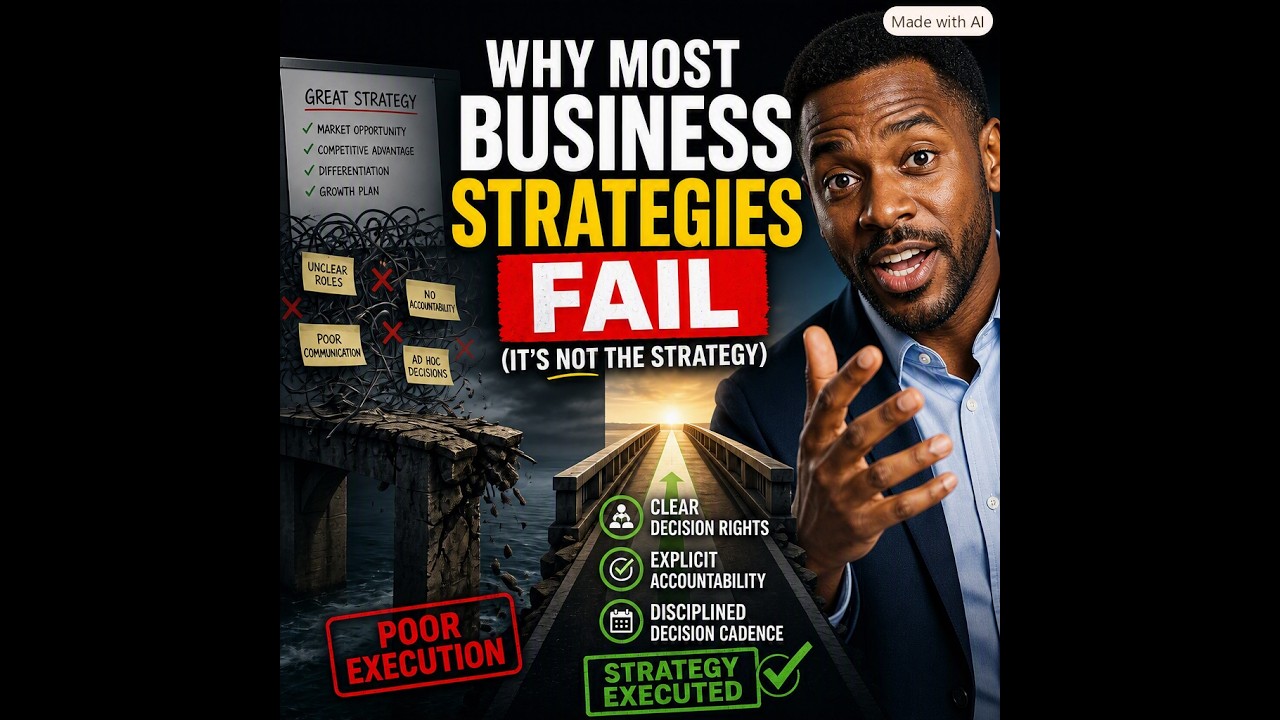
In this solo presentation, Abdul Kunateh argues that the primary reason most business strategies fail is not the quality of the strategy itself but the lack of a robust execution infrastructure. He explains that while organizations invest heavily in strategic planning, they often neglect the structural disciplines needed to turn those plans into results. Kunateh identifies three common breakdowns in execution: unclear decision rights, lack of single-point accountability, and insufficient decision cadence. He illustrates how each breakdown creates bottlenecks, chaos, or delayed responses, and contrasts high‑performing organizations that eliminate ambiguity, assign clear owners, and maintain frequent execution reviews. He also highlights the tension between consensus‑driven cultures and the need for rapid decision velocity, emphasizing that clarity beats consensus. The talk concludes with three diagnostic questions leaders should ask to assess their execution infrastructure, and a call to engage with the audience on the topic of organizational excellence.
Chapters
Every year, organizations spend millions of dollars developing strategic plans. They hire consultants. They hold executive retreats. They spend weeks refining goals, priorities, and initiatives. Then 6 months later, nothing has really changed. The strategy looked great. Everyone agreed with it. The PowerPoint was impressive, but execution stalled. Here's my belief: most organizations don't have a strategy problem. They have an execution infrastructure problem. And until leaders understand that difference, they'll continue rewriting strategies instead of fixing the system that was supposed to execute them. One of the questions I've spent years thinking about is this: Why do some organizations consistently execute while others, with equally talented people, experienced leaders, and well-thought-out strategies, struggle to turn ideas into results. After leading teams across operations, enterprise technology, digital transformation, and organizational change, I've come to one conclusion. The organizations that outperform everyone else usually aren't operating with dramatically better strategies. They're operating with better systems because strategy doesn't create results. Execution does. And execution is a structural discipline. Think about it for a moment. Almost every organization has a strategy. They have a mission statement, strategic priorities, annual objectives, and ambitious goals for the future. Leadership teams spend months building these plans because they genuinely believe they're the right direction for the business. Yet, very few organizations consistently achieve what those plans promised. Why? Because strategy, by itself, changes nothing. Strategy is simply a decision about where you want to go. Execution determines whether you ever get there. And the gap between those two is most organizations lose momentum. From my experience, execution usually breaks down in 3 places. Not because people aren't motivated. Not because leaders aren't intelligent. Not because the culture is broken. Execution breaks down because the structure isn't designed to support it. The first breakdown is decision rights. In other words, who gets to decide? It sounds like a simple question, but in many organizations, it isn't. Most organizations know their strategic priorities. Very few know exactly who owns which decisions. When decision rights are unclear, 2 things happen. Some leaders escalate everything because they're afraid of making the wrong decision. Every issue has to go up another level, creating bottlenecks at the top of the organization. Others make decisions independently that unintentionally conflict with another department. Now one team is moving in one direction while another is unknowingly moving in a different one. One creates bottlenecks, the other creates chaos. Neither creates execution. High-performing organizations eliminate that ambiguity. Every leader knows, these decisions belong to me. These decisions require collaboration. These decisions require executive escalation. That clarity dramatically increases execution speed because people spend less time wondering who should decide and more time actually making progress. The second breakdown is accountability. One of the biggest myths in leadership The second breakdown is the phrase, we're all responsible. It sounds collaborative, it sounds inclusive, but in practice it usually means nobody is truly accountable. Strategies describe outcomes. Execution requires ownership. Every strategic initiative should have one owner, one measurable outcome, and one deadline. Not a committee, not an entire department. One accountable human being. Because when everyone owns something, no one really owns it. Ownership creates clarity. Clarity creates action. And action produces results. Decision cadence. Many organizations review strategy quarterly. Some only revisit it annually. But execution happens every single day. Markets change. Customers change. Technology changes. Competitors change. Priorities change. If you're only reviewing execution every 3 months, you're reacting long after the problem already exists. High-performing organizations create a rhythm of execution— weekly, biweekly, consistent execution reviews. Not to micromanage people, not to create more meetings, but to learn faster, remove obstacles sooner, and make better decisions while there's still time to influence the outcome. That's not instability. That's responsiveness. And in today's business environment, responsiveness is a competitive advantage. What's interesting is that I've seen incredibly talented leadership teams fail to execute, not because they lacked expertise or commitment, but because their organizations were optimized for consensus. instead of decision velocity. Consensus feels comfortable. Everyone agrees, everyone feels heard, everyone leaves the room aligned. But execution often requires making difficult decisions quickly, sometimes before everyone feels completely comfortable. Organizations that execute well understand something important: clarity beats consensus. Because speed with alignment almost always outperforms slow agreement. So, if you're an executive, a department leader, a project manager, or a business owner, let me leave you with 3 simple questions. First, can every leader in your organization explain in less than 30 seconds which decisions belong to them and which require escalation? Second, does every strategic initiative have one clearly accountable owner? Not multiple, one. Third, do you review execution frequently enough to identify problems and course-correct before they become crises? If the answer to any of those questions is no, your strategy probably isn't the issue. Your execution infrastructure is. The organizations that consistently outperform their competitors don't necessarily have better ideas. They've built better systems for turning ideas into measurable results. Because strategy may tell you where you're going, But execution infrastructure determines whether you ever get there. If you found this valuable, I'd love to hear your perspective. What's the biggest obstacle to execution inside the organizations you've worked in? Share your thoughts in the comments. And if you enjoy conversations about leadership, enterprise transformation, organizational excellence, and building organizations that consistently execute, be sure to follow and subscribe. I'm Abdul Kunateh. And until next time, remember, great organizations aren't built by strategy alone. They're built by the systems that turn strategy into reality.