Casey Neistat Interview About 368, Collaboration, and more
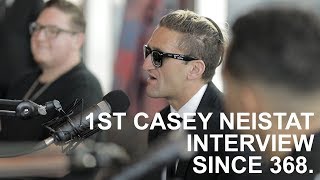
Casey Neistat discusses 368, his new collaborative space for creators to share resources without diluting individual style. He argues past networks failed by prioritizing business over creators, and that success means the ongoing process and joy of work, not a finish line. He sees podcasts as easily scalable and tells creators to take action, keep producing, and learn through execution.
Chapters
Casey Neistat, how are you doing?
I'm happy to be here.
Are you?
Yeah, it's fantastic to be in Montreal. And I'm sorry that we're running late. I was having a really good time speaking to your audience here. You know, one thing led to another, we got a little caught up, and the talk ended up going a little over, but it was fantastic.
Awesome, awesome, awesome. Casey, you mentioned that you had been in Montreal as a kid and you learned some French words. Anything you would like to say in French while you are In Montreal?
Um, no.
No. Adam.
Perfect. Adam Greenberg here with Casey Neistat. We're live on Facebook right now. You have recently launched your new game plan, loosely 368. And basically, to catch everyone up, you're starting sort of a collaborative space in New York.
Right? That's a very, very fair characteristic.
Fair characteristic. You know, in starting this new collaborative effort, you've spoken about the ice cube. And you've spoken about how the ice cube is like an idea, and when you pass it around to too many people, it melts. And you've explained that collaborating is almost like that. So in this new endeavor of collaboration, how do you sort of balance that? Collaboration versus doing things yourself?
Sure, I mean, I think creativity by committee is very different from the idea of collaborating. You know, I think that like, I think that if you think of the Beatles as a number of different musicians coming together and together collaborating to create amazing music, it's very different from, you know, institutionalizing music where there are filters and approvals and that kind of systematic creative thinking. And certainly what the way that I know that I collaborate best is I work with people who have their own creative vision and I step into their world and we make something together. And then they step into my world and we make something together. So I think that by definition is sort of siloing your own sort of defining unique characteristics around creativity instead of marginalizing it by trying to make it something that is more universal.
[Speaker] You've introduced Dan as a character. He's right there at the camera. He's like, what? What? So in collaborating with him now on 368, what is sort of the thing, you know, and you've outlined it in your vlog, but what is the thing that you haven't mentioned yet in your 2 or 3 vlogs that you've posted about 368? What is the thing that you guys are really most excited for?
[Speaker] Well, I mean, I think Dan's a really good example. Dan and I have worked together for, known each other for years, and we've worked together on a bunch of movies together. But he has his own specific style. He has his own channel, he has his own little universe of creativity. And when I help him on his movies, I'm stepping into that world, and when he helps me on mine, he's stepping into mine. So, the thing that I'm most excited about when it comes to 368, especially the physical space, space is that if you can, if you can provide the resources that enable that kind of creative overlap, I think that the possibilities are really, um, they go on and on. Uh, I mean, literally, you know, we put the first video out 4 days ago announcing the space, and then I got a text from like a friend of mine who's in town who's a content creator, and she lives in Los Angeles, and she and I've known each other for a while, and we've never had a reason or the ability to get together and make something, right? And all of a sudden, like, this space, which is by definition so undone, and this idea which is so still in its infancy, like, it yielded an opportunity for she and I to collaborate in a way that otherwise would not have happened. So, um—
Already opening—
Yeah, I mean, I'm not reading into that too much, but the idea that, like, if there is a central hub, if there is a nucleus, it's a lot easier for the planets to revolve around that.
And I love what you talked about during the talk. You mentioned— I'm a big fan of WeWork. I think WeWork is really answering— I'm a real estate guy at the base. Founded Raymax Griffintown, downtown Montreal. And I genuinely believe that the future is in a community as far as businesses. It's disrupting everything. And I love that you actually did that comparison because that was the first reflex I had. I was like, oh my God, Casey Neistat starting like a WeWork kind of community where people are going to create. And hopefully we see them popping up everywhere in the world. Is that— how would you go about doing it if you were looking to actually deploy that kind of strategy?
I mean, I think that one, I think that it has to start from a place where it's creator and creation first. Yeah. I mean, like, I don't think a business person could sit down and say that I'm going to scale, I'm going to be able to scale a creative space where creative individuals are going to find their own voices. I think that it has to come from there's a need and there's a void in my life and in my career of just this. So let me see if I can correctly fill that void to a way., in a way that's satisfying for me, and that is productive for me. Because if it works for me, then it's gonna work for like-minded individuals. And I think one thing I've learned in the last sort of 5 years in the creative space is that, like, the amount of people that wanna create a— whether it's a hobby or a career on a platform like YouTube— isn't shrinking at all, but it's growing at a rate that is, um, extraordinary.
It's exponential.
—Sure. And I think like, you know, MCNs of 5 or 7 years ago, they were a disaster, and they all sort of buckled. Because they were all created by, I think, people that were focused on business first. They were focused on people that were focused on, uh, people coming from a sort of an old media perspective. And it just didn't work. It didn't— it wasn't what was best for the creators. And I think what my focus is with 368 is like, can I create something that's first what creators want, what creators need? And if we can do that, then businesses will grow from that. But if you flip those two, I think that it's a nonstarter, right?
What I've noticed, you always speak on how your best opportunities either came when you were at the bottom or at the top. For example, you speak about standing upon the rock and then like you looked away and the rock kind of slipped out from under you. So my question to you is, For everyone that's watching you now, you know, and outside of this room, perseverance— what does it look like to you? What does it feel like? And now in this new opportunity where you're sort of pivoting again, where we sort of look at you and we sort of see like, whoa, Casey Neistat's on this great high, he's got, you know, a huge following, he's doing what he loves, but still it seems like you're making a huge life change in a way, and a huge pivot. So how does that feel to you?
Um, I mean, success for me is the process, uh, and I've realized that every time in life where I've, I've sort of reached a bench— a benchmark that's enabled me to pause. When I pause, I'm miserable. Yeah, I hate it. I hate it. When I sold my HBO series and I had 2 years before it aired, I was miserable during that time. Exactly. And I don't like that. So I think that like The journey, the process is the reward for me. So like right now, starting something new, this is the most successful time in my life. And whatever this yields, like when that exit or however it might manifest takes place, like sure, that's great and it's a cool story, but it doesn't equal happiness. Like Beam, the most exciting part of starting a tech company was, you know, when it was my, Matt Hackett, my co-founder and I, just the two of us sitting in a room trying to figure out, that to me was like the pinnacle of success. You know, when I was at, MIT, it was like sitting in that lab every single day across from these brilliant minds. That was the— that was success for me. So the journey is what I strive for, and it's what excites me the most. And with 368, it's like it's really building to enable that journey as much as possible. I'm not focused at all on a finish line. There is no let's raise $100 million of venture money and make this thing a unicorn. I could give a shit.
Like, that's not interesting. I feel like the finish line is like every day for you. Like every day it restarts and there's no real—
Yeah, I mean the journey is the reward. The work is the reward.
But we asked that question to Gary. Will you ever be satisfied though? We had GaryVee on the podcast and Gary said no. He put the F-bomb and then he followed it by no. You know what I mean?
What is being satisfied? Like, we're all gonna be dead. Yeah. I mean, there's no— like, come on. Life is this fleeting stupid thing. Some people get more time than others, but like, it's not— There is no, like, you know, no level of success is gonna take you anywhere that the, the richest person in the end gets the same exact thing as the poorest person. So who gives a shit? What makes you really happy? And I've tried relaxing, I've tried sitting on the beach, I've tried like chilling out. Doesn't work. I've tried staying in fancy hotels and ordering room service. That shit just makes me bored and miserable. Yeah, I hate vacation. I hate relaxation. Yeah, work is the only thing that really, really keeps me motivated and keeps me happy in the morning. I'm a better, like, father. I'm a better husband. Great point. When I'm working than when I'm not. Yeah.
Speaking of family, like, you just touched on that. Like, as an entrepreneur and somebody that's vlogging and producing a lot of content, sharing a lot, has it been tough, uh, as far as family? I mean, is there times where your wife is like, well, maybe we shouldn't show this, or maybe you don't want to do that?
Yeah, I mean, it's, it's, it's At the beginning, when it was less defined, it was harder. It was harder. Now there's a structure. It just makes a lot of sense. And it's sort of easy because we understand where the boundaries are. And also, my daily vlog was never meant to be this personal thing. It just kind of went there. So when it got there, neither she nor I really knew what to do. That was challenging at times. But that was years ago. And we really, really have an understanding now of what the implications are. What the opportunities are that it brings, and more importantly, like, how we want to present ourselves. That's why she and I are so excited right now about doing a podcast. Yeah, amazing.
Clap it up for that podcast! How many people are gonna subscribe and listen to that podcast? Raise your hand.
I know I will. There you go. And that's gonna—
that's gonna happen soon. It's amazing.
Super, super soon. And, and I think it's like the perfect medium for someone like Candace because she's like such a firecracker. I'm gonna never sit still long enough to be in front of the camera.
But are you gonna be starting it before that, like, podcast room in 360?
Because we don't need anything. Like, this is the setup we need. And that's what, like, on our walk here, we're talking about the idea that, like, I don't know how to scale a production, uh, like a production house, right? I don't even know if it's scaled. Yeah, but I know how to scale a podcast for sure studio. Yeah, so like we can do that and then share that space collectively very easily. And maybe that can be sort of the model that we then leverage for for video.
And voice is getting like real, like, I mean—
I mean, just anecdotally, I listen to more and more podcasts than any—
Yeah, I think everyone hates— It's my favorite medium. Yeah. And it provides so much information. It gets an opportunity to hear from people like you that are doing cool stuff. And the whole concept of today, you know, this is my first Influence Gen that I'm hosting, and What I've learned from the people who are in the audience and the people who are on the panels and all that is that an influencer really is not necessarily someone with a million followers or so on. It could be somebody with 2 followers that is saying something that they're passionate about. Where should they start? What should they start doing, like, from Casey Neistat?
Um, you know, I just think, I think action, action, but yet more action, which ultimately yields success, but it's like, you know, if painting is what's really exciting to you, then pick up the brush, right? And if it's, you know, singing, then, you know, have the guitar in hand and sing more. So I think no matter what your medium is, I think it's the act of doing that really kind of paves that road. Yeah, I know, like, for me, the most exciting part of making a daily video when I started in 2015 was like how much better I got. So I learned more in the first year of vlogging than I learned in the 15 years prior of making videos, right? It's just when you're—
when you're starting—
when you're acting that much, when there's that much action, it just— you learn so much about not just the medium but yourself and everything else. It's like, what is it? It's— it's vision without— vision without execution is hallucination. Like, that is—
yeah, that is the truth. And that kind of good segue, you know, in a lot of your videos, you provide motivational quotes from a lot of like major people, whether you like it or not, you are one of those major people for a lot of people. So while Influence Orbis is putting together the video of this day and like the highlight reel and things are flying by and whatever, what's like the Casey Neistat motivational quote that they should put on the video? Oh God.
Yeah.
Casey motivational quote they should put on there.
Casey Neistat, you know, like, eat more poutine. How do you say it? Poutine? Eat more poutine? Yeah, I think eat more poutine. All bold, all caps, exclamation point.
Just say it clearly one time so they could—
How do I say it again?
Eat more poutine. Poutine.
It's poutine.
Voilà, poutine.
Poutine.
And guys, we're gonna take like— we only have time for like 2, 3 questions. I know Anna had a question, so Anna, uh, okay, she's not ready, but somebody else, another question.
Is there any footage?
Yeah, I didn't climb with my brother. I climbed Aconcagua with my friend Graham, and there's a shitload of footage from up there. Um, I think I put some of it into that video I made about the climb. It's called like The Day I Almost Died. Have you seen that video? Yeah.
Yeah, there's—
couldn't find it. There's a lot of footage from up there, and most of it's in that video. But that's, um, don't do that. Don't go near that. I don't wish that mountain on my worst enemy.
All right, so we're gonna take another question. We're just gonna repeat it. Yep, go ahead.
I don't have any human connection. I don't value human connection. He's literally not here. I told you, I only like my my family. And I say that somewhat rhetorically, but I, um, I don't socialize. I don't like socializing. I don't like hanging out with friends. I don't like partying. I don't go out. I don't have dinners. I don't meet friends for drinks after work. Literally never. I never do that. Family, like, when someone says let's go out and meet for dinner, like, the anxiety or stress that that gives me is indescribable. The only things I like to do are work, spend time with my family, and run. Like, if that's all life is reduced to, I'm happy. But I fucking hate socializing. I don't like want it, like it doesn't make me happy. Yeah. Stresses me out. Dinner with friends? Come on.
Overrated.
Horrible.
We're gonna take another lady question because I want to make it up to the point that Casey made an excellent point and I thought that was really amazing. And before we get to that question, you talked about Me Too, like #MeToo, and the fact that the same way mental health has kind of like these things have been coming out, You are from the video industry and the world of— how did you react when you started to see like a lot of people that are, you know, some of them were creators, and like what was your reflex when you saw some of these people?
Oh, from the MeToo movement? Yeah, from the beginning. I've been in the— I was in sort of the mainstream media world long enough to know that it's filled up with a lot of scumbags. No, I mean it. Like, my, you know, my wife was once like an extraordinarily beautiful 20-something who lived in New York City, like, I— she tells me plenty of stories of what it's like to have, you know, powerful people sort of take advantage. So no, none of it was a surprise. It was just— and what I was talking about on that stage was that I think it's absolutely wonderful that social media is giving an opportunity to raise these issues that otherwise are so easy to be buried. And certainly mental health is one of those, and there's any number of them. And I think that social media gets shit on a lot, probably fairly so, but there are virtuous aspects of it as well. And when I think of the kind of exposure that it shines on things like mental health and things like equality, I think we're all reminded that it does have a lot of power for good as well. Awesome.
Wanna take a lady question once more? Got someone hiding. Yep, come in the front, let's go.
So my question is about brand safety.
Brand safety?
Okay. Adpocalypse, yeah, no, how did brand safety change after Adpocalypse? I think it's very challenging from a creator's perspective as to how it changed. I think from a platform's perspective, it necessarily forced the hand for them to really establish a methodology, both technologically and socially, for being able to seek out, find content, pair content with the advertisers. So there's sort of a symbiotic, mutually beneficial relationship. From a creator perspective, I think it created a lot of frustration. And I think that frustration largely stemmed from the lack of clarity. Everybody's creating something, especially if they are making a living or aspire to making a living. They want to be paid as much as possible for their hard work.. And when there's sort of nebulous guidelines or ill-defined parameters as to how to achieve that, I think it is frustrating. So I think it's a very, very challenging problem to address when you have a sort of open platform like YouTube where anybody can post anything. And ostensibly, or theoretically, everyone should be able to monetize that content. So I think it's a huge problem. I think we've seen less solutions than we have seen confusion. But hopefully in time, there will be clarity because I think that it's where eyeballs are and where they will continue to be. So brands will need to figure out a way to safely reach people.
And you mentioned YouTube. You talked about recently what happened at the YouTube offices.
What's your perspective? I mean, I think it's shitty. I think that what's shitty about the attack at YouTube shooting at the YouTube offices is that there were a lot of comments online about policy. And it's like, it's not about policy. That woman was just a fucking homicidal murderer going there intent on hurting people. And it had nothing to do with policy. If you're upset over policy, whether it's the fact that you don't feel like you're getting the attention you deserve on a platform like YouTube, or the fact that McDonald's took the double cheeseburger off the dollar menu, You have a number of ways of venting those frustrations, but to sort of equivocate that kind of frustration with violence I think is really gross and wildly unnecessary. I think that was nothing more than the case of a violent, violent, horrible individual intent on doing harm and had very little to do with anything else, and it had nothing to do with anything that was in the control, within the control control of a company like YouTube.
We spoke to the creator and the person who's maybe looking to work on their personal brand and stuff. On the flip side, there are a lot of old-school brands that have sort of like a dinosaur mentality when it comes to social media and new-school marketing. And you being one of the disruptors in that area, you know, you've mentioned— you mentioned in your keynote Nike and how you weren't even wearing anything that was Nike. What sort of message do you have to the guys at the top, let's say, that are scared to evolve and they're hesitating because they're used to what works for them?
I mean, look, I think Nike is the— Nike has one of the strongest brands in the world because they're willing to take chances on a video like that. And the reason why someone like myself works well with a company like Nike is because, like, it's about an ethos as much as it's about a product, which is to say that it's very little about the product.— I think Apple Computers, like, their commercials are never about their products or their products' features. They're about an idea. And my philosophy on branding and marketing as a whole is like, if you sell the idea, people will invariably buy the product. So all the marketing that I do is always about ideas. It's never about products. But I think that ultimately, if brands want to connect with individuals, they want to connect with people, if they want to sell more of whatever it is that they sell, sell. They have to find a way to get in front of people. And as eyeballs turn away from really safe, controlled places like network television, and they go to much more volatile places like live streaming and YouTube and places like that, um, I think that, you know, brands are necessarily just gonna have to figure out how to navigate those waters. Um, I don't have anything, you know, I don't have anything super interesting to say there. Like, I understand, uh, I understand the cautiousness on the brand's part. I really, really do. And I think it costs them. I think they're losing market share because of that cautiousness. But like, you know, a lot of brands don't want to be associated or take that kind of risk. And I could never fault them for that. I could never fault them for that. If you sell laundry detergent and you want moms to buy laundry detergent— I mean it. Why take a chance that you might show up in front of a really risqué video or something that's racially motivated? Like, why take that chance? Why be hedgy? That's exactly right. But I think that I think that it's going to be interesting what we see in the next 5 to 10 years when us, the viewers, have true agency over what we watch.
Casey, we thank you for being with us. Yes.
Do you think I'm going to make my flight?
But before we let you go, in Toronto you did an amazing 30-second elevator pitch. I don't know if you remember that one on the podcast.
I do.
This time around, we want to picture you going into a hotel, and then you see a younger version of yourself. What would you give as an advice during the 30-second elevator pitch at Influence Podcast?
Well, I'm sure I'm going to say the same thing I said last time. So let's do it again. What did I say last time? I mean, what would you tell yourself? The generic advice I always give to young people is that the two things you need to do to find success in the world, no matter what it is you want to do, is you need to work hard and be brave. If you're willing to work harder than the next guy and you're willing to take chances that the next guy is not willing to take, you will find success.
Casey Neistat just got the advice of a lifetime from his older self. You guys get what I'm talking about. Thank you for being up, guys. Clap it up for Casey Neistat. Thank you for tuning in. Thank you to Audi, Amex. Thank you to RBC for supporting Influence. Hopefully you guys enjoyed. Remember to smile and stay influential.
Heyo! That was great. Yeah, thanks for having me up.