3 Keys to Ace Your Pitch
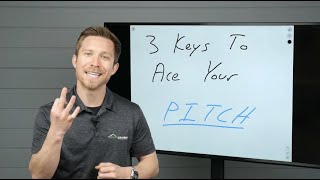
A short instructional YouTube video by Adam Bensman (the Roof Strategist) presenting three keys to "ace your pitch": (1) Verbal — what you say (he teaches flexible formulas: SLAP for door approach, ARO for objections, CAR PARK for closing); (2) Tonality — voice, cadence, pauses to shape feeling and influence decisions; (3) Body language — gestures, stance, facial cues to convey confidence and trust. He emphasizes practicing in low-stakes real-world interactions, prioritizing learning in this order (verbal → tonality → body language), and offers a paid training plus free playlists and a phone contact for follow-up.
Questions this video answers
303-222-7133
Chapters
In this video, I'm going to be teaching you the three keys to ace your pitch. And I'll be sharing the journey that I went through because truthfully, I only focused on the first one of these three keys and the other two evolved over time until I started to dedicate time to studying and mastering the craft, so to speak. And this video is going to be applicative to you. If you're brand new or if you have 20 years sales experience, you're probably going to say, hey, some of that makes sense. And I'm hoping each of you will grab one or two golden nuggets to start using right away on the very next sale you run to connect on a deeper level and truly ace your pitch. Now, before we get started, one thing I want to be clear of is I don't really believe there's such thing as mastery in sales. And the reason I say that is when we practice something, we don't ever reach this level of proficiency where we hit the scene like, whoop, I'm good enough. And this goes to show in the Olympics and any professional athletics, whether it's the NFL or Olympic track athletes, you see these records, these world records getting broken over and over again. And how do people do that? They practice using the latest, greatest technology, the latest, greatest learnings and discoveries and they practice over and over and over and over again. And one thing that I see is one of the biggest mistakes that salespeople make is to say, hey, I'm good enough. So I don't practice, I just show up in the real world. And when we show up in the real world, when we're selling, this is the most high stakes because when we lose or we mess up, we're playing with our income, we're playing with the experience of our customers. So what we want to do is use role play as well as encounters in our day to day life, whether they're at the grocery store returning items, if you're out shopping or dealing with customer service people. And it's a really fun way to engage people and practice these skills in what I'll call a low stakes environment. So we're in the real world. Selling it just simply works. So let's get to it. First, just want to say quick welcome or welcome back. My name is Adam Bensman, the roof strategist and everything I do here on this channel is designed to help you and your team smash your income goal and give every customer an amazing experience. And my mission is to help you have tiny breakthroughs that result in really Massive growth by giving you the resources that I wish I had when I got into the business and I was earning $1,600 a month before going all in and being broke and made it happen. So I'm just really glad to have you here and thanks for being here. If you like this video, give it a thumbs up. And if you haven't subscribed, you know what to do. All right. Three keys to acing your pitch. I want to break down these elements in order. The order in which I learned them and the order in which I want to help you fast track this experience. And the first is the obvious one, which is the verbal. And this is what we say when we're pitching, right? Everyone focuses here. They want the perfect script, the talk track. You want to know exactly what to say when you're approaching the door so you can stay quick on your feet, that you're able to navigate whatever the customer throws at you. And this is, in my world, what I teach. Oopsies. The formulas. So we have the slap formula for pitching at the door. Say hi, break the ice, let them know why you're there, ask an open end question, present to their answer. We have the ARO formula for objection handling and the car park formula for closing. And by the way, all of these are included my entire training system, the all in one sales training, sales strategy and sales system called the roofing sales success formula. There's a link in the description, should you be interested. This is where everyone wants to start. What do I say? Alright, now what's funny about this is only like 10 to 30% of human communication is verbal, literal. The words that are coming out, 70 to 90% fall into these two other categories, which is tonality and body language, which I'm going to break down here in a second. Again, everybody's first place to start and this is the right order to go through them. In my opinion. You have to learn this stuff in order. First you have to learn what to say and whether you're using your stuff, my stuff a combo. I teach these formulas and the reason I teach formulas is formulas are fluid. They can be adapted on the fly to meet the customer situation, to blend in your unique style and flair culture, personality. But what they do is allow you to knock down the right dominoes in the right order in order to get the sale. And so many people fall into this business who are quote unquote, good with people. They're natural conversationalists, they make friends easy. But they often talk themselves out of sales or simply can't talk their way into a sale. By the way, I'm guilty as charged of doing both. When I got into the business, I'm like, I do well with people, but I couldn't close deals. So that's why having the right verbal track or script or formula. And by the way, I'm not really a word for word script kind of guy. I believe in formulas. There's a big reason behind that. In the storm game, there's seven different scenarios we need to pitch to. In the retail, there's four. So having a word for word script just doesn't apply to the real world. And that's why I teach these formulas. So first we have to start off on the verbal and acing what you're going to say in the in the main categories and these are the main three that I see. It's presenting at the door, the slap formula, Objection. Handling the aro formula, and then presenting in closing, which is the car park formula. So we have to get those fundamentals down. Next, we need to move on to tonality. You'll notice tonality is before body language. Now, why is this? Because the tone in which we speak will greatly impact the message. It will greatly impact how the story feels. And when it comes down to it, our number one mission in sales is to guide the feeling, to create the feeling for our customer, to be heard, understood, and then guided to taking the action that we know in our heart of hearts is best for them. Now, I want to pause and I want to ask you a question right now. Do you believe in your heart of hearts that you are the best choice for that customer to work with someone who cares about them, Someone who's going to do the right thing and stand behind their work? Is that you? Now? I'm hoping and I'm guessing that you're saying, of course it is. And the reason I say that is because it becomes now your ethical duty and responsibility to communicate clearly and to win the business. And tonality changes feeling like you wouldn't believe. Like when you watch a TV series. I was just watching First 48 with Sheena the other day. We were laying in bed and watching we love the true crime stuff. And you hear the narrator and he talks very slow. It's a super heavy cadence in the tonality. It's very somber because they're talking about people who've been murdered, right? Meanwhile, you jump on the cartoons and everyone's talking with a weird voice like this and it's like happy and playful and funny and all that changes if you read the script word for word, there's not much emotion behind it until it's supercharged with the tonality. So when we learn to play with our tonality, we can use intonations, we can change our cadence, we can change the way our voice sounds. And all of this will change the meaning in how our message is being heard, connected with and understood with our customer, our hopefully soon to be customer. So playing with your tonality, using pauses, they draw people in. Going from really exciting to making people feel heard and understood, to being someone who's speaking out of authority, saying this is exactly what you need to do and how it's going to go. And all of this changes just by changing our tone, which leaves us to the last piece. And by the way, this body language thing, we lose if we're not selling in person. So if you're tuning in on the podcast, for example, and you're hearing this, you can't see what my hands are doing. All you can hear is the tonality. And that's why I believe you need to focus on the top two first to build these fundamentals. Because if you're ever selling over the phone, if you're following up with customers, having this tonality is going to be far more valuable than the body language pieces. And I'll be honest with you, I went through this in the other order. I started on my verbal and then my body language and then my tonality. Why? Because I didn't really know about how significant the tonality was. And again, this is. These two represent the tonality, body language, 70 to 90% of our communication, depending on the studies you see. So the body language will be how your customer feels when connecting with you. This has to do with your gestures. And I'm going to put myself in the hot seat, go back and look at some of my older videos. I've come a long way and it's through repetition you'll see that I'm very straight faced. In my older videos. I want you to know that I know what I'm talking about. I'm a little bit spastic in some other videos because I started to be more confident and have some energy. But ultimately what comes across as confident is communicating clearly. Having your hands in the right position, blading your stance to be non threatening, using facial cues, eyebrow flashes, chin raises where you're lifting your head up, and using these sweeping, calm gestures that show that you know what's going on versus being like a spastic squirrel. And you'll see this as you communicate with people, people that are calm and confident, they use these big, wide, sweeping gestures. Their hands are clearly visible, they're not fidgety. Likewise, watch the squirreliest people. You know, they just don't seem trustworthy. And when we become aware of how people perceive us, we then become more in control of the mess that we send. And at the end of the day, the verbal messages, the tonality and body language all come together to signal to our customers, this is trustworthy. This person is confident. They're hearing you and they're guiding you with their authority and expertise. So my message to you is to practice these three in this order if you want. Play with this when you're the tonality and body language. When you're meeting the waitress or waiter at the restaurant, or when you're dealing with a customer service issue or checking out with your groceries, simply acknowledging people by name and just seeing how quickly you can get them to soften and have a conversation with you. This is how I practice in the day to day. And I especially love doing it when I'm waiting in line at the grocery store and I see that the clerk is in a really grumpy mood. You can tell they've had a bad day. And I just go in there and I say, I want to see if I can make them smile. That to me, is the number one sales skill. How do I just completely transform this person's experience by the radiant energy that I can give them and make them feel heard and understood. Even something like seeing their name tag. John, man, that last person. I'm sorry that I gave you such a hard time, man. I hope you have a better experience working with me and give me a little smile and an eyebrow flash. And all these little times that you practice, they mean nothing. There's no high stakes. But you begin to develop mastery in your tonality and your body language. And again, mastery being used loosely. So there you have it. And if you want some additional help, of course I can help you do this. By the way, I have a program called the Roofing Sales Success Formula that includes the verbal piece learning, the SLAP formula, the ARO, and the car park. My entire sales system, I cover tonality and body language in the bonus sections. And I'd be honored to support you in doing that. There's a link in the description below. You can always call or text our team as well. It's 303-222-7133 and I've got the number here written up on the screen. Last thing, as we wrap up this video. If I miss anything, I'd love for you to drop a comment and share with me what I should add in the next video about acing your pitch. Are there elements that should be in here that aren't? So just because our time here is about to wrap up doesn't mean your and my time has to. If you want specific playlists that are 100% free, you can download a free copy of my pitch like a pro roofing sales training video library right here. I've got playlists on body language, I've done videos on tonality. I've got playlists on objection, handling, pitching, and closing. You can get that right here or YouTube thinks you're really going to dig this video. Thanks for joining me, and I will see you again very soon.









