Easy Money Management For Roofing Sales [LockDown LIVE]
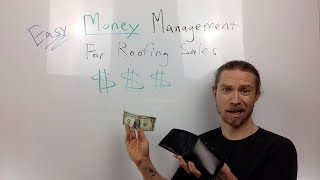
Adam Bensman (Roof Strategist) presents a LockDown LIVE YouTube session explaining a simplified Profit First system tailored to roofing sales. He urges salespeople and owners to route all income into a single deposit account and immediately distribute each payment into separate buckets/accounts for operating expenses (opex), payroll (take-home pay), taxes, and profit. Using a sample $2,000 commission check, he illustrates approximate starter percentages (example used: 20% opex, 50% payroll, 20% tax, 10% profit) and explains how this creates predictability, tax readiness, funds for rainy days, and guilt-free profit for big purchases. He advises owners to adapt percentages based on overhead and recounts an anecdote where a company was $30,000 in the hole until financial controls were applied.
Chapters
Money, money. Hey guys, Adam here, roof strategist and welcome back to today's lockdown Live easy money management for roofing sales. Now, before we hop in, I want to say two things. One, thank you to everybody who is on the insiders who's shooting video ideas over. I love producing the videos that you guys want to see. That's what this channel is about. So if you're not on it, click. If you're new to the channel, there's a free link. Well, of course all links are free. No, it's free. To join the insiders, there's a link in the video description. Get a copy of my ebook, some other good stuff. You'll get notifications when I go live, few emails firing your way. And I've got a really some great stuff that I'll be sending to those folks that are on the insiders list. Second, this video is for both owners and salespeople. So listen up. This is super, super important. All right, let's jump into the nitty gritty. Now, it's no secret that this industry can be a little bit violent, volatile in terms of cash flow. Again, for both owners and salespeople, it goes like this, right? We have really high months and then we have low miserable months and then we get really happy because we do well and then we get really sad because things are low. And we really need to kind of level that curve out a little bit to create some consistency and stability and make sure that we can get through the tough times. So if you're commission only or if you're new in sales, I saw a comment on one of the videos where a guy says, hey, maybe I should get into roofing sales. I've got a six figure sales job now. But this roofing thing sounds great, but what we have to figure out is how do we maintain that level of consistency and then how do we survive? The look at, I'm an artist, that's a cloud and this is rain or hail. So those are rain days, not hail days and especially in the off season. So for most of us in roofing, we are busy. Typically I'd say eight months out of the year and then there's kind of four months. Every market's different. Up north is really low. I've talked to a couple companies in Canada. Their window of opportunity is really, really short. So if we've got Jan to December, we need cash to survive this whole time where ultimately we might be making the most of it right here. So how do we create that stability for our own Personal expenses and as owners, ongoing expenses for overhead and stuff. So what I'm going to share with you is a system that I use personally and I learned it from a book that I highly recommend. I am sharing my interpretation of the book called Profit First. Okay. If you are into the audiobook thing, get it, listen to it. If you're into reading, read it. It's called Profit First. I always have a hard time pronouncing the author's last name. It's like Michael Michalowicz. It's a tough one. But anyway, Profit First. In fact, I'm going to put a link to the video because this put a link to it. I didn't think about that until now. I don't have any affiliation with him whatsoever. But this book was, was 100% on my best ever read book, most transformational in my life. So there's a link to the book, by the way. So again, this is all of his concepts and I'm showing you how I've applied his concepts to my cash flow. Okay, so when you're commission only, you've got highs and lows, right? You've got some months, some weeks where there's no money coming in, then a big check. The hard part is how to not blow your wad on something you really want. And when you follow the simple system, there's a few things that will happen. One, you're going to have a clear picture of your actual you can afford what you can't afford. Two, this is actually going to help you make those big purchases that you want, like maybe a new house, big purchases, a new truck, new hiring move, whatever it is. Big purchases. And the other thing is make sure that you don't get screwed on taxes because you're going to have money set aside. And the last thing is some semblance of predictability. Predictability, Sorry, sometimes you need the spell check from when you're typing and then obviously some stability to get you through. So new salespeople, it's important to manage your money. Okay? Existing salespeople, you don't want to go to the beginning of the season asking for a draw. And then owners, you need to make sure you've got that those cash reserves to pay for those critical things so you don't go cash poor and have to tap into lines of credit or take out a home equity line or something like that. And I know this, this isn' issue as your company grows typically, but we all have dry spells. I know that we experienced, you know, our best month, followed by or, excuse me. Or our best year followed by worst year. And stuff happens. You just be prepared for it. So again, profit first, okay? And let me see if I can pronounce his name. I'm going to give it a go. It is Michael Michalowicz. Michalowicz, yeah. So here's a scoop. Owners and salespeople. This represents a check, okay? And I'm going to call this. We're just going to say check, okay? So as you're getting paid, ultimately what you want to do is have all the means go into one account. The only purpose of this account is to accept payment, okay? So you're paid, okay? Now instead of this money sitting all in one account, you're breaking it up into separate buckets. Some people will do this on a spreadsheet, by the way, and then they'll track it that way. I personally do the separate accounts. I think it's a better way to do it because you have a really clear picture of what's in what bucket. So this is a distribution. I'm going to break it down into what's in there. So first we have opex, which is opex. This stands for operating expenses, salespeople. Okay? What that means is truck fuel for your vehicle, your insurance for your vehicle. Buying a ladder. Let's see, what am I missing here? Your cell phone bill, your Internet bill. Repairs, oil changes, tires, any software fees that you might buy. Interactive hail maps, all that stuff, okay? So that's for salespeople. All the things that are associated with selling are going to cost you a certain amount per month. For owner, you're operating expenses, insurance, rent, utilities, by the way, payroll, separate. I'm going to be touching on that. Marketing expenses, anything that is not personnel related, okay? So that's your operating expenses. Then I'm going to show you how these divvy up. Then we have payroll, by the way, payroll for salespeople. This is what you're going to actually take money out of, okay? Meaning you're going to get paid. This is what you actually live on. Because there's other buckets that need to, you know, you have to set aside money for your operating expenses. The last thing. But I've seen this with new salespeople. You run out of money for gas, that's a problem. We don't want to do that. Right? So there's your payroll. Then we have a tax bucket. Because let me tell you something, if you don't pay taxes, not nothing good, nothing good comes from that. And then, let's see, we have opex payroll. Okay? Then we have another one over here which is profit. Okay? Now this is a simplified version of what's in his book. But I want to give you a palatable process, a simple process to follow. So let's say, and I'm going to show an example first on salespeople because it's more consistent. Okay? So I'm going to show you the distribution percentage for each of these buckets that that money should go into owners. Yours is going to be different based on your overhead. So I'll touch on that. So typically operating expenses might be, let's say 20% of your total income. I'm going to use a sample check. Let's say you get a 2000 DOL commission check, okay? From that check it comes in and it 20% should go into this, this bank account. This bank account is specifically set up to pay those bills, period. So you know, hey, if, if the metaphorical poop hits the fan, you know that you have enough money in this account to float you for a month, two months, three months. By the way, once you set this up, you'll likely build up a little bit of a nest egg, so to speak, or a little like rainy day fund in each amount. So you'll have your operating expenses covered again. Insurance on your, on your truck, expenses in your truck, fuel, cell phone, all of the costs for you being out in the sales, sales running in the fields, even if it's closed. Like a monthly budget for clothes, new shirts, cougar paws, whatever it is. Okay, Payroll, this should be 50%. Okay. And excuse me, I shouldn't say it should be. I'm using sample numbers here to show you the picture. So 50% of that check goes to you. So you get a thousand bucks, 200 bucks goes into this account, and then let's say 20%. By the way, everyone's tax bracket is different. It depends on how you're set up. It depends if your commission, if you're an employee of the business and they're already taking taxes out. But I just want you to see a rough idea how this comes together. If you're an independent or a 1099 commission only salesperson, then we have profit and that profit is the remaining 10%. Okay, so what does this look like? So sample is 2,000 bucks. Come in. We have 200 bucks that is already set aside for your operating expenses for the month, which would cover your gas and all that. Payroll means you get a thousand bucks. This is your actual income taxes. That's 200 bucks goes uncle Sam. And then profit means a hundred dollars. So you can see that if you amplify this by 50, which would bring you to 100 grand. I'm just going to show you. I'm going to just math this out super fast. But I need some help because I'm bad at math. All right, so 200. What did I just say it was? Times 50. So before grand in the operating expense. So this is annual 4K. Then we've got 50,000 of payroll, by the way. Don't worry. You're thinking, holy crap. I better. I sure, sure as heck better be making more than 50 grand. But you will. I'll show you. And then the tax account is going to have another. What did I just say? 200 times 50. 10 grand. How did I get to 4 grand? Someone should have corrected me on that one. So there's 10 grand. Okay, 10k, 10k. And then that should have been. What in the world did I do? Guys, this number is all wrong. Don't listen to this guy doing math. I've said this before. Let's correct some things. Sorry about that. I shouldn't have. I threw this idea on there. I'm like, ah, we'll do some samples. Let's start from scratch. 2,000 bucks. 10% will be 220% is 400. So we got 400 here. Okay, 50% here is our thousand. We have another 400 in taxes, and then we have 100. I apologize for that. So here's our projection. So now we know each time that check comes in, it goes to all these accounts. Now, as you can see, each check is going to add to each one of these buckets. So what happens is, at the end of the year, you're living off of these payroll. You have tax set aside so you're not in oh moment. And you've got your operating expenses covered. Now, it is a little daunting at first, but go sit down with whoever it is you bank with. I encourage you to set this up. I set it up. These are sample percentages. I'm not an accountant. I don't claim to be. As you can tell, I just butchered those numbers. And that's the beauty of doing things live. I can't go back and fix it. So you break it up. And then that way, as this grows. And I want to show you an example, because what Mike Michalowicz shares in his book is that each quarter. So every four months, you get to take half of this bucket and do whatever the heck you want. And that way, what happens? So let's say in 10 jobs, it's a thousand bucks, right? So you get 500 bucks to do whatever you want. 20 jobs, so. And so owners, by the way, this is beautiful. You can use for anything, whether it's investments, whether it's the nest egg to buy the house, but that way, 50% always stays in there, and then it grows, and then it grows. So you get started, you're only drawing a little bit of play money out, and then as you grow, it pays for really big things. What will happen when you establish the system is you will start to build up these, these nuggets. So let's say payroll comes up, and then you've got a dry month. Well, you'll likely have a number of checks literally sitting in, in the bank account. So you can draw that money out and essentially pay yourself like you're on salary, so to speak, to get you through all those rainy days. So. Hey, Eric, good to see you again. Hello from Kansas City and Shamrock Roofing. Love it. So when you do this again, so you have the payroll to get you through rainy days, you have your operating expenses that you at least know I'm be able to pay my bills. I know it needs to get paid from here. Tax is a big place that people get in trouble if you don't plan ahead, especially when you're starting to earn good money like we can here and should be in roofing sales. So you want to make sure that, that a tax amount is there and the profit is. This is the guilt free. This is, I want to do that vacation. I want to buy a house. I want to get the down payment. I want to buy a new truck, you can ask yourself simple questions, can I afford this? Yes or no, does it fit my budget? And if you look at this and you want to buy the new truck and let's say it's a $400 a month payment, I'm just using a random number. And you're like, okay, well, if I want to buy the new truck because I have the profit to put down the down payment, and then I've got a monthly payment of 400. You now know, okay, well, that's got to come out of, you know, some, some of these buckets. And we have to adjust these percentages. So the beauty is, as you increase your income, some of these percentages may vary. But this simple system of these buckets can change your life and take all the guilt out of all those, those, those decisions of, can I afford it? Should I do it? It's just guilt free. It's stupid simple. You're living within your means. Because one thing, and obviously I'm not an accountant, I am here to help salespeople and owners grow and be smart and. And this I believe to be a really powerful thing that a lot of people just don't spend a ton of time talking about because we can get into trouble financially by spending all of our money. At the end of the season. I know I'd have sales guys come to me like, say, Adam, I need a draw to start the season. I'm like, dude, you made $150,000 last year. And I see a brand new truck and you went on these vacations, you made a bunch of poor choices. How did you blow through all that money? Right? So this simple system to break it down is really easy. Money comes into one place and then you just immediately distribute it. And these are okay starting percentages. You need to. I recommend reading the book again. There's a link in the chat. Your operating expenses, how much you're going to pay yourself, how much you need to pay in taxes and profit. And for owners, this can get operating expenses is going to cover general material, material labor, and then your overhead expenses as well. Okay. So this might be a higher amount. Payroll will include payroll for yourself along with any employees that on staff tax account. We already know what that means. And then profit is there as well. And it's important to focus on this because this needs to come first. All right, so hopefully this was a helpful system. I'm very curious to hear if you guys have any systems you're using to make sure that you're spending, saving and investing your money that you're making in roofing sales to help you grow. Because this is a great way to get ahead. But if you're using something else, drop a comment, let me know. That's all I had for today's video. I wanted to do something just a little bit different, just to see how you guys liked it. The talk of money and commission only and taking the risk and getting into this industry comes up a lot. And I do want to share one short story before I close. So I was working with a company one on one, and a gentleman comes to me and he says, adam, how should I pay my sales team? And this was a month or so in, and I said, listen, I can't tell you how to pay your team without knowing all of the numbers of your real business because. And I need to know what the salesperson's doing. Are they doing the process start to finish, are they not? Well, turns out we started to get into the nitty gritty and once we looked really, really deep into it, found out that his expenses were really, really high. He wasn't putting aside money for taxes. He was producing jobs with no profit margin and he was actually $30,000 in the hole so far in the year. So the first thing I did is say, stop paying me. We need to get this stuff fixed up. So I shot him an email, I helped him outline it, and he put together a system. Year later, he reaches out and wanted to work together again because he uprighted the ship. So it's important to take control of your finances whether you're an owner or you're an individual rep because what it will lead to is growth opportunities, making the next move, buying the truck, hiring a key employee. If you're an owner, right? Buying the house you've been saving for, taking the vacation for you and the family because it's all already set aside. So anyway, hope this helps. If you liked the video, give it a thumbs up. If you didn't drop a comment and let me know because I know this deviated a little bit from my normal thing. I'm doing these lockdown lives, but I felt this would be a fun one to play with. So appreciate you guys being here. Have a great Friday. If you haven't subscribed yet, click subscribe. You'll get notifications when I go live and and read Profit first. There's a link in the live chat and it's a great book. Changed my life. It will help change yours. Here is to a really profitable and successful season. It's on the horizon. We've seen it. I've shared the stories. People are making sales. Things are still happening out there. Go after it. Be safe, be smart. And let's make it your best year yet. We'll see you guys on Monday for another lockdown live.









