Hail vs. Wind vs. Hurricane | 3 Things You MUST Know About Roof Claims
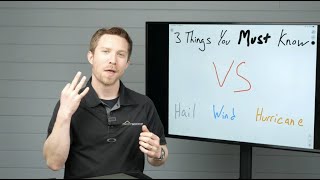
Adam Bensman breaks down hail, wind, and hurricane roof claims. The sales process is identical across all three, but damage identification, deductibles, and filing language differ significantly. Using the right terminology when reporting to insurers can prevent homeowners from paying duplicate deductibles.
Questions this video answers
303-222-7133
National Claims Institute (Matt Mulholland)
NTSID (and John Cenac's 'Name that Shingle' Facebook group)
Generally six months to one year from the date of loss (varies by state/insurer)
Chapters
There are three things that you must know whether you're selling hail, wind, or hurricane damage roofs. I get this question a lot. And in this video, I'm going to be answering the following questions. Number one, what is the difference between selling hail, wind and hurricane? Number two, what do I need to know? And then number three, hey, I'm in retail. Where do I even start when it comes to adding these losses onto my business? Learning how to take advantage of them because they will inevitably occur darn near wherever you live. And the last question is a big one, and that is, I've been familiar selling wind, but not hail, or hail, but not wind or hurricane, but never hail. And whether or not you've had this experience. This video is going to help highlight the three key differences. But I'm going to end this video with a very important tip. I'm sharing it for the end because it will make sense once I go through these three tips. I just spoke with a gentleman who's been in the business for seven years and I shared this advice. I have him. I said, this is very important for you to add to your workflow. You need to be doing this when you get these claims called in, and here's why. And his eyes open, he goes, holy smokes, I need to start doing that. So whether you're brand new or you have experience, I promise you this video is going to help highlight those differences and help you serve your customers even better. Because, hey, that's what it's all about. Helping you smash your income goal and giving every customer an amazing experience. So welcome, welcome back. My name is Adam Densman, the roof strategist, and I'm super excited to dive into this because as I said before, my mission is to help you smash your income goal, give every customer an amazing experience. But in order to give them an amazing experience, that's on you. It's not up to the insurance carrier. Quite frankly, I don't think they care that much. What we need to do is understand this process intimately so we can best serve them. Because when all of these things align, that's when you go to bed feeling fulfilled, excited, intention honored to serve, and feeling really good about yourself. So let's get to it. The three things that you must know. First, I want to get one thing out of the way. I get people that ask me this question, say, Adam, you know, I want to use your program, your all in one sales training, sales strategy, and sales system. Will it work for hail? Will it work for wind? Will it work for hurricane? Will it work for retail. And the answer is yes. Not only yes, I have specific material for storm claims for retail in Spanish in Florida, by the way. It's the battle pack, okay? And the actual sales system. So this is kind of the fundamental background. The sales system or the sales process, the sales strategy is the same no matter what. Alright, now I know you're thinking, oh well, it's different. It's not, I promise. The sales system, the key touch points, what you do, how you process that customer is the same. The only thing that changes, there's two pieces. One is what's said in the material used. So the communications. That's why I said one thing. I'm going to group that together in the communications. And number two is any of the direct dealings with the insurance company. Nine out of ten of those are behind the scenes anyway, which means it doesn't change the sales process or the sales flow from the customer experience. That's why companies, the thousands of folks who are using our all in one sales training, sales strategy and sales system called the roofing sales success formula for you or your team. By the way, there's a link in the video description below, are able to follow this. But that's beside the point. The key thing is that you need to know it doesn't change, alright? Whether you're using mine or your own, doesn't change. By the way, if you have questions about our programs, you can call our office. Here's our number. 303-222-7133. That's 303-222-7133. You can call or text. All right, now let's get to it. So the three touch points, number one, we just covered, all right, this was a bit of a teaser. Process is identical, okay? So remember, Hail, Wind, hurricane, doesn't matter. Let me walk you through it. One, you need to show up and identify the damage. Number two, we get that claim filed. Number three, the adjuster comes out and says yay or nay. All right, Number four, we're going to review that scope with the homeowner. Number five, we're going to start that work usually with a deposit check. And then when we're done, we're going to invoice the insurance company to release, file or excuse me, to release any depreciation that may be due along with any supplements. Then we collect final payment. Hail, wind, hurricane. Same. So process from a sales standpoint, a claim standpoint is identical. That's the beautiful part. Alright? So don't be afraid or timid. To go from working one to the other, it is identical. Now this is where we start getting into what is different and that is how to ID the damage. Now it's really important for us to get into some weeds here. And then I'm going to give you, when I say weeds, I mean the details. I'm going to give you a couple recommendations for resources and people that I trust to help on this front. So let's go through the fundamentals. I'll never remember the very first roof that I was on that got covered by hail damage. I'm up there and I'm doing the thing, you know, you know, the hail damage inspection, the bent over and you're staring and you're doing your thing and you're poking and feeling and it's like you're trying to find a needle in a haystack sometimes. By the way, my friends down south that get like Texas, Texas size hail, you may not experience this, but when you're working, you know, one inch hail, sometimes it's not as evident. And I remember being up there and I'm like, why are they replacing this roof? It seems fine to me. And it's because to the untrained eye, I didn't know what to look for. I didn't realize the significance of the bruising to the matting of the granulos that exposed the matting to the UV light to then rot the shingle from the inside out. I didn't realize that the lifespan of the roof was compromised, meaning shortened. I didn't realize that the manufacturer's warranty was null and void after being damaged. All of these is why it's covered. So it's not only understanding what to look for, but the reasons why it's covered. And for that is where I'd recommend the National Claims Institute. Matt Mulholland, who considers himself the Dean of Students, I believe. National Claims Institute Matt is a fellow mentor inside the Pitch Pro Movement link in the description below as well. And I am not, by the way. Matt doesn't even know I'm mentioning this. I'm not affiliated with National Claims Institute. I don't get kickbacks or referral fees. I'm sharing this because I've had people go through it and reach out and love it. I have every intention of getting down there myself. But Matt at National Claims Institute in his facility has like literally mock structures to walk you through what to look for, why it's covered. So it might be resource for you or your team on all different types of losses, not only on what to look for. But the insurance side of things as well. So again, that's Matt Mulholland. You can find him on Facebook too. Matthew Mulholland with one T M A T H E W Matthew Mulholland. So that's one. Resource number two is understanding to ID the damage. I'm going to slide into another recommendation here. All right, and this is for John Cenac, a fellow mentor inside the Pitch Pro Movement. Again, there's a link in the video description for that. Let's say, IDing the damage. I remember my first wind CL claim where I had multiple lifted shingles, but only some had creases. So sometimes wind damage is obvious, right? Like shingles are blown off, Sometimes they're just lifted, sometimes there's creases. How many do you need? Well, what can often happen, especially in states that are. There are certain regions where there's a higher saturation of homes that were built with shingle products that are now discontinued, which means there's compatibility, accessibility, repairability issues. By the way, this is what John Cenac teaches these three Compatibility, accessibility, repairability. By the way, anyone that if I said it wrong, please correct me. So let's say one shingle is lifted up, increased. That is a loss that's covered by the insurance wind. Well, with John Cenac, by the way, he also co founded ntsid, which is a laboratory. You can actually submit that sample to to get indisputable evidence that that roof cannot be repaired, therefore deems replacement. And. And while I was at roofcon with John, a gentleman walked up with his phone. He's like, john, I used it and man, I just got this church approved from like two shingles. Now, the church is super stoked because they needed a new roof and it was older and it was damaged, but it was not repairable. So at any rate, John Cenac. So I'm just going to put here ntsid. And he also runs a Facebook group called Name that Shingle. And so those are two ways. But if you want to go even deeper inside the Pitch Pro Movement folks have been putting up their documentation how they use NTSID and kind of sharing that process behind the scenes of working with insurance carriers to get those claims approved. And John's been really helpful, by the way, on helping some of our members identify shingles, like through pictures on roof. What is this? So things like that. So again, I know I said I was going to get in the details, but ID the damage is really important to deeply understand. All right. The hail and wind are really the two categories. Hurricane of Course that's going to be a lot of wind. Right? So we know that. Again, unfortunately, so many people get fixated. My hail friends are fixated on hail. Wind. People get fixated on wind. But oftentimes, like here, even in Colorado, we had a few dry years and this is usually a pretty heavy hail market, but we had some really big windstorms kick through on a couple separate occasions that the guys and gals out here, my Colorado friends, you have to be well versed in understanding both sides the equation, what to look for when doing both. So that is a, a big difference is what to look for in IDing the damage and understanding the nuances of how to get those claims approved. Alright, this brings me to the third difference. So process is identical. You must know that that's important that it's the same from a sales claim. Number two, the difference is identifying things and understanding implications. Number three, this is the final difference which is the deductible and time limits. Okay, deductible and time limits. Let me get this erased here. So let me give you a few examples. When there is a named event, what I mean by named is a hurricane. Whoops. Often, more often than not, a named event or hurricane is going to have a specific hurricane deductible which typically is quite high. Usually a percentage of home value or a fixed amount that would be different than all other insured losses. Okay, Meaning hey, your insurance deductible is x dollar amount. But if it's a hurricane, it's this much. So excuse me, the type of loss will dictate the deductible amount. Likewise, we are seeing more and more that there can be hail or wind specific deductibles. On my personal residence, for example, on our previous insurance carrier, we had our general insurance deductible and then a wind deductible which is a percentage of the home value. Why? Because we were in a high wind area, so they said, hey, you're a higher risk of wind. So we're going to go ahead and slap you with this big old deductible which I don't even think would have covered the roof. Frankly we would have been paying out of pocket for it, but again, different. Then we switched carriers and now we're back in the same fixed deductible for hail when everything is under the same one. So it's important for you to understand this because oftentimes if you have a homeowner and you go through all this work, the last thing you want to find out is they have like a 5%, a home value deductible, which means it's essentially going to be not covered because the roof value is lower than the 5% or x percent deductible, meaning they're going to end up paying cash for it and it's treated like a retail deal. So the deductible amount is important for you to understand based on the type of loss. Next is the time limits. For hail, you generally have six months to one year from the data loss, meaning when a storm hit July 1, you have till July 1 of the next year or a six month window to file the claim and get it approved and get the work done and invoice the insurance carrier. With hurricanes you often have a number of years, okay, that changes by state and by insurance company. But that is a very wide window of opportunity, which is one of the reasons that when there are hurricanes this becomes worked year after year after year. And we pick through and find those by understanding how do I do the damage? And you might not be in like ground zero where the main stuff came through, but but the outlying areas because if you can link that damage to the named event, it opens up that window of opportunity to work that claim. So these are the. Which I'm just going to write years by the way. Florida Senate Bill 76, my Florida friends, I forget off the top of my head the time window, but I know it adjusted Florida Senate bill. If you google Florida Senate Bill 76, you're going to see for the Florida folks, that time window, it was shortened and I don't want to quote it wrong here, so just take a peek because they did reduce that time window. It is still a number of years. At any rate, these are the three things that you absolutely must know and I promised you a tip at the end, okay. Of what you need to do so. And I also said it will make more sense once I go through this. Let me explain. The number one process is identical sales claims process, same flow. Whoopsies. This pen just got slippery. Number two is how do I do the damage? And again, I recommend National Claims Institute. I don't make any money off this. I don't take referral fees or NTSID in the name that shingle Facebook group. Both Matt Mulholland and John Cnack are mentors in the Pitch Pro Movement link in the description if you want to join us for interactive live training sessions and in our discussion boards and so on. And then again knowing the difference between the deductibles and time limits. So this brings us to the tip, this is a very key takeaway no matter what you do. Oftentimes when homeowners call that claim in, they're asked what caused the storm, what caused the damage, and what that insurance company is trying to do is pigeonhole you into the path where you can't undo what you say. That saves them money. I'm going to give you a direct example. I was on a house. This was, man, how many years ago now? Probably about seven years ago. It was later into my roofing journey. I'm on this roof. We got hail, we got wind, lay down deal. By the way, the entire side of the house was ripped off from a wind event. I am really excited for this homeowner because we were about to get a full wrap of siding. We're about to get the whole roof approved. The adjuster comes down the roof and he goes, all right, Adam. Well, homeowner called in a hail claim and we found the wind. So the hail date is the date of loss of blank. But the last wind date that we have is blank, which means homeowner is going to have a $2,000 hail deductible and a $2,000 wind deductible. We got two claims. Do you know how much that just absolutely put a knife in my heart that I had to go to the homeowner because I could have prevented that. I could have helped guide her to filing that claim the right way, which is by using the word storm damage. Okay. Why? Because storm is a loose term. No one can say you called in for hail. I told her to say hail. Why? Because in my head, there's a claim. That adjuster took this literally and had to put dates to it when the discovery of damage was storm damage. I would encourage you to advise your homeowners. And by the way, anyone who's a public adjuster who understands this language, if you have anything to add to this, if you think of this storm stupid, this is great. I just want to hear from you, all right? I'm not an expert on this stuff. I'm not an attorney. I'm not your attorney. I'm not a public adjuster. But what I can say is that when we paint ourselves in a corner, we can't unpaint the corner. So when we say storm damage, it's an all encompassing umbrella, and it puts our homeowners in a favorable position where the insurance company doesn't try to do something sleazy like this because that stiffed my homeowner. I'm having two claims now, and two deductibles, which is not a win. So there you have it. You got the three tips. Excuse me, the three differences of what? You must know what's different and what's the same. And the most important key takeaway is how to file those claims moving forward so you don't end up in a situation that jeopardizes your homeowner. And the last thing is to remember that the sales system, whatever it is, whether it's my material or yours, stays the same. Hey, thanks for joining me. Today's video if you have any questions, drop them in the comments below. I do take a peek. I keep a very close eye on those and I respond to all productive and insightful conversations because I value your time and I want to make sure that the attention you give here helps you smash your income goal and give every customer an amazing experience. So if you haven't yet done it, click right here to get a free copy of my pitch Like a Pro Roofing Sales training video library sent right to your inbox. Or continue your journey with me and click here to watch this video. I'll see you in the next one.









