How Much SHOULD You Be Making in Roofing Sales?
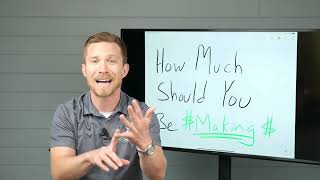
Adam Bensman lays out roofing sales income: aim for $75k minimum in year one, $100k–$150k mid-range, up to $300k–$450k if you're exceptional. What you make depends on whether you're W2 or 1099, your market size, storm vs retail work, and how many jobs you handle start to finish.
Chapters
So how much should you actually be making in roofing sales now, whether you're brand new at this or considering a career in roofing sales, or whether you're a seasoned sales veteran, one, two, three and 10 years under your belt and you're just kind of wondering, where should this really be shaking out for me and how do I compare with others? That is exactly what I'm going to be getting into in today's video. But even that last thing I just said about how do I compare to others, that's the first thing. This is our ground rule for this video. I want you to throw that out the window because there's some great things happening in our industry. People coming together, bringing integrity, honor back to roofing to try to drown out the scumbags that have given all of us a bad name. And with that, there's been an emergence of activity online and Facebook groups and discussions. And I see a lot of chat around there, which by the way, is all like really good stuff. But then I know when people are celebrating wins, we start sizing ourselves up and wondering and it paints this false sense of reality. Everybody's doing all these amazing things and I sit here and suck. And that's not the case now. Roofing sales is personal development in disguise. Did you hear what I just said? Write that one down. Roofing sales is personal development in disguise. I'll be the first to tell you, I don't really care much about roofs. In fact, I really don't care about roofs at all. I'm not passionate about it. What I'm passionate about is this industry and the opportunity it presents for us to jump in and literally have a game of personal development that we get better at communication, at sales, at organization, at discipline, at time management, at communication, conflict resolution, all of these different categories. When we get better, we end up serving more customers, landing more sales and making more money. So you have to embrace the journey. You have to embrace the suck as the endurance athletes say and say, hey, listen, I'm in this to just get better each and every day. We all come in at different places with different backgrounds. Someone might earn twice what you did in their first year, but it doesn't matter because it's not you. So all I want you to focus on is you and how do you move the needle each and every day. Getting better. Now that we have the disclaimer aside, shall we jump in? Alright, let's do it. First, I just want to say welcome or welcome back, if you're new here. My name is Adam Bensman, the roof strategist. And everything that I do here on this YouTube channel, my podcast and in my all in one sales training, sales strategy and sales system called the roofing sales success formula is designed to help you and your team smash your income goal and give every customer an amazing experience. And for more information on that, you can click in the video description or podcast description below. Alright, let's get to it. How much should you be making now? Truthfully, I believe that anyone who's a good fit or a decent fit in roofing sales should earn a minimum of $75,000 a year. Now there are people who don't, there's people who struggle. By the way, there's a gentleman, Caleb, who I mentioned on the channel a few times. Caleb, I know you're tuning in man, and I just want to say I appreciate you. If you see this, you want to drop a comment, do it. But your story was really inspiring to me, Caleb. And the reason is Caleb struggled for a number of months. He got denial, denied, denied. Then he got a streak where he made some sales and then they would get denied because they were stormed and he didn't make. It was just this roller coaster and like every door was like boom. Slammed in his face, slammed in his face. And it's like four or five months, my memory serves me. And he was relentless and if it weren't for sticking through and being persistent, he would have quit. Right? But he didn't and he ended up three months after turning 21, making his first six figures his first year in the business. It's wild what can happen and unfortunately many people quit too soon. So the reason I say this is 75,000 I think would be a first year reasonable goal. Alright, now realistically, 100k to 150 is also realistic. I'm going to call first year. That would be on the low end and 100 to 150 would be on the mid range end. Above that you're going to see. And I have worked with some folks who've done up to about 300,000 in their first year. And this is what I'll put on the high end. By the way, I have worked with some other folks. I just had dinner with a gentleman. He did 450,000 of income his very first year in roofing sales, leaving from being a schoolteacher. So again, crazy story. Almost half million dollars in a year, in his first year. Will everyone do that? No, no they won't. Only the top, top, top will do that. And I want to break this down now into a bit to substantiate these numbers so you can just say, hey, like what? Where is this going to shake out for me and why? So again, 75,000. Again just with roofing sales, the schedule, the hours, the stress that it can take, the expense that we have, the wear and tear in our vehicles, things like that, our equipment. Like to me, if I wasn't doing this, I would just go get a job elsewhere because I think that I'd be happier or maybe make the same amount of money or a little less, but have less costs. So that is to me like the threshold of are you a good fit? By the way, one sale a week, if you're truly working full time, bare bones minimum, if you're not doing one sale a week, it's not a good fit. That's my opinion. If you're actually out there working, you should be doing more and if you're not, there's some, by the way, it doesn't mean you should quit. You need to give this a hard look. Am I the right person for this? And if you are the right person, it means we need to start fine tuning some of those sales skills. So that's that low end mid range. Again we're looking about 100 to 150. The high end, 150 to 300. Now, year over year you'll see some growth because again it's personal development in disguise. You get better at time management, you're going to have a pipeline, more referrals carry over from the previous year. So what I want to break down is some of the factors for you to understand when you see these numbers thrown out online and you have the temptation to size yourself up and compare because it's human nature and unfortunately that's what social media is designed to do. So let's break those down. First we have the W2 versus 1099 can of worms. W2 is an employee. Your employer has a higher cost to have you as an employee. There's an additional 7.5% if my memory serves me, tax that's being being taken out on that you do get more stability and you can go buy your first home, for example, because you don't need the two years of tax history as an independent contractor. So W2 will likely usually pay less. But there's additional benefits oftentimes either a benefit plan or perks of having the protection of being an employee of a company. 1099 usually going to be higher commissions because the cost of the company is much lower. So that's the first factor. All right, next we're going to talk about is location. Let's talk location. Come on Penn, here we go, location. So a roof in Mississippi is very different than the price of a roof in Minnesota and very different than Texas and very different than Florida. Texas, Mississippi, much lower roof prices than they are in Minnesota and Florida. Right. Minnesota and Florida right now are probably about almost twice the cost per square as Mississippi and Texas. Not quite twice, but almost twice. So you can imagine that there's more profit if someone is out really scrape by. Like I've got some guys down in south Texas, their average roof is 10,000 and then the folks up in Minneapolis, 22,000, twice the volume. So we have to remember what size roofs are they selling. So location is the next one. Alright, next factor you got to think of is this retail or storm. Okay, storm deals can be really big, often easier to do high volume because there's an established need. Those roofs are damaged where retail. We got to go create the need. Not everyone needs a new roof. And then the final piece on this is leads. Are you self generating your own leads? Are you out knocking doors or is your company setting those appointments? Alright, because imagine if you had to go set every single appointment up, you had to go generate your own leads. That's going to take more time than if you had a setter, an appointment setter and you literally showed up every day. You look at your calendar, I just got to go here, here, here. And again, I work with companies that do both. One of them, their sales team is closing on average about 16 sales per month. And the other one, they're closing less, larger project size, more in depth, self generated leads versus these guys are just boom, boom, boom, running appointments every day. Show up here, here, here and here. So as you can see, as you shake this out, there's a lot of factors. How are you employed, where are you selling and the size of the roofs, is it retail or storm? How do the leads come in? And then the last one is probably the most important and that's your responsibilities. Okay, so let me break down what I mean by responsibilities. There are some companies that run a project cradle to grave, meaning from the minute you sell it, everything that happens in between to ordering the material, to managing production, to cleaning up and invoicing. And if you do it cradle to grave, your commission will be higher, but it's more time consuming. On the other side of the coin, some companies focus on just keeping salespeople selling. And that's it. You turn in deals, office handles, the Rest likely comes with a little lower commission because you have a lot more time to focus exclusively on selling. And that's why it's so important for you to understand what kind of person you are. If you're horrible with managing details like I am, if you're horrible at math like I am, and if you're horrible with managing time and all this running around, you definitely do not want to be selling for a company where you're doing everything cradle to grave. If you're an amazing salesperson, you're like, just put me in front of people. You probably want to go to a company that's got leads selling retail where you can just plug in and just show up and have conversations and close deals and move on to the next one. So you need to really hone down that good fit for you. By the way, I've done that. If you're new in the business, I've done a video on how to choose the right roofing company to sell for, to match culture, what questions to ask, and another video I've done that you might be interested in. We'll put a card up. Here is the brutal truth of roofing sales and what to expect. I break down a little bit more into a little bit more detail than kind of what those realistic expectations are and the aspects of this career that people just don't talk about. So in summary, realistically, 75k first year, absolutely doable, 100 to 150 mid range, again reasonable target, 150 plus. You're in a great spot at that point and Those key considerations W2 versus 1099 where you're selling and the size of those roofs and the profit margins in your market retailer storm whether leads come in or not or if you're self generating them and then your responsibilities. So there you have it. Now if you are someone who's new or eager, maybe you're an owner running a team and you want to help your team not only figure out how much they should make, but find a goal and turn that goal into a daily plan and then give them everything they need to smash that goal. The material to self generate leads, canvas overcome objections and close those leads. It all awaits for you inside the roofing sales success formula. I do have packages available for individual reps or teams, both of which are backed by my no BS money back guarantee. If you're not satisfied, I buy it back from you. It's that simple. Details are in the description below and if you have any questions I invite you to reach out to talk with a member of our team. You can call or text the number on this screen which is 303-222-7133. That's 303-222-7133. You can call or text. Alright. Just because our time here is about to wrap up doesn't mean your my time has to. Got a few video recommendations for you to get started. If you're new, get a free copy right now of the Pitch Like a Pro Roofing Sales Training Video Library. And I want you to pop into the playlist called Roofing Sales Basics and New in Roofing Sales. Start here. Those playlists are going to get you ramped up and rocking and rolling with kind of a foundation that you need and I think you're really going to like it. And if you're already in this and you want some more, there's two videos I recommend. One is the Brutal Truth of Roofing Sales. You know what, let's trim it back to that one. I really think that one's going to pair the best with this video. So you can click right here to jump into the Brutal Truth about Roofing Sales or. Or click right here to get a free copy of my Pitch Like a Pro Roofing Sales Training Video Library and I will see you on the next one.









