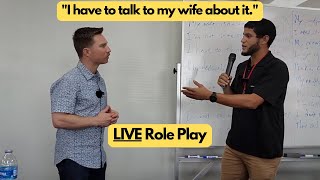
Live coaching role-play led by Adam Bensman (with participant Sergio) teaching how to handle the common sales objection "I have to talk to my wife." The session demonstrates using the ARO formula (Acknowledge, Reassure, Open/questions) and a three-question sequence to isolate the spouse's true concern: (1) How are you feeling about this? (2) How would your wife feel about it? (3) What would be your wife's number-one concern? Bensman also shows closing moves: 'if-then' close and risk-reversal (72-hour right to cancel) and practical scripts for leaving a sample board and obtaining a signature while preserving an easy out.
Chapters
So we're gonna do the objection. I have to talk to my wife about it. Who's heard this one? Yeah. Comes up a lot, right? Does that really mean that they are gonna, like, go pop a bottle of bubbly, be like, oh, honey, the first roofer, I love. The second roofer, not so much. No. What does it mean when they say that they have to talk to their wife about it?
They don't want to trust.
Yeah, they don't trust. They want you where? Out. Out the house. So what we're gonna do here is, is learn how the power of a question using the Aro formula can overcome that one. So, Sergio, you ready to rock and roll? Let's do it. Cool. All right, Sergio, thanks for coming out, man. I like everything, but my wife's at work, so I just gotta talk to my wife about it first.
Yeah, Adam, I completely understand that if I was gonna be making a decision on my home, I would definitely wanna speak to my significant other. Just so I leave you guys with the right information, what is it that you guys are looking for in a contractor before. Before you make this kind of decision?
Pause. Awesome work. Give him a round of applause. Give him a round of applause. All right. Critique yourself first. Well.
I don't know. I always tell myself at the door, I can always be a little bit more confident, make sure that I'm radiating enough positivity. So that's always what I critique myself on.
Yeah, well, we didn't ask critique yet. What do you do well?
What I do well. Can I tell you?
People will focus on what they didn't do well, so. So focus on. Well, first.
I reassured you on your question. I asked you what is the thing that you guys value most in a contractor, but also tell you that if it was up to me, that I would also take that kind of caution before making a decision. So reassuring you in that way.
Perfect. Awesome. Awesome team. What did he do well? Acknowledge. Assertive. One more time. Filed the formula.
Aro Eye contact.
Eye contact was great. Did he spend a short period of time or a long period of time? Reassuring. Pretty short. What's funny is it was short, but it really wasn't. It felt long. And I was like, yeah, dude, thank you. You get it. I ain't making a decision on a route without talking to my wife. What else did he do?
Well, he was pretty calm and confident.
Calm and confident. He did say, you know, he can leave him with the information, so. And he. He prefaced it with so I can lead with info.
Well spoken.
Well spoken. Okay. My feedback. You nailed it. You didn't skip a beat. There was a ton of empathy in reassuring. I think you did enough reassuring. That really told me you knew what I was going through. You're like, yeah, I'm not making a rogue decision either. I get it. Question was good. What you could do better is learn. This is a hard thing, learning to ask powerful questions. So what was your name?
Monica.
Monica brought up that question. If your wife were here, how would she feel about it? That's a very direct question. That's really good. One way that I do it is a series of questions. So I drip this information. So you guys, if you want to take notes, you should write this down first. Say, I completely understand. Before we talk about next steps, may I ask, how are you feeling about this? What I'm looking for is his commitment. If he says, oh, I feel great. This is awesome. Now what he's doing is describing to me how he wants to work with me. And then I'd say, listen, you know your wife really well. How do you think she would feel about it? And then likely it's going to say, she would feel good. She would just want to be part of the decision and pick colors. That's usually what's said. Then my third question is to isolate the big concern. You know your wife really well. What do you believe would be your wife's number one concern? That's it. I'm pinpointing the key objection. Now, I know exactly how to deliver that information. I'll give you an example is how you can end up closing one leggers. So again, before we talk next steps, how are you feeling about everything? Oh, I feel great. This is awesome. You know your wife pretty well. How would your wife feel about everything? Oh, you know, she'd be really excited about this. I just know she wanted to be part of the decision process. Awesome. So knowing your wife, what do you believe would be her number one concern? You can say the top concern. And she'll say, you know what? It'd be to pick colors and to make sure that she was really comfortable with you. And then I can go in for a close at that point, using risk reversal, say, hey, listen, if you feel great about it, your wife feels great about it. Her only concern is, is picking colors and being part of the process. You guys are busy, and I respect your time. How do you feel about getting this process started? And if for any reason your wife comes home and wants to murder you, you just call me. As the law states, you have 72 hours to cancel. And you just send that to me in writing. We'll rip this up. You don't owe a thing. And it'll save you guys from having to sit down with me or anyone else. Because let's be real, I'm sure you don't want to be spending time with roofing people. Boom. One call close on a one legger. And again, it doesn't work like magic every time, but you have the path to close it that way by isolating the key concern. If you don't isolate that key concern now, you're out of the house empty handed. So what we want to do is make it inviting and remove risk. That's the whole idea of a risk reversal close. They have nothing to lose. So we started off with the classic if then close. If we can make it such that your wife is going to pick the color that she likes, then would you be comfortable moving forward? So that's the if then close. But I can tee it up to make it even more no brainer. Like I could ask. And again, I'm just going to give you a few more ways you could run with this and then we'll do another round. Yeah, I could say, hey. So you mentioned that your wife's biggest concern was picking the colors. You know your wife pretty well. The sample board comes out, say, hey, do you think that she'd find something that she likes on this board? Yeah, I do. Excellent. So if we can get this project started in a way where your wife controls every decision on the colors and you have absolutely zero risk, would you be interested? Absolutely. Perfect. So here's what we can do. I'm going to leave you with this board. We'll get this process started. If your wife comes home and looks at this board and says, I hate those colors. What did you do? You just call me. There's a 72 hour right to cancel Dust in the Wind. You don't know it's a thing. Perfect. Sound good? Sounds great. Excellent. All we need is an autograph right here and a date. And again. Ideally, I'd have a follow up set to be back with the wife. To reconfirm the decision, go through the color selection. We're just giving you the fast version. You want to do one more? Let's just do. Let's skip the tail end close and just focus on how do you feel about it? How did your wife feel? How would your wife feel about it? What's your wife's biggest concern?
How do you feel about it? How does your wife feel about it?
How was your biggest concern?
Just jump to that.
Just jump to that. And then we'll end it. Yeah. When I give you the response, we'll just end it. And again, we're just trying to focus, to have good practice, not bad practice. Does that make sense to everybody? Yeah. It's rock and roll. Sergio, thanks for coming out. I really like everything, but I just gotta talk to my wife about it.
Adam, great to hear. I'm glad that you like everything so far, and I know that you need your wife to think about it. Just question, how are you feeling so far in this process?
You know, I'm feeling good. I just want. Like I said, I just want to make sure that my wife is also.
That your wife is also. Yeah. And how do you think she would feel if she was here?
You know, she would probably be on board is my guess. Yeah.
That's fantastic. So what would you say her biggest concern would be then? If.
About moving forward? She would want to make sure she could pick the color she likes.
Just the color. See right here in our folder, we have.
Pause right there. Great job, man. Give Sergio a round of applause. Stay up there. One more time. Okay. Critique yourself. What did you do?
Well, I kept it to the same formula.
Kept it to the formula. Spent time reassuring.
Mm.
Keep going. What else?
I was able to improvise off of what you were telling me.
Yep.
And I kept my eye in contact.
And you nailed the questions. And the thing I'd say is spend it even more time reassuring people.
Yeah.
Because then it says, I'm just like you. If it were my house, I wouldn't be comfortable making a decision unless I knew that my wife was on board. Also, because I know that I wouldn't want to create that kind of tension in my marriage. Right. You know, like, say what it is. I don't want tension in my marriage. Yeah. And again, that really connects with people. So give Sergio a round of applause. Sergio, awesome.