NEVER Say These Words in Roof Sales
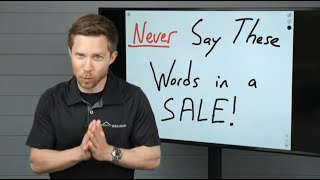
Adam Bensman (the "roof strategist") explains how specific words in roof sales appointments trigger negative emotions/images and reduce closing effectiveness. He identifies words to avoid—"contract," "price/cost/buy," and "sign"—and recommends reframing them as "agreement," "investment," and "get" (or "obtain/access"). He also gives one rare exception: using "cheaper" strategically in comparative (good/better/best) offers to signal savings. The video closes with a practice tip (visualize subtitles/imagery while listening) and CTAs to additional training resources.
Chapters
The no, no words, yes, they do exist in sales. And in this video, I'm going to be sharing with you the words that you never, ever, ever should use in a sales appointment, except for one specific circumstance which I'll share with you here in a minute. Listen, whether you're brand new in sales or you've been selling for a long time, you've probably studied sales, communication and the language we use. But in this video, I'm going to take it one or two steps deeper and leave you with an actionable plan to improve your communication so you can win more business. Before we get started, I just want to say welcome or welcome back. My name is Adam Benzeman, the roof strategist, and I'm super glad to have you here. If you haven't yet done it, subscribe to the channel. I put out new content twice a week, all designed to help you implement as quickly as possible as fast as your very next sale to help you make even more money so you can smash your income goal and give every customer an amazing experience. So let's get to it. In today's video, we're going to talk about the words that you should never, ever use. Now let's get the fundamentals out of the way. First is words create emotion and images in our mind. Emotion and images. When we hear a word. Oopsies. Come on now. Come on. Tablet. There we go. When we hear a word, they trigger emotions or we visualize the story that we that we hear. And that's why certain movies are so captivating, because as we're watching the visuals, there's like the narrator in the background and they really supercharge the story and bring that emotional feel. Whether the narrator is using this soft voice or they're really intense, it changes everything. But it's not just the words they use, it's the emotion that's tied to that word and the image of it. So I'm gonna give an example. If I say the word stop sign, you're going to visualize in your mind's eye a stop sign that's in red, right? That's the image. Now, that emotion that's tied to stop is one of caution, fear. Okay? So then the emotion comes in all from a simple word like stop. Alright? We paint that visual individual triggers the emotions. Or sometimes it goes the other way around. Where we hear the word sad, we might feel sad and then have an image in our mind of the sad emoji, right? Or whatever it is, or someone frowning. But these two work hand in hand and True artists in sales understand the emotions and the images that are tied to the words that they use. And that's why I encourage sales salespeople to study the art of direct response copywriting, the written form of selling. Because you get more choosy, because you lose the body language, the tonality, and being able to read your customers. And you rely exclusively on the language that you use. So, pro tip, go study direct response copywriting, and you're gonna fine tune your sales skills in a really big way. All right, now that we have our fundamentals and the groundwork laid that words trigger emotions and images, let's now go into the words that you should stop saying or never say in a sale, along with the one exception. First is the word contract. Now what emotion comes when you hear the word contract. Contract sounds like handcuffs to me. I am contractually obligated. A contract sounds scary. There's a lot of risk. It's long term. Contract, not fun. The images of a contract is fine print legal terms and feeling like you don't really. Would you agree contract's not a very good word. I'm going to go through the list. We'll talk about the words to use in its place here in just a minute. Another word is price. Okay. And I'm going to throw cost in here as well. Price and cost, these are two words that we don't want to use. And some will go so far as to say buy. And the reason for that is all of these have a sense of losing something. There's a price, meaning it comes out of my pocket a cost. I'm giving up money when I buy something. Although I do get a reward, I. I'm losing my money in order to get it. So price, cost and buy all have this feeling of loss associated with it. In images of when you buy now online, it's I have to go give them my credit card. I'm going to forfeit this money. What's the cost of something? There's no upside. It's purely a negative connotation to losing money. And then again, price. I'm seeing a big ticket item with a big red dollar sign in at least 4 numerals. To me, that's how cost breaks down. So these simple words again are scary words to people, as is this one, the word sign. And oftentimes, you know, people say, hey, I just need you to sign here. We don't want to say sign. Sign is a contract. Again, fear. Do you like signing things? No. What does it mean when you sign something? Usually you're giving up your rights because you're acknowledging how something works in this. The. The deck is stacked in the other person's favor. So again, the words and images associated with these things here. Contract, price, cost, buy and sign, all share a few common themes of negat and sadness and loss. Alright, with the feelings of loss, not good words. Instead, a few simple adjustments. We'll get this erased here. And I want to share with you what you can say instead. And then again, that one exception, because there are some times that this can be used in what I'll call reverse psychology. And I'll touch on that in a minute. First, with contract, instead, what we can say is agreement. Okay? An agreement is a mutually beneficial arrangement. We've agreed to do this, so this is our agreement. Again, you might be thinking, oh, it's called a contingency agreement. Yeah, not a contingency contract. It's called an agreement. The price and cost are investments. Okay, Instead of buying, you get. I know it sounds crazy, but getting something is positive. Buying something is negative. Do you want to get access to this or do you want to go buy a new phone? Do you want to get. Get the latest technology on the newest iPhone or do you want to go buy one and spend the $1,400 retail? No, you want to get it. So again, the positive spin of all of this. Positive emotion, positive images, agreement, I think visuals of handshakes, investments. I put money in, I get money out. I am playing into one of the strongest human motivators, which is greed. And by the way, greed has its upsides and downsides, but all of us are looking for gain, which psychologists kind of classify into the realm of gain, excuse me, of greed. I can gain something from this. And then again, get is a positive mindset. Obtaining, becoming wealthier, having access or ownership to something. And again, images of that coming to me versus buy, I have images of me forfeiting my money. Do you see the difference here? Again, whether your customer is aware of this or not, it's going on in their head. Now, let's get to the one little exception here. There are times where I will mention price and cost, but in an inverse way. You know, here's what I mean by that. If I'm going through the details of, let's say, a good, better, best system, what I may sometimes do is say that this option is cheaper. Now, I know the salespeople that are watching are saying, adam, that is an absolute. No, no, we never want to say the word cheaper because that includes that something's more expensive. But I challenge on this because it is a strategic use of this word in a way where that customer feels like they've gained something. This is a cheaper alternative. So what I know that they're worried about if they object to the bigger package, the best system, because it's too much money, and I'm talking about it as an investment, I may say, hey, I have a cheaper alternative investment for you. And to them, cheaper equals what saving money. So those are the very, very rare exceptions where I'll use these on the inverse to play into the words and the emotions that I know are tied to the word che. Cheaper is a better deal, a better bargain, saving money. And I want that homeowner to experience that emotionally and the visual images. And then I'm going to very quickly tie back in to talking about the agreement and the investment in the longevity and all the benefits of this new roofing system that we're looking at. So, again, I did want to share this as a bit more of an advanced practice of going through the good, better, best, because I've had some people push back with me on it. And I'm not saying that you need to agree with me, and I'm telling you now, I'm not saying I'm right. What I am sharing with you is the psychology behind the words and images that are tied to the language that we use. Now. How do we put this in action? It's very simple. Throughout your day, become very conscious of the words and images that are appearing in your mind when you hear people. And I want to give you a tip that I use when I practice this, I close my eyes, and as I'm hearing people talk, I envision right on my eyelids coming up, like the subtitles of the text. If you were to watch a YouTube video on mute, for example, and you have the text overlay, I'm envisioning all of this in my mind's eye as I talk and as I use creative imagery in words, I start to see and feel those feelings. And then by experiencing this firsthand, I've been able to refine my skills of using the proper word choices to create the right emotions in images to clearly portray the message that I'm trying to communicate. And when you master this skill, people will not only hear you more clearly, they'll find you to be a stronger communicator, but your message becomes more emotional. And what's the number one thing people buy on emotion. That's right. So I hope that you're able to practice this in your day to day and you'll see as you begin to communicate the details of your retail bid, the details of the contingency agreement and asking for the business is where these language pieces will come in really, really clearly. Now, in my sales training that I teach with the car park Formula, Slap Formula, the Aero Formula, you'll notice that a lot of the key points that I emphasize in that training system are designed around this use of language to really engage that customer emotionally, to capture them on their visual imagery so you can close more deals without having to really understand the psychology behind why it all works. It's just, here's the fast track. Follow this and it's going to kick some butt for you. So there you have it. Now, if you like this video and you want more of them, what I want you to do is click right here and you can download a free copy of my pitch like a pro roofing sales training video library. If you geek out on this psychology stuff, I've got a whole playlist in there on body language and psychology. And if you want to continue your journey with me right here, YouTube thinks you're really going to like this one. Hey, thanks for joining me and I will see you on the next one.









