NEW Laws Threaten Contractors and Policy Holders (In Florida Only, For Now...)
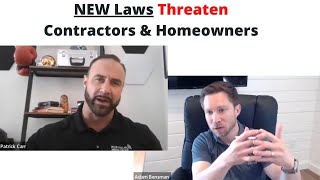
YouTube interview (Adam Bensman with Patrick Carr) discussing recent Florida legislative changes (special session/Senate Bill references) that affect roofing contractors and homeowners. Key topics covered: new mandatory marketing/disclaimer language on contractor materials; changes to Assignment of Benefits (AOB) that limit homeowners’ ability to recover attorney fees; a 15‑year roof-age rule with a contractor/engineer carve‑out; and a seven‑day timing rule for adjuster notifications and estimates. The discussion emphasizes practical impacts for contractors and homeowners and urges organized pushback and clearer homeowner communication.
Chapters
Patrick, welcome to the channel. I'm so pumped to have you here because we're going to be talking Florida laws, changes and what is threatening contractors and how to overcome it. Patrick Carr, welcome back, my friend.
Thank you very much, man. It's good to be back with you and with your audience. So hopefully try to bring some value here about Florida.
Yeah, you know what's funny? I think you're the most, the highest repeat guest here on the channel helping out with the Florida legislation. This is round three, three or four, I don't remember. But anyway, I'm super pumped, man. So I've got my, my notes pulled up in this on my other monitor. For everyone who doesn't know you yet, just a quick intro. Tell folks who you are and how they can follow you right here on YouTube as well.
Absolutely. So I got a, I got started in the business years back doing collections. From there I moved into starting my own company doing content creation for roofing contractors. And with that I was out with roofing contractors all the time and got me interested in all the laws that are changing in the state of Florida. Last year I began to join your show for Senate Bill 76 and fighting against that. And already this year we have new bills that have been introduced despite them not giving Senate Bill 76 much time at all. And so I don't have a horse in that race per se. I felt like I'm a contractor. I just have a lot of great clients who I see the pain that they feel from bad legislation. So I think it's my job to get out there and fight against it.
I love that. And you now run the Patrick Carr show, available on YouTube.
Yeah, the Patrick Carr shows on YouTube. And I go out with mostly blue collar industries, restoration, roofing, you name it. And I really try to hone in on their stories. Man, everybody's got such a great story from your sales manager to the owners of the $100 million companies. And that's again what pushes me to fight against some of this bad legislation as I see how many good blue collar workers they're out there and unfortunately a lot of them don't get a voice in Tallahassee or whatever. Excuse me, their capital city might be.
Yeah. Well, awesome. Well, Patrick, thanks for being here. And for folks who don't know you, like why, why do I have Patrick on and talk about this legal stuff because you're one of the few that is hyper focused on value. Like this has nothing to do with your day to day technically, but you're in the Back office of a couple of law firms. You're deeply involved in the political environment there in Florida because it's home for you and you help bring resources to me through, to help me support more contractors through this Florida legislation. So when you reached out over Instagram saying, hey, we got to talk about these four topics, I was like, of course man, we got it, we got to do it. So without further ado, we're going to jump right in. There are four kind of key things that are impacting root roofers and the ability to operate now in Florida. Kind of what we need to change, how we need to change, what kind of pressure we have from a legal and policy standpoint. But most importantly for everyone who's tuning in not from Florida, that's hitting, about to hit the stop button, hang tight because Florida has been the pioneering state of where other legislation begins to follow. So whether this impacts you or not, my honest opinion, it's a matter of time until the attempts are there through legal processes. So disclaimers aside, we've got the four pieces. Number one, marketing language. Can you share with folks as we introduce the new threats to the marketing language, what all unfolded behind the scenes? Because this just popped up. It happened and now this new, this new legislation is in place without any public forum, which is mind blowing to me. So quick background and then let's hit these four points.
Last year, Senate Bill 76, they tried this where they tried to say what, what door to door salesmen could say and at the front door that was immediately turned over and a judge in Tampa said no, you can't do that. Now what they did during this special session, I want people to understand quickly what happened. The session in the state of Florida, which is approximately three months, ended and then after that, Governor Ron DeSantis went ahead and set a special session needed to happen to address homeowners insurance premiums. And now they've reintroduced this language portion of this bill in Senate Bill 4d 2d. And what it says is there are certain three paragraphs that need to be included on any marketing material moving forward. And those paragraphs have to do with there is quotes you have to put on there, but have to do with people paying their deductible, somebody waiving the deductible, that it is a felony and making sure the homeowners know that they are required to do so. There's very small paragraphs, it says that it must be 12 point font or at least half the size of the largest font on the piece of marketing material. So what you're seeing here is a push by carriers to put these long paragraphs, I mean, it's three paragraphs onto any marketing material. And I think it's meant to scare or otherwise deter homeowners from filing an insurance claim by seeing a bunch of disclaimers on there. But it does have to be on marketing material moving forward. If you have letters, if you have pamphlets, if you have emails, it's important that you get this marketing language and include it moving forward.
It blows my mind that roofers are under more scrutiny for these disclaimers than the financial industry and the health care industry. I mean, it boggles my mind, but. And then I could. And I know I don't run a political channel, but the fact is these policymakers, many of which have vested interests in insurance companies and this is how our legislation is unfolding. And there's one person who wins from this, it is the insurance company. This does not benefit the homeowner, which is the number one, and it does not benefit the contractor. And I view a win as when the contractor and the homeowner's interests are aligned and they win. That's how this works in when we play by the rules until Florida comes in. So the new marketing language, and I was looking down on my journal here, you said it's about three paragraphs, 12 point font, has to be printed on everything.
Yep, that's correct. And I that language is available right now. I don't remember the exact website that is available on, but a number of attorneys have that exact language to be quoted and put on there.
And is that public or do we have to go through an attorney and pay an attorney?
That's public.
Public, yes. I'm going to try to find that and put a link in the video description for folks and we'll be getting that added as well. So next thing, anything else on the marketing language front?
No.
Which is essentially by quick summary. Right. Correct me if I'm wrong, just disclaimers that you got to abide by the rules, you got to pay your deductible. We're not making any promise or guarantees. We can and cannot do this. So again, a bit of a bummer, especially 12 point font. I mean, look at a pharmaceutical ad. It could be like side effects, death. Don't worry, we put it on there. Is it legible? No, it's in two point font and it's on the screen for four seconds. So the next one here, AOB changes. What do we got with AOB changes? This is a big way AOB for those that don't know, AOB is assignment of benefit. It is not legal in every state, but it is in Florida. Sorry to interrupt. Go ahead. AOB changes.
No, this is big. New law prevents attorney fees from being collected under an aob. This was huge. I want to give people an idea of way this normally works. Let's just say you go ahead and have there's a loss, AOB gets signed, you put in the claim, claim gets denied by the carrier, in which case you have nothing but to do to file suit against the carrier through that AOB. AOBs have gotten a bad name, of course, in Florida since hurricanes started hitting. We had contractors come in from out of state and then perhaps they left the state before work was completed, leaving people with AOBs, but no work done. Fine. That was very, very small amount of people who did this, but it became. It got a bad name back in 2019. What this law now states. And get this how this would work, if a homeowner then therefore wants to file suit against their carrier, they are responsible for attorney fees on that claim. And get this, even if they win the case, you can, you can have somebody steal from you, you can sue them for stealing from you. And then even when you prove it, they go, yeah, but you still got to pay the fees in order to prove that. What this does is it dramatically reduces a homeowner's ability to fight in the court system against their carrier. And so this, it takes a lot of the teeth of the AOB away. And that is what. I didn't like it. It's terrible, in my opinion, because what it also is trying to do, the next step will be binding arbitration. It wasn't a part of this one, but the Office of Insurance Regulation is moving towards that, where homeowners will have to do arbitration, not even have access to the court system. It's tough. Now, I want to give everyone an example of the way that this could work, because I think it's so key. There is also, and I think this might be something we've talked about, a separate roof deductible that is being introduced in the state of Florida. And so that separate roof deductible will go on the next insurance renewal. And what it says is that now for all other losses, you'll have one kind of deductible, but if you have a insurance claim on your roof now, you'll have a separate roof deductible over here for just your roof loss, that separate roof deductible is going to be 50% of the roof value or 2% of the value of the home. So I want to bring this all together, what this example could look like for a homeowner here. You could have a loss on a $300,000 home, $20,000 roof right there. So I'm going to take the lesser of those and say that your deductible is now six grand on your separate roof deductible. The claim is denied, and you have to go to court. In doing so, you pay $7,000 to your attorney for that $20,000 roof, and you win the case. $6,000 deductible, 7,000 to your attorney. That's 13 grand out of pocket. $20,000 roof. You get seven grand, everybody, for your $20,000 roof, and they go, see you later. It's. It's not right. But what I want to, you know, I don't want to be too long winded. But what this aob, what we're going to see, and I think the solution for contractors is to take that aob, if the claim is denied, move into some kind of direction to pay at that time with your homeowners and move any kind of. Any kind of suit that might be possible against the carrier through a direction to pay instead of through the assignment of benefits. That, in my opinion, is the best solution that I've seen out there. And it wouldn't be that difficult. It's just an open and honest conversation with your homeowner. Yeah.
So does this change if a carrier, if a contractor does not use an AOB and they use a contingency agreement, does that change anything on the legal side?
No.
Okay, got it. So essentially, Florida, for anyone that doesn't know, they lead the nation by landslide in terms of the number of lawsuits against carriers. So they're the most litigious state in the insurance world by a landslide of any other state. So what they're trying to do is limit the fees that the carriers are paying, but that's criminal. It's like a personal injury. This. They're kind of classified in the same realm of personal injury, meaning if you're found at fault, you got to pay out and then make the other person whole. And now that being stripped away, it just boggles my mind. It really makes no sense because it's not like that in any other state that I'm aware of. So AOB changes. You got to just be aware of this. And this may encourage folks, correct me if I'm wrong, Patrick, that guys that might have been relying heavily on Attorneys, which SB 76 required us to. Now they said, hey, you need to use attorneys essentially for everything. Now they're saying you need to use attorneys, but we're not going to pay for it. And they're trying to bleed out the homeowner and contractor from fighting.
Yeah. So they want to move the contract, they want to move this AOB thing away from the contractors. What they're trying to do because they, what they feel is that. And I'm going to be open about what's happening. Carriers know they're underpaying homeowners in the state of Florida. And if we go through the contractor and I have to deal with them, they're going to make us pay, they're going to be beat us back up, they're going to fight back against us. Homeowner has no idea what drip edge or underlayment cost. And so when I tell the homeowner, I'm going to pay you 12,500, they look at it and go, great, thank you very much. Not knowing that that's a $20,000 roof, inevitably, what I want contractors to understand is how important it is to be to advise homeowners of why you may need me is because I don't want you to go shopping around, even if it's not with me knowing or thinking you've got enough money for a roof and you don't. The carrier's goal here is simple in my opinion, to pin the homeowner against the contractor. Here. I gave you a line by line item and I gave you this money. Your greedy contractor is saying that it's more. They're not understanding. That contractor has been the one fighting for more money on the back end each and every time in the past. And so I just hope contractors are understanding and ready for that conversation that homeowners inevitably, well, they're going to be taken advantage of, in my opinion, and they should. Contractors need to be there ready to help.
Yeah, yeah, absolutely. It's, it's, it's again, it's a matter of time until we start to see this on a more widespread scale. 15 year old roof rule. That's the third piece. This one, I think. Yeah, go ahead.
This one's interesting. It's, it says this in the state of Florida underneath, 15 years, your roof cannot be dropped due strictly to the age of your roof. Over 15 years old, your roof can be dropped due to the age of your roof. But here's the caveat, very interesting one here. If the carrier, it's very gray. But if a contractor licensed in the state of Florida or engineer tells the carrier that you have five more years of useful life on your roof, then they cannot drop you that year. What is five more years of useful life up to the individual contractor who inspects it. What form do you turn into the insurance carrier? Not sure. What does it even look like or is there timetables on this? I don't know that one either, but that's the law now. And what I want, people are like, why would this, why would they do this? Well, because carriers are smart. What carriers are relying on is that there will be some greed from contractors in some way that when a contractor goes out there to inspect said roof that they will tell the homeowner there is not five more years of life and that they will push for a financing deal instead of going through an insurance claim. And therefore. Correct. So therefore carrier gets a brand new roof and doesn't have to pay for it by having a contractor go out and look at that roof and try to assess it for the homeowner. So what I'm asking carriers and what I'm telling guys to do is hold on guys. If that roof has damage and it is 15 years old, but it has sustained damage, in my opinion that is in line with their policy and that they deserve at least a shot, then give them that shot. And if it doesn't, then you advise them accordingly and give them what the options are. But what that is, in my opinion, logically what the goal is here is to ensure that they try to get a roof, a retail roof and insurance company doesn't pay for it.
Yeah, yeah. And they're trying to spin this, in my opinion too, on homeowners say no. This is more advantageous to property owners because we've removed the right for a carrier to drop you if your roof's over 15 years old. Now, as long as you can prove that it's got five years left, you're good. We'll take care of you. This was such a, a PR game to try to make it where they're spinning this. This is the. By the way, I finally realized, like the art of politics, how to let greed be manipulated in a great marketing message to get your way. That appeals to the public is valuable when really the only one that benefits is you and your cronies. So this is politics. Maybe the most controversial thing. Clearly I'm not that controversial on my channel, but I'm going to guess most people agree with me. I have very little trust in our government, to be frank. They that separate discussion. So 15 year old rule. If you agree or disagree, by the way, drop a comment in the comment section. I'd be curious to hear your thoughts on this and how we can, you know, elegantly communicate this stuff to property owners. All right, seven day rule point number four. What is the seven day rule and how does that change things for us?
Yeah, so seven day rule, what that's basically saying is this is 45, let's back up 45 days from the time the carrier learns of the loss. So from the time you call in, the loss, Carrier has 45 days to get an adjuster out there to take a look at that loss. Okay, that's fine. I don't see that being nice. They put a number to it. Rule of sevens, as I'm calling it is this. And I really want. This is big for contractors. I think it's going to be overlooked. The once the carrier assigns the adjuster to the home, they have seven days to notify the homeowner that they are entitled to a detailed statement from that carrier of what they find out there. Cool. They notify the next seven days comes this way. Once that adjuster turns in that claim, the carrier has seven days to provide that detailed estimate over to the homeowner. This really brings everything full circle. So I'm glad we waited till last for this. I want everyone to stay with me if possible. I want you to think how this is going to go down. Now. Homeowner gets a detailed statement from the carrier saying a line item of stuff that needs to be done on their roof for 14,000, let's say. And they go, okay, look at all this stuff needs to be done. This is great and wonderful. And the carrier is going to go and go sign off right here and here's your $14,000 check. And the homeowner is going to go, great, awesome. 14,000, let's get shopping here. And they're going to turn around and start shopping for that. This is where this plus separate roof deductible. Together we start to see where there can be an issue because now they're going to turn around with that 14 grand and they're going to go, who am I going to for my roof? And we all know that is not going to cover the cost of replacement of that roof. And it's going to pin contractor against homeowner as they try to negotiate for what is rightfully the homeowner should have received in the first place. The only benefit that I see to this, and I mean, I mean this, is that perhaps now the homeowner will begin to see the kind of pain that contractors have had to work against in trying to get what is rightfully owed to the homeowner from the carrier. And they go, what do you mean? I was short paid on this thing that I know I'm going on a long shot here, but I'm hoping that that is what comes out of it, that I don't think positive.
You know, you just brought something up. I'm making a note in my little journal about this is how. How so often the carriers are trying to paint us as the bad guy, the evil, greedy slime ball. The news articles I have been sent, and I'll tell you, if I had it in front of me, I'd share it, but I had multiple folks from Florida message me with screenshots of the letters that these carriers are sending out, literally claiming that all contractors are showing up to be greedy, that they are going to manufacture damage on your home. Like statements of fact, blanketing every roofer into this. And I think it's just critically important for us to develop a really good relationship with our. With our property owners, our customers, whether it's residential or commercial, to let them know that our interests are wholly aligned when they. When the homeowner offices, oh, well, my insurance company says you're being greedy because you're asking for a supplement. Say, hey, do you think that I get paid for work I don't do? Do you think anyone would willingly write a check for that? No, we. Our interests are aligned, that I am trying to get the best possible outcome for you with the roof that you deserve, at the full scope of repairs that you deserve, and with all of the necessary installation practices that you deserve. And your amount is your deductible, which I can't legally touch or will end up in jail. And then we can share the video of the company that's, you know, unfortunately going through that right now. So when we go through this, we are the one that has your best interest at heart. And unfortunately, I just want you to ask yourself, this carrier, who wins? You are the carrier. And people start to compute that on their own. So, Patrick, thank you for joining. Man. Any closing remarks from you before we call today a wrap?
I appreciate your time, Adam. One thing I want to put up here, I think this kind of solidifies and drives home what you said right there. One of the people are saying is a positive part of this bill is what was called the Reinsurance to Assist policyholders fund for $2 billion was created. It's called RAP and what this does is it allows insurance carriers to get money quicker from this fund after a loss.
Okay.
You would think that if insurance companies are bleeding out in Florida, that this would be a very positive thing. But they did one thing at the very end. They said if you decide to be a part of this program by June 30, 2022, the carrier must give you a check, a rebate for the money that was saved by them being a part of the wrap program. And so I thought to myself, we talked about on the radio last week, I'm still waiting for that one person who ever gets a check from their carrier for savings that was made. And in fact, companies like American Integrity, who were some of the biggest ones to cry wolf in this thing, aren't even joining the program knowing that they don't need the program. And so when I see good things even that could possibly be there, I still have a yellow flag that goes up and I want contractors, hopefully I'm not making this a plug here for you and your group to bring people together, you know the pitch pro and people like that, so that contractors can have a unified voice to help these homeowners and fight against the millions of dollars being poured into the lobbying on behalf of carriers. Because it truly is a one sided fight oftentimes out there.
Yeah, it really is. Patrick, thanks for joining, man. I am just really, really honored to be having you in the corner with me and supporting our people because Tate Law Firm, shout out to them, they've been on the channel and have helped you with some, some great info. I know Cohen Law, I've heard really good things about from clients. I haven't worked with them personally. You've been close with them and you've distilled all this. I saw your notes. If you're tuning in the podcast, Patrick's got all the legal stuff printed out right there. I've got my notes pulled up on my other screen and, and, and being able to help folks navigate and doing so in a way that's not out of fear. Guys, gals, remember we will continue to survive and thrive. The industry is going to throw things we can't control and it's how we adapt that's going to, that's going to change everything. And we will, we can so appreciate you. Remember to go check out Patrick Carr show the Patrick Carr show on YouTube and follow Patrick Carr. Patrick, what's. Which Instagram handle should we use?
Patrick? Underscore R. Underscore Carr. There we go. C A R R. There we go.
Perfect and I'll put all the details in the description. Patrick, thanks again for joining us, man.
Thank you very much. Appreciate it.









