OBJECTION: "My Insurance Company Said I Need 3 Estimates"
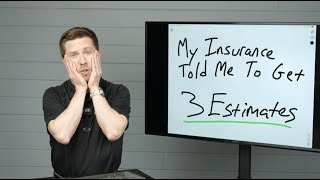
Adam Bensman (the Roof Strategist) explains how to handle the common homeowner objection that their insurance company requires three estimates. He advises salespeople to avoid badmouthing insurers, instead asking homeowners three questions that reveal the insurer's incentives (what happens if a cheaper estimate is found, whether the homeowner keeps freedom to choose a contractor, and who benefits from the 3-estimate rule) so the homeowner arrives at the conclusion themselves; he then transitions to closing techniques and links to related training.
Chapters
My insurance company told me to get three estimates. I hate this one. But in this video, I'm going to be teaching you how to overcome it like a boss. Hey, welcome. And welcome back. My name is Adam Bensman, the roof strategist. And everything I do here on the channel in the podcast is designed to help you smash your income goal and give every customer an amazing experience. And unfortunately, we know that an insurance company saying this, do you think they're committed to creating an amazing experience for their customer? The answer is no. Because that insurance company who says this is doing one thing and one thing only, protecting their own financial interest at the expense, oftentimes of the homeowner. Now, we can't say that directly to a homeowner because it likely won't go over so well. What we definitely don't want to do is throw the insurance company under the bus, throw the agent under the bus, because you just never know who's all involved. And I have made this mistake before where I'm like, oh, you're with so and so insurance company. And then all the things that you just want to say start coming out and all of a sudden you're bad mouthing this insurance company. So let's put ourselves in the mind of our customer for a minute. I just made what I felt like was an educated choice to choose this insurance company. You're basically saying that they're stupid, which is calling me stupid, and you're questioning my own judgment. So I need you to remember this. Here's another analogy. Let's say you show up at someone's house and they look at your truck. I'm going to offend some people. You drive a Ford dude found on road dead. You make this much money and you bought yourself a Ford. Okay, who does this insult? Does it insult your truck or does it insult you? By the way, I drove Ford trucks, so that's why I said that it insults you. This is the same feeling that those homeowners get when we talk bad about their insurance companies. We have to tread lightly. Likewise, you don't know if they're like dad, brother, cousin, or best friend is their insurance agent. So disclaimer out of the way. What I just said is we know that the insurance company is protecting their financial interest. We have to walk our customer into this conclusion creatively. That, my friend, is what we're going to be doing in today's video. It's just the same as people feel empowered when they've made the decision on their own versus being told what to do. Do you like being told what to do? No. Buckle your seatbelt, pay attention. I'm talking down to you like a child. No one likes that. But instead we're going to walk them to this conclusion. So here's how. This is a very common objection. Insurance company says they want three estimates. We know why. So what do we do? If you've paid attention in the past, which I hope you have, you've heard me say this. What are the most powerful questions that you can ask a homeowner? I want you to think about this. The most powerful questions you can ask a homeowner. What are they? They are the questions that the homeowner cannot answer. This is how we act, this mirror. And we showcase the pain that they were not aware of. In sales, there is no action without feeling pain or a problem. So the homeowner's giving this, you know what seems like the insurance, hey, get three estimates. We want to make sure it's fair and that you're getting taken advantage, you know, you're getting a fair value. It's not how it works. We know that. Right. So instead what we need to do is mirror back the obvious to the homeowner. So when they look at it, you know, like the fat mirror. So I'm short, I'm pretty stocky, I'm built like a fire plug. When I'm in changing rooms at certain stores, I'm like, oh man, this mirror makes me look like a frickin like a monster. And those fat mirrors don't feel good. And I remember vividly what made me want to lose weight. I was at my bachelor party. God, this is kind of embarrassing, but I'm going to say it anyway. I was on an ATV and I was driving down the driveway and my brother had bought me a skin tight, skin colored suit with a zip up hoodie. So my friends, because he rented his house in the middle of nowhere and I pull up the driveway and he's got pictures of me cruising through in my little like skin tight suit. And I saw that picture from behind me and I saw my love handles pouring over my hips. That was the pain, that was the mirror that said, hey dude, you've turned into a little chunker. Time to shape up. And it was that moment. So what we need to do is give that homeowner that experience, but doing so in a tactful way. Got it. Alright, so how do we do this? By asking questions that they cannot answer. So when the homeowner is presented with this from their insurance company, we want to Start asking a series of questions. Number one, did the insurance company say what would happen? I can't write this fast enough. We're going to just go on the audio here. Let's rock and roll. Number one, did the insurance company tell you what would happen if you found someone cheaper? What are they going to say? They said, well, you know. No, not really. So what happens if someone was cheaper? Did they tell you whether or not. Whoopsies. You would be obligated to pay your deductible no matter what? Well, they didn't quite indicate that. So. Okay. And then did they tell you if you have complete freedom of choice to choose the contractor that you wish to work with? And they said, oh, well, no, not really. So, okay, now I'd like to hit these three points for you so you're aware and can make the decision that's best for you. Number one is if you find someone cheaper, it doesn't do you any favors because your deductible is a contractual agreement between you and the insurance carrier. So whether the claim is 2 million or 2,000, you owe the same amount. So if you find someone cheaper and provide evidence for that, they will pay based on the cheaper evidence. Excuse me, based on the cheaper estimate. Based on cheaper estimate. By the way, this language is on many carriers insurance cover pages on their loss summary. All right, so homeowner. Now again, we need to just make sure to ask, well, did they tell you what would happen if you found it cheaper? Well, no. Well, they're going to pay based on the cheaper estimate. Which means, Mr. Homeowner, you still owe your deductible. Because their language is we're going to pay based on the cheaper estimate. Pay, meaning your portion. Think of it like a copay. You're the doctor. If you went in for knee surgery and Your copay is 100 bucks, but they can find a surgeon to do it, $5,000 cheaper to pay. Does that save you any money? No, you still pay the 100 then. This is the last one. Did they tell you that you have complete freedom? Now, I know that there are some policies that have the right to repair and things like that. There are preferred vendor programs. But so far as my understanding goes, and please, anyone who disagrees or has a deeper understanding of the insurance side, the legal side, than I do, I encourage you to comment below because I want to make sure that these facts are accurate. That being said, my understanding, and I'm not an attorney, I'm not your attorney, and this is not legal advice, is that by law, an insurance, excuse me, A homeowner has the right to choose the contractor of choice. The carrier cannot dictate who can or should be used. So Mr. Homeowner, you by law have freedom to choose whoever you wish. By the way, I know there's some again the right to repair. There's preferred contractor networks, but homeowners are not required to use those preferred vendors again, unless something I'm unaware of or something's changed. I know this is an ever changing landscape and you're deductible, you're paying no matter what. And then if it's cheaper, you they're going to pay based on their estimate, which means you pay the deductible. So Mr. Homeowner, can I just ask one more question? And they say yeah, say so when the home, when the insurance company wants you to get three estimates, is this in your best interest or in their best interest? This is where we ask a leading question. Is it in your best interest or their best interest? Now we're highlighting to them, guiding them to, oh wait, that's the insurance company's best interest. So say great, Mr. Homeowner would agree and I'm glad that we're on the same page. And then now is where you can transition to closing the deal. I'm going to talk on that here in a minute. That is an entire own video that I don't want to dilute the key takeaways from this. So at the end of this video I'm going to link to another one that you may want to watch. So again we're going to ask those three questions. Say Mr. Homeowner, I understand that your insurance company wanted you to get three estimates and if I were you I'd want to make sure I'm getting a fair value as well. However, can I ask you a few questions? Sure. Did they say what would happen if you found someone who is cheaper? Did they explain that your deductible would be the same whether you found someone more expensive or less expensive similar to your copay? No. And then did they explain that you have complete freedom to choose the contractor of your choice? No. Well, by law you do. And can I ask you now that you know this, is this getting three estimates in your best interest or in the best interest of the insurance company? Now all of a sudden, what have we done? We've shown them the love handles. By the way, that's self deprecating. I'm talking about myself. If they're overweight. Don't say that. So you've highlighted their pain. You've made them aware of this. They've come to their own conclusion and then now we can transition to positioning ourselves to close the deal. So listen, just because this video is about to wrap up doesn't mean your and my time has to because you might be saying hey Adam, I really want to continue this journey. How do I start closing those deals? And if that's you, click right here. I've got a video on using the contingency agreement as a closing tool on how to position yourself to close that deal. And if you haven't yet done it, I encourage you where to go. Let's pop this open to download a free copy of my pitch like a pro roofing sales training video library. All the videos I've ever done organized by category and I've got more videos in here on the contingency agreement closing and all that jazz. So thanks for joining me and I will see you on the next one.









