OBJECTION "My premiums will go up if I file a claim"
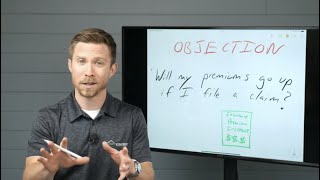
Adam Bensman (the Roof Strategist) explains how to overcome the homeowner objection: "My premiums will go up if I file a claim." He outlines three objection categories (trust, need, money), gives a legal disclaimer about UPPA and not being an attorney/agent, defines negligence vs. act-of-God claims, and argues carriers focus more on claim frequency than claim dollar value. Recommended actions for salespeople: ask how many claims the homeowner has made (e.g., in the last 3 years), educate them about act-of-God language in policies, and encourage the homeowner to check policy wording or ask their agent for that language before filing.
Chapters
But I don't want to file a claim because my insurance company is just going to raise my premiums. This objection stands between you and signing a new customer more often than we'd like to admit. And I've been hearing this more and more as we are in busy season selling hail, wind or hurricane damage roofs. The homeowner is right there, but we need to get them over the edge and they don't want to do it because of this one objection. So in this video, I'm going to be teaching you how to overcome this objection. Because I teach that all objections that we ever hear fall into three categories. And I teach this in my objection handling formula, which by the way, is part of my all in one sales training, sales strategy and sales system called the roofing Sales success formula. There's information in the video description below, should you be interested. Now, those three categories are trust, meaning the homeowner must trust you first, they must need you or a new roof, and we must overcome the money issue. So funny enough, trust, need money, the three objection categories and the three dominoes that we need to knock down in order in order to get the sale. We have to develop trust, create the need, and overcome the money issue. We follow this path, we win the deal. And again, all objections will indicate that that homeowner doesn't trust you, they don't think they need a new roof or your services on the insurance side or it's a money issue. So right now, would you agree with me that we're pretty much targeted right here on this money issue? Yeah, I'd agree that I don't want my premiums to go up. Means they have to come out of their pocket and they're going to be paying for this roof one way or another. So likely, hopefully by now we're going to, we've developed some trust with that homeowner through a conversation, we've created a need for that new roof. But the one thing standing between you and them is this money piece. So in this video, I want to give you the tools and resources to have a conversation with your homeowner and overcome this objection. But first I just want to say welcome or welcome back. My name is Adam Bensman, the roof strategist, and I am really excited to have you here. Everything I do on my channel and in my programs is designed to help you and your team smash your income goal and give every customer an absolutely amazing experience. And if you're interested in supporting supporting your journey, you can click the video description or podcast description for some Freebies and some information about my roofing sales success formula. The same training being used by thousands of folks, including quite a few of the top 100 roofing companies in America. And as of recently am honored to be the sales training partner of Owens Corning. So if you're an Owens Corning contractor, do reach out. Love to hear from you. All right, now let's get to it. This objection. Will my premiums go up if I file a claim? There's a lot of misinformation out there, so I want to distill this into the most accurate information I possibly can. But I got to get this big old disclaimer right out of the way. I'm going to write it out here. I am not an attorney, I can't give legal advice. I'm not an insurance agent. And most importantly, you need to be aware of UPPA laws. This is the unlicensed practice of public adjusting where we cannot talk claims things or interpret policy coverage details or provide any sort of advice along their policy or coverage. So with the information that I'm sharing you is for educational purposes only, for you to digest and then communicate how you see fit that's compliant with the UPPA laws and your local state laws, etc. Etc. This is on you. Alright, now let's get to it. First, I want to break down why homeowners think that their insurance will go up. Then I'm going to teach you how to have this dialogue with the homeowner to get the right information in their hand and then how to put this all together. Let's get started. As we do, I invite you if you agree or disagree, if I missed anything, if you need to correct something I said, please drop a comment below. I look at this as an open forum for all of us to support each other in overcoming this really difficult objection that does come up. So thanks for participating and being a really valuable part of this community. Alright, first is the different types of claims. I want to address negligence first and then we'll move on to the next one. So oops. Negli. When you talk and spell, you spell things wrong. Let's do this again. Alright, Negligence claims. This is where a homeowner could have done something to prohibit that loss from occurring. So I'm giving an example. Let's say your front sidewalk has a crack in it. And that crack is because the concrete settled and it gets really big. So then one day a little old lady's walking up to your step to ring the bell and she trips, she falls, she breaks her Wrist. And the insurance company gets involved because there's a lawsuit, because that's what happened. And the insurance company says, hmm, that crack, I mean, come on, man, that's like two inches. You knew about that. You step over it all the time. You should have maintained your property such that no one would get injured. So again, there's something that could have been done or like what happened with a family member of mine. I won't say names, you know who you are. One of my cousins had drank too much, been ill in the sink upstairs in their bathroom, had the water running to clean up and then proceeded to go back to sleep. And. And due to the level of intoxication, slept for a really long time. But there's one problem, that water kept running. So when she woke up in the morning, she came downstairs, there's water pouring through the ceiling because the faucet had been on, which of course would result in an insurance claim. And that insurance claim is negligence. Like, come on, you dummy, you shouldn't have done that. We can all say that. And those claims are handled differently. Same thing on an auto claim. People look at car claims similar to homeowner claims, but they're quite different. So if someone were to crash their car, had someone run into it, whatever it is, if there's something that home that that driver could have done and they were found at fault, their claims, excuse me, their premiums are going to increase. Now, on the other side of the coin, we have what's called an act of God. And this language is very often literally written in these words in the insurance policy which indicates a category of insurance losses or types of insurance. Those are beyond any reasonable control of that homeowner, meaning he or she could not have prevented a hail or windstorm or hurricane from coming. Alright? Now, if they left the window unlocked and someone came in and stole some expensive jewelry, again, they could have had something to do with it by having better security, keeping the window locked, whatever the case is. So on an act of God, that homeowner kind of gets a pass, like, hey, there's really nothing we could have done. So by definition, insurance carriers, again, correct me if I'm wrong, please cannot increase your premiums due to an act of God. Now there is. This may open up some can of worms and I'm going to qualify this in a moment to talk about how and why premiums often go up, alright? An act of God homeowner can't do anything about it. The carrier can't say you filed a hail claim, your rates are Going up. Now, are there other ways they're going to increase that? Of course, but we're going to talk about that in a minute. Because whether or not they file the claim probably won't change whether or not their premiums go up. Now, like likewise, excuse me, on the other side of the coin, on a negligence claim, if they had a theft claim, if they had a little small fire, if they had the same incident that my cousin did with letting the sink run all night when it was clogged, they're going to say, hey, you're a liability. So we're going to raise your rates. Just like this person who had three speeding tickets, they're going to be paying more for their insurance than someone who just had one. So the frequency of claims is almost more important than the type or the amount. Alright now, so that's the big difference. The act of God. Homeowners must know this is an act of God. You didn't ask for this to come. And again, I'll share with you the advice and kind of how you can facilitate this. But this language is usually written as is act of God events. Now let's take a look at the causes of premium increases and then we're going to tie this whole thing together to give you that plan of attack. Fair. Okay, now think about Mr. Homeowner, you've got a neighborhood. And I'm just going to draw six houses for now. Okay, so you've got this neighborhood. There you go. And let's say this person files a claim and this person files a claim. And this person files a claim. So what is this one? So we got most the neighborhood filing claims. So I want to ask you, when insurance company or many insurance companies have all these claims coming in, what do you think is going to happen to insurance premiums? They're going to do what? They're going to go up. Because they go up like every year, just like health insurance does. So no one sees health insurance premiums reducing. Everyone pays more on health insurance. It just goes up. And homeowners insurance kind of does the same thing. It just goes up year over year, whether you use it or not. The difference is on that act of God, they can't do it as a direct result, whereas on those negligence claims they can. Alright, so that's the first piece. Now I want to get into a little bit more background knowledge. There's two schools of thought about what causes premiums to go up. There's the school of thought that says the number of claims, meaning how many times this homeowner's had to rely on their insurance and then there's the payout or the amount of the claims. Now this information, I think would be very difficult to get to the source of because now we're digging into the true profitability and the back end stuff of how insurance companies work, which we all know and guesstimate. But when we're talking about the sums of money that they have at their disposal, I don't think we have all of the facts. So I want to break down the two that I have heard from folks who've been in the insurance industry for 40 plus years. What I'm hearing is that carriers are more concerned about the number of claims than the dollar amount. Let's give you an example and break this down so you can see it. Let's say this homeowner living in a $500,000 home, and they have never filed a claim before, but they have this severe storm that comes through and it causes, let's say, $45,000 of damage. So they have a $45,000 claim and it's the only claim on last three years. And it's an act of God. There's nothing they could do about it. Now on the other side of the coin, let's say that this homeowner has had three different claims. They've had one claim. Oops, we got to get our pen back up. There we go. They've had one claim on jewelry that was lost. And let's say this one, it was an expensive piece, was $10,000. Then they have a negligence claim. Let's say they started a kitchen fire while cooking because they left the oven on and went to bed. And that claim was a small one, but it was another $10,000. And then they have a third claim. And let's say on this claim it was a liability. Someone tripped and fell and hurt themselves and there was lawsuit. We had some medical bills. And we're just going to say liability issue. And this one was the same amount. We're going to call this 25,000. Okay, so all in. Both homeowners ended up having $45,000 of claims payouts, essentially $45 worth of claims. I want to ask you which one's a higher liability? Right, duh. The one. All of these are negligence. There's three claims. It's like, when's it going to end? Is there going to be more? So my understanding is that carriers are more concerned about the frequency of claims versus the value of the claim. Just like a car or, excuse me, the Operator of a vehicle, a driver that has five or six speeding tickets is different than the person that has one. The liability exposure. So I wanted to give you these facts so you can understand by asking questions. Hey, Mr. Homeowner, I understand that you're concerned about your premiums going up. You can ask again the open ended question. How many claims have you filed in the last three years? That's going to give you an indication if they've had a whole bunch of claims. This, you know, could their rates go up as a direct result of the act of God? By definition, no. However, could the carrier decide to cancel or drop them? The answer is it could happen. So if you want all of the information, because most of us in the industry, we glob onto the act of God and we're like, hey, well it's an act of God, you're good. And that is true. But it's important that you have further information. So again, the real difference here isn't on the dollar amount, it's on the liability, that particular homeowner. So how do you overcome this? Let's break down those action steps, but first let's get up the right information. There we go. Sorry about my little tablet having a spaz. How do we overcome this? Number one, we can ask the open ended question. Ask how many claims have you had? How many claims? This will help us get an indicator. If they say, hey, well, we've never filed a claim, great, we're going to go straight in and say, hey, my understanding is on an act of God. And then we can start talking about that. Number two, I want to give you this example because of the UPA laws, because we can't give that advice, we don't want to use any absolutist or certain statements that give policy advice. So here's what we can do instead. My understanding through serving lots of homeowners through this process is that there's some language that indicates the type of claim that you're filing. And my understanding is that's called an act of God, meaning there's absolutely nothing you could have done to prevent this from happening. And if your concern is of your rates going up, you can look into the details of your policy and your coverage either on your own or with your insurance agent, or simply ask them, because what we found. And then you can repeat the need for the roof because of the damage that was found. And by doing that, we put the ball back in the court and say, hey, this is really important. Go do your homework. And likely what they'll find in there is the act of God language and then they'll proceed with getting that claim filed. So again, advising them on where to turn, advising them on asking their insurance. Now I know, oops, there we go. I know that many of you that are seeing me say, ask their insurance, they're like, Adam, panic button, don't do that. We can never do that because the insurance carrier is not going to give accurate information. They're going to stonewall and do everything they can. And the answer is, yeah, they might. So what we want to do to encourage the homeowner to get the proper information is to say, can you please send me that language in the policy? Okay, please send or direct me to send me the language. That way the homeowner can sit there and look at it with their own eyes because there's a difference between the carrier or the person who answers the phone might say versus the actual language. So again, I just wanted to add that caveat. You sit there saying, hey, Adam, but don't put the carrier in it because they're going to give false information and freak the homeowner out for filing a claim. Which, yeah, it could happen, but if you want, you could file that claim right there and support the homeowner through that conversation. Alright, so there you have it. Biggest thing you need to do is understand the two different types of claims. You can communicate to homeowners that auto insurance and home insurance, although similar, they really aren't, and how they categorize those losses is entirely different. Then we need to explain to homeowners that regardless of whether they file a claim or not, just like health insurance premiums, due to the volume of claims, they will likely see an increase in premiums again, just like their health insurance, whether they use it or not. Then finally, we move on to overcoming by first discovering how many claims they've had, if it's even an issue, educating them on your direct experience, and then as they fall back, advising them to reach out to their carrier directly to their agent or claims department to ask, hey, listen, I have damage to my roof. Whether it's hail, wind or hurricane, I want to get this claim filed because I believe that there's enough damage for us to do it. And it makes sense. But my one concern is will my premiums go up? And I want to understand the language of my policy on this act of God to see if it can go up because of this or not. And can you please send me the direct language? So this is again your absolute last resort, but you have it there if you need it. So that's all. Hey, thanks for joining me on today's video. And thanks for participating in the conversation in the comment section below or comment section below. Listen, if you want to continue your journey with me and you haven't yet done it, I'd love to get a free copy of my pitch like a pro roofing sales training video library in your hands. It's all the videos I've ever done, organized by category, and you can get yours for free right here or by using the link in the video description, where you'll also find information to all of our products, programs and more. Now, if you want to hang with me here on YouTube, YouTube thinks you're really going to jump, like jumping right into this video. Hey, thanks for being here with me today. And I will see you on the next one.









