REJECTION Body Language Signs Prospects Use | How to React and Win The Sale
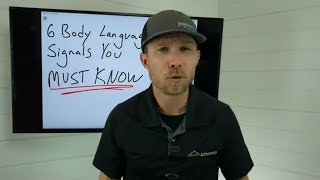
Adam Bensman (The Roof Strategist) explains six body-language signals prospects display that indicate distrust (eyebrow raise, pucker, arm cross, half-step back, look-away, head tilt). He teaches salespeople how to spot these cues early, pause the sales pitch, and reengage by finding common ground, asking open-ended questions to give control back to the prospect, or (as a last resort) giving them an out. The goal is to build rapport and trust first, then establish need and value to win the sale.
Chapters
What if I told you that there were six very easy to read body language signals that your prospects were giving you that basically said this, I don't trust you, I don't like you, I don't believe you, and I do not want to do business with you. No be spooky. Right? So what would you do when you started to spot those signals? Well, you do what I'm about to teach you in this video to teach you to read people like a book, make a snap decision to change what you're doing in your pitch or reel that customer back in, take control of the sale, and if you do it alright, you'll walk out that home with a signature. Yeah, it's that easy. It's wild, it's simple. But you know what? There's a lot of statistics out there that show different numbers of how much of our communication is body language. And in this video, forget what number it Is, whether it's 45% to 70%. The point is this. These customers that are giving you these signals are doing so before they can verbalize them. And they may never even verbalize them because they're not comfortable. But these signals speak louder than words. And you may be wondering, Adam, how did you figure this stuff out? There's a combination of things. Number one, it started with direct experience. Reading people when I was in direct sales, understanding what they're doing, how they're saying it, what body language is going on, learning the hard way by failing and being like, man, I should have read that sign. No wonder they said no. So number one is direct experience. Number two, I, I learned it by being a silent observer in the home. Here's what I mean. I've trained salespeople all across the us I've been inside lots of homes. I have watched a sales rep present to a homeowner and I'm just a helper because I got a baby face. And that's what I do. Sit there and smile and watch. And having that third person perspective is incredibly valuable because unlike doing a sales call on Zoom, no one can record it. So I got an inside view into the home, watching what this rep says and watching how this homeowner responds. And the final one is reading books. And the book reading came later after, and it just validated this stuff. By the way, great book on that, Jack Schaefer's books, the Like Switch. Let's see. The Like Switch is really good. We also have his book called the Truth Detector. And then another good book that touches on this is Straight Line Selling by Jordan Belfort, by the way, I was very resistant to that book just because of, you know, him going to prison and all that. But there's a lot of really good stuff in there. And after I started reading it, which, by the way, I'm in the middle of right now, you'll see some overlap in our style, which is kind of cool. All right, so. So let's take a look at these six body language signals. How you can learn to spot them, how you can quickly course correct and then close the deal. First things first, I just want to say welcome back. I'm really glad to have you here. And if you're new, welcome. My name is Adam Bensman, the roof strategist, and everything I do here on the YouTube channel. The podcast is designed to fulfill upon one mission. And if you've been tagging along, what is it? It's to help you smash your income goals. And if you haven't done it, I'd love to get this in your hands to help. It's a free copy of of my pitch like a pro roofing sales training video library. Great for newbies, great for seasoned veterans looking to sharpen skills or break out of a sales slump. Owners, managers, growing a team. Great tool to put in the hands of your new hires to get them ramped up to speed in a hurry. Get your free copy right now over@the roofstrategist.com and there's a link in the description in both the podcast and YouTube channel. All right, let's get into them. Six signals, what they mean. Now, every single one of these signals means the same thing, and we are ultimately going to respond the same way. Spoiler alert. I'm going to be giving you that right now. And then we'll break down those six body language signals here in just a moment. So remember, all of these signals regard or excuse me, are in regards to trust or safety. As humans, we've evolved as an animal to seek safety and comfort. And whenever that safety and comfort is violated, people respond and their body language responds way sooner or even in lieu of communication, verbal communication. So these signs all mean people don't like you, they don't trust you, or they feel unsafe. So what do we want to do? We want to focus on building rapport and building trust. I'm going to give you a little bit of a teaser and I may mention this in other videos. I believe that all objections mean one of three things and I teach this in my objection strategy. It means they don't trust you, yet. It means they don't think they don't need you or a new roof yet or roof inspection or it's a money issue deductible or the price. Trust, need money. Now, funny enough, when we're selling, we need to knock down these dominoes in order. First we need to build the trust, then we need to establish the need. First is the need for the inspection, then the need for the roof replacement. And then we need to showcase the value to make the money issue go away. So build trust, establish need, showcase the money. Boom. Knock them all down, you win the sale. The hardest one is the first one, which is a trust issue. Every single one of these body language signals is a massive sign they're screaming at you that they don't trust you. So what you're going to do when you see each of these is you are going to spot them and say to yourself, it's a trust sign. Okay? And you're going to shift, you're going to stop selling, you're not going to talk about work, you're going to do one of three things. Number one, find common ground. I'll give you an example, actually, I'm going to save that example for later in the video. Find common ground. Find that thing that you can discuss a common interest, something like that. Two, focus on building rapport by asking open ended questions, okay? Open ended questions to get them talking as opposed to you talking. This shifts control. When they're defensive in their body language, flashing the sign, you're putting control back on them for the moment. And this really, really helps reengage them. So asking an open ended question to get them speaking again and feeling in control. And then the third thing we can do is to give them an out. Now this is my least favorite. It's the total backup plan. If nothing else worked, this one does run the risk of losing the deal. Which, by the way, if you're seeing these signs often, you may have already lost. But when it goes the right way and they become slam dunk deals, because by giving them the out, which I'll explain what that means in a minute, you develop a tremendous amount of trust. Just like when I teach in the closing strategy, hey, you know what, I just want you to know before I share how we can help, that you can choose anyone you want for this project, right? It's the illusion of control. And then we explain why, which is really a way to overcome objections like I need multiple estimates, I want you to eat my deductible, you know, give me your best price, all that stuff. So let's get started. The six body language signs all mean the same thing. They don't necessarily trust you, they don't like you, they're not going to buy from you. We're never going to get further if we don't establish trust first. And then what you're going to do is build rapport by finding common, excuse me, finding common ground. Building rapport by asking an open ended question and reengaging them or giving them an out. And I'll explain what that means here in a minute. So let's get into it. By the way, if you're on the podcast, this would be a great episode for you to tune in on video because you'll be able to see these facial expressions. So let's start with the eyebrow raise. That's number one, the eyebrow raise. The one we're looking for is the eyebrow raise where the eyebrows come up in the forehead scrunches. Do you see this eyebrow up forehead scrunches? Usually people won't make eye contact with you. They're looking around you, at you, but it's not like direct eye contact. And what this signifies is basically this. I don't quite know who you are, I don't quite know who, why you're here. I'm not quite ready to kick you off my property. Kind of curious what you have to say, are you? And then they start thinking and they're like, is he here to sell me something? And basically what happens is their brain impulse has fired, saying they're not safe, what's going on? But they're curious. They're curious to either validate meaning say I was right, this guy's here to sell me something and they want to close the door. Or they're giving the chance to be like, am I right about this? Am I not right? What's really the deal? What's going on? So the eyebrow raise with the forehead scrunch is a sign of temporary distrust, but not quite really at a full conclusion yet. But if you keep pressing, you're going to get that door slammed, metaphorically, whether you're at the door or the kitchen table. So the first sign is the eyebrow raise and at that point it's really good. The easiest way on this one is to speed up your pitch until you get to asking the open ended question or if you're in the middle of your presentation at the kitchen table to flip back control with the open ended question. And again, how or what, how do you feel about everything we've been talking about? How's this all sound? To you. Where are you at in the process? Any of the open ended how or what questions are a great way to reel back in control. So that's the first one, which is the eyebrow raise. Next, the pucker. This one. Maybe other people call it the pucker. I just gave you the names I use on my notes here. But the pucker is this, and this one is offensive. Okay? Who does that? Okay, let me try to really get into it. We've got whole face being pulled down, forehead's pulled down, eyebrows, mouth is coming in, nose is coming in. This pucker is a sign. It's like when you walk into a porta potty at a hot concert outside. It's that level of repulsion and I just wanted you to feel that. See, emotions are powerful, right? You got to experience walking into a porta potty when it's hot out. And that dank, disgusting smell just permeates your nostrils and you can almost taste it. Okay? That's how that homeowner feels. And you'll see this often at times, what it means. Excuse me, I shouldn't say you see this often at times, I'm hoping you don't. Oftentimes what this means is you said something that was offensive or completely unbelievable to that homeowner. And when they see that and you'll see, it's like sometimes this stuff comes up, you're like, how in the world was that offensive? And all you need to do when you see the pucker is to realize that it's just like this. Another analogy, it's the cat or the dog that, you know, throws their back up and cackles come up, they are on guard. They are instantly repulsed. There's something that you did or said that they don't believe, they don't trust, they don't like, but they didn't vocalize it yet. So when we see that happening, we need to ask a question. And by the way, one thing I didn't share before on the three ways, by finding common ground, asking an open question and building rapport, giving them an out to call them out. And you can do that by asking a question. Did I say something that was offensive? Okay, don't be afraid to do that one. But generally speaking, when you see that, it means that you need to focus on building more rapport because they don't believe you, they don't trust you. So again, find common ground, turn it and ask a question to get them engaged. Call them out on it. I'm going to say the giving them an out doesn't work for the pucker face, but I just want you to know what that one means. Next one, the arm cross. You'll see this oftentimes from men. Again, I hope this doesn't come across as being sexist. It's not. This is my experience. People express themselves differently. Yes, that's a blanket statement. No, you can't pretend that everybody acts this way all the time. My experience is women are more likely to give you the pucker face. It's a strong indicator that says, not safe. I don't like this. And then men give this one. It's the arm cross. And the arm cross is a power play. And I'm going to tell you a story about the arm cross. The arm cross is like this, and it often is coming with a chin back, chest puffed out. Total ego. This is a power play. This is me saying, you're on my property. What do you got? I'm in control. I'm only making my own decisions. You ain't going to tell me anything. You ain't pushing me into anything. All right, lay it on me. What do you got, huh? Yeah, this is my house. Okay? That's what that means. So the arms cross is often, again, more common in my experience, among men. Now, I want to show you in a real world example, I was out running this sales point with Keith, who's a subscriber. And Keith and I go to the door. I'm the helper for this. Once Keith's appointment, I'm just here to watch. And the property owner, the husband, answers the door, arms crossed, and he was squared up to us. And that's the big thing of the arm cross. When they're squared up. And I knew when someone's got their arms crossed, that is the number one indicator. You will not get that deal until the arms come down. I promise you, you will not get the deal. So I decided to kind of interject a bit, and I recognize the arm cross. So the first thing I do is I search for common ground. And I see a deer mount right on the shed right next to me. So I stop talking. We're doing our walk around, by the way, the house was smoked, doing our walk around. And I stop, say, hey, that. That rack up there, do you do any upland game or turkey or just. Just big game? Instantly, you should have seen it. Instantly, arms come to his side, and he walks side by side to start telling me stories of hunting. And we talked about the turkey hunting trip that I was going on the next week. When you find that common ground to get those arms uncrossed. Remember, as humans, we're protecting ourselves, right? So the arms uncross and all of a sudden he is receptive to having this conversation. It was wild. Alright, so that's the power of finding that common ground and connecting. And I did both. I found the common ground and I asked a question. Pretty simple. Alright, next is the half step back. This one is an indicator where people are one foot out the door. This one, if you ever see arms crossed with a step back or people kind of trying to retreat, you have a few options. Number one, cut to the chase. This is the best one in my opinion, to ask the open end question. Focusing on rapport. They want out, just cut to the chase. Ask a question to reel them back in and re engage them. If that doesn't work, your other option. This is where the give them an out comes into place. Hey, it seems like now is not a good time. When would be a better time for me to come back? Tomorrow morning or the following day? In the afternoon? So giving them that out and I know, I know, I know. Yes, you may lose the deal. But if they're trying to get out the door and you show respect because you and I both know there's nothing, no magic cure. When they're like, I'm not ready to tell him yet, I got to go, is he over with this? Is he over? And then before you know it, they're scooted out of the frame just like that. So what we really want to do is acknowledge this. Then they're like, hey, this person's kind, they're nice, they're trusting. And many people will give you that opportunity to come back. Alright, so the next one is the look away. There's two types of look away that we're going to touch on here. The first look away only applies when you're first at the door. And it's this one. The look over and around you. This is complete distrust. They are not paying attention. They feel that their safety is in jeopardy and you know what they're doing. Just that gesture, do you know what that tells you? Here's what it tells you. I don't trust you. I don't know you. Who else is with you? Is there anyone else that might come barging in? Am I in danger? That's what that means. All right, so be friendly, build trust. Focus on finding that common ground. Compliment their home, Ask the open ended question. Now. The other type of look away usually comes when they're in a sales appointment. They're further on in the journey and what will happen is they'll drift off the daydream. Best way ask an open end question. Hey John, how does all this sound so far? Even something simple like that. Hey John, you know after going through this, what are you thinking so far? This will instantly like that, reel them back in and capture their attention. Alright, you ready? Last one. This is the head tilt. The head tilt is often a head back with an inquisitive look. If people do this and they look down at you, this here, this. So I want you to bring this into dogs for a minute. Have you ever watched dogs when they start getting at each other like before the fight breaks out, they side eye, they won't make the direct eye contact because they're trying to avoid the full on. Like let's brawl. It's I'm on guard. What's your next move? You come at me bro, I'm getting you. That's what the dogs mean. And it's always the whale eye or side eye, right. And their face is oriented this way. So when your homeowner gives you the head tilt, chin up to the side, looking at you like this, that is a complete sign of distrust. You need to soften and really focus on finding that connection in the rapport and asking that open ended question. So hopefully now with these six body language signals that you can read, you're going to read people like a book. Knowing what they're telling you is I don't trust you, no I don't like you and no I probably won't do business with you. And you're going to spot them and you're going to take course corrections by building rapport. Asking an open ended question to give them back control and reel them in or in the one situation of the step away giving them an out if now is not a good time and respecting that time. Guys, there's also the balance. And gals, there's things that work in sales and things that align with your integrity and doing business in a human way, in ways you wish to be treated and and I will tell you I will always err on that side because I love to go home at night knowing that I took care of people the right way. Yes, I'm in sales but I follow my heart, I follow my integrity and I respect people. And yes, there's times that you can pressure your way into it. I know it, it works. People walk out the house with deals. I'm not saying it doesn't, it's just not the way I do business. And it's not the way I want to make other people feel. So now that we have them all, we're going to do a lightning fast recap. Number one, the eyebrow raise with a forehead crinkle. Okay, that's the one that we see first. Next is the pucker. Okay, the repulsive one. Next we have the arm cross and the power play usually squared up. We have the half step back, the retreat. Then we also have the look away, the inquisitive look away for safety and or the daydream look away. Then the last one is the head tilt and that's the very on guard. All right, now you know how to spot them. I want you to start using these in the field. If I missed any body language signals, drop a comment and let me know. And you know, last thing, just because our time here is about to end doesn't mean you're in my time eatsand in fact, maybe it can start and we can begin working together with you or your team in a more intimate environment weekly in a tight knit group. And if that's you, you may want to look at a pitch. Pro Movement enrollment opened, what is it? Last week and now through October 15th. There's a founding member lifetime discount that you may want to take advantage of. And in that group there's a private discussion board for salespeople and owners. Managers, you're welcome to participate. In fact, there's owners and they're participating as we speak. And through this discussion board is a place to turn for questions. I'm in there giving feedback as well. We have a role play center as well, so you can learn my role play style, even upload your own videos of you doing role play, maybe even practicing these six body language signals for feedback from me and the team. There's also a section to watch all of our recorded calls because we are going to be doing three live sessions together every single month. Three weeks on, one week off, Three weeks on, one week off. So I guess it might be even more than three in a month. In leaders and owners and managers, you're going to have a space, a private space just for leaders and owners in your own discussion board. And one of those calls is dedicated just to owners and managers once a month for us to roundtable together and talk through the difficult challenges of personnel and running teams and the things that come up and that may not be either appropriate or needed to have the team in. So whether you're an individual rep or an owner with a team, if you're looking for more work together if you're looking to get some sales performance mentorship or leadership mentorship and work with me and like minded people, that's what we'll be doing Inside the Pitch Pro Movement to fulfill upon the mission of smashing your income goals faster, easier and surrounded by like minded sales professionals. And again, that lifetime founding member discount expires October 15th. There's a link in the description. Thank you for joining me on this video. I'm super excited to see you using these six body language signs to spot them. Course correct, read people like a book, feel empowered, take back control and sign more deals that you would have otherwise lost. Thanks again for being here. We'll see you soon.









