They "Liked You" But Did NOT Buy From You?
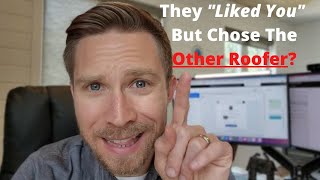
Adam Bensman explains why contractors lose deals even when prospects like them. Likability isn't enough. You need to identify a problem the homeowner recognizes, get them to own it, then prove you're the expert who can fix it.
Chapters
So they liked you a lot. They told you we liked you, but we decided to go a different direction. And you're losing deals hearing this and you're wondering, but people tell me people buy from people they like, people they know, people they trust, and if they like me, why didn't they choose me? And I mean, hearing this more and more, especially from the good guys and roofing sales people that are really trying to do right by customers, and you begin thinking to yourself, did I, what am I? What am I doing wrong? Do I need to be a hard seller? Do I have to compromise my ethics? I. Well, the answer is absolutely not. And in fact, the answer is actually kind of simple. So in this video, I'm going to share with you why you keep hearing this. We liked you, but we decided to go a different direction so you can get ahead of it and hopefully it doesn't happen again. Before we get started, I just want to say a quick welcome or welcome back. My name is Adam Benson, the roof strategist. Everything I do here on my YouTube channel and my podcast and my all in one sales training, sales strategy and sales system that's currently being used by thousands of people for both storm and retail is designed to help you and your team smash your income goal and give every customer customer in amazing experience. And in order to do that, we got to win the business. So when we're hearing people reject us even though they like us, causes us to question what we do. So this video is going to be short, it's going to be powerful, but let's get to it. Why does this come up? The answer is here. Let's start with a story. Imagine you go to two doctors. Scenario you blew out your knee. It's unexpected. It was on the weekend, right? You blew your knee out. You find out you need surgery. You see the first guy, he says, yep, you need surgery. So you go for a second opinion, he says, you need surgery. You reflect and you look back on both appointments with both doctors. Doctor number one, he's brand new. He's done this 10 times. He was super nice. You both love the same football team, you both love to cook, you both have two kids, and you both love the outdoors and you both love hunting. You really, really connected. But the neck surgeon, he was someone you didn't necessarily like. In fact, your political views were different. You didn't have any common interests. He wasn't married, didn't have any K. But the thing that set him apart is he spent this time explaining to you exactly what was going to happen. He let him let you know that you were in really good hands because he's done this surgery literally thousands of times over decades. Now I want to ask you, which surgeon do you choose? The one that you like that doesn't have that much experience, or the one that you didn't quite like personally but was a professional and an expert? He was credible. He guided you through the process, and he had a lot more experience like, but don't like. The answer is pretty clear, isn't it? You choose the doctor who's the expert. And oftentimes we put too much emphasis on liking people. There's no doubt that it will help the expert if he was likable. Oh, man. These are, like, done deals. You and I know that. So what we need to remember is that although it's important for us to be liked, what's more important is to bring value. And I know this word's thrown out. So overused value. Bring value, sell a value. Believe me, I agree. I just think it's overused. So I want to break down. What exactly is value? How do we. How do we define what value is? And here's where I do. Number one, it's helping to clearly identify a clear problem. Oftentimes in roofing, this is problems that the homeowners did not know that they even had. Like, when you show up and they're like, my roof is fine on the storm side or on the retail side, by the way you get there, you know, my roof's fine. We can get three, four, or five more years out of it. So we have to identify the problem, and it's not that difficult to identify. Number two is the hardest one. Which brings us to number two. We have to get the homeowner to take ownership of that problem for them to describe the situation. Not for us. Not for us to go, Mr. Homeowner, roof damage, you got all this. And for help on that, I'm going to click to a card on YouTube here to a video I've done saying, never, ever, ever, ever tell a homeowner the roof is damaged. Okay. They'd be like, me going to you being like, you're an alcoholic. No. Only you're the one that can decide that for yourself. Because if I say that to you, you will not change. But if you take ownership of it, you'll change. Same thing about losing weight. And I apologize for being really forward here. I'm only sharing this because I quit drinking and I had someone, family member, be like, Adam, it's like 10, 30 I'm like, we're on vacation. Go grab me a beer, right? I didn't take ownership of what I found later was just not a healthy relationship with alcohol. So when I took ownership of that problem, I initiated change. And sales is. Is change. When someone buys something, they intend to make a change or to change something about themselves or their situation. People will not embark on this journey of change unless they take ownership of the problem. So number one, identify the problem. Number two is making sure they take ownership of that problem. Watch that video I linked to before. It's really going to help. And then the third thing is showcasing your credibility and expertise with your solution. Your solution, your credibility, your authority, your expertise. By the way, if you're using my car park closing formula that I teach in my all in one sales training, sales strategy and sales system called the roofing sales success formula, in the car park formula, I guide you through these steps. I guide you to connect and build that likability. But it doesn't just stop there. I guide you into identifying the problem with the homeowner, but also creating a really compelling case. I guide you to show you how to get the homeowner describing the damage to you. Then we go straight into overcoming the price or deductible objection. And then only from there do we then transition to that third piece I talked to you about, which is showcasing your value. Showing your credibility and authority in our presentation only comes way later and too many people are trying to sell themselves or buddy up first. We need to hit that before we explain how it works, before we showcase our expertise, before we showcase our social proof and credibility. And when we follow those steps, we then start closing more deals, which is what it's all about. So there you have it. The real reason that people say they like you but didn't choose you is because you didn't bring enough value. So your mission in summary is to one, identify the problem. Number two, get the homeowner to take ownership of that problem. And number three, provide an absolutely amazing solution by showcasing your credibility, authority and expertise. Just like the example with the doctor. Hey, that's all for today's video and I'm doing some new formats, so I'd love to hear from you if you like it, if you don't like it, if you want to see me back in studio. But I'm trying to create just casual content as soon as I think of it, to fire up this video and give you the messages that I'm coaching throughout every single day, whether it's in the pitch pro movement or with one on one clients or an in person trainings. I want to give you more of these little tiny golden nuggets. So I'd love your feedback because everything I do here is for you. So if you liked the video, give it a thumbs up and subscribe so you don't miss one. And if you don't like it, do let me know because again, everything I do here is for you. So as we wrap up, if you haven't yet done it, click here to get a free copy of my pitch like a pro Roofing sales training video library. If you sent right to your inbox or watch that video that I linked to before. That said, it's really going to help. And that's this one right here to never ever, ever tell your customer that the roof is damaged. We get them to tell us. That's all for now. I'll see you soon.









