Tie Downs? WEAK vs STRONG Closing Questions
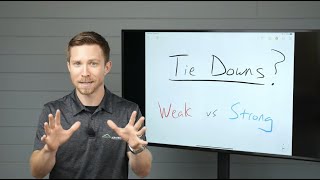
Adam Bensman breaks down tie downs, the sales micro-commitments that close deals. Weak ones feel manipulative and backfire. Strong ones repeat a prospect's own words back as a question, so they sell themselves instead of you selling them.
Chapters
Tie downs in sales are one of the most common tactics taught to get yes agreements from customers. And in my opinion, which I'm going to tell you now through this disclaimer, is not popular opinion and many people will not agree with my viewpoints in this video. That is okay. I actually invite and encourage disagreements and conversation in the comment section to help you strengthen your position because at the end of the day, you got to do what works for you. So in this video, I'm going to be breaking down tie downs, the weak versus strong tie downs, when to use them and how to use them. And before we get started, for anyone who might be newer in sales or newer to the roofing industry, and you don't know what a tie down is, a tie down is a micro commitment where you are getting a yes or an agreement throughout the sales process that indicates to you that that customer is following along and literally bought in and agreeing with everything you have to say, essentially mirroring back to them, you, here's what's so amazing about what I can do for you. Right? Yeah, it is. And then now all of a sudden that homeowner is yes nodding and they're bought in and they're agreeing with you. And the theory is you do this enough that when you get to that final ask, people can't help but say, oh my gosh, you are just so amazing and brilliant. Where do I sign? And that's kind of the philosophy of how it sold. And I know, I know that was a bit dramatic, but I keep finding in my own experience, seeing through a sales process. Do you know what I mean by that? Seeing through a sales process. When you go through an experience and you just feel like you're being sold, you can pinpoint they're doing this, they're trying to manipulate that this doesn't feel natural or organic. That's what I mean by feeling or picking apart that sales process or that what's being trained the salesperson. And it doesn't feel good. In fact, Sheena, my wife and I have sat through sales appointments and she'll literally like nudge me under the table, like, here we go again with his yes track of nonsense. So you guys would really like this, wouldn't you? You think this would really make your lives better? You think that your home value would go up. Do you agree? All these things sitting through cheesy solar proposals and furnit sales, car sales, you name it. So I really want to break down the core concept. What is a tie down? How do we use it effectively? And then where do people go wrong? Where it becomes cheesy, where people feel like they're being sold and can kind of sniff through it. Especially because today's modern age buyer is smarter than ever before. They've been exposed to more sales and more sales tactics than ever before. So we have to be a bit more authentic and we have to have a deeper understanding of the psychology so we can integrate it in a more subtle way, but an even more powerful way. Thanks for joining me today. My name is Adam Bensman, the roof strategist. And everything I do here on this channel and in my podcast and in my roofing sales success formula, which is being used by thousands and thousands and thousands of people in every US state, is designed to help you and your team smash your income goal and give every customer an amazing experience. So to help you out on that journey, if you haven't yet done it, head on over to the roofstrategist.com right now. There's a link in the video description and you can download a free copy of my pitch like a pro roofing sales training video library to get instant access to every video I've ever done, organized by category for easy binging, training and sharpening your sales skills. Alright, now let's get back to it. We're going to talk tie downs. Weak versus strong. Let's first hit the weak. This is. Here we go. Weak tie downs. These are what I'll classify as the obligatory yes. Okay, so a lot of times people will use questions like this. Here's an example. I show up at the house, we're doing a presentation about water filtration. So you'd agree that drinking clean water is safer for your health? Oh yeah, it is. And you'd rather drink reverse osmosis water than chlorinated chemical water, right? Oh, yeah, Yeah, I would. And you'd agree that there's really no cost for your family's health and wellness, right? Oh, of course, yes. So you again, you're seeing this like idiotic track of putting words in someone's mouth. They're obligatory yeses that no one could say no to such a statement. Tie down attempts throughout the sales process are incredibly weak. They insult people's intelligence and then homeowners feel it because they're like, well, why the hell are you asking me if I agree? The answer is obvious. I would be like, nope, I prefer brown stagnant water with, you know, fly larva floating on the surface. No, no one's going to say that. So these weak obligatory yeses in These tie downs really just, in my opinion, are more harmful than helpful. Next, on the weak tie down, I am going what I'll call a statement tie down. And I've seen people use these specifically at the end of a sales process. So you see the value in how we can help you do this, right? Yes. So you see how important it is for us to be on your side through this process, Right? So those type of statement tie downs are forceful, that we are forcing our opinion. You know this, you've told me this before, please agree with me. Again, that's what comes across. And yes, I know I'm animated, I'm dramatic, but I'm trying to get that point across to you of how it feels to be on the receiving end of a statement tie down, where you're being commanded of a viewpoint or reminded of something you said. Well, before we were talking, you understood why you'd want to own your electricity and not rent it. Right. By the way, classic solar tie down, alright? Using this statement and using words that they've used previously, especially when that was also a leading statement like would you rather own or rent your electric? I'd rather own it. So you'd agree before that you'd rather own your electricity, you're going to rent it? Yes, yes. And that's part of these tie downs that people use. And again, you're using both the obligatory yes, you're putting words in people's mouths and then the statement tie down is darn right forceful. So there's how I believe that tie downs are more detrimental than helpful. And now you're probably thinking, well, Adam, if you're such a wise guy, what are the best tie downs? Now let's start with the disclaimer. When I say best, this means this is my opinion and my experience. This does not mean that I'm preaching the gospel. This does not mean that what works for me is going to be the exact same thing that you need. So I want to give you this disclaimer when I say the best, that's what's worked for me and the many thousands of people I've trained. Do I have all the answers? No. Do I learn every day? You bet I do. So if you disagree or agree, let's just keep it professional here where we can all benefit from each other, your disagreements and your things that you maybe agree on or maybe something I missed. So share those in the comment section below. But my final disclaimer is this experiment with everything you learn here. That's the beauty of sales. Prove it. Right or wrong for yourself and either way it will strengthen your position in the last piece. I know I've said final a few times, but I keep thinking of final, final things. And this is the final, final one. And then we're going to get to it. If it ain't broke, don't fix it. If what you're doing is leading to success, I'd be an absolute moron to tell you otherwise. Fair enough. Disclaimers aside, so we can get into it, this is what I believe is the best tie down. And this is a bit more advance to teach. So this is going to be a tie down where we get the homeowner to continue selling themselves. So the weak tie downs. All we're looking for really is a yes agreement. Come on, pen, here we go. Is a yes agreement. Alright, that's really it. I just want to get them saying yes. But what I view the best tie downs are is when we get the homeowner, get them selling themselves. Okay, now what do I mean by this? I'm going to show you an example. This is the outcome that we're looking for is getting them to sell themselves. I don't care about a yes. I'm going to give you the obligatory yes if you ask for like clean drinking water. But if you said to me, if I said throughout the presentation, you know, hey, I really would love that filtered water, man, the taste that comes out of my tap. I would just absolutely love to not have to use my refrigerator each and every time. Okay, so if I said that, and I'll bring this back to roofing in a second in a water filtration sale. And I said I would love to not have to go to my fridge instead of that tie down saying, so you'd like clean water, right? Yes, that would be the weak tie down that's taught in the mainstream. Instead, what I'm going to do is repeat back what the customer told me in their words with a question mark or an inflection at the end. So you'd really love to drink out of the sink and not go to the fridge. Do you see that? All I said is I repeated back. So you would like to do this without going to the fridge with an inflection and a question mark. Do you know what's going to happen? The person who hears that it's an invitation to elaborate without even thinking twice. That prospect me in this case would say, yeah, because my fridge tap runs so bloody slow that I have to sit there, open the fridge door. Because by the way, we did the water inside? So we'd say, have more shelf space. I have to stand there in the freezing cold fridge for about two minutes to fill a water bottle. That's a trickle. And I absolutely can't stand it. So what did I just do? I sold myself. I continued to focus on my pain and frustration of dealing with the water in the refrigerator. So what's a better tie down in this experience? So you'd really like to have more convenient water? Yes. Or getting that customer like I just did, breaking down everything in more detail. So there you have it. Let's break it down to different steps here. Step number one. Oops. Come on, Pen. Step number one is to repeat back what they said as a question. Repeat back as a question. And I want to give you a few examples in the roofing world. Okay, so if I said to a homeowner on a storm claim, hey, you know what? Your roof is about 18 years old, and I recognize that we're kind of on this fringe in terms of damage that I would say it's. It's marginal. There's a chance it could get approved. There's a chance it doesn't. Best case scenario, though, you get a brand new roof, which you're going to need anyway, and it's going to save you from coming out of pocket to pay for the whole thing yourself. So we could use this as an opportunity, you know, an unfortunate opportunity to turn a bad situation into a favorable outcome. Meaning you get a brand new roof, brand new warranty. We can pick new colors. You can upgrade the look of the home, the curb appeal. So when you drive into the driveway, you look up and you're like, I love it. And then the homeowner interjects and says, oh, my gosh, I would love to get a blue roof. I think that pop of color would be absolutely beautiful in the neighborhood. The new paint we put on and the shutters would shine. And what am I going to say instead of, so you'd like to get a new roof? Yeah, that's a weak tie down. I'm going to say. So you'd like to go blue? Oh, blue. I love blue. Because no one else in the neighborhood has blue. And the new shutters, the orange, oh, it's going to feel tropical and look so cool and fun and vibrant. And now this customer, simply by repeating back what they said as a question. So you like to go with the blue roof, means they're going to continue selling themselves. So to wrap this up, what you need to do is listen very closely. For the exciting thing, that little emotional spark that flies from the customer that they get excited about. Wait, you can handle the whole insurance process. Wait, we get a brand new warranty. Wait, we can pick a new color. Anything that gets them excited, you get to lean into, rephrase it as a question with an inflection and watch as that customer continues to sell themselves and give you more and more information that's going to help you just dial your presentation to exactly what they want. So there you have it. My unpopular opinion on tie downs and how to use them. Agree or disagree? Drop a comment in this comment section below and let's chat about it. And thank you again for joining me here today. If you haven't yet done it, I would love to make sure that you catch every new episode. We're putting on some new shorts as well, so hit subscribe to the channel so you don't miss a thing. And if you haven't yet done it, get your free copy of the Pitch Like a Pro Roofing Sales Training video library right here and I will see you on the next one.









