Your 1st Second at the Door and What NOT to Do
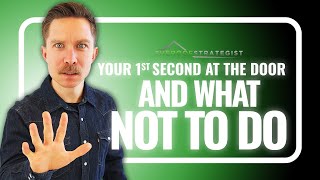
Adam Bensman breaks down the first second when a homeowner opens the door. Master a five-signal sequence: smile, eyebrow flash, chin tilt, bladed stance, and a one-second breath. These moves disarm, comfort, and build trust before you say a word.
Chapters
What if I told you that you had just one second at that door that's going to make or break whether or not you have that conversation and you can even start to pitch. It sounds pretty crazy, but in door to door sales, when we can learn to master the initial impression, that split second, the first second at the door, this can lead to having 1, 2, 3, 4, even 10 more conversations a week. That's getting on a lot more roofs and stacking up to probably 5, 10, 15, 20, even 50 additional sales each and every year. And that's the beauty of sales. When we master what we say, how we communicate and how we interact with others, we can literally begin stroking ourselves. 5, 10, 15, $20,000 a month in checks, all from changing how we communicate. And as you know, communication is far more than just verbal, it's more than the words we say. So in this video, I'm going to dive deep into giving you a tactical strategy to master your very first second at the door to make door knocking easier and to help you start even more convers. Welcome or welcome back. My name is Adam Bensman, the roof strategist, and I'm really glad to have you here. Everything I do here on this channel and on my podcast is designed to give you the tools and resources that you need in order to smash your income goal and give every customer an amazing experience. And when I got started in this business back in 2011, we didn't have stuff like this. So I'm just so excited to be able to share this with you. What I wish I had to help you fast track your success. So thanks for spending your valuable time with me. Now let's get to it. Your first second at the door. First I want to take you, you on a little journey, an exercise to put ourselves or to put you in the mind of your customer. Because by deeply understanding our customer, we can then engage in the best way, knowing what they're thinking, to connect more deeply. And that's really what it's all about. So what is your customer thinking when you show up at 6, 30 at night and do that? Alright, now put yourself in your shoes. You just finished dinner with the family, you moved over in the living room and you sat down to watch some TV together. And then all of a sudden you hear it. There's a knock on the door, you get up, you turn to your wife and you have that inquisitive look like, who is that? Are you expecting anyone? Am I expecting anyone? No. So the two questions go right in your mind. Don't they who is this and what do they want? Why are they here? And those two questions are in their mind as they get up off the couch. You get up off the couch and you walk to the door and answer the door. So we know right away when that door is open, that homeowner does not recognize you. They don't know who you are, why you're there. So immediately there's a flood of distrust, right? A flood of wondering who you are, are you safe? Are you trustworthy? Why are you at my house? And our immediate mission is to do these three. These three things. Number one is to disarm the customer. Basically say, no, no, no, it's okay. I'm not here to hurt you. Because again, I know that's a dramatic explanation, but the truth is, that's what people are thinking. Remember, we are human. Human animals by nature. We are animals, all right? We lose sight of the fact that we still have these survival instincts and safety in our own safety is one of them. So we have to disarm them and say, hey, we're good. Number two is we have to make them feel comfortable, comfortable with us. People are only going to engage with someone that they're comfortable with. And then number three is to begin building trust. And these all go hand in hand by again understanding what they were thinking at the door. Who is this and what do they want? And then learning to disarm, create comfort and trust. Now, how do we do that? I'm going to share it with you in a second. But first, before we do, I want to cover a few key things not to do. These are some of the biggest mistakes, okay? Not to do. Do not do this. Not to do. All right? Number one not to do is do not tower over everybody. Okay? Do not tower over anyone. Now, those of you who have met me in person, I'm a pretty small dude. I'm a small statured guy. My wife used to say, adam, the reason you did well in door to door, especially with stay at home wives, they'd answer the door and size you up, say, I could take you because I'm not that threatening. Meanwhile, I was training a guy named Troy, who's like 6 foot 6 and he's a monster and built like a. Like a brick house. And when he stood too close to the door, that person who answered felt like they were being towered over. And it's again, threatening. So does that make people feel comfortable or trustworthy or trust you or disarm them? No. In fact, it reinforces the safety signals, saying I feel threatened. So be mindful of your size and in your stature and do not tower over anything, anyone at the door. Okay, Number two is do not square up. Now what do I mean by square up? I mean standing square. So you see me right now shoulder to shoulder, squared up versus talking to you like this, which is feeling more comfortable and friendly. If we were to engage meeting out versus this, we don't go out with our friends and grab a beer and stare at each other. It's just unnatural. So when we square up, it's a very aggressive and forceful and not friendly nature. So always make sure to have your stance bladed with enough space. And then the third thing is, do not talk instantly, okay? Do not just jump right into it. Sometimes the minute that door is opening, we are just like word vomiting our pitch to them. And I had someone reach out the other day. It was a comment, I remember, on Instagram. By the way, you can followstrategist on Instagram. Love to see you there. And I post little stories. We just did it behind the scenes of this video, in fact. So someone commented either on Instagram or on YouTube saying, hey, Adam, do you talk first or wait for them to talk? And the answer is, it kind of depends. I give people that little window and this short window that I'll be breaking down for you in a second is really going to help. Alright? So we don't want to talk instantly and we don't want to jump right down their throat. Okay, now we on the same page, ready to move into the tactical pieces. Let's do it. Okay. What you should do this is how to maximize that one second, your very first second at the door. Number one, you're going to laugh at me for this one is to smile. Now, the reason I'm covering this is because it is so critically important to friggin smile to be happy, to make other people see your joy. An authentic smile. Not a cheesy smile, okay, that's forced, but a real smile that engages your forehead, your eyes and the corners of your mouth. All right? I cover this because for some reason there's a trend. Someone's going to hate me for saying this, but I'm saying it. Sometimes men are the worst at this. They get too serious and I swear it's like a comfort thing. They'll answer the door, they'll have this very serious face on like, I'm here for business and I'm here to tell you exactly how I can help you, ma'. Am. And it's going to be very heavy. And straight to the point, and it's just like super threatening and not really fun. And people, again, does that help disarm them? When you're the straight shooter, serious guy, no smile a little bit. You have to check up from the neck up. Gosh, Bill Sansom, I know that's a. He shared that saying with me, and I know that's been a saying circulating the world for a while, but I just. I love it and I heard it from him recently. And I want to show you. Check up from the neck up. All right, so next, beyond smiling is to use the eyebrow flash. You've heard me talk about this, hopefully, in the other videos I've done on body language. The eyebrow flash. Okay, one of those. See my forehead? The eyebrow flash is kind of the international signal. And I shouldn't have said international. I haven't traveled every country in the world. I don't know how they do things there where we're knocking doors, we can safely say it's the international signal. All right? The international signal of safety. Your friend walks by, okay, if you're in conversation, you see that familiar someone in the background, we kind of just do that little eyebrow flash. We see someone we know, and it's a signal of, hey, I see you. I'm friendly, what's up? It's a really inquisitive and inviting gesture that people read and understand, even if it's not conscious. So again, person one answers the door with a burrowed frau. They're serious versus this. Who do you like more? Duh. We're going to put this all together here. In the end, the next thing is the chin tilt. Okay? Chin tilt. Or some people call it the. The. The head tilt. But I call it the chin tilt. Why? Because the chin comes up. So we put it all together. Smile, eyebrow flash, chin comes up. By the way, I can't even separate them because I just do this naturally all the time. It's like my instinct when I meet people. And the reason I do that is it makes people feel good. It puts them at ease. It disarms them. And you'll be amazed at how much softer, more natural random conversations are, whether it's with a hostess at a restaurant, a server, customer service, checking in on the airlines, trying to work your way up into a better seat when you're about to take off on a flight. So all these little gestures really disarm people. And then the fourth thing is, is to blade your stance and leave space. So blade, stance and leave space. And you know what? I'M going to throw in one more. Okay, this is the one second breath. This here, this is the beauty by the way of doing these videos in one take because they don't always go well. So we shot this one and I left this one off and I'm really glad that we get a chance to bring this in because this one second breath is what's going to buy that time for you to let this message you sent that homeowner. Yeah, I said it. The message. These little, these four little body language signals to sink in, disarm them, create comfort and trust before you begin pitching. So I'm going to first show you what not to do and then I'm going to put all five of these together so you can see them. Okay? So the first one, what's not to do? I'm squared up, I'm straight faced and I'm too close to the customer and I say and I start talking instantly. Hi there, my name is Adam and the reason I'm here today. Okay, so that's the experience number one or experience number two. I've created some space, I've bladed my stance. The door is going to open, I'm going to smile, I'm going to do a chin raise. Alright. I'm going to furrow my. Excuse me, I'll lift my eyebrow with the eyebrow flash. I'm going to take that breath and then I'm going to start talking. So again, putting it together. Hey there. Hey, my name's Adam. Do you see the difference? Do you feel the difference on that one second? Now when you do this, it very well might feel like an eternity, but I promise you, it really isn't. What you've done is disarmed, created comfort and trust by giving them space and sending the right signals to them that they interpret completely unconsciously. And the stuff works magic. Now practice this on the very next door you hit and I promise you it's going to help you develop confidence, settle into the quiet nature and learn how to send those right bodies language signals to maximize your very first and most important second at the door. Hey, thanks for joining me in today's video. If you want to continue our time together, I got a few options for you. First, if you're interested in learning my complete canvassing strategy and my all in one sales training and sales system, it's everything not to close. I'd love to chat with you about it. There's a link in the description. They'll bring you to the website. You can learn everything there. But maybe you have some questions, you can call our office. This will reach our team and someone on our team be able to help you out. It's 300-322-27133 and again there's links to those in the description. Now say you want to join me for more videos. Option 1 click right here. Get a free copy of my pitch Like a Pro Roofing Sales Training Video library. All the videos I've ever done, organized by category, sent to your inbox. Or stay with me here and let's hang out on YouTube. Click here on this video and I'll see you on the next one.









