Why My Clients Stayed For 5+ Years (for Personal Trainers)
Adam Hayley explains how personal trainers can keep clients for 5+ years using gamification and milestone rewards. He breaks down how to structure client journeys and incentives so people stay engaged and motivated long-term.
I had online fitness clients that stayed with me for more than five years online, and I want to show you exactly how I did it. I'm Adam Haley and I've helped over a thousand gym floor pts get fully online and hit consistent 5k months. So when it comes to online fitness coaching, most coaches tend to lose their clients around months three, four or five. It's really bad. And it's the reason that most coaches never truly grow in income because they're constantly having to replace their clients every handful of months. When I was coaching, I had clients that were with me for 1, 2, 3, 4, 5 plus years. And the only reason that I stopped coaching these people is because I end up, of course, launching my mentoring of coaches. And while there are a ton of things that I'm going to teach you in terms of retention over the coming weeks on these videos, I'm going to pick one thing right now that I'm pretty sure you're not doing, and that is gamification. So here's how I look at it, is when somebody signs up to us, they have a start point. You know, whether that's a certain level of body fat that they're out, whether it's a body weight, whether it's a dress size, whether it's, whatever it may.
Be, they ultimately have a starting position.
That they want to get away from. And at the opposite end of the spectrum, of course, they have a goal that we promised them. Whether it's a certain weight target, whether it's a certain strength metric, whatever it is, they have a dream outcome that.
They would love to get to, that they're going to be really happy with.
Once they get there. Now, the issue is that for most people, for them to get from A to B, it feels like quite a long way. And it might actually be a long way if you've got a lady that.
Comes to you that is weighing, you know, 80 kilos, for example, and her dream is to get to 60 kilos.
That's going to take a while.
So rather than overwhelm them with this.
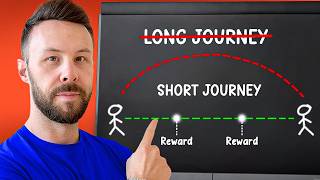
Long sort of journey across here, I prefer to shorten the gap and add some gamification in along the way. Here's how it looks.
Instead, we're going to draw a line.
From A to B and then roughly.
About a third of the way there, there's going to be a moment that's.
Going to stop them on their journey and kind of reward them. And then from there, let's say, another.
Third of the way down the journey.
There'S going to be another milestone, another moment along their journey that's going to break it up. So what ends up happening is instead.
Of them having to do this big.
Long journey, we can actually effectively shorten the gap. So I'll show you.
What I mean visually is instead of them having to, you know, go all the way down to here, instead we chunk down this part of their journey. We then reward them here. This part of the journey again is nice short and chunk down. And we give them a reward here. And then this part of the journey of course is chunk down.
And their reward is actually by this point they're at the end goal. So what do we do at each of those checkpoints? I like to break them up into.
Having a process based checkpoint and then a performance based checkpoint.
So when it comes to the process based checkpoint, we basically want to break down what are the actions that if this client does enough times will help move them towards their goals.
It could be a certain amount of check ins completed. It could be a certain amount of MyFitnessPal entries. It could be an amount of gym sessions.
So workouts.
It could be a total amount of.
Steps over a long enough period. Let's pick workouts. So what we want to do is we want to try and determine what, what is the amount of workouts that if they were to do it would take them just about past where a client would naturally drop off. So let's say that right now your average client tends to drop off right after month three, so that's 12 weeks. Now let's say that for them to hit their goals, you believe that they need to be training three times per week on average. What we can do is we can set up a little checkpoint, a little notification so that when your client hits 36 workouts, which would be the equivalent of three workouts per week across 12 weeks. So once they've completed their 36th workout, they're going to receive some form of gift recognition celebration from you. So let's add that in.
So we're going to do 36 workouts completed.
What you now want to have a think about is what's the gift, what's the incentive for them? And there could be tons of different things that you could do here. It could be that they get more one on one time with you. It could be that they get a hoodie, they could have a set of glute bands sent to them, a supplement care package, your favorite book. It really doesn't matter what it is, it doesn't have to cost a lot. It's just something that's going to give them a pat on the back for, hey, great job. You've just done 36 workouts. And the reason that we're doing this.
By the way, is because it will.
Be really easy for somebody to start this journey in this long journey at the top and get to around here and then go, I'm not seeing much progress, I'm going to leave. But instead we've shortened down this journey. They've got a short way to go, They've hit this 36 sessions that they've done, they've got this pat on the back, they're fired up and they're ready to start chasing down the next checkpoint. So now we're into performance and this could be setting a certain body weight squat, a bench press, a hip thrust, a certain run time, somebody's first pull up. It's really up to you to have a think about what sort of performance metric suits and what is going to have them sort of hedging their way down this track. And towards that end goal for a.
Guy it might be to do either a 100 kilo bench press or it.
Could be like a 1.5 times body weight squat. Ultimately your job here is to have a think about what is the process metric that if they hit X amount of times will move them further to their goal but still will shorten down that journey and probably take them three or four months to complete. And then secondly, what's the performance based goal that again if they hedge towards it and they hit it is going to give them a larger chance of getting to their end goal and it's also going to just spread out this journey and keep them fired up throughout. To help give you some ideas and put this into perspective, I'm going to run you through like what we do within my business. When people come to us, they are.
Typically at zero online clients and they.
Don'T have any online coaching business. Once they've been bitten by the bug, they're into momentum or often we get.
It fed back that at this point they really want to start building a.
Team and chase down like 15, 20, 25k plus months. And just like on a client's big.
Fat loss journey, doing this can feel.
Like it's going to take a while. So what we do is we chunk down the process. Checkpoint one is that we want to.
Help get them to their first 3k.
Per month and when they do that.
We get a hoodie sent out to.
Them with a handwritten note in the post. I know it might sound really basic, but these hoodies, they can't buy them. They have to be earned. It's only those that have hit 3k through the OT that get these hoodies. They're a really cool like black on black design. They say get shit done. They have the two arrows from our logo involved in them. Our students love them that much that they'll wear them to webinars, they'll bring them to our in person events and God forbid if they ever lose their hoodie, they do actually message us and ask us to send them a replacement. It really means a lot to them.
The next checkpoint is for them to hit their first 5k month and that brings an invite to the Inner Circle.
The Inner Circle is a smaller program, so the OTE is our core program. The Inner Circle sits above it and it's all about helping people start to build a team and then get them towards those 15, 20, 25k months. So they get a nice invite into there. They get a custom care package sent to them in the post that has some books and suggested reading, nootropics and so on.
Then you guessed it, there's another checkpoint and this one is when they hit their first 10k and I send them a bottle of my favorite champagne.
And then we have one final checkpoint.
Which is for them to hit 20k months. And then that gets them an invite.
Into Founders board, which is again a much smaller group. We do private dinners and so on. Now the only difference between my setup and yours is that you'll realize on yours I've suggested some sort of process based metrics and that's because we, we don't really want to have a client just chase body weight targets. I think you and I can agree that that will probably really annoy them when they have their fluctuations, start attaching their value to their body weight and so on. It's probably not a good rabbit hole to go down. So while we use revenue outcomes for you, I would break it into a process based goal and then a performance based goal. That way the client's not attaching themselves and their outcome to a certain number on the scales. Now the final piece to the puzzle is really, really important and that's that you want your entire client base in the community to know about these milestones. You want them so that when somebody comes into your program, they're aware of it and they're indoctrinated into it in day one. So that when they see somebody hit that first, whatever it is, milestone and wear that hoodie or get that that T shirt or get invited to this event, whatever it may be, this person's made it. So that's what we have is when somebody sees another OT student wearing that get shit done hoodie, they know they've hit 3k. When somebody sees somebody at an inner circle event, they know they're doing at least 5K. When somebody sees them at a founder's board dinner, they know that they're doing at least 20k. And it has the whole community sort of like heading in the right direction with each other. If you don't have any gamification at the moment. If right now a client signs up here and they're expected to get to here and that might take them 6, 9, 12 months. It's a really long journey. Look at starting to chunk it down and make the gap between each stage shorter and then give them a pat on the back and then and celebrate them at each checkpoint and milestone. And while we're talking about delivery, I've put a video together that shows you how to do better check ins from keeping clients engaged and actually wanting to check in to them. Getting better client results and then ultimately staying with you longer. You should go check it out here.