Anupam Rastogi: Navigating Venture Capital, AI, and Innovation in Q4 2023 #216
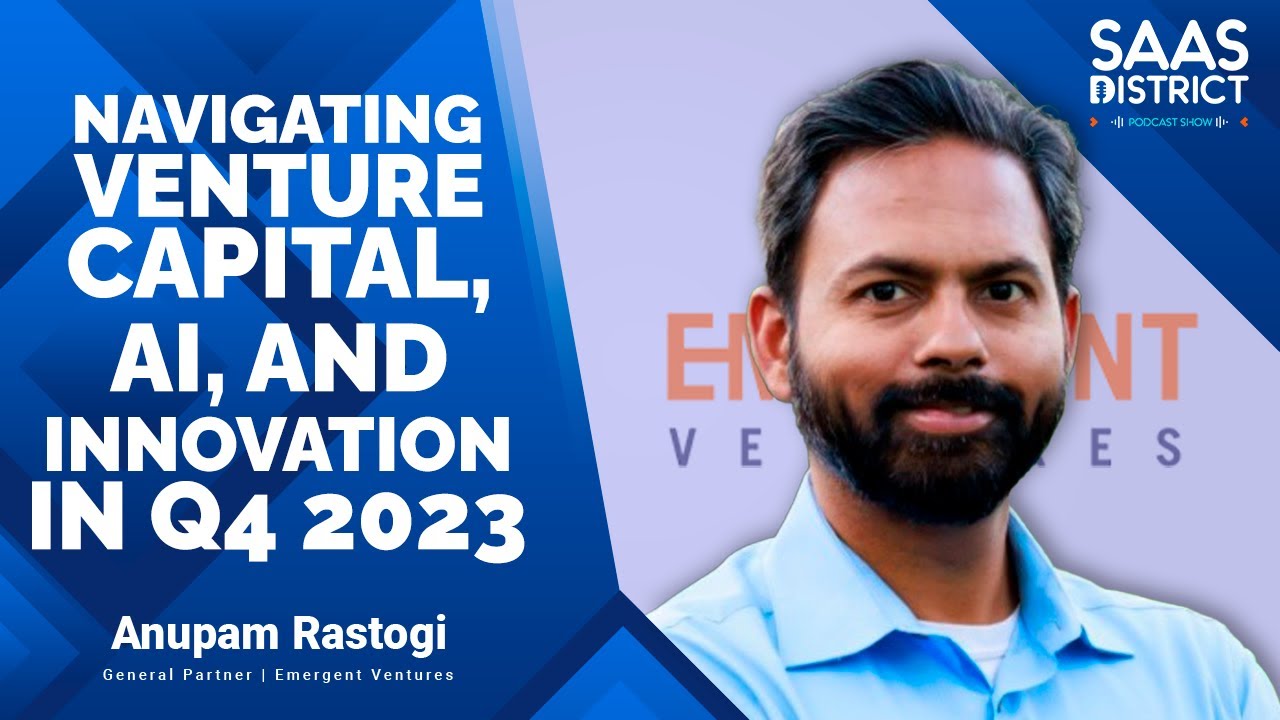
In this SaaS District podcast episode, host Akeel Jabber interviews Anupam Rastogi, General Partner at Emergent Ventures, a seed‑stage VC firm focused on AI‑powered SaaS and enterprise infrastructure. Rastogi reflects on how AI sentiment in Silicon Valley has shifted from early hype to a more measured phase, noting that while a few niche segments still see "gold‑rush" valuations, overall the market is beginning to rationalize. He outlines the firm’s investment thesis, emphasizing that the founding team is the most critical factor, with traits such as vision, perseverance, growth mindset, ambition, balanced optimism/realism, and integrity. Emergent Ventures operates remotely, often investing without meeting founders in person, and supports founders through network introductions. Rastogi predicts a normalization of venture capital after the 2021 boom, expecting fewer but more long‑term‑oriented investors and ample capital for ambitious AI startups. On AI’s impact on work, he argues AI currently augments knowledge jobs rather than replaces them, and the biggest winners will be those who quickly adopt AI tools and continuously upskill. He envisions “100x engineers/marketers” accelerating product development and lowering costs for end‑users. For founders seeking funding, he advises deep study of fundraising processes, learning from slightly more advanced founders, and focusing on market size and a clear path to $100 M ARR, rather than early revenue. He also describes the minimal traction expectations for pre‑seed (often zero revenue) and the importance of extensive customer discovery. The episode concludes with rapid‑fire questions revealing Rastogi’s personal flow activity (running), advice to take calculated risks early, his definition of success (helping five teams reach $100 M ARR), and contact information for pitching Emergent Ventures.
Chapters
Hello, hello everyone. This is your host, Akhil Jabber, and welcome back to another episode of SAS District. In today's episode, we'll be talking about navigating venture capital, AI, and innovation going into Q4 2023. Today we have our guest, Anupam Rastogi, joining us. Anupam is a GP, general partner, at Emergent Ventures, which focuses on seed and early-stage ventures, including in transformative AI-powered SaaS and enterprise infrastructure companies. They invest at pre-seed, seed, C+, and post-seed rounds across enterprise and B2B software, including application SaaS, cloud, data, infra, security, vertical SaaS, and dev tools. Over the past decade, Anupam has led or played a substantial role and over 20 successful tech investments globally, ranging from early to expansion stage, and has had several large exits. So welcome, Sven-Erik. I'm super excited to have you on the show today.
Glad to be here. Thanks for having me.
So we chatted a little bit before the episode recording that you mentioned you've been investing in the AI space since 2010, and you're obviously based in Silicon Valley, but I'd love to hear from you, you know, with boots on the ground in Silicon Valley. What's the current sentiment in Silicon Valley about AI compared to, you know, 10 years ago when you started?
Yeah, like you noted, I worked on my first AI-related deal in 2010, and then at Emergent, we've been investing exclusively in AI-powered SaaS businesses since 2016, and we are investors in about 40 SaaS companies across the board, application layer, infra layer, and actively investing in the AI space for the last 6+ years. I'd say, how does the sentiment look today? It's a tale of two words. And in some segments, some subsegments of AI, for certain kinds of founders, for certain kinds of businesses, it almost feels like 1999 or 2021. But those are very few segments and certain scenarios. I think broadly we are past the peak of the hype cycle. It feels like both overall but also, you know, within the LLM and AI space, we saw a very significant spike in interest over the last 12 months or so, especially after ChatGPT came out and people started to think about the application infrastructure around it. And now it's time, I think, for delivering some actual real value. And, you know, of course, we've seen a lot of prior cycles as investors and also as operators and notably, you know, things like mobile, social, cloud, but then also autonomous vehicles, AR/VR, crypto and others. And some of these have panned out very well, you know, areas like mobile and cloud and some others maybe not as much yet. We do think, you know, AI is here for the long term. I think it's going to transform a lot of things as we know it in the way work is done, how we live our lives and beyond. So yeah, if you're building something of value and have the right dynamics around what you're building, the level of ambition, interesting market, I think there's ample capital right now in Silicon Valley for the AI.
I mean, there's also seems from some of the recent deals that have gone through in the AI space, valuations are at an all-time high. I mean, people are asking kind of whatever they want. Seems there's a lot of hype and and excitement around this space. Are you guys also seeing that in terms of the valuations you guys are seeing for the AI companies being launched?
Yeah, I'd say in a small subset, a very small subset of companies of a certain kind, that is true, where people are seeing this as, you know, almost a gold rush that's going on and you want to be there at the ground level of that or at some level of that. And for the right types of companies, you know, folks have seen You know, the valuation of OpenAI and others skyrocketed in the last year or so, and they don't want to miss that. But I'd say, you know, some of that happens at the beginning of a cycle. We are starting to see, I'd say, in the last couple of months, some level of rationalization coming in. And I'd say a lot of the smarter investors already made a lot of the AI bets before this current, you know, mania. that started about 12 months back and are being pretty judicious about thinking about where's the real value that's gonna be created and applying true filters of, hey, can this really, is this something of very high value to a large set of customers? And then, you know, pricing things based on that and taking calls based on that, I'd say. But yeah, certainly I think there's certainly a set of companies which are raising very large amounts at extremely high valuations.
Yeah, yeah, I wouldn't be surprised. Now, so, you know, having an idea, being in the, you know, AI market, obviously one important check of deciding to invest in the company, right? So you understand the market. The other side is obviously looking at the founding team. What do you guys typically looking at and helping you guys differentiate and understanding what is the ideal founding team or founding founders you're looking at when it comes to early-stage VC investments?
Yeah, at the stage we come in at, I'd say, you know, the founding team is by far the most important factor in our investment. And that's, that's, you know, along with, of course, the market and how attractive that is. But yeah, we spent a fair bit of time trying to really understand the founding team. And I'd say I'll give you what StableStake's first very quickly. Of course, it's about the big vision, being able to have that reality distortion field around the vision and make things happen around that.
Mm-hmm.
Just smarts, ability to put in the hard work, communication and stakeholder management ability, ability to convince your customers, investors, employees to join you. And then of course, depth of understanding about the problem that you're solving, either through prior domain expertise or through just sheer hard work and talking to a lot of customers and building depth about a space. That's table stakes. You have to have that, I'd say, to be up and running. In addition, I'd say what we look for and I look for at Emergent is also a lot of things on the softer side. And I'll give you a few of those.
Okay.
And one thing we look for is, you know, is this someone or a set of people that are learners on a strong trajectory of personal growth? Because no matter what you're building, you will— if you are to take this company from where you are today to, let's say, $100 million ARR business in 7 years, there's going to be a lot of things you need to learn. And that's not just in the domain or in the specific technology, but also a lot of softer skills of being able to lead people, being able to manage very large organizations and other things. So we try and support us we want to see evidence of people having done that, where they've gone in and learned things that they haven't done before. Second would be really, you can call it great resolve or perseverance, which I think really separates out a lot of companies that end up winning versus those that don't. Every startup that I've been involved with that's had a great trajectory eventually has gone through some really hard days and entrepreneurs that are able to persevere through that and find ways out of that, those are the ones that we end up seeing as the big public companies of today. And there were oftentimes equally worthy competitors at the same time that just gave in at some point. Third would be really ambition for building a venture-scale business. Again, in our case, we're really looking at that ability to get to that and desire to get to that $100 million ARR. And you know what, I think in today's world there's more 20 million, 30 million, 50 million potential ideas than there have ever been at any point in history.
Right.
And that can be a great outcome for a founder, but we're looking for those who are really singularly driven to keep going beyond that and build that $100 million ARR+ business. And then I'd say fourth is a balance of optimism and realism. Founders have to be really optimistic people inherently, just like investors. But at the same time, someone blends that with a dose of realism when they know something is not working or what works, what's not. Being really— that's what enables you to hone in into that product-market fit and know where things are working and where they're not. And then last but not least, I'd say one of the most important pieces is integrity. I think that just goes— that's, I'd say, all the others are factors which there's a scale for those and some combination of those. But I'd say integrity is one which has to be there. That's a must-have from our partnership perspective. And that includes, of course, the obvious stuff that, you know, that there shouldn't be any fraud and things like that, but also making sure, you know, there's no overreach. And also, I think, includes things like, which relates to the previous point of knowing when things are working, when they're not working, and where they are at, being able to recognize where things are today. So those are, I'd say, yeah, it's a long list and a mouthful, but That's actually a set of things.
That's a, that's a great list. I mean, the only issue with some of those you mentioned, I mean, I completely agree with the whole list, but some of them are harder to see, you know, when it's just a pitch deck and a presentation, right? Then a lot of these take time and, you know, you're taking that risk that, you know, hopefully you'll see it. Hopefully you'll see those as time goes on. But yeah, if they have that track record, then it's easier.
Yeah. So that's, those are areas we're trying to get some sense of during the few weeks typical process that we engage with the founding teams and we encourage them to do the same with us, evaluating if we are the right partners to work with them because, you know what, it's a long journey. If things go well, this is a 7 to 10 year journey and you really have to— so yeah, we do spend some time getting to know the founders and try and pick cues on some of these softer side skills or the softer aspects as well.
And can you go maybe a little deeper on that? What does that mean in terms of getting to know them? Are all the founders you're investing in, you know, locally in the Silicon Valley area, or, you know, if they are across the US, do you go there and spend some time with them, or do they typically come down and you expect that, you know, you know them in person, or has it all been, you know, still very virtual in assessing that?
You know, one interesting fact is that we have been very remote-friendly at Emergent Ventures since day zero. So since before the pandemic, since 2016, We've actually made multiple investments without ever meeting the founding team in person. Of course, that's not all our investments, but we are pretty happy to invest without meeting in person. But that doesn't mean we're not spending time. So we do spend a fair bit of time on Zoom calls and both directly with founders, but also, you know, we facilitate meetings for founders with folks from our network who could be relevant as prospective customers, prospective hires, advisors, or others who know the space. And often we'll sit through those meetings and that's a great way for us to learn more about the business, make us smarter on the business, but also get to know the founders and for them to get to know us. And but yeah, to answer the other part of your question, all of our companies are US market-facing because that's where we specialize, that's where we can help them the most. But we do have founders who are building in other parts of the world and we do like that a lot. Founders are able to leverage talent pools and other emerging tech And they're really passionate about building a Silicon Valley company over time that can scale in a venture style, then we can work with them.
Makes sense. So, I mean, not very ideal for bootstrapped or lifestyle type businesses, but the ones who really want to shoot for the moon and can leverage teams across the world. I guess that's always super valuable, right? So I guess better leverage of your capital.
Yeah, yeah. I mean, some companies can be bootstrapped. In our portfolio, we do have some companies which were bootstrapped in the early days up to a certain point, but at some point they decide that, hey, look, now we've found some level of early success and now we want to raise, we want to get on the venture path and switch gears, accelerate growth, and aim for the moon. And that works well for us as well. And there's some others who just decide to start a company on day zero and they know it. that they want to build a venture-scale company and invest in those companies as well, of course.
Where do you kind of see the venture market, the VC space in general, likely to head in the next few years compared to the last 10 years or so?
Yeah, crystal ball is always hard, you know, but let me give you a sandwich. I think 2021 was, of course, one of the hottest venture markets that we have ever seen, probably the hottest venture market because '99 was a much smaller market. But, you know, the impact of tech across business and all aspects of our lives, I think that just continues to increase rapidly. And that's a long-term, multi-decade thing. And that's here to stay. So I think 2021 was a lot of the zero interest rate policy era, which fueled a lot of that surge in capital. Market is definitely a lot slower right now. And but, you know, 2021, that attracted a lot of tourists into the market in terms of investors. I think everyone wanted to invest in startups and raise funds. And but, you know, this is a hard business. So I think we're going through a much-needed period of cleansing or, you know, just more normalization of the market. And I think that's really good both for the venture market and for startups because I think after this period, what may happen is that we may have fewer firms, fewer folks investing as the tourists leave. And I think who will be left standing would be folks that are really long-term oriented and in it for the long game, the entrepreneurs. So I do feel, I think, given what I said earlier, that, you know, sort of this multi-decade trajectory with AI, LLMs, and many other technologies just going deeper in our lives. And there's a lot of risk capital. The world has seen a lot of returns. So I do think there'll be normalization where venture activity will pick up, and we're starting to see some green shoots around that. I don't know if it's too early to call it, but as of at least Q2, a lot of companies are reporting a bit stronger performance now compared to the previous 3 quarters before that, both in the public markets and private markets. And we are seeing a lot more activity in venture, especially in the AI and LLM space. So I do see being a more normalized market, and I do think there's going to be ample capital for ambitious entrepreneurs who want to build transformative companies. I think there's going to be ample capital in the next few years. Yeah.
And when it comes to AI, there's a lot of conversation around understanding of how it'll replace— be replacing jobs. So, you know, what kind of jobs do you foresee the AI will be replacing, and will it, and who will be the biggest winners and maybe biggest losers from that outcome?
Yeah, good question. I'd say the filter I'd put on it is— or let me start with the prelude that the current era of AI is very good at augmenting what humans do. For most knowledge jobs, it's not that great yet for completely replacing what a human does end to end. So as a result, I think humans and people in the workforce who are able to use AI tools to do their jobs better, faster, stronger, more efficiently, they are going to thrive. And companies are going to do a lot more with less over time. And you can pick pretty much any function, you know, whether it's sales, marketing, customer support, customer success, operations, finance. In all of those, you'll see people who are able to use the best-in-class tools and deliver a lot more with better judgment, with better results. And they'll be the people who are using the latest and best-in-class of AI tools. And that's going to happen. I'd say there's not a single function or single industry I can think of. I think there's going to be temporal differences. Some functions like marketing, sales are adopting AI faster, potentially customer service being another one. And some, some industries, for instance, may be a little bit slower with regulations or just other reasons. But over time, if you take a 10 or 20-year view, I cannot think of an industry or function where AI will not be very heavily used to some reasonable level. So I think the winners and losers would be, I think, the folks, the people that really adopt AI who are very malleable and are continuously on the lookout for what's next in this space and how they can take their craft further, they are the— I think they are going to do really, really well and they're going to be most sought after. I think generally, and that applies, by the way, to companies as well. I think in each industry, each segment, companies that are able to leverage AI to get ahead and think forward, they're going to do well. And vice versa, folks that are slower to adopt, I think they're the ones that You know, may not do as well.
I mean, I think things like, you know, prompting, learning prompts, and kind of managing the AI, maybe a stronger skill, right? Just like learning, you know, Excel or Microsoft Office. But I mean, wouldn't you say that's maybe just a, you know, 5-year skill that would probably fade out into some other, you know, as the kind of AIs adopt and evolve? You know, prompting is probably the biggest thing right now, but I wonder, you know, what do you kind of see That's kind of the next thing that you need to understand to be able to manage an AI effectively.
Yeah, I'd say, you know, the prompting may end up— my view is right now prompting skills may end up being relatively temporary because I think the engines will get smarter. And so you won't have to be as smart in writing the prompt. Engines will get smarter in really deriving the context and what you want. And also, I think a lot of specific workflow software is being built as we speak, which abstracts that out. It abstracts out the prompting. So, you know, salesperson writing lots of emails which are personalized and, you know, which is taking a lot of data that you already have with people that you've interacted with in the past, and it's able to now write emails to those people like a human would or like you would. So there are tools. which do that, which are already, you know, there. There are similar tools in customer service. So again, you can pick any workflow, there are tools being built. So I think people that are able to identify those tools and be able to leverage those and focus their energies on, you know, one level higher on tasks like, you know, on judgment, on the actual interface with the person and other innately human skills, I think those people are gonna do better. And so I'd say, yeah, prompting is a very important skill in the near term, but longer term, I think just that ability to be malleable and that ability to learn new softwares, continuously tracking what's the latest best-in-class software in your field that's coming out and be able to adopt it quickly. I think that's pretty key.
Yeah, and it makes sense. I mean, still the soft skills are still yet to be able to be replaced, right? But then, you know, the productivity is going to be, you know, unbelievable here. Well, what do you kind of foresee as happening in the market when we have, you know, 100 times the engineers and 100 times the marketers who are now using AI and leveraging that to be, you know, impressively productive in the workforce?
Yeah, I think that's a good question. I think— I do think we'll see that. We'll see the proverbial 10x engineer becoming the 100x engineer with the right tools. And I've actually written about this, and we'll see 100x marketers and 100x salespeople. And I think what may happen is, you know, there's a lot of work to be done in a lot of companies. And if you ask any employee in a large company, and I've been in those shoes, both in both larger and smaller companies in the past, there's always a list, a very long list of things that can be done that you want to do. but there's just not enough hours in the day and enough cycles to do them. So a lot of those things will start to get done faster. And I think in general, companies and work will start to move faster. More projects will get done because people are being more productive. So if you just take software, I think the pace of creating software will just continue to increase at a faster pace now because software is getting written faster. We were just, I think, constrained by how long it actually took to write all those lines of code. But now a lot of the basic software is getting written by all these copilots, and the smart engineers and architects can really focus on the architecture and the actual design. And then also others in the product team can focus on the business cases and all the other things they had on the roadmap. The roadmaps just get accelerated, and these are in the end just able to deliver more value to their customers. So I'd say that's the— so I'm definitely glass half full. on this one where I do think at least in the near to midterm that there's enough and more things to be done which will get done by these proverbial 100x engineers and marketers.
Yeah, I just wonder if they're, you know, if they're getting 100 times the results, are they getting the same value or compensation, right? Or is it just, you know, I feel maybe just me squeezing more out of less as well, right? Where you're using tools, but, you know, maybe humans don't get the same output that businesses do, right?
Yeah. And what that might mean from a business and then eventually customer perspective is that if businesses are able to create software and products for a lot less, the beneficiary in the end is the end customer of those businesses, whether it's another business or the end consumer. So we've seen this broadly, tech is deflationary and in a good way where makes more things accessible to a wider set of people if it can build more things faster. So I think we will see that impact, that we will see more tools, more software, more newer products being available to people at a lower cost as a result of this. And then more things will get built, which is how I think we've seen the world in the last 30 to 50 years for sure, with the internet era and the tech era, and then before that with other kinds of products.
Yeah, like the— this is kind of the Industrial Revolution, but in a different sense.
Yeah, yeah, exciting times. Cars became cheaper, you know, the whole world drives cars now, but, uh, you know, no one drove a car 100 years back, or very few people did. So I think we'll see a lot more of that where a lot of things become affordable.
Uh, yeah, flights as well.
Yeah, a lot of things.
Yeah, those— yeah, not a bad thing. Um, So last question here, Anupam, before we get into the rapid-fire questions, which is, you know, if I'm a founder looking to pitch you guys at Emergent Ventures, what can I do to improve my startup pitch for most likelihood of success in raising with you guys? And then what types of companies are you seeing that are able to raise successfully from you?
Yeah, I'd say, you know, the Biggest game changer from an investment, maybe just 10 hours for a founder that's looking to raise, can be just studying the process of fundraising in a little bit more detail. And I'd say I'm happy to go into some areas on this, but there's actually a lot of resources out there now. And I think today's founders are fortunate, you know, just 10 years back or 15 years back when I started in venture, there weren't actually as many resources. But today there's so many podcasts, so many blog posts and others which are available that if someone just takes 10 hours to read the best content on fundraising, that can be the best use of their time. And there's a lot of different things, some of which I've written about, many of which I talk about around how to run a process, around how to specifically Talk about your market and how attractive that market can be, how to talk about your product, how to spread out those first 30 minutes that you get with an investor in terms of your pitch, in terms of time allocation. How do you create a specific process rather than just being a— creating it with a time-bound, milestone-bound process versus just a thing that doesn't have a specific timeline? I'd say, yeah, that would be my suggestion, just taking 10 hours, reading up a lot of things, and maybe speaking with a few folks. And one thing I recommend actually to founders is speak with 5 to 10 successful founders who are just half a stage or one stage ahead of you. Of course, talk to people that have done an IPO if you can, but the most helpful advice often comes from those that are maybe 6 months, 12 months, 24 months ahead. So if you're raising a seed round, talk to someone that raised a seed and maybe someone that raised a seed and Series A, and maybe talk to 5 to 10 of those people. And then if you already have some investors, then Definitely talk to those. And I think that can be the best investment of time at the stage where you're going out for a fundraise is just learning more about fundraising if you haven't done it before. Yeah, excellent, excellent advice.
So, you know, you're helping companies find product-market fit. They haven't found it yet, but they have some traction. Are there some specific metrics or traction that you're looking for that people can be aware of and mirror against to see if they're a good fit with you, what you guys offer?
So we actually invest as early as, you know, pre-idea stage, if you want to call it that, but certainly PowerPoint stage. So we do not look for a certain level of revenue. I'd say our median company has close to zero or zero revenues at the time we invest.
Okay.
For us, it's really about the founder and the market. And I think we spoke about the founder a little bit earlier, the founding team. And on the market, it really has to be a market which we think is, or over a period of a couple of weeks, a few weeks, can get to an understanding, a deeper understanding of that market, that there is a potential opportunity here to build a $100 million ARR business in the next 7+ years. And there's a lot of many different subcomponents to that. But in a nutshell, I'd say that that's what we're looking for. And there's no real traction criteria, especially for a—
Makes sense.
pre-seed round. And then of course we do seed and post-seed round as well. So there we are looking for some level of, especially post-seed round, we're looking for some level of customer traction. It doesn't have to be revenues necessarily, but we do look for founders who've gone and spoken with a number of customers. And so this is an exercise which a lot of great pre-seed founders have also done. With, you know, it doesn't take a product to go and talk to 30 or 50 prospective customers these days with LinkedIn and the era of data. You can, if you know, you know how to write cold emails or use your network, you can go and talk to 30, 40, 50 people in your target persona and collect enough feedback from the market. And if you distill it well, that I think is a home run at that pre-seed, seed, sometimes even post-seed stage. If you've done that and have a pretty nuanced view. of what's the state of the art today, how are, you know, what's the pain point, what are customers using today, who's the exact champion or sponsor in the org chart likely to be, are they likely to pay, why would they pay, what's the ROI. If you form a view on that, that's what really moves the needle, I'd say.
Yeah, that makes sense. Cool. This has been awesome, Anupam. Are you ready for the rapid-fire questions, second part of the show?
Sure, bring it on.
Yeah, yeah, ready. All right, love it. Uh, what's one activity you, you enjoy outside of work, looking at deals, investing, that, that gets you into flow state?
Yeah, if I had to pick one, I'd say for me it'll be running, which I don't do as much, uh, anymore as, uh, I like— I'd like to. But yeah, certainly I'd say if I, you know, anything over a half-hour run, that puts me into that flow state and lets me reflect on things. Yeah, love it.
What's one piece of advice you wish you had known? And if you can go back, you would tell your 25-year-old self?
Yeah, one thing I'd say is take more calculated risks early on. You know, and I did some of that. But if I were giving someone advice, I'd say, do more of that. And I think there's obviously 2 aspects to that. Take risks, but take calculated risks. Early on.
Does it get harder later on, right? So I guess what's early on?
There's more ROI on those risks the earlier you do it. In the case of founders, for example, it'll be starting a company or going out on their own. So there's never a time where you're 100% confident that, hey, this is the idea or this is the time to jump in. If you are feeling the conviction, I'd say just, of course, on a calculated basis, if you think it's a good space, good idea that you're passionate about, and so just take the plunge and then things evolve from there. Yeah, makes sense.
What are some of the biggest challenges you're currently facing in order to continue to grow your firm, Emergent Ventures? Meaning, is there anything that keeps you up at night these days?
You know, we always, as seed investors, looking a few years out and at what's next and investing behind those kind of things. So, you know, we've been investing in AI for 6, 7 years or more. So, so yeah, it's always about, you know, what's next and intersecting with that and how can we help founders in that segment better early on.
Who or what are some of the best 3 resources? This can be books or people or mentors or people you follow in the space who have been most instrumental to your success over these last few years.
Yeah, I'd say too many to list. Lots of different resources, lots of different mentors, people that I've learned from, have been in the fortunate position to be learning from. I'd say probably the most I've learned from is the founders I work with and, you know, other investors that I work with. And then in terms of other resources on the web, I'd say it's an amazing time where there's so much insight that people are putting out on the public internet, especially across software space and for founders more broadly. A lot of actually firms put out very good content, including, you know, Iconiq, Insight, a16z, some of the larger platform firms, I think, are putting out great content. So which gives you a sense of what's sort of best in class and what's happening with somewhat larger companies. So you know what success looks like. And folks like, I think, SaaStr and Lemkin and others, they put out some good content on SaaS and early stage building and So I'd say lots, lots of different pieces of content, and I think evolves with time, the ones that I'm following and learning from.
What does success mean to you today, Anupam? You know, you've had great success as an entrepreneur. You're now involved and invested in over $100 million over the last 10+ years. You know, whether it's personally, business, financial life, there's no right answer. How do you measure what does success mean to you today?
Yeah, so this decade in the 2020s, I'm working towards helping at least 5 founding teams get to $100 million ARR. That's my personal goal. So I have 7 more years. I'm involved with about a handful of companies actively investing and hoping that I can help at least 5, hopefully more, get to that $100 million ARR this decade.
$500 million companies is what you're aiming for, and that's, that's your— Okay.
Yeah. From, you know, close to zero to that $100 million ARR mark. Beautiful.
Awesome. This has been a really interesting and great episode. Is there anything else you want to add here or to— for our listeners? And so where can our founders get in touch with you? Sorry, where can our founders get in touch with you, learn more about you, and maybe look to pitch their company if they're interested to work with you?
Yeah, absolutely. We always, you know, happy to hear from great founders. It's easy to look me up on LinkedIn and read up more about what we do on our website at emergent.vc. And my email is pretty easy to figure out. But yeah, my suggestion is don't add investor emails to Salesloft outreach sequences and do it impersonalized with 500 founders. Personalize the message. I read every email that comes in, every note that comes in, but I cannot respond to all of them. But I do read all of them. And if you personalize it and, you know, if your vision is compelling, then I think you can, you can get meetings with investors, including us.
Love it. Yeah. Say, say you actually heard the podcast and you heard it here. I'm sure you'll, you'll respond back at least very soon.
Yep. Yeah, that sounds like a plan.
Awesome. Awesome, Anupam. Thank you for your time. I appreciate you sharing today.
Thanks a lot, Akeel. My pleasure. Thanks for having me. Cheers.
Thank you all for watching this episode and joining SaaS District today. Don't forget to like, subscribe, and hit the bell for future episodes where we interview top leaders in the SaaS industry. If you're a SaaS company looking to grow and unlock the true value of your business, get in touch with us at Horizon Capital and myself or one of our consultants We'll provide a free assessment to help you get there and hit your goals. If you have any feedback or suggestions for this podcast, please comment down below and help us improve our content for you all. Thanks again, and see you on the next one.
More from Akeel



Get a mentor as soon as possible — and make sure it’s a mentor in your space.




Keith Gillispie: Why Most New Investors Fail & How to Avoid the Common Traps #250 | SaaS District



