Asia Orangio: How to Get Your First 100 Customers with Confidence and Clarity | SaaS District
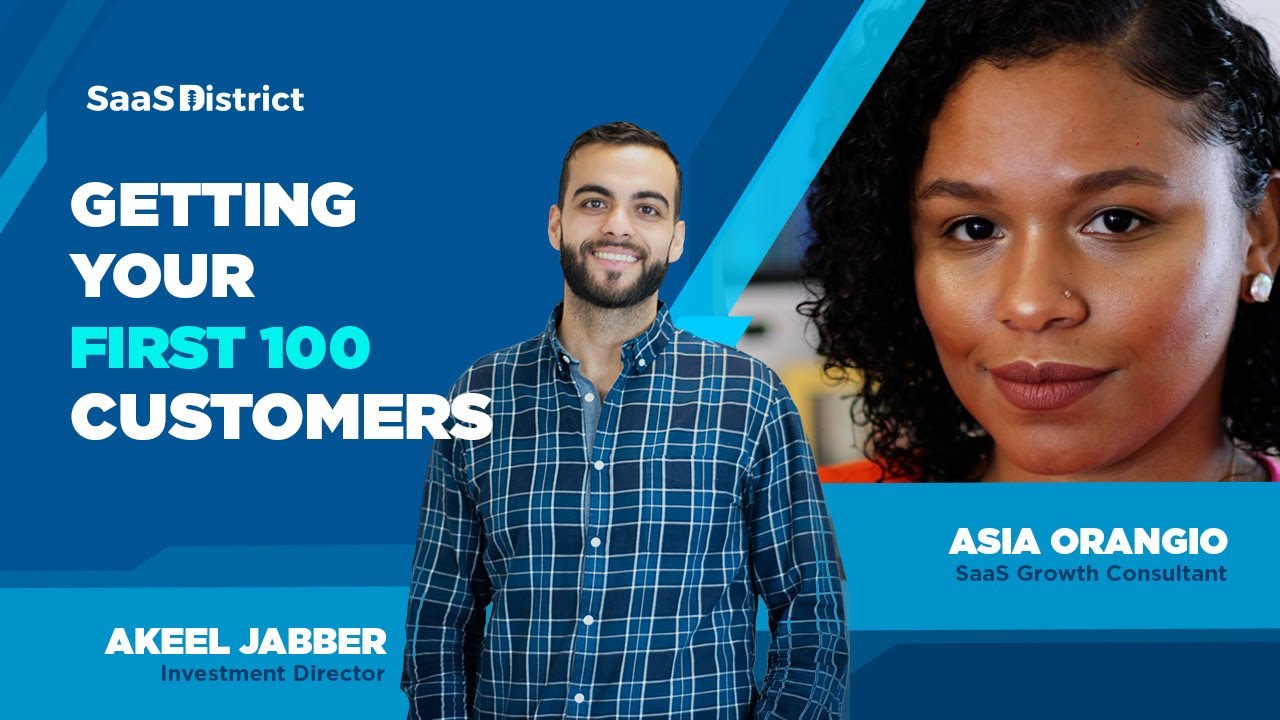
In this SaaS District episode, host Akeel Jabbar interviews Asia Orangio, CEO and founder of Demand Maven, to unpack how early‑stage B2B SaaS startups can acquire their first 100 paying customers. Asia defines demand generation as the discipline of building an audience of sales‑ready leads, distinguishes it from lead generation, and stresses that the channel mix (content, SEO, integrations, partnerships, paid ads) should be chosen based on product‑market fit, average revenue per user (ARPU), and target market. For pre‑revenue beta startups she recommends a customer‑development approach—direct outreach, phone interviews, and rapid iteration—to validate fit before scaling marketing funnels. Once a handful of customers are secured, she advises low‑cost acquisition tactics such as organic search, content marketing, and strategic integrations, while higher‑ARPU mid‑market firms can test paid channels (Google, Facebook, Instagram, LinkedIn) and balance free versus paid spend. The conversation covers common pitfalls (not knowing the ideal customer, building the wrong product), CRO benchmarks (CPL $4‑$80, 3‑month payback, 15‑30% trial‑to‑paid conversion, 30% demo‑to‑opportunity, 50% close rate), and tactics for improving freemium conversion (segmentation, activation, product gaps). Asia also highlights underrated growth hacks: founder‑led content, YouTube videos, and community building (e.g., groups, ABM communities). She explains her “growth roadmapping” service, which helps founders identify blind spots, prioritize experiments, choose go‑to‑market models (freemium, trial, demo), and create actionable plans based on resources. Finally, she shares practical advice for technical founders who shy away from marketing, urging them to start with simple problem‑focused messaging and to publish content wherever it’s easiest, then iterate. Contact information (Twitter @AsiaMatos, demandmaven.io) is provided.
Chapters
Hello, hello everyone. Welcome back to another episode of SAS District. This is your host, Akhil Jabbar, and on today's episode, we'll be talking about how to get your first 100 customers with more confidence and clarity. Today we have our guest with us, Asia Orandio, with us. Asia's career and business has been focused on working with early-stage startups and high-growth tech companies. She is an expert at helping SaaS companies define their go-to-market strategy, craft a data-driven approach to growth, implement marketing strategies and programs that help them win an audience in their market and beat the 90% of startups fail statistic, as many of you know. Asia is currently the CEO and founder at Demand Maven, or demandmaven.io, which is a company focused on helping startups either get their first 100 customers, which we'll talk about today, or help them get to the next stage in their growth of their— to their business. She is also head of marketing at Hull, an advisor at Atlanta Tech Village, and is currently a mentor at companies such as TinySeed, and growth mentor. So welcome, Asia. Really glad that you're here, and thank you for taking the time today.
Thank you so much. I am so excited to be here.
Awesome. Um, I know you talk a lot about, you know, demand generation, and I know some people may not fully understand that term. What does demand generation mean to you, and how can you explain it in simple terms for founders who have maybe less marketing experience? Maybe start with that.
Yeah, absolutely. I'll start with the very first kind of like over overview of marketing in general. I think what maybe a lot of founders, they definitely discover this as they start doing marketing on their own. But one thing that's very true about marketing is that there's actually very many different sub-functions of marketing and then also very specific skill sets and practices that you can have. And a great example of that is like copywriting, for example. Like you never think that you need to be able to do it well until you start doing any kind of marketing. And then you realize pretty quickly how fast it can drill down into being a master of just one thing. Demand generation is really a function of marketing. So I would say if marketing is the overall umbrella, demand generation is a pretty big function or practice of that. What it basically is in the most layman of terms is all demand generation says is build an audience of people who are most likely to become a paying customer of your product as it exists today. Demand generation is very similar to lead generation in that it's kind of like the squares and rectangles situation where one kind of encompasses the other. Lead generation doesn't necessarily guarantee that the leads that you generate are going to be people who are ready to buy. Demand generation is focused on sales-ready leads. Like, it's focused on people who are— they've got the pain, they've got the problem, they want to solve it specifically and hopefully with your product. So demand generation also doesn't really care about how you do this. I think that there's a lot of misconception that demand gen is just paid advertising. That's not necessarily the case. It just so happens that paid advertising is the flavor of the year or the flavor of the decade. Demand gen really just says like, hey, all you have to do is accomplish, you know, generating sales-ready leads, get them into your funnel in some kind of way. We don't really care how you do it so long as it You know, doesn't make your potential customer upset, and, you know, hopefully doesn't hurt anyone in any kind of way. So really, it's all about, you know, what channels do you have access to that's actually going to resonate with your target audience. But as long as you're doing that, you're probably doing demand generation in some kind of way.
Got it. Yeah, makes sense. Never heard it that way explained, but that makes it a lot more simpler for me to understand it. Now, a lot of these questions, we, you know, I think a lot of our audience You know, their focus, they work with a lot of, you know, B2B in terms of their focus, what their SaaS is about. What marketing strategy do you suggest for early stage? Let's say they're at a beta stage, maybe pre-revenue, to get, let's say, their first 10, 100 customers. And then how do you, you know, second question to that, how do you differentiate that when you're working with, say, the mid-market product? You know, they have product-market fit and looking to go from, say, $10K to $100K in, you know, MRR.
Yeah, absolutely. Okay, so what I find 9 times out of 10 is in the early days, the activities that you're probably doing to, to get those first 10 or even like 25 paying customers, it's probably not marketing in like the formal sense. It's probably much more closer to customer development and customer discovery. And the reason why I say that is because Especially if you don't really know if you have product-market fit. It's actually really, really, really hard to build an entire growth and marketing function on something that you're not even sure if it's going to be profitable for you in the end, or if it's actually going to generate revenue, or if it's even the right product. So what I find really works for businesses in the very early stages, maybe they are in that beta stage and they're kind of considering either launching like full-on beta or offering a free trial to the market. I actually recommend doing the customer development kind of work. So getting on the phone with prospects, generating prospects through— it looks like sales on paper, but really you're approaching it from like a research kind of approach as opposed to trying to build out a bunch of marketing funnels and build out a bunch of things off the get-go. And this is really just to solidify if this is actually going to resonate with the audience that you were thinking of and also highlight any product gaps that you may or may not have. It's impossible to know though, unless you actually do that kind of, uh, development. After about like the 10 to 25, and I'm assuming that this is B2B, so if you're B2C and listening to this, yeah, it's a little bit of a different story. But if you're B2B and you've got that first 10 to 25, that's usually enough to know, like, just as a general litmus test on if you've got pretty clear product-market fit, or if you've gotta make some adjustments or focus on a very specific target market. But once you get to the milestone of 100 customers, that's where it's really all about expansion. And by this point, you probably have implemented some kind of marketing or growth strategy to actually acquire more of those customers in the first place. It's tough to say exactly what strategies or channels are actually going to work, but purely because it's really more based off of your average revenue per user. So if you've got an average revenue per user that's pretty small, then the cost to acquire customers needs to be as low as possible. Well, what are the free channels out there? Organic search. I mean, this is kind of where we can kind of dig into, uh, what the market overall and your landscape looks like. Uh, and then of course, on the flip side, if you've got a higher average revenue per user, maybe it's like, I don't know, $10,000 or something, then we're probably gonna look at sales. Um, that's kind of where like your place in the market and the product that you have and who you're ultimately serving So much of that really dictates your marketing strategy for you.
So let's get kind of more deeper into that last point. So what does that marketing strategy look like? Say you're focusing on your user base, B2B, say SMB. So you're, you know, low ARPU, low LTV, maybe, you know, all self-generated through your website. They come through a funnel, they sign up, very little inhuman interaction versus, you know, mid-market kind of businesses. Let's say, you know, over 10 employees or There's more kind of a longer sales cycle, maybe, you know, higher price points where they need more people. How does that marketing strategy change? Or what do you recommend anyways?
So let's say you're on the lower end. What I find from a strategic perspective, and this is really to be validated through customer research and through talking to existing paying customers, but 9 times out of 10, almost undoubtedly, we're looking at some kind of content marketing in some kind of way. Because you need to be able to acquire new signups, new trials, leads as cheaply as possible. Well, Google search for the most part is free unless of course you do paid, you know, Google Ads, things like that. But search in general, organic search, these things are— it's a free channel. So if you need to acquire customers as cheaply as possible, you're almost guaranteed to be looking at content marketing in some kind of way. Beyond that though, there's likely some larger, really like go-to-market functions that you could look at. I wouldn't necessarily put them exclusively in the marketing bucket, but depending on what your product does, you might be looking at integrations actually as a channel where it's really all about building a product that is extremely sticky and has a very horizontal approach based off of like whatever pain it is you're solving. A great example of this is, I mean, it's used constantly, but something like a Dropbox or a Google Drive. Like, if your product is truly applicable to a very large total addressable market, then we're looking at strategies that, again, scale as, you know, far and wide as possible, and at the same exact time acquire people as cheaply as possible.
Mm-hmm.
I mentioned integrations, partnerships, co-marketing efforts. Again, think if it's free and if it really just requires time and effort, then those are the kinds of channels that, or practices that we're going to look at and implement and evaluate. On the flip side, there's the, like, let's say you've got like a much larger average revenue per user, comparatively speaking, or, you know, like you said, going to that mid-market place, you know, targeting SMBs. There's probably a little bit more of a balancing act between leveraging the more free channels and then leveraging channels that you can pay for. So if you're— if it's available to you to leverage paid acquisition, and that's typically something that we test, we, we identify, and if it's something that you can actually scale, then even better. The challenging part here is, of course, knowing just based off of your market if there are any true paid acquisition opportunities available to you. Google Ads, Facebook, those are the main 2 that almost every single business tests and tries. But beyond that, that's kind of where it really depends on the market itself.
So a couple of points there. So I know about what you said about the content marketing, SEO. You know, if you're— I think one thing about that is it takes time, right? Like, I know it's free, but also to rank and if you don't have domain authority, your site is new, it takes a little bit of time. So I think, and then integrations, I guess, would those two also work if you're working with bigger clients as well? Would you say that's effective?
Again, and this is kind of where so much of your product and your market does ultimately depend how you go to market or define it really, or influences it. Not to say that you can't stretch outside or beyond that, but Integrations could be something. It, again, it just depends on like what your product actually does and the kinds of pains that it solves for people. But I have found for, for SaaS companies that have like lower ARPU overall, but, but their product is remarkably sticky, like it, it probably— my guess is that it probably replaces a pretty big function or it solves a pretty big pain for people. But it just so happens that the total addressable market is huge in some kind of way, and that's kind of why the ARPU is lower potentially. But I find integrations have been an incredible channel for people because we find that, especially with SaaS products, when it touches other parts of a particular pain or problem that that customer has, it becomes another way for people to find you and discover you. Integrations is one thing, and again, this is kind of where it's like It's technically not free if you think about the time that you spend on it, but it's, it's something that, uh, some usually does not cost you anything unless of course you're looking at API costs, which different conversation.
Sure.
But, um, integrations, partnerships, uh, co-marketing opportunities in general. Are there influencers in your space who are talking about the problem that your product ultimately solves? Uh, building your own personal brand, building your own thought leadership. These are all things that take time. And I'm so glad you mentioned the time aspect because I find that when you've got a lower ARPU, your vision really needs to be 2, 3, 4 years out. Yes, like there's like the 2 and the 3-month kind of like goal setting and management. But I mean, ultimately you wanna scoop the entire market, right?
Yeah.
So you've gotta really, and this is true really for any business, but you've gotta really be thinking that 2 to 3 years timeframe of where you want to be so that way you can start investing in those things now.
Makes sense. And then you were talking about paid advertising for maybe the higher value ticket businesses. Other than Facebook and Google Ads, have you seen anything else that seemed to be successful or work well, especially for B2B startups?
Yeah. It's been so contingent on the customer base and the market. So like Instagram, for example, is something that has worked extremely well for some SaaS companies that have a very specific focus on like a very specific kind of customer.
Okay.
Instagram isn't necessarily gonna work for everyone, but depending on who your customer is, it could be an incredible channel because it's not, it's not as crowded at least as Facebook. And you're able to create the overall vibe of Instagram has, like it has a culture. And if that culture matches your customer, if your customer is there all the time, then of course that would make sense. But beyond that, I would say Google and Facebook are probably the top 2 places that you would test. Outside of that, again, it just really depends on your customer.
LinkedIn. I know it gets kind of expensive. A lot of people say it gets, you know, cost per click is what, 10, 20 times as much as Facebook, but it might be worth it.
It's super high, but it's also, most people don't live inside of LinkedIn. So unless like your prospect lives in LinkedIn, so like recruiting, for example, If you're targeting recruiters, LinkedIn could be amazing. If you're targeting people who, like college students, LinkedIn can be an incredible channel. Job seekers. Every channel has a particular context. The only thing that I've found to be relatively universal is search and, well, the biggest social media platform on the planet, which just so happens to be Facebook.
Yeah, makes sense.
But that said, I mean, I think it really depends on, again, like who that customer is and who you're ultimately trying to target and if they actually live there or not. That's really the big question.
Makes sense. So what do you see as the biggest mistakes that startups make in their marketing strategies?
Oh my gosh. I feel like this could be a book. The first one is one that we've kind of touched on, um, but it's, it's not really knowing your customer to the extent upon which you can confidently create a growth strategy. Uh, I find 9 times out of 10 in the early days, you're making guesses because you have to, like you don't really have a choice. Uh, but as you start to do that customer research and development, you start to learn who actually has the pain the strongest and who's willing to pay the most. By the time that you get to that 50 to even 100 customer mark, usually it's pretty clear on who is your absolute best paying customer. But knowing them like the back of your hand, knowing them as well as you know your partner, spouse, best friend, whoever, that's really the key I find to continuing to build like a marketing function that actually is revenue generating for you and just a growth function in general. Whether that's marketing focused, product focused, sales focused, whatever. I find that that's usually a blind spot that a lot of companies have. They don't really actually know if someone lives inside of Instagram versus Pinterest versus, you know, whatever, or what kinds of things they actually care about. Um, and, and what kinds of content or activities they actually want to participate in. What are their pains? What are— what keeps them up at night? Um, those are the kinds of things that I find when, uh, SaaS companies are able to tap into, when founders know like the back of their hands, they're able to create just incredibly, not only revenue-generating campaigns, but businesses that really last for a lifetime. That's one. I think, I think the second one, and this is really, again, just dependent on just like where you are in your journey, but, but I think not necessarily knowing what problem your product solves. I think that that's something too that, and it sounds so obvious to say, but it's actually really easy to jump right over that fence and to go straight into build mode and also marketing and sales mode without even really understanding, like, what the product actually does for someone.
Mm-hmm.
This can lead to building the wrong product oftentimes, uh, and also sometimes even focusing on the wrong market segment, even with the product that you have. I think that that's something that's, uh, it's, it's hard to identify when you're in it, but when you take a step back and you again go through that customer research phase, But then also, you kind of just, you know, clearly define what does the founder want to build? Like, where do they want to go? And where do the two meet in the middle? That's also something too that is a very common mistake in the early days, building the wrong product or not really understanding what it actually does for people.
Right. And that's where I think a lot of the failure, I think you said 90%, is just maybe they spend a lot of time or money, and they're just spending a lot of money and time on the wrong Problem, right? They're solving the wrong thing or just not tackling it properly.
It's shockingly easy to be a vitamin and not be a painkiller.
Yeah.
It's like just so easy. Ideally, you're a painkiller.
That was that core product, right, that you're actually solving. Yeah, vitamins can come later, right? Once you get the diet and the exercise in place, right?
Right, exactly.
Yeah. What do you find? So let's say you have a I don't know, let's call it $1,000, $10,000, the most effective or highest ROI marketing channel to focus on for a B2B SaaS, either short-term or long-term. So would you spend that $10,000 on content and you'll see the returns in a couple of months and in the long-term, or is it Facebook ads, or what do you find from your experience?
Yeah. What I have found has been variant just based off of where the business is in their journey and who the customer is. But I find, at least for right now, so like if I'm thinking about the context that we're in right now, well, I think many of us are probably still in quarantine and/or coming out of pandemic mode.
Mm-hmm.
I actually find that focusing on long-term strategy, to me, at least for right now, makes the most sense. Quick wins are going to be hard right now. And if you're listening to this at this time, then You know, you know that we're in an epidemic, pandemic, you know, wherever you're at. But quick wins are going to be really hard or challenging at least, and especially based off of whatever industry you're in. So my, my honest, you know, best bet right now would honestly be focusing on long-term. So long-term strategies are things that they obviously take time to produce, but content marketing is one of those. If I had the $10,000, I'd probably put maybe like 20% of it in some paid acquisition, but most of it would honestly be focused on building out content. Are there things that we're just not ranking for that we should be? Because when the market does ultimately bounce back, which we're assuming that it will, it won't happen overnight, but it absolutely will. You want to be on top no matter what, because I guarantee you that like the competitors aren't stopping. So to me, it's really all about long-term right now. So if there's a lull in the business, I would be focusing on if there are short, quick wins, let's identify those. But it's probably gonna be all about the long-term stuff right now. I put content marketing and organic search in that bucket. I also put partnerships, if at all possible, in that bucket as well.
Makes sense. Yeah. So a lot of people are kind of hiding and shriveling and cutting their ad budget or their marketing budget as the first thing. You're saying is do the opposite, like invest and in the long term it's gonna pay off and when everybody else is doing the opposite, right?
Yeah. Yeah. It's also, it's tough too because you obviously want to stay afloat. So if you do it because you have to, it's like, okay, fine. But if there's a possibility to not, I would say continue to invest in marketing growth because I guarantee your competitors aren't stopping. And if they are, then Then this is even like the time to overtake them.
Yeah, yeah, that makes sense. I want to go into the kind of the more of like a middle market where product market fit is done. And then now you're trying to optimize their conversion. So CRO, conversion rate optimization, you've built a funnel, let's call it, I don't know, going through Google Ads or Facebook Ads. Do you have some stats or numbers you can share on like what does an optimized Or, you know, well-tuned funnel look like for certain metrics or what they should be aiming for? Let's call it, you know, dollar cost per click, percentage to trial. I like getting into the nitty-gritty of these, you know, details, 'cause it gives you like a comparison of what you should be aiming for, you know, demo sales, qualified lead, paid user acquisition, all these numbers. Do you have any numbers you can share from what you've seen?
Okay, so I heard, I heard several questions in that. It sounded like the first part was something around CRO. So like, is, is there a process there? Is there like a framework there? And then the second part was, what are we seeing today? Um, so I'll, I'll tackle the CRO piece at least, um, to start. CRO is one of those things that, uh, when you have the volume, it absolutely makes a ton of sense. Uh, when you're like pre-product market fit, CRO actually is really, really challenging. In fact, many say that it's like pointless.
Yeah.
What you can do at least is prioritize your ideas with some kind of framework and from there execute them after having prioritized them. And if you see a lift in a particular place that you're actually focused on, awesome. And if not, then it just means that there needs to be more experiments that you run. From a, you know, standard funnel, I would say in that B2B mid-market space. And even here, cost to acquire an actual customer is going to be so variant just based off of how much you're actually charging.
Yeah.
But I mean, ideally you're able to acquire leads as cheaply as a 3-month buyback period. I'll let you determine what the 3-month buyback period is, but just because this obviously depends on what your LTV is. I have seen CPLs as low as like dollars, like sometimes $4, and I've seen them as high as $80. But as long as it met a 3-month buyback period, so, you know, which means whatever it costs to acquire the lead, you get paid that back if they convert within 3 months. That's a pretty standard, at least it's a pretty healthy way to acquire a new customer. And then of course, as you get to like a more true like LTV to CAC ratio, then you can go for like the You know, the typical 3 to 1, what have you. In terms of like the actual funnel though, I mean, we're really looking for the basics, and this is if you have a free trial, but we're really just looking for, are you converting 15 to 30% of the free trials that you get into actual paying customers? Are you below that 5%, even 3% churn mark? From a demo model perspective, so maybe people have to book a demo in order to get access to the product. We're, we're really looking at, uh, are 30% of our demos converting into opportunities? And then are we closing? I would, I would say at least 50%. There are some salespeople though who would cough at that number and be like, it's gotta be like 70 or maybe even lower. I don't know. I think it depends. Um, but those, I would say, are just like super basic numbers. And there's more benchmarks that come out over time.
Sure.
Even more specifically on like if you're acquiring a credit card or not, or, you know, what have you. So those are the basics that I look for. On the acquisition side though, of just like building awareness and traffic, as long as the website is converting that 1 to 2% of total marketing site traffic into the funnel in some kind of way, then we're probably doing an okay job. After that, it really comes down to on a per-channel basis. But yeah, and even that, I mean, I've seen some websites convert as high as 20%. Like it just, it's so variant honestly. But healthy, I would say those are likely the baselines. Are there outliers? Of course, always.
Sure, yeah, I think that's what I, the numbers I had in mind. So let's say just hypothetically freemium, I think a lot of, you know, SaaS users who are B2B offer that freemium free trial offer. You know, you get your traffic, 2% of those are converting to free trials. You know, that's top of the funnel. But, you know, from there, if you're not seeing enough of those that are converting to paid users, you know, like we talked about, said maybe 30%, 15%, 20%, 30% of those should be converting to paid. How do you approach that issue of like, you know, it's less than 5%, for example? What would you look at?
Yeah. The first thing, the first question I would ask would be, are these the right customers? Is there something that we're doing that Like we're attracting the wrong kind of person in the first place. And then the second part would be if it's the right person, but it's very clear that they're not coming down into like the actual paying customer funnel, then my guess is that we have a product gap. So it's either the market or it's the product or it's both.
Right.
And this is a concept that's, I think, really hard to to visualize sometimes, but many people feel like product-market fit is like you've got it and it's done forever. But the reality is that you're constantly achieving product-market fit with many different parts of the market throughout your entire journey. And as you grow as a business, your customer base grows, you've got varying degrees of product-market fit with each of those segments. So if we're finding that a freemium— like if we've got a freemium plan and they're not becoming paying customers, The first order of operations would be to segment out those users and to really do the tear— the customer teardown. Like, let's do the analysis of, are these people that we even want in the first place? And if not, then we either exclude them from our overall, like, you know, main business KPIs, or we figure out how to actually meet their needs and actually convert them into paying customers. It's likely that there's either a product gap or sometimes it's just onboarding. We're just not doing the best job of activating them.
Mm-hmm.
Which it is. Honestly, it, it really comes down to if we can evaluate it ourselves, I'm assuming we've got the right tools. Like maybe we're using like an Amplitude or a Mixpanel. Maybe we're using FullStory to watch those journeys ourselves. But I find customer interviews and research like that is usually how we identify that. So if people are having issues converting or if they don't even know what the problem is, we try to get those people on the phone and say, Hey, was there something that we could have done that would have helped make your journey better? Did you know that we do these things? And you'll either get the, no, this isn't for me, I decided. And that kind of tells you, okay, well, probably the wrong market, probably the wrong segment. Or it's the, oh man, I had no idea. I wish that you had told me that, which tells us, oh, it's activation. We're not activating them very well. Or sometimes it's just, it's not for me right now because you're missing XYZ feature. And it's like, oh, okay. This is kind of where we get into the overall business strategy of, well, do we want to put in the effort to acquire those people, or can we do some things activation-wise that increases that conversion rate overall? This is kind of where we get more into that strategy, the big strategy question. But that's how I would think about that. At least those are the questions I would ask, and that's the process I would go through.
Yeah, makes perfect sense. You know, a lot of that, if it's that first problem where it's the wrong people you're attracting, I mean, if you've built SEO, is that just kind of adjusting your campaign and who your message to who you're going out to and just trying to adjust that at that point? Like whether it's your paid side or SEO and just trying to focus on a different person now?
Yeah. This is where attribution really helps a ton and also attribution patterns. So if we find that there's a very specific kind of segment that's coming in, but they're not converting very well, but they're coming in from a very specific campaign that we're running, or from an integration or a partnership, then those are things that we reevaluate. And we say like, okay, maybe we don't do that anymore. Conferences are actually a great example of this. So sometimes, mostly because it's the most concrete example, I think, where like you go to one conference and it's like, man, they loved us, we killed it. And you go to another conference and it's like, oh man, like this totally fell flat. It's either them or it's us or both.
Right.
And I think that that kind of mindset is how you would approach attracting maybe the wrong kind of customer segment and then shifting your marketing activities to focus really on the ones who you really do want. You're always going to attract tire kickers. I think that's going to happen no matter what, but you can likely minimize that by figuring out where they came from in the first place.
Right. So I like that analogy. So next time you find, okay, this conference did really well, we're going to get a bigger booth, we're going to be right in the center, you know, it's worthwhile, we're just going to— it'll just double our conversions, right? Yeah. So we speak with many technical, you know, founders, they're just, you know, very focused on building product. They've spent maybe a million dollars or more on building their product. These are people we speak with every day at Horizon Capital. They built their product, they've built decent-sized revenue, have grown a certain point, and then they say, we haven't done any marketing. So I know they're saying they haven't done any, they haven't invested in it. They're probably, you know, they've done some kind of product-led marketing unknowingly. They write some technical articles. But, you know, what do you tell those kind of founders? They've spent all this time and money And what do you consider that as a mistake when they're building a startup that they could have done differently?
Yeah. I usually tell them that it's okay if you're not a marketer, that's absolutely fine. That's why marketers exist. But one thing, if the marketing process scares you, what I always recommend is focus on the problem that you're solving and talk about the problem that you're solving. It's the easiest high-level awareness that you can build about what your product does. And I find that when founders take their head out of the, I'm caught up in like the marketing cycle and the fluff and I hate it, or I don't like it, or it's intimidating to me or scary, whatever. I actually find like if you step outside of that and if you focus on what problem am I solving for my customers or what problem am I hoping to solve? Maybe you don't have customers yet. Talk about that. That's the most basic form of marketing that you can possibly do. And it hopefully doesn't feel inauthentic. Because, you know, we're assuming that, you know, you built the product for a reason. We're assuming that you built it because you wanted to do something in a particular space for a particular kind of person. So talk about that. And I find that when I talk a lot about founder-generated content, actually, which it's something I'm really passionate about, I think founders should be creating content even if they're bad at it.
Okay.
It's just because it kind of gets you over that hump of thinking about marketing. And if you're violently against marketing, I think the reality of it is that it's just not a build it and they will come situation. There's, there's too many distractions. There's way too much competition. Even if you don't have direct competitors, there are people who are doing competitive behaviors like they're There's something that they're doing instead of using your product. And you've got to convince people or to show them the light that yours is a better solution. And it's not going to be obvious. And they have no— they've never heard of you. They have no idea that you exist. So really, you're not just competing with your competitive behaviors. You're competing with the distractions of the world. How do you get the attention of your actual audience? How do you, how do you get them to know that you exist and know that your solution is better. That's, that's marketing. That's, that's really what it's supposed to do.
Yeah.
So I would say if you haven't thought about it yet, it's a good time to start, especially if you're seeking capital, if you're seeking, actually, you know, like really taking this to market and achieving a certain level of growth. It's going to be critical at a certain point, but I would definitely say don't wait until it's too late. Because one thing that happens that's really common is, you know, you'll spend years building and then you've got 6 months left to live and now you've got to suddenly prove that you've got a product that, you know, is worth something.
Yeah. So I like that concept of founder-led content or writing content. Do you have a specific channel or does it matter? Like, should I be writing on my blog? Because I feel like if I'm writing on a blog, then I'm over— Analyzing it, I feel I'm gonna be judged, I know, and then, you know, trying to make it as perfect as I'm trying to build the product. Or are you just writing tweets, or does it matter, right? On Medium or whatever you feel like, as long as you're writing.
Yeah, I would say to start, it really doesn't matter where at first. It starts to matter more as you have more clarity around who you're talking to and who you ultimately want to get the attention of. I find, and this is really just a personal preference, but I find that connecting with others on Twitter is so easy. And micro essays on Twitter are things, I mean, it's having a moment right now to do like micro essays. But I think it's all about what's easy for you to start. The goal is to remove as much friction as much as possible in the beginning. And then over time you can start to learn, okay, well, my audience is really on Medium, or my audience is, well, everyone is searching content. You know, so I would say, bare minimum, the blog would, would be a good place to start if that is comfortable for you. Um, but really the goal is to get all the knowledge inside of your head and get all of the, here's, here's how I see the world out of your head. And here's the problem that we're solving out of your head into a place that is public. That's the whole mission. And then over time you can start to learn, you know, better content marketing practices. And then, you know, if you're at a place where you can have someone help you with that, then not have to think about it entirely. And I mean, you're still a voice obviously, and a participant, but eventually you get to that place where it's no longer up to you necessarily. And people who are better at it than you can kind of take over. But to start to lay out the vision and the pain of what it is that we're solving, it doesn't really matter where, just do it.
Makes sense. Yeah, I love that. Asia, other than content, what are some other underrated growth hacks or marketing resources that many startup founders, maybe they don't normally consider and maybe they should?
Yeah. Well, I would say this is still technically content. I mean, really anything that you produce is kind of content. One thing that I love to see founders do, whenever I see this happen, I absolutely love it, but creating content on YouTube, actually creating video content. One thing that I think a lot of people underestimate about YouTube is that, at least from like a B2B perspective, it's so underutilized. It's actually really easy to rank for certain keywords that have enough search volume on YouTube itself, but you can actually rank for, for certain phrases, keywords, and create video content about that. And YouTube is an interesting platform in and of itself, but whenever founders create just video content in general, it It's just like a remarkable, uh, I don't hate to call it growth hack because it's still kind of like part of the marketing function.
Sure.
But to me, it's like, like, yes, like you're not only putting yourself out there, but you're educating people about something. And that is always just, you know, one of the best ways to, to kind of grow a product and to really grow your own vision too. Um, outside of content though, uh, I think that there's a number of practices that I think are certainly interesting. I think their application is critical, but like how you, how you actually do this is, uh, like how you tactically execute it, I think does ultimately depend— determine its success. But community building efforts.
Hmm.
Um, so previously I was at a startup that really focused on building out a community and building out, um, some would say, you know, building a category. I actually don't know if it was quite building a category so much as redefining a pre-existing one. But building out a community and building out some very large-scale awareness about a very specific kind of marketing. In this case, it was account-based marketing. But community building in general is something that takes a lot of effort, a lot of time. But if you can do it, I mean, it's a great resource from a marketing perspective. It's, it's absolutely part of demand gen. It's long-term for sure, but When I work with businesses today and they already have communities, I'm always like amazed because it's just an incredible way to build relationships.
And that's like a Facebook group or like a LinkedIn group or something like that could work.
Yeah, exactly, exactly.
Yeah, I love the idea. That's a really good idea. I never would have thought of that as using YouTube videos. I think a lot of people get caught up in, you know, trying to perfect it, right? Getting the right video, wearing the equipment. I know you can just throw up your cell phone and throw something on, but maybe the professionalism also helps, uh, getting nice quality work. And then also there's the editing and then, you know, putting nice thumbnails. And, you know, so people think it's a 5-minute video but ended up taking like 2 hours. And then I think if you do that a couple of times, maybe you'll start getting discouraged, right? And you're like, oh, it's too much work. But yeah, I think you have to build some systems beforehand so that you can avoid getting into that, right? Yeah. Last question from my end. You provide growth roadmaps for early-stage startups. I think that's where you're focused on. How do we get that 100 first users? What does that entail when you're talking with them, and what can they expect to get if they follow your advice, you know, from starting till the 100 users?
Yeah, absolutely. It's an awesome question. So the growth roadmapping session was really designed for early-stage founders who are blocked by something. If you want to roadmap your growth, it's usually because you're, you're blocked either because you're inundated with ideas, or it's because there's a very specific problem or challenge that you're experiencing, and, and you have no idea how to overcome it. Or maybe it's a similar situation, there are many different ways that you could do it, but you're not sure exactly which is the right one or the best one. So what the roadmapping session does, the design of it, is to help founders identify what are their blind spots. So part— and part of this is leveraging just my own experience of the known unknowns. So what It's a very common feeling, but I don't know what I don't know. So what are those things and how can we fill those knowledge gaps and fill those success gaps? So that's the first part of it. The second part of it is knowing what we don't know. Here's what we need to do to, to learn and to learn how to learn.
Mm-hmm.
And then there's also just the very, like, tactical— well, we just, we define the strategy, of course, but then there's the, here are the action items, here are the projects and the experiments to go and run in order. And all of the tactics that you're going to need to actually do, in addition to, based off of what current resources you have, time, team, money, you know, whatever. Here's how we would prioritize that as well. So founders typically use the growth roadmapping session to overcome those blockers, to figure out, you know, just get, get the, get the outside view, which is really me, on, okay, am I thinking about this in the right way, or what, what don't I know? that, you know, you're obviously going to highlight for me. And then from there, we define the strategy. We define what are the right channels here. If there's very— if they want to focus on go-to-market, so, um, maybe they're beta, but they're not really sure, like, should we freemium? Should we free trial? Should we demo? Like, what do we do? We'll define that as well. And if there are any big product-market fit gaps that we can identify too. Um, and then of course, the target market, we define Who is all of this for? And then after that, it's the action plan. So here's what needs to happen. Um, and there are many different applications for this. Sometimes it's as simple as like, I just want to, like, I want to build a campaign, but I don't know how. And then sometimes it's as big as, okay, we've, we've, we've got the full, like, like we know what we're doing. We've got some inkling of product market fit. What do we do next? Sometimes it's as big as that.
Yeah.
So it can really be applied in many different ways.
Awesome. Thank you so much. This was really great. I actually learned a lot from this as well, and I'm sure our audience has as well. Where can our audience learn more about you and get in touch with you if they want to learn about your services or, you know, learn, get a product roadmap or roadmap set up for them as well?
Yeah. Okay. So there's 2 places. The first is Twitter. So if you just@ me on @asiamatos, my name has changed over time. I did get married, so I'm technically Asia Arangio now. But I'm @AsiaMatos, and then my website is demandmaven.io. If you go to demandmaven.io, you can go there, learn more about me, book a session, learn more about other services I provide, subscribe. I mean, there's so many things that you can do there. So whatever, you know, finds your lost remote, whatever floats your boat. But yeah, those are the 2 ways to get in touch.
Okay, awesome. Thank you so much, Asia. I appreciate the interview.
Thank you.
Take care. Thank you all for listening in to today's episode. Don't forget to join us for another episode where we interview top leaders, And experts in the business and SaaS industry. If you enjoyed this episode, I ask that you please give us a 5-star review on iTunes. That would be really, really appreciated. Otherwise, if you have any feedback, suggestions, or improvements for this podcast, please feel free to send it directly to me on our website at horizoncapital.com, or you can just tweet me @akeeljabbar. Thanks again, and hope to see you guys on the next episode. Thank you.
More from Akeel



Get a mentor as soon as possible — and make sure it’s a mentor in your space.




Keith Gillispie: Why Most New Investors Fail & How to Avoid the Common Traps #250 | SaaS District



