Bree Brouwer: How to Create an Epic Content Marketing Plan for your B2B SaaS Company | SaaS District
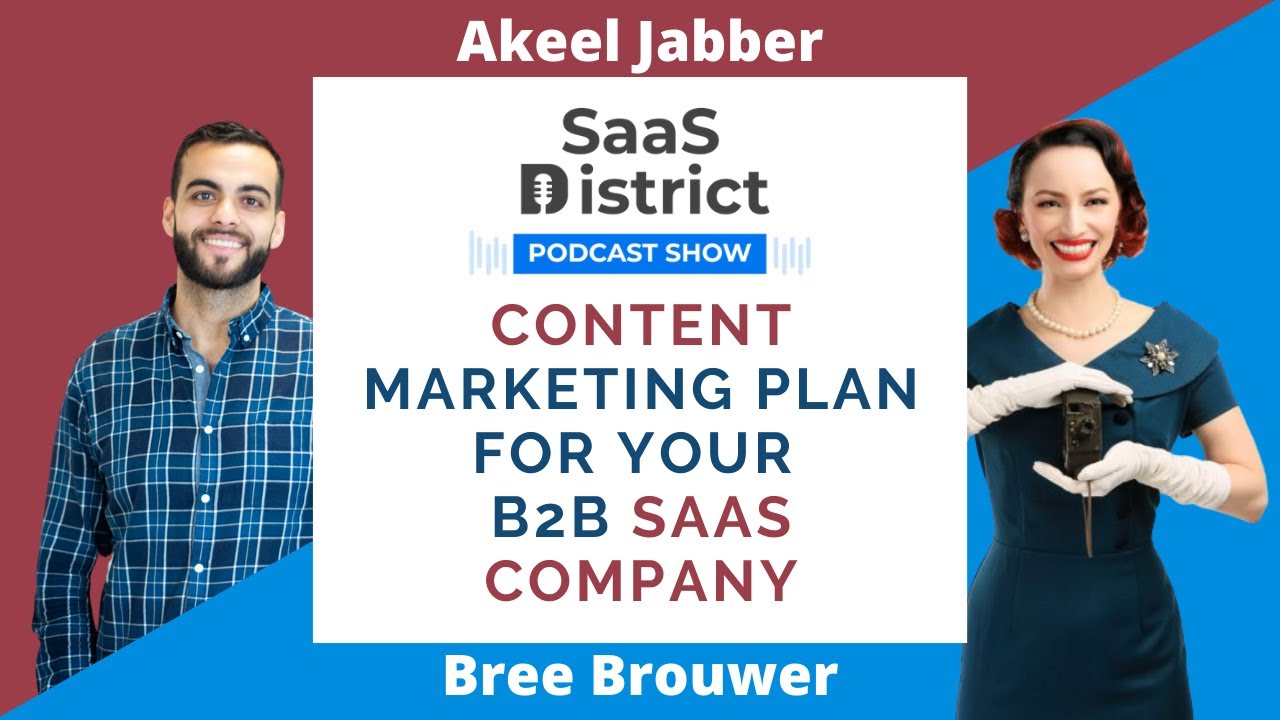
Bree Brouwer, former content marketing editor at Tubular Insights, breaks down a B2B SaaS content strategy: prioritize owned blog and SEO for long-term growth, use LinkedIn and Reddit for quick wins, and lean on case studies as your highest-ROI asset. Start video with a phone camera and good audio, then repurpose everything across formats.
Chapters
Hello, hello everyone. This is your host, Akhil Jabbar, and welcome back to another episode of SaaS District. On today's episode, we'll be talking about how to create An epic content marketing plan for your B2B SaaS company that drives real sales. Today we have our guest Bree Brower joining us. Bree is a specialist in content writing for the B2B SaaS industry, specifically in the online video industry where she's an expert in. She helps write content that actually ranks in the top spots in Google, has rewritten homepage copy, which has increased product downloads by more than 64%. And has written blog posts that has generated $40,000 more in extra revenue, which we'll talk about more today. Most recently, Bri was a content marketing writer at Tubular Labs, and now she's the editor-in-chief of Tubular Insights. For those of you who don't know, Tubular Labs is the leading global video measurement and analytics platform that powers broadcasters, publishers, and brands to create successful content and scale audiences faster. Now, thank you so much for joining us today, Bri. For those in our audience who don't know who you are and your background, could you please share a background of how you got to where you are today as a writer for SaaS companies?
Yes. Thank you for having me, first of all. My background actually is a little long, so I'll try to keep it short. My dad was actually a news anchor, so I've grown up in media and communications pretty much my whole life. So I went to school, I went to university for English writing and secondary you know, minors in journalism and digital media. And I started out actually as a teacher at an online academy. That was the first job I got out of college. And, you know, I was teaching English and literature and all that. And it's great. And I like, I love teaching high schoolers in particular, but it just didn't quite work out. That's not what I wanted to do. So I moved into consulting, freelance writing and marketing and consulting. And that's, I've been doing that for, holy cow, probably—
10 years.
It's going to be 9 years now by mid-June. So that's pretty much how I got started in B2B content marketing.
Cool. Thank you for that. Now, speaking of content marketing, as a SaaS founder or a company, there's so many different options to explore, right? You have blog articles, you have white papers, you have case studies, you have video as well. How do you know where to focus your energy and where to get started? There's just so much when there's so many options out there.
Right. So while I can't speak 100% from the entrepreneurial side, I do know that with any business, it is of course, like you were saying, to get to know where your audience is. So maybe regardless of getting started with content marketing, maybe at some point ping your ideas against your friends and colleagues, see where they think that audience might be lying, do some of your own research, maybe throw out a survey or so if you have a current email list. You know, ask your current email list what they, where they might want to see some more content or what platforms they want to see it on. So definitely start there. But then once you kind of figure out that point, I usually suggest no matter where you start, if you start having a social media, you know, post once or twice a day, that's fine. But I do believe it is very important that all companies have their own owned and operated platforms. Where they put their own content marketing out. The best option I personally feel are blogs because blogs still keep your rankings in Google. And they put out— if you put out fresh content even every 2 weeks, Google's still going to see that. And the more, of course, you use keywords and SEO in your site and in your blogs, the more likely you are to rank on the first page of Google. And that, of course, takes time, which startups don't like to hear necessarily.
Right.
They want to get stuff out immediately. But the thing is, if you want more of a long-term strategy and you want it to be your owned and operated platform, you have to pretty much be looking at blogs. And if you are okay and you have that runway of about, let's say, 2 years at best, even 6 months to a year should be good enough if you have great blog posts and great SEO to get yourself in those rankings. So there was an example I was thinking of. Buffer apparently did this really well when they got started. And I saw a quote from someone over there that said, for the first several years that they were a startup, they could attribute 70% of their new leads to content marketing. And most of that came from their blog. So I consider blogs still highly important. That is where I would personally start if that is where you think your audience could be.
Awesome. And would you have anything suggested on the, on the short-term periods of those who can't wait 6 to 12 months? Is there a faster channel even though you don't own it per se?
Right. Yeah. Social media is still good. It totally, again, kind of figure out where your audience is though. You don't want to be on every social platform if it's going to be fruitless and not worth your time. LinkedIn is still really good for professionals. So if you are B2B in particular, apparently LinkedIn's working great for people, especially LinkedIn Video and LinkedIn Live. Those are something definitely to check out. And the other thing is don't just consider popular platforms like Twitter and Facebook and such. Maybe even look into things like Quora and Reddit. Those are kind of more community-based, but I personally feel like a lot of people want to have brands that are a little bit more community-based or community-focused at this point. Especially with everything that's going on in our world right now, I feel like people are going to not like brands and companies that feel distant. So if you feel like your audience is probably going to want something more community-based, look to starting maybe a LinkedIn group to get them all together or start a Reddit community or something like that.
Makes sense. Yeah, I agree with that. I'm a big fan of Quora myself and I find it's just such an underrated platform that people don't think to use.
Yep. Yep.
So speaking of timing, at what point does content marketing become important for a B2B SaaS company in their growth? Are they doing this right when they first start or should you wait a certain time period when you have leads and you have sales and like, okay, let's start doing it?
Right. So it totally depends on the startup and how many people are involved. If it's one person and you're just launching, of course you want to try to get as many sales in the door as you can. And your second priority is most likely going to be getting a developer on board to help you continue to develop those features and tools. But I would say your next plan of action should be marketing. And that might look like, okay, I can get to that in 3 months, or I can't do that until about a year down the road. So, you might have to gauge it, but I would argue that it's not necessarily so much a matter of time as to when you should do it, but a mindset as to how you view marketing. A lot of SaaS companies only know the tech end of it, and that's not bad because a lot of them create fantastic products, right?
Right.
But often that means that marketing is put aside, and then if growth slows down, they're confused as to why. So I think it's more a shift in mindset as to marketing is and should be considered a major part of your business, even though it might not seem techie to you. So I think The sooner you can start, the better. And that matters. It'll be decided within your own organization, but yeah, sooner the better. Especially like if you can even have a couple members of your team offer to write blog posts once a week, then they can rotate out and you can just get some stuff started slowly. It doesn't have to be anything amazing right off the bat.
Makes sense. And then, you know, when you're speaking to different stage B2B companies, And they have a certain budget. Let's say, you know, I come to you and Bri say, hey, I'm just starting off. I have this much money to work with versus another SaaS company who has product-market fit. They're looking to scale their content marketing. What do you suggest to them, you know, differently and where to allocate that budget?
So to differentiate from competitors or just to expand their own?
Just expand their own. Yeah.
Expand their own?
Yeah.
I would say, what, what makes you different? Like, why do you feel you're different? What else? What other value can you offer your customers that you don't feel you currently are offering? So let's say that you are working on, you have a blog and you have a couple of videos up on YouTube. That's a, that's a start of your content marketing. What about any sort of guides? Are your customers struggling with not just your product, but something in their careers, is there a typical problem that they address in their business? Why not write a guide or a white paper about it? It doesn't have to be long. A lot of people think white papers have to be these super long, 20-page academic things. And that's not really the way it has to be done. So start with a 5-page guide. It could even only be 300 words or less on each page. but with even some nice graphics and images or even links to other videos for more assistance. So, you can go there. There's— I would say the sooner you can get case studies under your belt, that's very important. Customer stories, success stories/case studies. So, that usually doesn't happen, obviously, until a customer's used your product long enough that they see ROI or tangible results. But if you get those, definitely talk to them about seeing if you can write a case study about their success, because a lot of people want to hear that other customers are in the same boat they're in, the same problems. And once they see that and that your product helps solve that problem, they'll immediately be like, oh yes, this is what I need too. So case studies, definitely, as soon as you can get on those as well, that's a good option.
Would you say that is where you see the best ROI or is there another channel that you recommend if you're going to create a certain piece of content and you want to see some ROI, what would you focus on?
I would say customer success stories and case studies probably see the best ROI. I'd probably, I'd have to like do Googling to see if that's like scientifically true or not. But most of the people I've ever worked with have said a lot of people like to read those. They like to read them. They can even be video interviews, honestly, case study video interviews. And I feel like Again, because it's so personal, it's a problem you address and you see the results. I feel like people react to that more easily because I think there's some— the stat is somewhat old now, but there was a stat about 3 years ago that said people, new customers will click through or have a touchpoint on something like up to 10 pieces of content before they ever choose to work with you. Right. The theory there is you could put out more content and you should, but it needs to be the right content. Because if you can limit that amount of touchpoints that convinces someone to look at your product, that's important. That's less work for you and it builds trust faster with your potential customer. So, case studies, I feel, do that a lot more quickly because it's more narrow. It's, here's a problem, here's a solution. Let us know if we can help you. And it's direct and it's not just tooting your own horn. It's literally a success story from someone using your product. So I do feel that the ROI is quicker there.
Okay. And I want to talk more about the video marketing side. So I know you write a lot about video marketing as you've worked with many SaaS businesses in that industry. With the value of video marketing, can you share any effective strategies and what do you really need to get started if you're a founder or marketer looking to use video marketing to drive real ROI? You know, whether it's TikTok, YouTube, Instagram TV, do I use a flip phone? Do I use, you know, HD cameras? Like, I don't know, where do I get started that I want to make an impact and get results?
Honestly, the most important thing I would say first of all is to get started. Pick one platform, experiment with it for a little bit and see how it works and then expand into a different platform. And like I said earlier, if you feel your customers are mostly going to be on LinkedIn because they're professionals or business professionals, definitely, do recorded videos and LinkedIn Live. So start there at minimum, and then you can choose to expand to other platforms. In terms of equipment, I tell everyone this, and this is something that when I worked more on the YouTube creator side of news reporting, everyone thinks they have to get these big fancy cameras, and you really don't. Honestly, most phones nowadays, like my Pixel, like I'm pretty sure this thing has the best camera I've ever owned in my life.
Yeah.
So, you know, but I don't— I've never owned a Canon, you know, a professional Canon camera. But you don't need that anymore to get started. So as long as you have a relatively new phone, that's good. But actually, what most people don't realize, what's most important is good audio quality. So if you can at least invest in like a Blue Yeti, or a Yeti Snowball, I think the Snowball is like $50 and the Blue Yeti is like $100. Those are still considered some of the better affordable, high-quality microphones and such. So audio is actually more important than video quality. A lot of people are willing to overlook video quality if the audio is good. As an example, just look at the millions of people that watch esports livestreams. You know for a fact that those livestreams are not always up to date and there's probably some staggering and lag here and there, but people just do not care. If you have good quality and the commenters are excited about it and the game is good, they don't care about the video quality. Same thing will apply if your customers like you and they love your product. They won't really care if your LinkedIn Live video lags every once in a while. As long as you sound great, they'll be like, this is good information. I like this.
That's right. Yeah. Yeah, I agree with that. I actually listened to a podcast the other day and I think the interviewee was just muffled and started getting distorted. I just stopped it. I couldn't handle this anymore. I just shut it off. So yeah, it doesn't matter what he was saying.
Yeah. So one more thing I would add there though, of course, while I said it's important to get started and you don't need super fancy equipment, I would say once you kind of figure out if there's a platform or system that's going to work for you, make sure you put effort into an actual video marketing plan. Don't just make one video and then 4 months later throw out another one. If you want it to work for you, it's a consistency thing as with any marketing. So actually set up this Like, what do you want your video marketing to do? What tone do you want it to have? Who do you want in your company to do it? Like, is it just the CEO going to be on camera or do you want your chief technology officer to make some comments here and there as well? So once you have, once you've gotten started and you feel like there's something there, set out, set out a video marketing plan for yourself because otherwise it's just going to be pretty sporadic. So.
Yeah. You buy all this equipment and then it just sits there and collects dust, right? Right. Yeah. Would you consider it as a video marketing as a top of the funnel marketing or middle of the funnel? Because I try to understand webinars, YouTube videos, I know has the search, and then you have Facebook Live, LinkedIn, Instagram Stories, all of the above.
I feel there's a place for almost any kind of video marketing and content marketing across all the funnels. If you're going to introduce your customers to your brand, then that's going to be probably a basic YouTube video discoverable by anyone, right?
Right.
Middle funnel, that's more of your customers are asking more questions about you, right? Whether or not they want to work with you. That might be something more like, let's say, a couple of how-to videos or guides that you have on your site and you don't necessarily host on YouTube. Or you could even, let's say, if a customer— you've got an email sequence set up and a customer asks about a question or wants more information, you could then email them that video that answers that question. So a lot of questions. One thing that I feel is pretty powerful, at least for middle of funnel, is even, I mean, it works for almost any stage, but I think it's probably more powerful middle of funnel. If people have frequently asked questions, just make videos about those. And once they're in that middle, like kind of buying stage, email it to them and don't make them long. They can, they should only be like 2 or 3 minutes. There's people get so many emails and written texts per day. It sets you apart, makes you look a little bit different if you send them back video answers instead. So yeah, there's almost any stage you can use it. It's just how you use it and the level of application and relevancy basically. Right.
And you would throw that on YouTube? Like you'd create these little FAQ and say, hey, this is an answer.
You could. I would say those would be, but that is, That's of course introductory level, right?
Yeah.
That's a top funnel broad application. If someone wants to know, does your product do this? That's really simple. A demo you'd put on YouTube. But let's say the stage is now at the middle funnel and they have a little bit more serious questions like, how detailed is this capability? That's the kind of thing that you probably don't want to reveal to everyone in general. in your marketing, that's more of like, they're kind of serious about buying. So now it's more specific question to their business. So then maybe you record a specific 1 to 2 minute demo just for them, and then you send it to them via email. So it's that kind of differentiation for each part of the funnel that you should figure out.
Makes sense. Yeah. How do you provide a great experience to your audience and stand apart To get that wow factor, whether that's content through your blog or through your video? I know, like, for example, I went to your website and I was pretty impressed. You know, there was nice images standing out. You had a different dress than somebody else and the way you wrote, it stood out. How do you provide that? It's interesting.
On my end, I just figured out that this is, you know, this is who I am and I felt confident dressing in '40s, '50s, and '60s attire. And, you know, and I realized no one else really does that. Great. Good for me. It just worked out that way. But I think that's part of it, though. And that's part of my entire— that's part of my entire mission, basically, when I'm helping companies is storytelling has always been there. And being unique and telling stories has always been in people's blood. Even in caveman days, we gathered around fireplaces to tell stories, right? So that's kind of where I come from. And honestly, what I think is going to be most important and has been important but overlooked by companies for years, you have to tell a good story and just be human. A lot of tech companies are so involved, like I said earlier, in tech that they don't realize that they can just be themselves. themselves and customers will relate to that. So that is definitely a good place to start. That will set you apart. It doesn't seem like a big wow factor, but it truly is. If you can tell me right now one company that you feel sounds like a human when you go to their website, I would actually be kind of impressed. SaaS companies are, like I said, they make amazing things that change the world, but Sometimes the language is just like, okay, I know what you're saying as a tech person here, but you know, it makes me feel like you're a robot a little bit. Yeah.
Yeah.
So telling a story and just being human will immediately have a wow factor that'll set you apart.
And how do you set that as like, um, so you have your, you're hidden behind a company. Um, you know, you have some people who build a personal brand from their SaaS company. Um, do you want to portray that brand and your, your message and your story Through your company or do you want to do it on like a personal level and then use that as a way to channel back to your brand?
I feel that's probably more of a larger branding choice that you have to make, right? An overall company tone, voice, mission, and branding choice that you have to make. I personally feel it's best to stick to one entire mission and carry it through all of your departments. So marketing, also tech if you can, customer support if you can, carry it through everything. So, I mean, as one example, my husband actually works for a large tech company and they do that. They do, they have a mission, you know, to basically make everyone, every customer feel like their business is important. And they carry that not just through their marketing, but customer service representatives do like ask questions too about small businesses and ask their customers, how are things going? How can we help you? with your small business and things like that. So I would personally carry it through your whole company. It's just implementation there that gets tricky depending on how big the company is.
Makes sense. Can we talk about that blog post that I mentioned at the beginning of the interview where you helped drive, I think, is it $40,000 in revenue? And what was it that caused it to be successful or why was it?
Yeah. So I was writing just as a writer. I say just, it's still a cool job. I was a writer for Tubular Labs' blog called Tubular Insights, and we did this thing where every month or so we try to— the software that Tubular uses is able to basically measure a bunch of different videos and, you know, engagements and views and such, and they also are able to measure sponsored videos. So, you know, when an influencer works with a brand to create a video, sponsored, sponsored content, branded content. So we would, we liked to do a rundown, a leaderboard every month of sponsored content, like who was winning basically that month. And we chose to do a gaming sponsored leaderboard one month. And I like gaming. I game all the time with my husband and my friends and So I kind of knew, I knew the industry. And I just, I took the top 10 that we pulled from our dashboard and my colleagues made sure that all the data was correct. And I just wrote about it. Like, here's why this worked. Like, this was a good partnership because of this. And it was an art, you know, a blog article of maybe 750 to 1,000 words. And one of the companies, one of the gaming companies on there, Sorry, it's a gaming publisher, not a gaming creator developer.
Right.
A gaming publisher was listed on there, I believe, as number 2. One of their partnerships had turned into like the number 2 most watched that month with the brand that they worked with. And they were not actually a full customer of Tubular yet. They had one version of our software, but Tubular has multiple products and they only had one of the products and they didn't have the one that measured sponsored content. And then suddenly they were like, oh, we can figure out how well our sponsored content is doing as well. And it was because of that post that they started negotiating and talking with their Tubular account representative. And then I asked my colleague later, I was like, did that ever come to anything? And he's like, yeah, they eventually did sign that new product. And I was like, cool, great. So in general, like, again, it took months. I should clarify that.
Yeah.
That's why content marketing is frustrating for people who don't understand it. It's, I always reference it more as like a marriage. You invest in it and long-term results turn, you know, turn out if it's a good marriage. So it was like that. I wrote that blog post about the sponsored gaming leaderboard in like May of last year. And I don't think I heard about any results until August or September.
And did you know going in that this piece of article would do so well or was it like, okay, this is our plan. We're going to write continuously and then one of them just picks up and ends up paying off?
Right. No, that's the thing. You just have to keep writing content that you think and that your audience will like. Obviously on the backend, you want to measure traffic and engagement rates and bounce rates and things like that. It's really, again, kind of going back to knowing who your audience is. Do they find this content valuable? Even if it a couple months from now still doesn't generate new revenue for you, what if they really liked it and they pass it on to their colleague in a different company and then that company comes to you? So again, I don't ever really have a feeling that anything I write for my clients will blow up. I just put all my efforts into making sure it is quality and it is exactly what audiences in that company want to read. Because that means it's going to more likely resonate, right? It's going to hit home.
Makes sense. What are some strategies or questions that founders or marketers can ask themselves to start improving their website content and try to start driving some of those leads through content marketing?
Yeah. I would say, First of all, definitely go back to that. Ask the hard questions. Ask whether or not you sound like a robot. Start there. Then look at how you're writing. How are you speaking? What is your tone? Do you— are you a little bit more lighthearted? If so, great. Maybe you don't need to change that. But what about also like the actual language that you use? Is it too Jargony? Can you make it a little bit more fun? What about the fact that— do you use the word you anywhere, for example? If you make it more personal, and there's research behind this too about using the word you and how much more powerful it is to connect with someone directly. Things like free, I know, is another one. So say free trial helps more than Start your trial now, things like that. So it's, it's a lot of detailed questions I would start asking yourselves about specific language you're using. And then broader questions I'd ask about how do you want to be portrayed? Do you think people see you that way? And if you have to, you can even ask your current customers. You can just send them a short survey, an email and say, hey, quick question. Like, we know you like our products. You've told us that. But do you like our marketing? Do you think we could change the way we sound? Like, what would you suggest?
That's a great point. Is there any SaaS companies that you admire their writing styles and maybe people can look to for inspiration?
I'm pretty— I'll be honest, I'm kind of bad at just skimming the web for SaaS companies. I do feel though, kind of like I said, I can't not a lot come to mind because of the lack of humanness and uniqueness that I feel that I would like to see more of.
Sure.
I could point out smaller companies for sure. Like there's a bunch of small businesses that do so well with having incredible brand voice. There's a— oh man, I'm trying to remember the name of it. There's a company out of California that makes soap. I'm going to pull it up now because their words and their brand and their tone are so good. And it basically— I actually, for most SaaS companies, maybe what they should be doing is looking to small companies like this to see how they are a lot more personable. So yeah, it's not a SaaS company, but if anyone wants to look at Live Outlaw, Outlaw Soaps, outlawsoaps.com. Sorry, I think it's liveoutlaw.com, but they're Outlaw Soaps and they're based out of California. But like, they have a soap that we got once for my husband. It's called Blazing Saddles and the description is the sexiest scent ever. And that's, you know, and it's great. They have a— what else do they have here? It says made with love and laughter, would probably be used by Steve McQueen if he were still with us. It will raise your level of kissability. Like, it's that kind of personable writing I don't see a lot of SaaS companies using, which is unfortunately why I can't think of too many off the top of my head that I really like to recommend.
Yeah, I love it. I can't think of any either. I do see it with some other ones where they get to be a little bit more creative and it works, right? People are like, oh, look at this, check this out. It's funny.
Yeah. Like Mailchimp. Well, I should say Mailchimp was really good at that for a long time. I haven't looked at their site in a while. I know they've changed direction from not just being an email service provider, but they are definitely one that when they started out, they really had it nailed down. So that would definitely be a place to at least kind of look at their history of their marketing.
Makes sense. What's your thoughts on using the pillar content as a strategy to then distribute to many different channels? So I know you talked about focusing on one channel and doing it really well, and then committing it to a long-term. But if you want to do, you have like a 1-hour video or whatever, 2,000-word blog post, where do you begin to build that framework as a B2B SaaS company to—
Yeah. So while this touches on other parts of marketing and not just content marketing, and it goes back to a lot of what I've said before, is figure out what's resonating with your audience. So let's say they really like to do tune into your LinkedIn Live shows, whether or not that's like a product demo or that's a Q&A with a founder. Let's say that LinkedIn Live works really well for your customers and your audience. So take that video and write a blog post, summarize it, and write a blog post about it. Maybe take 1 or 2 of those key points and put those snippets on social media. Linking back to your blog post or linking to the LinkedIn Live replay. You can also, honestly, a lot of these things you can also just take videos like that and put them into, let's say you have a learning center for your, your SaaS product, you can put them into your learning center and that doesn't take too much extra effort. You can send out an email sequence about the steps or the key points. Recommended in that LinkedIn Live video. So there's usually tons that you can do. A lot of people think you have to be creating new content all the time, and that's not true. So now let's say you have a really long blog post and it's a big step-by-step guide on how to do something better with your product or, or better in those customers' jobs even. Why not take that, throw it into a, like a slide, a PowerPoint, and Put that as a learning, you know, learning slide in your learning center or turn it into a short 3-minute video. Put that up on your YouTube, link to it in your Twitter, you know, put it on a Twitter post and there's just, there's tons you can do. So start with one larger project and then basically segment it off into smaller pieces appropriate for each platform.
Right. And, you know, we talked about, you know, high-quality content, you know, the wow factor a little bit, but is there other factors that you find that help the content stand out? Whether it's like the length of the article, is it the graphics, is the font, is there, you know, other little things that people can look at or just the format that could help stand out?
Right. So there's arguments all the time and the length of content always seems to change every like 3 to 5 years. So again, it kind of goes back to knowing your audience and your analytics. If you find that— let's say you've written now for about 5 months on your blog and you've written a variety of different lengths, like 500 words to 2,000 words. Let's say that the 500-word posts aren't doing well. Maybe that surprises you. But look at why the 2,000-word posts did well. Is it because they were a lot more practical and they had application steps for your customers and potential clients, maybe that's more of what you should be writing then and not wasting your time with 500-word blog posts. So, length is something you have to watch, but it's kind of, again, an experiment. But once you realize it's working, then you're pretty much set. You just make sure it's still working every month when you check analytics. So, in terms of like colors and other, like branding, and on your site? Yes, a lot of that. And the only reason I know anything about like color psychology is because my mom is an interior designer. So I actually, and when I got started on the web, I had dial-up. And I taught myself HTML and web design. So I'm no like expert in it. But I at least understand a little bit of where like designers come from. That stuff is, yes, I would also say that's highly important. And I've actually worked with a couple of SaaS companies in the past when I've been working on their copy or their blog with them as they're looking to redo a website design. And I even talked to them like, I feel like a larger headline over here makes more sense, or don't put that image there because that person is looking off the screen. You want them to be looking in towards your content. That's actually something that newspapers have been doing for centuries too. You never have a picture of an image of a person looking off the page. You always want them looking into your content or into the headline. So it's tiny little stuff like this that designers will know, but you might not know as a tech founder or even as a writer. Not everyone knows this. Sometimes if you don't know this, you have to be okay outsourcing it or even getting feedback on it for sure. But yeah, a lot of these little nuances play together. Even the copy on your call to action buttons, right?
Yeah.
Don't just say click here or read more. What I like to recommend for things like that is give me my free stuff. Make it sound like if you were talking to someone, they'd be like, I want that. Then I'm like, okay, so put the words, I want that, as your call to action button and see how it converts. Like, you can always change it. It's not going to hurt anything.
That's true. Yeah, I've never thought of that. That's an interesting point to think about. I want to talk about habits, specifically writer's block. Do you face this issue as a writer now that you've written probably hundreds of pieces and doing it for 8 years now? And if so, what's your habit, tools, or do you have any proven strategies to overcome this? And to go out there and start producing your high-quality content?
Yeah. So I do feel like I get writer's block. Some people claim it doesn't exist, but I do feel like I get it. What works for me, which may not work for everyone though, is taking a step back and going and doing something else. It's usually something else creative. It's usually for me, maybe writing a little bit of fiction instead of working on my client's blog post because I just can't focus. on it. Or it could honestly be like, I'm trying to grow like herbs right now, like maybe just go make sure they have the water that they need. Just taking a break, that can really help. Taking a walk, you know, now that, you know, we can all kind of go out at least on walks safely.
Yeah.
Just getting some perspective and realizing maybe you're putting too much pressure on yourself because that is a thing. Writer's block has this terrible like, oh, like you don't want writer's block, it really sucks. Well, yeah, but if you make it worse than it seems, it has more power over you. So So also maybe just try to relax, take a step back. That works for me. Another thing that works for me is if I'm finding that I am— I know that I know the information, but I don't know where to start, I will just start writing. Stream of consciousness kind of a thing in a general outline format. I don't even try to do a draft necessarily. Just try to get an outline of my thoughts together as to where logically they should go. And then honestly, Once I get to that point, half the time I don't even start writing until like a day or two later because then I come back to it and all my notes and all my thoughts are already out there and organized. Now all I have to do is expand upon them. And usually you have a fresh, you know, new eyes and your brain is clearer a day or two later. So for me, it's usually just taking a step back, realizing it's not as, it's not as terrible as it sounds to have writer's block. You just have to figure out what works for you. And those are the kinds of things that work for me.
And generally when you create that outline, you put it out there, you get it all written out, and then you come back a day or two later. Do you find that usually we'll go back and like, you know, start removing stuff and editing it? Or do you feel like, ah, this was good and I'm just going to fill it in and work with it?
Yeah. Sometimes, yeah, I do take stuff out. Sometimes a thought that you think is relevant just isn't relevant anymore. And you even have that, humans have that even in everyday speech, right? We go off on tangents. And there's nothing necessarily wrong with that if you're talking to someone and you have the time to do it. But in your business, especially as a startup, you want to pretty much make sure you're saying exactly what you need to say and get to the point. You don't want to have too much, too much fluff because again, like, people want— people are busy. Yes. So they want to have concise information, but they also want it to be relevant to them and personable again. So if you can make it really To the point, but still fun and like, hey, I get you. Like, I'm here to help you kind of a mentality. Great. Plus, let's be honest, if you're a SaaS company, especially a startup, probably don't have time to sit there and just like edit and fiddle and all that. So yes, you probably do want to be careful with the final result. Maybe take some stuff out if it's really not relevant at all. But in general, I feel that taking that day or two off and then coming back gives me that focus and I'm able to edit more quickly than if I had tried to force myself to do everything in one day. So it really does, in the end, save me time actually. Yeah.
Any tips or resources you recommend to our audience to help them start learning how to improve their content marketing strategy today?
Yeah, definitely check out Content Marketing Institute. They've been around for years. They even used to have a print publication for chief content officers. Now they do it digitally on email. So they have, they have so much information. Definitely start there. HubSpot is not a bad secondary place to start. Theirs is definitely more aimed towards businesses and how they can get started with content marketing, whereas Content Marketing Institute is for more chief content officers and creatives. I'm trying to think of anything else. I honestly, one of my favorite things to do, this may sound silly, but if you're interested in a topic, I honestly just like Googling it. And I like seeing who comes up. So like, for example, Neil Patel is really good at like a lot of like marketing and advertising, and ROI and, you know, articles like that. So like his stuff will come up. I'm trying to think of other people, but yeah, I just like Googling sometimes.
Okay, perfect. Thank you so much, Bree. I appreciate it. How can our audience get in touch with you, learn more, and learn more about your services and what you offer?
Yeah, so I am at breebrouwer.com. Bree is B-R-E-E and Brouwer is a Dutch name, so it's not how it sounds. It's B-R-O-U-W-E-R, breebrouwer.com. And then I'm on LinkedIn. I know I've mentioned LinkedIn a lot recently, but I'm finding a lot more that I really enjoy it. And it seems like a lot of professionals also enjoy it. So I'm on LinkedIn. I believe it's the /in/breebrower. That's pretty much where I'm at at this point. I don't even— ironically, as much as I work in tech and the video space, I don't even have like a YouTube channel or anything.
Okay. Awesome. Yeah, I love LinkedIn too. We'll connect on there. Yeah, and we'll add those, those links into our show notes for those who want to get connected with you. Awesome. Thank you so much for your time, Bri. I really appreciate it. It was awesome.
Yes, thank you.
Thank you all for listening in to today's episode. Don't forget to join us for another episode where we interview top leaders and experts in the business and SaaS industry. If you enjoyed this episode, I ask that you please give us a 5-star review on iTunes. That would be really, really Otherwise, if you have any feedback, suggestions, or improvements for this podcast, please feel free to send it directly to me on our website at horizoncapital.com, or you can just tweet me @akeeljabbar. Thanks again, and hope to see you guys on the next episode.
Thank you.
More from Akeel



Get a mentor as soon as possible — and make sure it’s a mentor in your space.




Keith Gillispie: Why Most New Investors Fail & How to Avoid the Common Traps #250 | SaaS District



