David Anderson: Building High Performance Teams while Maintaining Cultural Integrity #233
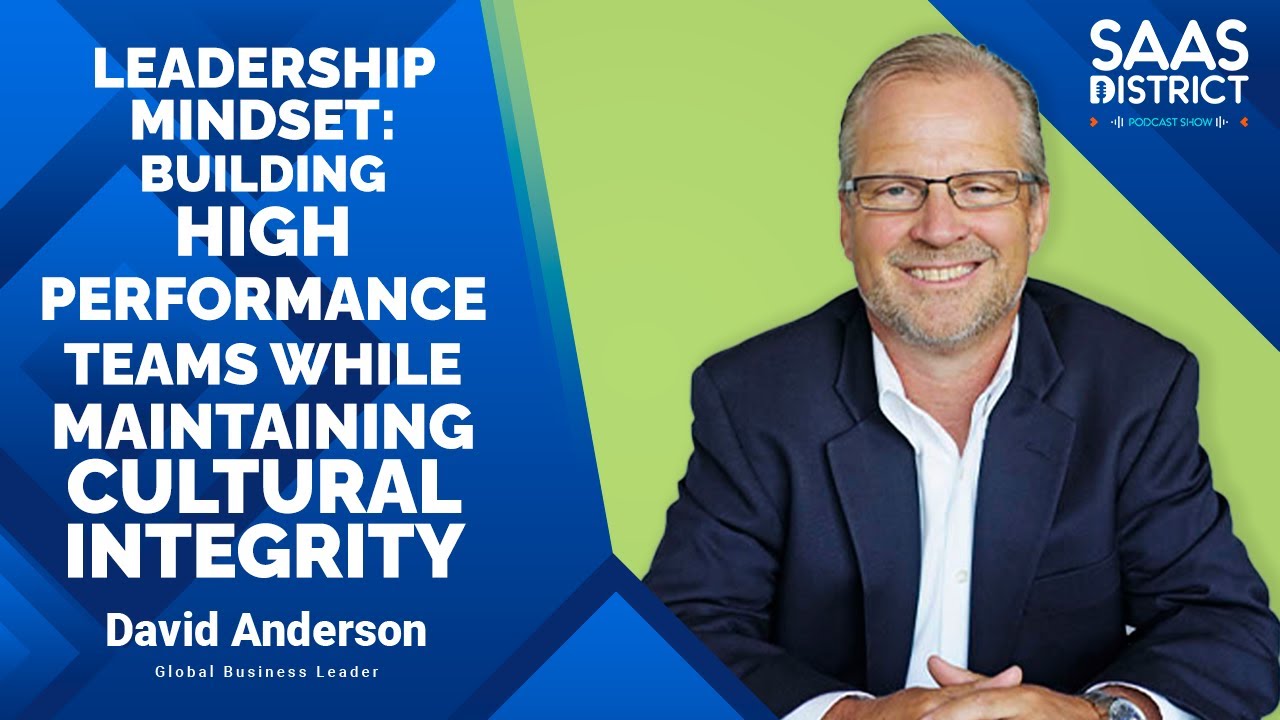
David Anderson discusses building high-performance teams without losing your culture as you scale. He covers hiring and firing decisions, psychological safety, coaching approaches, and how curiosity shapes leadership. Anderson shares examples from his book Leader Is Not a Title.
Chapters
Hello, hello everyone. This is your host, Akeel Jabbar, and welcome back to another episode of SaaS District. In today's episode, we'll be talking about the leadership mindset, how to build high-performance teams while maintaining cultural integrity. Today we have our guest David Anderson joining us. David is a global business leader with extensive experience as a C-level executive, board member, advisor, and he's an executive coach at DWA Leadership. He specializes in building high-performance teams, fostering a winning leadership mindset, and helping organizations navigate the complexities of growth as well as innovation. David has a strong entrepreneurial background and has served on many, many boards, including as chair bringing forward-thinking strategies to both nonprofits and businesses. So welcome, David. Super excited to have you on the SaaS District show today.
Well, thanks. Glad to be here. Appreciate it.
Yeah. So I'd love to maybe start off. We can talk about, you know, we have, we have, you know, SaaS founders listening in. They have, you know, strong teams, but maybe they struggle with how do you— would you, you know, tell them how to approach in identifying first of all, and then how to cultivate talented leaders without their organization that thrives and also building those high-performance teams, especially with this, you know, very rapidly evolving industries that we're talking about here, right? Especially with tech, AI, and these things changing on a week, week, week-to-week basis, right?
Tech's a rapidly changing business. I haven't noticed. I heard something about this thing called AI that's causing a lot of changes these days. So no, I'd happy to do it. Any specific area you want me to dive into or just kind of answer that in general?
I mean, in general, right? I mean, how do you, you know, look at identifying your talent, right? You have an organization and actually seeking, you know, have managers, but then how do you identify actual, you know, who can be talented leaders and lead your organization? And then how do you kind of help cultivate that, you know, high-performing teams around that?
Yeah, absolutely. And I appreciate all of, excuse me, the things that you said. I do also have a SaaS company, Lighthouse PE, which is a proximity marketing company. I also have written a book, and that's most relevant to the question that you just asked, that's titled Leader Is Not a Title. And so when you kind of, your question that you asked is hiring people going through rapid times of growth in technology companies and the 7 stages of growth that companies can go through. For me, it's the number one things that I'm looking for are people who are willing to learn and grow. They know, excuse me, they don't have every answer figured out. They don't know everything. They bring a strong willingness to learn. They also have to have a strong willing to collaborate. One of our companies, a marketing agency I have also, one of our core values is collaboration, respectful collaboration, because you have to have a team that is willing to collaborate. In my book, I talk about being like, if you're, But if you're one of the listeners and you're president or CEO, founder or something, your job is like being a chemist. Chemists are constantly changing formulas. It's a little bit of this, a little bit of that. Oh, we have to change this here. The virus, if you're in pharma, you know, so now we need to— being a chemist or being a CEO these days is you're a chemist. Your team is, Different skill sets, different personalities, different strengths, different weaknesses. And it's looking at your team as that chemist for what is the right mix to the best results. In chemistry, it's to, you know, cure a disease, do something. And you're— it's the same in business. You know, what outcomes are you looking for to go forward? One more is I'm also a very big believer in Culture Index. I know there's a lot of different assessment tools out there in that, but we use Culture Index to really help us identify the strengths, the challenges that a person brings to a team. And Culture Index doesn't tell you yes or no on anybody. In some cases it might. This isn't a good fit. But it also really helps you learn how to manage those, those people, the people that you're bringing onto your team or even the people on your team. Does that make some sense? You like the chemist analogy? Does that make— does that resonate?
I do. Let, let, let's use the chemistry analogy here. We're mixing formulas, we're trying to get the best, you know, results out of this. You know, it's interesting, right? 'Cause you have culture and then you also have, you know, especially now with the global leadership teams kind of building teams all around the world with, the diverse structures and ways they work. What would you say, Zain? How was your maybe global leadership experience shaped your approach to building and managing diverse teams, especially across those different cultural environments? So, you know, they're trying to put all these together, just so many different variables. How do you build a coherent formula?
Great, great question. And yeah, when I was chair of the board for the Organization Entrepreneurs Organization, Throwing in a plug there for them. I'm no longer chair, but I'm still in the organization. I learned so much because it was a global board. The biggest thing with a global workforce, which I'm a very big, big advocate for also, is you have to understand the person, but also the culture that they come from. I'm an American. We work one way. You know, people that are in the Philippines or in in South America or Asia, you know, they have different cultures and they work differently and the respect level for elders and, you know, who is more forthcoming. You know, us Americans can be kind of loud, boisterous, speak our mind.
Yeah.
But, you know, and this is not, again, bad or good. good. People that come from other countries, Asian countries or stuff, you kind of have to ask more than them speak their minds sometimes. So it's really important that you not only know the person, but you have a deep understanding of their cultural background and how they work. Because at the end of the day, for me, and again, I talk about this in my book, is leadership is a mindset, number one. But you are a leader if you have influence over somebody, and that doesn't mean I'm I'm your boss, so do what I say. You have influence over someone, and the reason you need to have influence is because it's all about how you motivate them. Leadership is motivation, and you have to understand them as a person, but also their cultural background to be able to do that.
Makes sense. So maybe we can speak more about the mindset, right? So if I'm the chemist and I have this team, I've assembled this team, I've identified the people that I want to, I want to get the best out of. What are, you know, maybe founders listening in, maybe they're, they need something to help them shift their mindset. What are some mindset shifts that are most critical for, for leaders maybe from transitioning from that management role to now to that C-level kind of leadership or board-level role?
Yeah, that we could talk about for a long time. I, what I would say as a leader, and this goes to one of my favorite quotes, is seek to understand than to be understood. And you, You have to listen way more as a leader than you speak. You have to take it in. You have to listen to people. You have to be very accepting of additional, of other points of views or additional points of view of how it is. Take it all in. And not that you need to agree with everybody, but people wanna be heard. It's a, you know, respect thing to other people. They wanna feel they're contributing. Take it all in and then make your decisions. but then explain why you make your decisions. Not just, we're gonna do this. We're gonna do this, but let me explain to you my reasoning behind. Because you want, as a leader, people need to understand the why. They need to understand why we're going in this direction rather than just do it. So the mindset of a leader, and again, in the book I talk about you are a coach. You're like a coach of a football team, baseball team, rugby team.
Mm-hmm.
You know, you pick it is, That you have to know your players on the field, you know, have to know their strengths, and you have to call plays and explain the why you're doing this, the strategy behind your games, and have an open mindset. For me, leadership, the mindset most is just being open to listening and hearing. As a leader, I think I, on my, I don't know, I have a kind of a background in politics too, which I am not going into.
Mm-hmm.
That is such a divisive issue anymore. But I did have the honor of working in 2 White Houses with presidents. And what I saw was the value of having people around you that are gonna challenge you, that aren't gonna just be yes people, that are gonna question you, that are gonna give alternative points of view, people that are smarter than you, is really important. And that helps you keep an open mind. open mindset.
And then how would you— how do you think about cultivating that environment where maybe, you know, folks feel, you know, comfortable to be able to speak their minds and share and challenge you and then be able to listen and take that feedback, right? Versus, you know, you're saying like, this is what we're gonna do, um, this is why. But, you know, maybe I think the listening part, you know, sometimes I find is a challenge where people don't really know how to listen. And then also creating a space where they can actively listen and allow people to, to to make, you know, challenge them and bring up new ideas and help, help, you know, set the tone?
That's a great question. And my first suggestion to any of your listeners here is go on the Harvard HBR Harvard website, go on McKinsey website, just do any type of ChatGPT. But what you will learn is the most effective, like you said earlier about building high-performing teams. The best high-performing teams are the ones that have psychological safety as a team, which means when the team comes together, when they're in a room together or some are on Zoom, whatever, I believe leadership teams should, whenever possible, meet in person. When that team, anybody in the room can speak their mind and challenge somebody else and give opposing points of views. And honestly, to argue, it's good to argue as leadership teams in a constructive way. constructive and respectful way. That psychological safety is the number one factor in building a high-performing team. And that's not me, that's Harvard. You pick any of the major that you go to, you will find. And that really falls on the founder CEO because you have to allow people, you have to tell your leadership team, you have permission to challenge me, you have permission to question what I'm doing, You have permission to bring up alternative views. And in the room, we are going to hash them out. We are going to argue, but we always walk out of the room as a united front. Everybody gets their say, but once we've agreed on the direction or the decision or whatever, it's going forward. And again, I would encourage any of your listeners to do some of that research. And there's tons of steps on things that you can do to build that level. And it doesn't happen overnight, not at all. It's a long-term process because people don't just come in one day, okay, I'm gonna challenge the CEO. And, you know, it takes time. But if you want to build a high-performing team, that is the number one factor that you as a founder, CEO, president, whatever your title may be, if you're, if you're leading a team within a company, you may be a division head, you may be a VP, you may be a group head, whatever the title But if you want your team to operate at peak performance, you have to do that.
That makes sense. And you also speak about the importance of what you call jumping the S-curve of growth. Can you speak a little bit more about that, elaborate on that concept, and then maybe share strategies for leaders on how to anticipate and then execute that effectively as they're scaling?
Yeah, absolutely. And again, for your readers, there's a book entitled Jumping the S-Curve that they can look up and Amazon, but really jumping that, the S-curve. And, you know, a lot of startups, they'll be this flat, a little bit of growth, and then you hit the hockey stick. But at some point or another, you're gonna level out again. So how do you jump that S-curve? You know, the S-curve represents the growth of companies and it's taking that next big jump. And that is constant innovation, constant thinking, pivoting sometimes. But the, at the core of that, I believe it's about having that high-performing team that is always looking towards the future. It's so easy, especially this day and age, to get in the weeds every day. You know, our day is defined by the first email we get more than anything, text message, you know, pick your poison. Sometimes it's even a phone call this day and age.
Yeah.
But it's how, as a leadership team, do you block time in regular intervals to be what I say is working on the business, not in the business. And a CEO who's ultimately responsible for that, if you have a board of directors, that's also part of it, is elevating yourself above the day-to-day to constantly be thinking about that next big growth spurt that you're gonna have going forward. And that only happens through innovation, maybe acquisition that you do it, But it's, it's a new way that you're going to propel the business further.
And, you know, when you're in the early stages, you know, maybe when you have a smaller team at the— before you hit that kind of S-curve growth, you're essentially building this culture among your team and you're trying to get the best out of them. But once you start scaling, right, this is where I think there's a lot of challenges that SaaS founders face is how do you maintain that cultural integrity? While that, you know, while you're still trying to build high-performance teams. So, you know, speed while also keeping, you know, the core foundation of how you want to operate, especially, you know, when you have so many people you're managing, how can you set time to sit down and listen to all these folks or get the feedback and then make decisions when there's just too much going on?
Yeah, it's a great question. And I'll be honest, I'm not gonna, you know, BS you. It's hard when you're scaling and you're adding people. It's really hard. Some of the things that I have found that works really well Well, is first of all, the people that help you found it are just as responsible as you are as a leader founder to help maintain the culture. It's them being the ones that say, hey, that's not how we do it around here. Or, you know, this isn't about silos. This isn't about your personal. This is, you know, what it is. So yes, the CEO owns it, but it takes a village, for lack of a better term. It takes everybody to do. It's hiring the right people. And one of the hardest lessons I've learned, and again, I wish I was smarter because it took me many, many times to learn this, is that when you bring a person in who is bad for the culture, no matter how important they are, you gotta let 'em go. Because when you bring a bad person into an organization, it's a cancer. And I've made every excuse in the book. Oh, they work on an important client. Oh, they're so smart. Oh, they know this. But when you have a person who's a cancer in the organization or doesn't live to your core values, which by the way, needs to be clearly defined so that you can't just walk up to somebody and say, hey, you're not living our values. Well, what are they? You know, they should be part of your hiring process of what your values are. But going back to what I was saying is when you have a person like that on your team, not only, you know, does it damage the, you know, the immediate relationships, what you're telling every other employee is, is that behavior is okay. We are going to accept that. And that's when you see the greatest cultural Degregation starts eroding. Whereas if a CEO or somebody in the organization, whoever it is, is like, almost make an example. That person was not living our core values, regardless of how valuable they are, they are gone. That's a pretty powerful message to everybody else that I have to live the cultures here. And sometimes it's just not a good fit. Let them opt out. That's fine too. But don't keep the bad people around. Gosh, I don't even know if I have enough fingers to count how many times I've done that poorly. But it just— it's hard as it is. We as leaders will make every excuse in the book. Cut out the cancer as soon as you see it pop up.
Yeah, it's just like you said, you're a chemist, you're putting ingredients in this formula. You put one wrong ingredient, Messes up the whole thing here. But yeah, I've seen countless times where it's tough, right? You keep trying to make excuses and you're hoping things will change or get better. But then usually when you make the decision, you're like, okay, this is not the right person, not the right fit. It's usually the right thing. So I mean, your gut is usually right, but I don't know, do you have any examples you can share? Like, how do you define a bad or maybe toxic individual that you may have— want to reconsider on your team or maybe consider Yeah, absolutely.
Um, I would suspect also, um, it sounds like maybe you've done that once. You're probably a quicker learner than me, but after you do let them go, I, I don't know about you, I'm like, why in the heck didn't I do that 3 months ago? Why didn't I take care? Yeah. Oh, I feel so much better. I don't go to bed thinking about that person. I don't wake up going, oh, I don't I don't want to see that person at the office. Almost always you're like, for me, excuse my language, I'm like, hey, dumbass, you should have done that, you know, 6 months ago or whatever. Yeah. I mean, for me, what I can say, specific examples is, you know, a person we had on staff who managed a very critical client relationship, you know, millions of dollars in billings, the main client. the client, you know, really enjoyed this person and were happy with them. But putting up with that person internally and how she treated coworkers, it became more about her and what the client thought they needed. The client was always right rather than, you know, taking the feedback of the team. And it just became where, quite honestly, you know, we lost some other people over being treated poorly by this person, um, good people. And again, I sent the message that, oh, that behavior is okay. And those other people were like, I don't want to deal with this behavior, I'm out of here, I don't have to do with it. And so it just creates a bigger problem because now I've lost key staff. And then when we finally terminated, the client was like, well, you know, why And, you know, who's replacing her? What's going on? And it was fine. You know, you just— we, we, we tell ourselves so many stories when we have to make big decisions, um, rather than just, you know, just do it. You know, I'm not saying don't plan. You gotta plan. You gotta have a plan in place. You gotta have a transition. Do that. But like you said, our gut tells us what to do 95% of the time. Mm-hmm.
Yeah, it makes sense.
So any of your listeners out there right now that have that cancer, take out, write it down on your phone, piece of paper in front of you, something. Say, I'm going to solve this problem by this date and make it happen. Just write the date down that you will make this decision and the person will be gone. Because again, otherwise we'll just keep coming up with reasons, excuses.
Especially as maybe more inexperienced founders or CEOs, maybe looking at— I would like to ask your opinion as being a board member as well. So you have lots of experience as a board member. What qualities do you believe are maybe essential as a board member to positively influence the organization and the innovation? So from your perspective, and then what are things that an inexperienced CEO or leader should be looking at their board for assistance and help? with as well?
Yeah, that's actually a great question. The role of board members is definitely evolving, and I believe, and I'm one of them, the most effective board members— effective or the most helpful, the most productive board members— are those that don't just come to a meeting once a quarter, get a packet beforehand, look through things, but then engage at some level of mentoring or coaching key people within the organization. And especially in the startup phase, or, and if you're an advisory board or you're, it's a, you know, 'cause you're getting funding, you have a real board, as I call it, corporate board, whatever. But the most, I believe as board members, you can be the most effective the more you engage with some, not all, but key stakeholders within the organization. I also believe that board members, just like we were talking about bad people, they help CEOs set timelines. This will be done by this date. We will see this plan at the next board member— we at the next board meeting, excuse me. So the board's job is accountability, is to hold CEOs, leadership teams accountable. And it's not just this dictatorial thing. It's, hey, these are decisions that need to be made. They need to be made by X point. How can we help put the plan together, mentor, do whatever to get there. And I think that's really important with earlier stage companies, um, that are going. Because listen, if you're a founder, a CEO in an earlier stage, mid-stage type of thing, and I'm guilty of this, one of the things I hate most in the world is hiring people. It's so time consuming and you got to go through that. So if you're a founder CEO, you're like, I have a list of of 500 things to do. And if I have to go look for a new person in this or do whatever, and yeah, you may have an HR person or whatever, but at the end of the day, if it's part of your leadership team, you have to be involved with it as CEO, founder, president, again. So we tend to put those things off because we have so much else to do and boards need to help set those, deadlines and help work through processes and get things done.
And just, just a follow-up question on that. So on one side, you're saying, you know, maybe increase the frequency of engagement with keyholders as a board member. And then, you know, how often are you engaging? So you're saying, you know, it's not once a quarter. How often would you suggest getting involved? And then the second piece is, how would you look at it from the CEO's perspective on how to get the most of their leadership or their board team as well, and maybe Maybe like, okay, we have this board member, we're meeting once a quarter, but maybe it's on them to try to get the most help that they can from their board members.
Yeah, great question again. You know, it's as simple as twice a month, bimonthly, I guess that is, once a week, something, 45-minute check-in call with them. You know, a very— and I do believe that there's one or two questions that a board member should probably ask all the time, but it's most important that the CEO or somebody on the leadership team of that company comes to them, to the board member, with, hey, this is what's on my plate, can you help with this? I mean, we're there to provide assistance, guidance, mentor. I'm also a big experience sharer. It's not telling what to do. It's like, hey, when I was faced with a similar situation, here's the decision cycle I went through, here's the outcome. So, you know, it's not do as I say. It's very experiential type of learning that you go through. And again, it's not, you know, you don't have to— maybe with the board meeting you spend an extra day or two on site where you're doing key meetings, but it's really as simple— you're really a coach to a key member of the organization. And it can be a— I'm a big 45-minute call. It can be an hour, whatever. I think if you can't get it done in 45 minutes, you're not using your time effectively. But it's just being that resource, somebody to talk to, somebody to bounce ideas off of. Hey, somebody to forward articles to. Hey, I read this in HBR, McKinsey, again, whatever, Wharton. Hey, I thought this might be of interest to you. It's just that constant flow of information.
Nice.
Does that make sense? Can you see how that would help?
Yeah, definitely. So how do you know— I imagine so you work with CEOs and leaders as a coach, mentor, or board member. How do you think about, you know, building strategies specifically to coach these leaders to help them, you know, perform better and then also address kind of their challenges they're facing as they're scaling their business? How do you kind of come in and, you know, kind of customize that for these founders?
Yeah, I am. I'm a— for those of you who have read Marshall Goldsmith, one of the leading business coaching people in the world, I am a certified Marshall Goldsmith coach, which is just really a process. I mix a lot of things together. But the first thing is identifying leadership areas of growth with a leader. There's a list of about 25, 20, 25, 30. Where most people in leadership roles need areas of growth, listening better, executive presence, time management, delegation, time management. And through a process of coming in and listening to the leadership team through some surveys of here's like, we'll do it on the CEO, the CFO, the COO, the director of manufacturing, whatever the leadership team is made up on, or if it's down a little bit, you get feedback from your team on what's the areas that my— that the leader could do better to help everybody excel better. And you may come back with a list of 5 or 6, and you don't tackle them all at one time. You kind of say, hey, here's the feedback of the team. You know, you don't listen You speak before, it's not to seek to understand. We need to work on that. And so we'll pick 1 or max 2 areas of leadership growth that people need to go through. Then we put out a plan like, hey, to listen better, I'm going to do this, I'm going to read this. Hey, I am not going to speak in meetings for the first 15 minutes. I will, whatever it may be. And then through a series of working with the coach, me in instance, and even getting feedback from the team is, hey, how am I doing on, you know, a monthly, every 6 meetings, just a quick 10-minute check-in. Hey, you identified this as part of the team. Here's the plan I put in place. How am I doing? Am I on track to do better? And at the end of somewhere between 6 months and 8 months, we'll take another survey and we'll be like, hey, did the leader improve? So you have a quantitative measurement behind it that Doing worse, doing a little better, but a long way to go, the exact same, hey, much, you know, listening better, you know, doing. And so you kind of can put a quantitative score behind the leadership things that they do. Now that's just one part of it. You know, I really work on building that psychological safety within teams, going into meetings and, you know, kind of facilitating. Being a coach of teams is a lot of facilitating to help them have that psychological safety to be the most productive, to build that high-performing team. And just through that, you kind of learn, you see other areas. But, you know, I do coach just the CEO, but I'm a much bigger believer in coaching the leadership team because sometimes the one leader is the problem. And if you're not working with the full team, you're not really going to change a lot.
That makes sense. And, and at what point do you find it's more critical? Where do you find that, you know, companies are coming to you and they're looking for help? What stage of their journey? Where are they in their business where they're like, we can use external help here?
Across the board.
Across the board.
Across the board, from Fortune 500 companies to startups. You know, it's, it's really Because again, going back to the chemist thing that I talked about, sometimes it just takes one or two new people to the team and it changes the dynamics and things can get off course. How do you stay back? How do you get back on course? You know, if you think about it, before you can drive a car, you have to go take a test and you have to go do a driving test with somebody. You know, my sister has adopted some kids and they have to go through all these courses and everything to do, but we'll pluck somebody out of an organization who's doing something one day and put them in a leadership role with no training. They maybe were a manager, they do, and now you're a leader. And oh, by the way, you're leading a group of 20 people. Do all companies give proper leadership training? Yeah, the big guys can afford it, but a lot of times no. So then those leaders need to be on-the-job coaching, on the Job training, as I say, going forward. And that happens across companies of all sizes. And also, you know, somebody who grows a company to $1 million has to manage— a CEO has to manage a company very differently as a $10 million company. And so how do people in leadership roles continually— as you asked me the very first question, what do I look for? It's people who have a growth mindset. Growth mindset, a learn-and-grow mindset. And I help with that, grow some of those leaders.
Makes sense. David, the final question here before we get into the rapid-fire questions. So speaking about the future and the growth, as kind of leadership maybe evolves in response to— we said that we're in rapid technological advancements, advancements with AI, societal changes, right, with remote teams, international teams, different cultures. You know, maybe managing, you know, AI processes and, you know, less human touch to their processes. What skills, key skills or traits do you believe will define successful leaders than the others and maybe in the coming decade?
Great question. For me, the people on your team or the people that you hire that have just an incredible sense of curiosity This is changing so fast every day. 10 more AI companies come out or claiming to be AI companies, even using AI prompt engineering. People who have an incredible desire to learn, grow, and for curiosity of what is possible with these technologies. Technological changes. Some schools have started teaching AI courses. I'm here in Arizona, Arizona State University, which I can see the campus out my window here, have started programs, which I think is great. But truth be told, there will be 100 different uses. Somebody starts a semester, by the end of that semester— 100's probably a low estimate. So it's just, I have a curiosity to learn this and use this because I am a firm believer in, yes, AI will eliminate some jobs. I'm not going to be— that you're— if you don't think that, you have to rethink what you're thinking. But way more important is that people who know and understand AI will replace you because somebody still has to identify, put this in place, learn how to use it, teach others how to use it. The— I'm an 80/20% guy on AI. AI is gonna get you somewhere between 50 and maybe at the best 80%, but it still takes that final 20% of human touch to get things where they really need to be, at least now. Who knows what 5 years is, but at least now. So, so, yeah.
Great. So just keep making sure they have that curiosity and driven and adaptability mindset. Yeah. Cool.
Don't fight it. It's gonna happen.
It's gonna happen. Yeah. Ride the wave. Yeah. Cool. David, let's, uh, let's shift gears to the rapid-fire questions if you're ready. Let's do it.
I think I'm ready. I'm a little worried now, but fire away.
Let's do it. Um, David, what's one activity you enjoy outside of work that gets you into a flow state?
Um, I, my wife and I love to travel. I'm one of those, uh, crazy— I just got back from Asia and I loved my almost 20-something hour of travel time because no bothering. I don't connect to the Wi-Fi.
It—
the flow state, it helps me think through so many things. Um, my airplane time on international flights, I love.
Wow, that's a— that's the first time I've heard that one. What's, uh, what's, what's one piece of advice you wish you had known? And if you can go back, you would tell your, your younger self, say you're 25?
Um, I was an absolute crappy high school and college student. I, I won't tell you what I graduated college with. My mother has asked me not to do that, but I wish I would've adopted a learn and grow mindset much earlier on in life. You know, I try to do around 24 books a year. I read, I subscribe to HBR, McKinsey, all of those. I am just constantly seeking out and learning, um, because it helps me connect dots. Um, oh, I read this here, I read that here. Oh, I just heard something about that. Um, so a learn and grow mindset more than ever is, is crucial.
Yep, makes sense.
I kind of thought I knew it all. Boy, did I. I lost a lot of money with that mindset.
Yeah. What are some of the biggest challenges and goals that— or maybe goals, the big goals that you're most excited about about for you, for your business going into 2025?
Adopting AI. How do we continue to adopt AI within our organization? Because I believe it is the greatest efficiency and productivity innovation that we've seen since the Industrial Revolution. Yes, the internet was a big part of that too, but what AI is doing, and I am amazed at the pace that AI is advancing, If you don't get it incorporated into your businesses in some ways, you will be left behind.
Yeah, I agree. David, who or what are some of the best 3 resources? These can be books, maybe mentors, or people you follow in the space who you'd say have been most instrumental to your success over, over your career.
Yeah, absolutely. Great question. I, as I said earlier, am a member of Entrepreneurs Organization, almost 20,000 members. in, I think, almost 100 countries now around the world. I'm a big proponent of that. But what I would tell your listeners is, if not EO, join something— YPO, Vistage, there's a plethora of them. But if you are a leader, surround yourself with like-minded leaders who are all in some phase of what you're doing, because that community is invaluable. So find that community. Like I said, read, pick your poison, HBR, pick some of them, but constantly read. And this time of year, especially from Inc. Magazine to Forbes to McKinsey, every one of them come out with their top reading lists for 2025. Look at that reading list, pick at least 12 books in there, finish one book a year. I do audiobooks because I do it while I'm driving, while I'm traveling, whatever. But, you know, use those and podcasts too. I'm actually a huge fan of podcasts. So, you know, that you're doing this is so great. You know, pick the top 5 podcasts and be religious about listening to them.
Awesome. David, what does success mean to you today, whether that's personally, business, financial, life? I guess there's no right answer, but at this stage of your life, what does that mean?
That's a great question. Can I— do I have time to read you a quote of what success is?
Let's hear it. Yeah.
Okay, I'm, I'm looking it up, so I'm gonna, um, fill here a little bit, um, um, of what we do, because I get asked this question a lot. And this is not my quote, this is, um, from somebody else. What is success? To laugh often and much, to win the respect of intelligent people and the affection of children, to learn the appreciation of honest critics and endure the betrayal of false friends, to appreciate the beauty, to find the best in others, to leave the world a bit better, whether by healthy child, a garden patch, or redeemed social condition. To know even one life has breathed easier because you have lived. This is to have succeeded. Ralph Emerson Waldo wrote this, and you know I'm a little bit older. Once upon a time, it was money. Once upon a time, it was you know a bunch of things that success was around. I believe today the success is the freedom. of time. But more in that quote is about you've made a difference, you've helped others, and we can do that through our businesses supporting communities. And that's probably a bigger answer than what you wanted, but that's kind of how I've, at this point in my life, I identify it.
I love it. Yeah, I haven't heard that quote before and I haven't heard anybody answer that answer like that. So that's probably one of my favorite answers as well. So we'll I appreciate you sharing that.
Great.
Thank you. Yeah, thank you, David. This has been, this has been great. I really enjoyed this, this podcast. Um, so we're wrapping up here. Is there, is there anything else you want to leave our audience with? And then, you know, maybe just share where can founders get in touch with you, learn about you, or if they want to, you know, get in touch about your company as well?
Yeah, absolutely. First, I want to thank you. Um, you know, I love doing these because you do make a difference by doing these. Um, You know, if just a few people who are listening to this take just one or two nuggets away, I've seen more speakers, this podcast, whatever, just take one thing away and implement it. And so I applaud you for doing this because you are helping others. If somebody takes one thing away that helps them achieve their success, however they do it. Yeah, you know, my book, Leader Is Not a Title. You can find it on Amazon. David Anderson. It's about a 90-page book. You can go read it over 2 cups of coffee. I've read many books that the first 2 chapters are great and the last 2, and the middle's a bunch of crap. So I just cut out all the crap and I put it there. And then if there's any way anybody ever wants to get in touch with me, go to DWA, as in David Wayne Anderson, at dwaleadership.com. You can connect with him. with me, you can, you know, reach out through an email or something, um, on that there. And my email address is dwa@dwaleadership.com.
Awesome. Thank you, David. We'll add your book as well as your contact information and your website to our show notes if you guys want to check it out. Make sure to say hi to David and, and get his book. So thanks, thanks again for, for your chat today.
All right, thank you. I appreciate it. Thanks.
Thank you all for watching this episode and joining SaaS District today. Don't forget to like, subscribe, and hit the bell for future episodes where we interview top leaders in the SaaS industry. If you're a SaaS company looking to grow and unlock the true value of your business, get in touch with us at Horizon Capital, and myself or one of our consultants will provide a free assessment to help you get there and hit your goals. If you have any feedback Or suggestions for this podcast, please comment down below and help us improve our content for you all. Thanks again, and see you on the next one. Bye.
More from Akeel



Get a mentor as soon as possible — and make sure it’s a mentor in your space.




Keith Gillispie: Why Most New Investors Fail & How to Avoid the Common Traps #250 | SaaS District



