Elizabeth Yin: How To fundraise Your SaaS at the Super early stages (pre-seed round) [SDI]
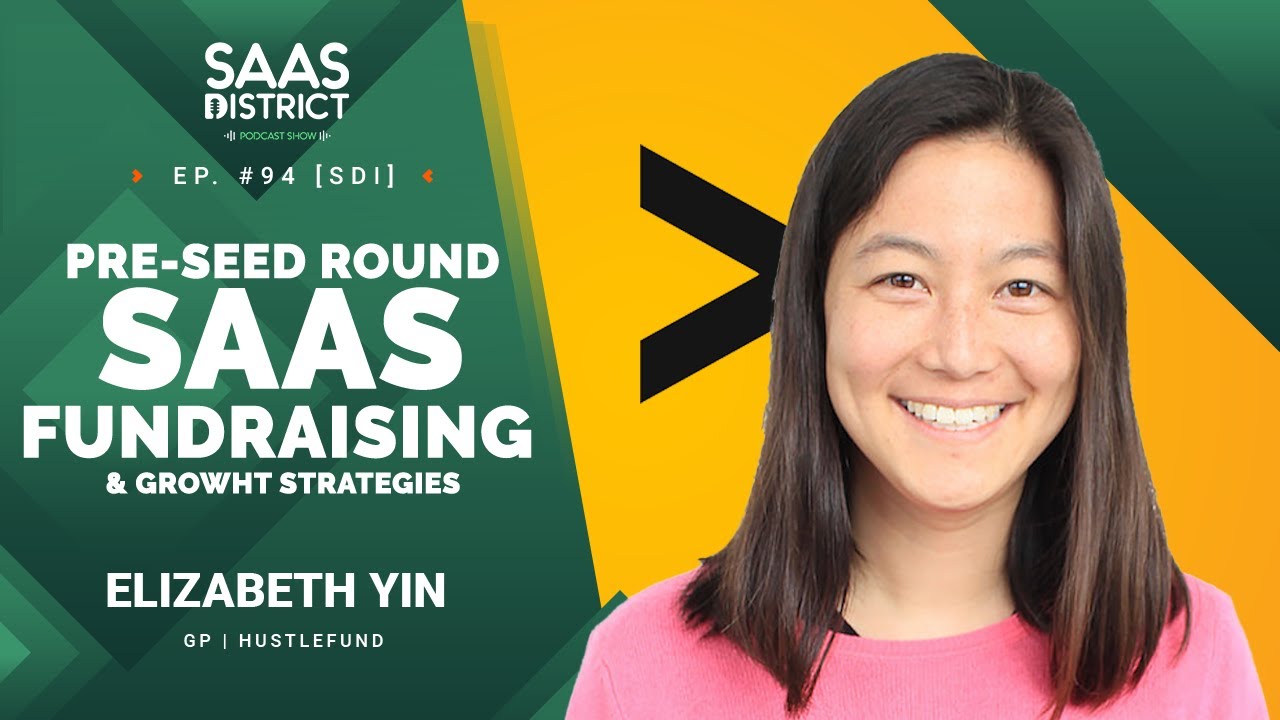
In this SaaS District episode, host Akeel Jabbar interviews Elizabeth Yin, co‑founder and general partner of Hustle Fund. Yin recounts her journey from a Google engineer to founding the ad‑tech startup LaunchBit, which she sold in 2014, and then transitioning to venture capital via 500 Startups and eventually creating Hustle Fund, a pre‑seed fund that writes $25K checks. She explains why Hustle Fund focuses on the earliest SaaS startups, emphasizing two core evaluation pillars: the founding team’s scrappiness and the market pull (potential for strong product‑market fit, low CAC, high LTV). Yin shares concrete growth benchmarks (50‑60% month‑over‑month growth as “fast,” 30% as “very good,” 10‑20% as acceptable) and discusses how differentiation and competition affect CAC and growth. The conversation covers Hustle Fund’s investment preferences—primarily SMB SaaS, rare enterprise bets due to limited runway, and a geographic focus on the US, Canada, and Southeast Asia, with legal entity considerations. Yin describes the fund’s support mechanisms: the Redwood School workshops, mentorship, and hands‑on help with analytics and go‑to‑market tactics, recommending foundational reading such as SaaStr, Predictable Revenue, and sales playbooks. She also shares operational challenges of running a fund (branding, fundraising, scaling the team, creating playbooks) and personal reflections on entrepreneurship as a career, encouraging founders to treat each startup as a “shot on goal,” embrace failure, and iterate across multiple ideas. Practical details are provided about check size, application process (direct website submissions accepted), and how to contact her via Twitter.
Chapters
This episode is sponsored by Contentfy, a premium video editing and content repurposing service for busy content creators, influencers, brands, podcasters, YouTubers, and marketers. Contentfy provides unlimited end-to-end editing and repurposing services to help you get your video and audio content edited and repurposed quickly, easily, and reliably. Join other busy content creators, founders, brands, and marketers who now spend even more time creating while they take care of the rest. You no longer need to worry about spending hours editing anymore. Just create content, build your audience, and grow your business. If you're a content creator looking to save time and money, or looking to outsource your content marketing team, get your first free video edited now at contentfy.co. If you'd like to sponsor the SaaS District podcast or recommend any guests that you think would be valuable to be on the show, visit horizoncapital.com/saas-podcast today. Thanks again, folks.
Thank you.
Hello, hello everyone. This is your host Akhil Jabbar and welcome back to another episode of SaaS District. Anyway, before we get started on our episode, we have a quick announcement to make. Since we've been kind of diversifying our content and for you, our listeners of the show have been asking for it, we'll be segmenting the episodes from now on into 3 different categories. So number one is the investors, where we talk with top leaders in the VC and investment space like we have today. We have the pitch, where we talk with founders ready to seek funding and want to pitch their ideas to get feedback. And then third, obviously, is the classic episode where we talk with top leaders, founders, marketers in the SaaS industry. So just look for the color in the episode cover. Green is for investors, orange for the pitch, and blue is for the other episodes for founders. So Thank you so much for your feedback, guys, and please let us know what you think. We're constantly looking to make more, uh, find more ways to improve our content so that way we deliver it and you can get the most out of it. Now let's get to today's episode. We'll be talking about how to fundraise your SaaS at the super early stages, your pre-seed round. So today we have our guest Elizabeth Yin joining us. Elizabeth is the co-founder and general partner at Hustle Fund, a pre-seed fund for software startups and entrepreneurs. In the past, Elizabeth was a partner at 500 Startups where she invested in seed-stage companies and ran the Mountain View Accelerator. In a prior life, Elizabeth co-founded and ran an ad tech company called LaunchBit, which was acquired in 2014, and has— she has a BSEE from Stanford and an MBA from MIT Sloan. So she's seen over 20,000 startup pitches from around the world in the last few years and helped several portfolio founders raise hundreds of millions of dollars. So welcome, Elizabeth. Super excited to have you on SaaS District show today.
Thanks, Akeel. Thanks for having me. I'm excited.
Awesome. So obviously, I'd love to hear a little bit more of your background of what you did. You have your past venture, I think was called Verbaite, or sorry, the one that was acquired, LaunchBit. Can you talk a little bit about that and maybe any failures you've come across?
Yeah, sure. Actually, I'll take it back even just slightly further. So I previously worked at Google, had a nice cushy job there, and in late 2008 decided to leave to start my own company. Probably not very good with timing, but it actually turned out to be a good thing because I had no idea what I was doing. I had a lot of meanderings, side projects that went nowhere, just a lot of what most people would call failure for over, you know, certainly over a year, if not closer to 2 years, before, you know, heading down the path of figuring things out. Ended up building out an advertising technology company called LaunchBit. Grew that over the next several years, and then sold that in 2014. And I became an investor after that, you know, after doing a lot of mentoring of companies, both at 500 Startups and outside, and doing some angel investing, and certainly investing through 500 Startups' high-frequency model as well, and then ended up starting my own VC firm about 3 years ago called Hustle Fund. So entrepreneur turned accelerator manager turned VC.
Super cool, so you've done it all, you've started a company, you've exited, now you're kind of, you know, you've mentored, advised companies, and now you're investing back into the overall kind of ecosystem, so, you know, obviously being acquired is like a dream of every company when they start off, I think it's the end goal for many SaaS entrepreneurs, we know some entrepreneurs, for example, Peldi from Balsamiq, he's an awesome founder, but he's like, I want to keep this company forever, can you share what that moment was for you, when, you know, how was that your life You know, going through an acquisition, and how did it change your life afterwards?
Actually, you know, it's funny that you bring that up because I think like many entrepreneurs, at the beginning of my journey, I felt like that would be an amazing milestone. But it's actually slightly depressing, as funny as that sounds. And here's why. Actually, when you think about it, people who sell their companies, to some extent, it's because, um, they were either too tired to take it to the next step Or they— so they were kind of burnt out. And many people do do that, unfortunately. And we can talk about that. But— or they just couldn't really grow that much more. And an exit is the better alternative. And so when you think about it, it actually is not really a success moment as much as you might think. I mean, it's certainly nice. But I think there is this moment where you've worked so hard, and this moment comes. And then you give away your baby and it's like, now what? I remember after sending over sort of the last pieces of information for our database on the day that we closed, I just remember sitting on the couch feeling like, wow, it's really over. It's really over. And then, I mean, then you have literally nothing left because you have spent your whole life working towards that. I mean, that's obviously an exaggeration. There are many things that are important in your personal life, but in your professional life, you literally have nothing left. And so it, you know, for me actually in building out LaunchBit, I actually see this as a startup journey where I'm never going to sell. Like, this is, this is what I am doing and I'm going to have this for my whole life.
You mean Hustle Fund?
Hustle Fund, yeah.
Hustle Fund. Interesting. So, you know, looking back now, you know, obviously some people get tied to that, their identity is tied to their business. I mean, that's what gives them purpose in their day. And so, you know, gives them, makes them feel alive and what they feel passionate about. So, you know, you sell that baby, now you're at that stage where you're like, what, what do I do now? I just gave away everything that I've known to, to be. Um, you know, looking back now, would you have done it again at the time that you did, or would you do something differently?
I, I think I would have for some of the reasons mentioned. I mean, I think if I'm going to be honest, like, we, you know, we had some internal struggles in our company, and frankly speaking, that is why we sold. You know, I think if everything had been nice and rosy and in all fronts, whether it's on the team front or on the growth front, we would have probably continued, right? I think that's what actually ends up happening. And, and so this is why I say that, you know, acquisitions are, are not as rosy as people think. Certainly built it to a certain level and then you get rewarded for that. But, you know, if things are really rosy, then you just keep going.
That's true. That's a good point. So shifting gears, let's talk about Hustle Fund. So Hustle Fund, sorry. So TechCrunch, many founders, a lot of people in the VC space, you know, they love your guys' fund. What truly makes Hustle Fund different from all the, you know, the VC or pre-seed stage funds out there?
Yeah, so I think as I kind of alluded to, coming actually into Hustle Fund or starting Hustle Fund is less about, oh, Elizabeth wants to play VC. You know, I had actually never thought about becoming a VC before. I didn't really know very much about it. Then one of the things that I was thinking about, actually, after selling LaunchBit, I was trying to figure out, okay, what company do I want to start next? If it's a company that I don't ever want to sell no matter what, it's got to be a problem that I want to spend my whole life on. That's really hard to find a problem that you are so dedicated to for 30, 40, or more years. For me, like, I— it took me a long time to kind of figure that out. But at some point, I realized, you know, 2 or 3 years in, actually, if I look around, you know, one of the problems that I'm really passionate about that seems to be a big problem is like how entrepreneurs get resources. It was certainly a problem that I faced personally. But then in looking around, it also seemed like a problem that many other people face. And, and so Our first foray into solving this problem actually is with Hustle Fund VC. But you can imagine there are actually a lot of entrepreneurs out there who will never get VC money. So, so what do they do? And it's really, really hard to get on that first rung of the ladder. And so for us, that is the overall problem we're trying to solve. Our VC is the first step towards that. But, you know, expect to see more from us. And actually, we recently announced that we have a separate revenue-based financing fund. that is run by a different team. I know nothing about this, but revenue-based financing is essentially like entrepreneur-friendly debt, and that can be a great source of funding for companies, especially SaaS companies that will never get VC funding or where founders don't want VC funding.
Yeah, that's an awesome alternative for people to look at. So you're mentioned in an article as one of the most interesting VC operators today, right? You've reviewed over 20,000 pitches. You're partnering at 500 Startups, and, you know, some people mention as hilariously early-stage startups that you work with. How different is it to deal with these super early-stage startups, right? You don't have established revenue, they don't have accessible models, they don't have product-market fit. What's kind of the general investment strategy? How do you, how do you look at that? I mean, that's, that's tough even for me to look at it.
I would say that it's really fun, but I think it's an entrepreneur's game for sure. I think, I think for people who are VCs who have not been entrepreneurs before, this would not be a fun stage because it's like, oh my gosh, so chaotic, like nothing is working. But as an entrepreneur, you see the exact opposite. It's like so much hope and so much potential and so many different directions this can go in. So, but in terms of then, well, how do I vet companies? Because there really is nothing there. And we invest pre-traction. So what exactly are we looking for? And I think the honest answer is there's just a lot of intuition, and that intuition could Could be right or wrong, to be honest. And I think when it comes down to it, there's intuition around 2 main areas. One is team, and the other is market pull. Around team, I think it's certainly subjective, but, you know, the kinds of things that we look for is probably no different from any other VC— scrappiness, hard work, tenacity, ability to learn, ability to, you know, to do a lot with little. So a lot of our founders tend to be more frugal at this stage as well.
Hmm.
On the other side, though, that, that's the harder side, I think. And, and I would even argue the more important side, more important actually than, uh, the founding team, which is potential for product-market fit. So what do I mean by this? Well, when you think about business, actually conceptually, it's very simple. The hard part is the execution. And, and what do I mean by that? It's like, well, you have costs. The cost to acquire your customers is probably the big one to worry about. And then you have revenue, you have money you're bringing in. So money in and money out. And how do you get more money in with less money out is the name of the game. And, and so there's a number of things that affect that. One is differentiation and competition. Like, you know, differentiation and competition affect your CAC, your cost, customer acquisition cost. If it's a really crowded channel, Mm-hmm. either as indirect competitors or direct competitors, Your CAC is going to go up, and you know, so that's a factor. And then if you if you don't have enough, I would call it margin, but I'm talking about like dollar margin between your lifetime value and your CAC. Like there's not a whole lot you can spend to keep pouring money back into the business, so that affects your growth. So there are all these different levers around that that we think about subjectively. Like do we think that the CAC can be really low here? But more importantly, do we think the lifetime value can potentially be high here because of all these characteristics? And that is very subjective since there are.
That's what I was gonna say. What do you look at? Like, uh, just companies you've invested in the past, similar business models, and then just kind of make kind of, you know, gauging, uh, comparisons in your mind, or just what you've seen over the last 20,000 pitches?
There's a, there's a lot of comparison. Like, I think if we're just talking about benchmarking growth, it's really hard to say in isolation whether a company is growing fast or slow. But what we really mean by that is, is a company growing fast or slow on average compared to all these other companies you see? And I would say fast growth in today's market is 50 to 60% month over month at a sustained rate for many months. I would say that very good growth is 30% month over month, which I think is, you know, if you can get 30% month over month growth, you know, sustainably for many months, everybody will want in.
Nice.
Anything below that, 20% month over month, 10% month over month, that's not bad. It will be harder to raise.
Um, come, that's when you come talk to us.
Yeah, so I mean, and that's not bad. I mean, there are plenty of great companies that can be built on 10% month over month or 20% month over month. But this is why, going back to the point of like, you know, VCs have limited dollars, so where are they going to put their dollars?
Yeah.
And what about everybody else? There's got to be great alternatives for everybody else. Because those can be great businesses, and you as the entrepreneur can make a lot of money. I have friends who have made, you know, tens of millions of dollars on those kinds of businesses. VCs didn't want to touch them.
Exactly. Yeah, different— they're just different investment thesis and model of what they're looking— the returns they're looking for. Um, what would you say is like the most common reason you would turn down an offer to invest in any SaaS company specifically? So you said team, you said product, and a lot of SaaS companies are pitching you. What's kind of the, the thing that you're seeing repeatedly that you're, you're, uh, Turning down these deals?
Oh, to be clear, I said team and market pull. So market pull is like how easy it is to sell this at a low cost. And, uh, the biggest reason would be if I feel like there's too much competition or not enough differentiation, because that affects your CAC. Like, that's gonna make your CAC go really high. And so it means you'll have to slow your growth to, to go after cheaper channels or free channels, which, which is kind of how we end up in this situation, right? But if you wait long enough, then, you know, 10% month-over-month growth Right.
Yeah. And have you, have you seen across kind of your entire portfolio of Hustle Fund, or even the past, um, have you seen any trends or maybe common traits among, you know, the more successful founders which you can pinpoint and have performed better versus like the, you know, mediocre ones that failed?
So I actually think that success and failure is less to do about the founders and more to do actually with this market pull concept. So picking an idea that actually has really strong market pull is a lot of luck. But if you happen to land on it, you can do really well even if you are, quote, only okay. But I think if we're just talking strictly great founders, like, who would I want to place in a company that has great market pull? Like, I think, you know, sort of the usual things: scrappiness, um, ability to learn quickly, um, you know, tenacity, hard work.
Hustle, hustle. You should just be saying hustle, hustle, hustle.
Yeah, yeah. The ability to execute with velocity is what we consider hustle to be, and that is something that's very important to us and founders.
Love it. And what have you seen, let's say specifically in the SaaS space, you know, with your focus on investments, what are some of the growth strategies you found to be more effective over the past few years for those markets and segments that have done well?
You know, it's funny, actually within SaaS, the interesting thing is there are a lot of repeatable playbooks regardless of industry, you know, certainly predictable revenue, By Aaron Ross is one of my favorite books, and I would encourage everyone to read it. And that process still works for many companies. The key thing, though, really is this differentiation and competition thing. If you are the, you know, 30th marketing automation platform that's competing against HubSpot, it's going to be really challenging to execute that playbook for your product. But I've seen it work really well for highly differentiated products. So I think it really is about that differentiation. And, and, you know, how are you really different from all these other players? And then you can use a standard predictable revenue playbook to work, or the HubSpot playbook, which is more inbound— create content, gate it with a landing page, collect business email addresses, and then you can drive traffic to those landing pages either through paid acquisition or partnerships.
Hmm. Do you guys also invest on the enterprise B2B SaaS side as well?
We have a little bit, but it's very rare. And the reason is we're a small check, and enterprise companies have to be able to survive for about 2 years before they land a really large enterprise client. So, so when I do invest, I really have a heart-to-heart conversation with, with those founders, like, you know, that No other VC is going to give you money for the next 2 years. You're not going to be able to bring in revenue or big revenue except from these small pilots. So you really have to be willing to bootstrap and eat glass for the next 2 years, and your life will be absolutely miserable. But if you're willing to do that, I'm willing to invest.
Interesting. So if they're willing to stick it out for 2 years, I mean, that's a challenge, right? Starting off with enterprise, I mean, not recommended, highly, you know, patient testing, but if you can figure it out, you know, You've got some serious skills or patience behind you. What are your typical check sizes? You guys mentioned, are you guys doing the entire round, the entire financing of the pre-seed, or what's typical check sizes?
Oh, just $25K, and that's why it's even more important for enterprise companies to be aware of the situation, because there's not a whole lot you can do in 2 years with $25K. But we do often help actually our founders bring in more money from other investors. Like, I've done introductions for probably 80 to 90% of our portfolio. But I would say that for enterprise companies, unless you're particularly well-connected in a, in a particular domain, it is really challenging to get other investors to hop on board at pre-seed if you don't have a pilot, or even if you do have a pilot that's not paying very much in enterprise.
Right.
Unlike sort of more SMB SaaS, where you can kind of show a consistent growth and you're bringing in revenue and that kind of thing.
Right.
So what is it? Enterprise— oh, sorry. The enterprise— the irony is enterprise companies actually can be way, way bigger. But anyway, this is kind of how the landscape is.
Yeah. Yeah. Patience is rewarding, I guess. Right. Um, so you guys are investing $25K, you know, pre-seed round. What's kind of the playbook? You know, usually you guys help them to grow, or what are some of the most common pain points you see, uh, these SaaS founders have at these early stages? Are they You know, just trying to build that product with that, with that money? Are they just trying to get out there and validate? How are you helping them?
We invest post-product. So because we only are investing $25K, we kind of need to be at the spot where founders can start running and getting sales right away to bring money in the door. And so as such, we actually have something called Redwood School, which is an internal program for our portfolio founders where we teach tactical growth. And it includes, it's basically a series of workshops that includes everything from outbound sales to partnerships, lead gen, you know, through paid acquisition around specific channels. And, you know, so, so we do try to help our founders with some of those things. We pair them up with mentors, people who are actually doing sales and marketing in, at fast growth startups. And that hopefully helps them get their, some of their questions answered or get some guidance on some of these things. I think that typically our founders already have a pretty strong understanding of their customer persona coming in, but I'd say that they're not typically well— I don't know what the right phrase is— tooled on the infrastructure side to be able to measure correctly. A lot of people set up Google Analytics, but as it would turn out, a lot of people also set up Google Analytics incorrectly.
Hmm.
So that's something that actually somebody on our team goes around and checks with every team to make sure that even just like the goal tracking is right.
Of course, yeah. So, you know, a lot of our listeners are kind of all over the world. We have people in South America, Europe, Asia listening in. Obviously, the accessibility to capital is always a challenge, you know, if you're not in the Bay Area or, you know, the other hot startup areas. Um, are you guys investing outside of the US? Are you— have you invested in businesses elsewhere? Um, what are you guys looking at on that side for, you know, where you guys are investing? And is it only SaaS, or what, what kind of startups are you working with?
Yeah. So our focus areas for this fund are the US, Canada, and Southeast Asia.
Mm-hmm.
And we hope that for a future fund, we can go truly global. But, you know, I think that we are starting to take the steps to work in that direction, but we're not quite there yet. We largely invest, actually, outside of the Bay Area. I think the Bay Area is, in general, quite frothy, and there are a lot of great founders and teams in in other markets. Um, you mentioned that you're from Canada. Toronto is one of my favorite places to scout for companies, actually. Most of our companies are B2B, but, um, you know, we will look at a lot of software companies to, you know, anything that makes money is in software is an area that we are willing to look at.
Um, and sorry, do they have to be, you know, registered there? Do they have to be physically living there, or what is the kind of the, the criteria there? Because I know people, you know, Like, I'm here in Mexico, but, you know, my companies are all in Canada or US, right? So—
Yeah, and I think the definition of geography is absolutely nuts these days, especially during COVID Like, what does it mean to be in a place? So, I mean, I think for us, it, it's from a legal perspective first and foremost. It's just a lot easier, frankly speaking, for a US VC to be investing in US companies, right? Um, we also do invest in Canadian and Singaporean entities, but We've kind of been able to figure out the legal infrastructure for these places, unlike in other places such as say the UK, where it may be a great idea to invest there, but we do not understand the legal system. So so that's a big big reason for these geographies. But as far as where you physically live, you know, I don't care about that. We've always done all of our meetings with our founders over Zoom, even from day one pre COVID. But I think geography does affect your knowledge to some extent. Like sometimes we get founders who want to sell to the U.S. market, and they're somewhere else, and they. have never met an American before, I think that's really hard. And I think also being in a challenging time zone makes it hard to scale your company as well if you're selling, let's say, to the US market and you're somewhere completely different. Not impossible and not always, but we take it case by case.
Yeah, yeah, that makes perfect sense. So besides capital support, right, if you're a founder, you need capital obviously to run some kind of experiments, test, you know, Validate your business and get your product out there. What are some underrated resources that you generally share with startups or founders that maybe they can help them leverage to grow their business other than the capital?
I think a lot of people feel like their number one issue is they don't have money, and I can understand that. Yeah, but I also think that a lot of founders don't think about go-to-market deeply enough before starting their company. So I think for SaaS founders in particular, what I would read before starting a business, I would pretty much read all of SaaStr's materials by Jason Lemkin and team.
Mm-hmm.
I would probably also read Pete Kazanjian's new sales book on building sales teams and doing sales for startups. And I would also recommend Predictable Revenue by Aaron Ross, which is the repeatable outbound sales process. These may all seem like sort of dry suggestions, but they're incredibly informative to how do you actually do go-to-market. I realize it's more sexy often to try to go and raise money than to read about how to build a business. But I think that's what it takes.
That's, that's a, that's a really simple but effective point, right? focus on building your business, don't worry about raising capital first, right? And learn, you know, by experiment and trial, and learn from the best who've done it. Elizabeth, you know, this kind of rapid-fire questions, but kind of more personal. What's one advice you wish you had known and would tell your 25-year-old self now if you're building a company?
Yeah, I think entrepreneurship is a career, and when you think about actually VC portfolios, they have many shots on goal, Like maybe they have 20 companies in a portfolio and maybe 1 or 2 make it big, usually 1. But when you think about entrepreneurship, what I see a lot of people do is they start a business and it doesn't go well and then they stop. And maybe it's not for them and maybe that's kind of the right learning. But I think if you, you should look at it more as a career. Like if you actually really like starting businesses, I would just keep going because really you should think about it as, do I have 20 shots on goal in my life? And will one of them work out? And I think that's the right way to think about it. The portfolio of your own companies that you start is really important. And so I wish I had kind of thought more methodically when I was 25 about how do you go about starting businesses. And I think embrace failure a bit more. And, you know, I think just like thinking about entrepreneurship more methodically in this way.
How would you approach that strategy? So let's say, you know, I'm at this stage, I'm looking to, you know, diversify my risk on starting this company, starting this new company. Do you come up with 10 different ideas and you rank them, and then you come up with, say, okay, this is my, my top 1 or 2, I'm gonna actually go out and validate and try this business model? Or do you say, I'm gonna put, you know, try these 10, put some, you know, if you can do all 10 at the same time and, and see what sticks?
Yeah, so I think this actually is— you're hitting it on the nose of, I think, what I didn't say very clearly is, um, I would— I wouldn't— so number one, I wouldn't get tied to any idea. But that is a common thing that founders do. I certainly have, which is the first-time founders, which is like, oh my gosh, I love this idea, I'm gonna go and do this idea. But usually that idea is not a good idea. I would be more agnostic about like, okay, what is this like maybe you have a problem that you're really passionate about solving, but there are 20 different ways to get at that problem or get at peripheral things in that problem set, right? So what I would do is I would latch on to what is your mission, who are the people you want to help, what is the overarching issue you want to solve, but not get so deeply ingrained of like, I want to be on this idea. And then to your point, then I would start doing customer development to learn more about this and then have some hypotheses around what the solution might look like and try them one at a time to see kind of like, does something seem very promising here? And I realize that's, that's a little bit hard to tell, like, well, what does it mean to be promising? This is so early, there are not that many customers or not that many people or whatever. But like, really be honest with yourself. Number one, by doing this, you can actually compare them against each other, which is essentially what VCs do, you know. A company in isolation is a company in isolation, but if you have 10 companies to choose from, you can decide who to invest in. Similarly, in your own portfolio, if you're work— if you have 10 different experiments going on, you can definitely tell who's the best.
Right.
Because you have, you have a comparison game. So, so that's, that's one thing I would do. And then the second thing is just being really honest with yourself. Like, even let's say you pick the, the one that's the best, like, are these people really buying quickly? Like, I talk about, you know, sort of 50 to 60% month over month, which is an extreme. But like, are these people going to close like really quickly at that kind of clip and that kind of level? And if the answer is no, maybe you continue on experiment 11, 12, 13, etc., and not, not get tied down to something too early.
Yeah, I love that approach. It makes perfect sense. Um, Elizabeth, what are some of the biggest challenges you're currently facing right now to grow kind of your fund and expand your portfolio? What What keeps you up at night?
It definitely changes. I mean, I think, you know, in the beginning— so we're about 3 and a half years old now. And in the beginning, like, we were definitely a startup. I don't think most people think of funds as startups, but they really are. When you think about startups, they have problems with marketing. Nobody knows about them and customer acquisition. And then the other problem is fundraising. We don't have any money even as a fund. So You know, day one, what do you do? You have to address essentially both of those. Like, you have to get your brand out there at a low enough CAC, and you also have to raise money, especially for a fund, otherwise you're not in business.
Sure.
So, so that's, that was, I think, you know, the typical startup challenges of just getting on the first rung of the ladder that we had as well for probably, you know, certainly the first year, but even beyond the first year, we continued doing that for, I would say, the last 3 years. Now, we recently announced our close of our fund 2. So, you know, we are actively working out of our fund 2, but, you know, fundraising is still something that we, we work on informally, even though we're not technically raising for anything, and building those relationships with potential investors. But, um, now that we've gotten going, I think we're sort of in the next phase, which is very common for any startup, which is sort of Team building. We now have more people. Like, how do you onboard people, reduce the chaos? How do you teach somebody else, like, how you invest? Like, similar to a startup, how do you teach somebody else to do some playbook? And so creating the playbooks, creating the processes, just common scaling up and hiring problems. And we've hired, we've hired great people. It's just like, how do you get them onboarded in a way that's not chaotic? I sort I suppose is the right phrase.
Sure, that makes perfect sense. Just like building another startup, right? Nothing difficult.
It really is.
I know it sounds so easy, right? Just to start a fund. Oh, people give you money, then everything becomes easy. But no, now you got to know actually how to use that money effectively, how to manage it, how to get people to manage it as well properly. Yeah, it's not as easy as it sounds, right?
Well, I think to give people a sense, for our fund one, I counted, we pitched over 700 people. I don't think most people realize that is what you need to do to raise a fund. I know other fund managers who have pitched more people than 700, and I didn't even count the number of meetings on our Fund 2, which is a larger fund and took a bit longer to raise as well. I'm sure it was well over 700.
Wow. So can you share the numbers there? Like how many, how much you actually raised on the first fund and the second fund?
Oh yeah, yeah, yeah. Our first fund was $11.5 million, and we just announced our Fund 2 last week. And $33.6 million, so we tripled our fund size between Fund 1 and Fund 2, but I mean, it just took a lot of meetings for both of them.
Wow, so it's very similar to raising a fund for a company, right? Nothing changes.
Yeah.
Yeah, cool. Elizabeth, you know, you've had an exit, you're doing, you know, obviously doing fairly well with your fund right now. What does success mean to you today, whether it's personally, financially, business life? There's no right answer.
I would say that actually tying this back to your original question, I'd say one thing that I feel very grateful in my life— actually, nothing really has changed about my lifestyle. I'm still incredibly frugal. But one thing that's nice is sort of the peace of mind of I can— like, I don't have to work for anybody ever again. Like, I don't have to worry about that. I can work on my own stuff.
Mm-hmm.
And that is a relief feeling as an entrepreneur that is so, I think, helpful, especially actually in starting a fund. When starting a fund, not only do you have the same issues in starting a company of, oh, when is money coming in the door, and I have these people to pay, or whatever it is, but in addition, when starting a fund, you often have to put in your own money into every single fund. And You know, to jumpstart the fund, we also had to do our own direct investing and then roll it into the fund later before money even came in. So there are additional financial burdens in starting a fund as well. And I think that, you know, as a founder, one of the things that I was just constantly worried about was actually money. How am I going to pay the bills?
Hmm.
I had some weird side gigs to pay the bills as well. And I think just sort of that is like the number one thing that I value. And I actually don't think that people need to be super rich to get there either. Like, I'm a big avid reader of Mr. Money Mustache. I don't know if you read that blog.
Sure. Yeah, he's awesome.
But yeah, I think that kind of FIRE, whatever movement that's happening—
Financial independence, retire early. Yeah.
Yeah, is, is actually great because it helps people actually just kind of do what it is you want to do.
Yeah, and yeah, most people think they need that $10 million exit or whatever it is to get there, but it's probably a lot lower than you think, and you can probably achieve it a lot quicker, right?
Yeah.
Yeah, yeah, cool. This has been great, Elizabeth. I really enjoyed this, this conversation. Um, great show for our listeners. Um, where can our audience get in touch with you, learn more about you, and maybe possibly pitch their startup if they're looking to raise some capital?
Yeah, um, so people can follow me on Twitter @DunkHippo33. If people want to pitch us at Hustle Fund, go to hustlefund.vc and submit there. We actually do read every application and respond to everybody, and 15% of our portfolio comes in direct from that website. So, um, we, we do take a look, and some of our best companies have come in directly from there. So you don't need a warm intro and, um, Yeah, we're a very open book, and people can ask me questions on Twitter as well.
Super cool. All right, uh, well, we'll add those links to our show notes, guys. If you guys are interested, uh, say hey to Elizabeth and send over, uh, an application if you guys are interested to raise capital. So thank you again, uh, Elizabeth. Really enjoyed this conversation.
Likewise. Thanks, Akeel.
All right, cheers. Thank you all for watching this episode and joining SaaS District today. Don't forget to like, Subscribe and hit the bell for future episodes where we interview top leaders in the SaaS industry. If you're a SaaS company looking to grow and unlock the true value of your business, get in touch with us at Horizon Capital and myself or one of our consultants will provide a free assessment to help you get there and hit your goals. If you have any feedback or suggestions for this podcast, please comment down below and help us improve our content for you all. Thanks again, and see you on the next one.
More from Akeel



Get a mentor as soon as possible — and make sure it’s a mentor in your space.




Keith Gillispie: Why Most New Investors Fail & How to Avoid the Common Traps #250 | SaaS District



