Garet Mehrguth: How to Blend Short and Long-Term Thinking when growing your startup
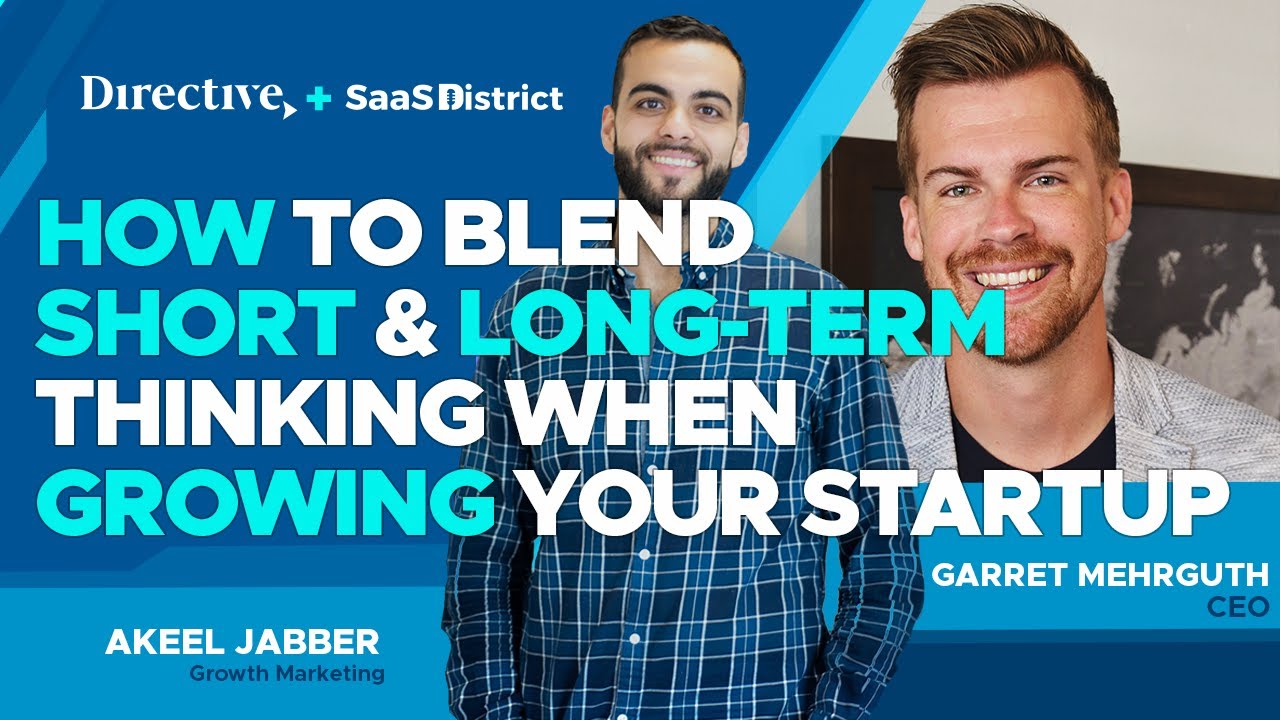
In this SaaS District podcast episode, host Akeel Jabber interviews Garrett Mehrguth, CEO and co‑founder of Directive, a performance‑marketing agency for software companies. The conversation covers Garrett’s bootstrapped origins, the evolution of his agency, and a deep dive into the strategic mindset required to grow SaaS businesses sustainably. Key points include: the importance of positioning and reducing psychological friction to move prospects from demo requests to product activation; how LTV/CAC modeling, demand‑gen budgeting, and creative incentive structures (e.g., gifting prospects) can improve acquisition efficiency; the role of data‑driven benchmarking via the Pulse analytics hub; the use of OKRs and quarterly planning to align teams; balancing short‑term revenue targets with long‑term brand and product development; content strategy that prioritises problem‑solution relevance over SEO‑driven volume; scaling sales and operations while maintaining high‑margin pipelines; and personal habits, mentorship, and tools that inform Garrett’s decision‑making. Throughout, Garrett emphasizes common‑sense, experimentation, and a willingness to invest in long‑term brand equity even when short‑term metrics pressure the business.
Chapters
This episode is sponsored by Horizon Capital, an M&A and micro private equity firm that acquires and grows SaaS companies. Horizon Capital only works with SaaS companies generating between $500K and $5 million in annual recurring revenue, where they help them unlock the true value of their business and scale to the next level. Whether you're ready to move on to your next startup or want to work with the right growth partner, Horizon's team will work with you to find the best structure possible. From M&A strategy to capital SaaS is all they do. Simple as that. If you're a SaaS founder with less than $5 million in annual recurring revenue and are looking to sell your business, visit horizoncapital.com today and get a free valuation. If you'd like to sponsor the SaaS District podcast or recommend any guests that you think would be valuable to be on the show, visit horizoncapital.com/saas-podcast today. Thanks again, folks. Hello, hello everyone. This is your host, Akhil Jabbar, and welcome back to another episode of SaaS District. In today's episode, we'll be talking about how to blend short and long-term thinking when growing your startup. Today we have our guest Garrett Mayer-Groth joining us. Garrett is the CEO and co-founder at Directive, which is a next-gen performance marketing agency for software companies. Since he founded in 2014, Garrett has led Directive in an expansion of 5 new locations in LA, San Francisco, New York, Austin, and London. He has led them to a 300% year-over-year growth rate and now boasts a team of more than 50 people with over 9 nationalities from his headquarters and home of operations. As a thought leader, Garrett has been published by Salesforce, Moz, Marketo, Ahrefs, Convince and Convert, and many, many others. He's also been a speaker at many conferences such as Digital Summit, State of Search, General Assembly, Moscon, and several, several more. Outside of work, when he's not writing a reading up on digital marketing and the latest trends, Garrett spends his time indulging in his passion for ocean sailing, fishing, and sailing with his family. So welcome, Garrett. Glad to have you on SaaS District today.
Glad to be here, man. That's a hell of an intro.
Not too bad, eh?
Gotta talk to my team, man. They gotta cut that down. Glad to chat with you, Akeel.
Lots of good information there. So cool. So yeah, just, you know, we've never met before. You know, a couple of people in our audience may have never heard about you. Can you just share a bit about your background, some of your past ventures, and what was the problem you were looking to solve when you decided to launch Directive? I think it was in 2014. Yeah.
Yeah. So, I mean, I wish I had some grand vision of some opportunity to solve in the market. That really wasn't how it went down. So I wanted to get in consulting. I applied to some consulting shops, and the ones I did, like, I didn't get— like, I got like auto-response emails where they had like application portals, and I just like didn't— like, my university wasn't even in the portal. It was like other, and then you get the auto-response.
Cool, thanks.
Like, good, good. So I mean, from there, man, I was just like, okay, I'm gonna like, what do people think I'm good at? And then I figured, you know, older people had money and they didn't know the internet and they figured I probably did. So I just read a bunch of blogs on like SEO and PPC, started my own shop, got some small accounts, brought my best friend on to help run the accounts, and then kind of just went from there. Like, I think we started like $20 or something and just kind of Yeah, I grew it.
So for anyone else who's looking to start their own marketing agency, so you didn't have any other like external capital to start off or it was just like you had, like you just everything bootstrapped just by yourself getting up? Yeah.
I never worked anywhere before. I mean, I had like odd jobs, John. Like I would be like a janitor at college. I worked at the Chamber of Commerce. I was like an independent contractor for some like family friend. Like, but I never like had worked at a corporation, was a W-2, never didn't have any capital. My parents were missionaries, so I mean, they're not exactly loaded. Um, like, it's pretty low on the economic food chain of like, like financial support from your family when they're missionaries. So it wasn't like— nah, man, I just kind of— I don't know, if you make more money than you spend, you still have money, right? So you don't— and then you just figure it out, right? Like, I don't know. Yeah, I don't think it's that complicated. I think sometimes people get a little bit carried away.
Sure. And how did— could you mind sharing, how did you get your first few clients? Like, were you just reaching out, or people in your network? Were you cold calling?
What did you do? Yeah, so the very first client was a shawarma shop. So I had this shawarma shop. I was like, so I went to college kind of in the hood. It's called Azusa. It's in East LA. It's not like an affluent area, but it was like in a crappy strip mall, like Class C building. I got a shawarma guy. I was driving around my old 1973 Peugeot moped. I drove over there and handed out a flyer and I told him I'd help him make a Facebook page and a Yelp page and I'll hand out flyers for him. I'll get more people to come to his shop. So I kind of did all that, um, did it for 30 days, came back to get my check. He said come back tomorrow. I came back, the whole place was boarded up. So that was the very first client. I got stiffed on the check. Yeah, man, it's like, the thing is like nothing's perfect. Nothing actually works. Like that's what I'm really about. Like none of your plans actually work. Like you just got to keep moving, man.
So sure, just take it and go take the punch and the hit and keep rocking.
Just keep going.
Keep going. Cool. So now Directive obviously doing really well. You guys are a leader in the performance growth marketing. You have a dedicated team for software companies. So when you're working with SaaS companies, once the team is aligned, what's your typical playbook or strategy execution to get those results? What are you doing now? Still handing out flyers or you got something better?
I mean, flyers are big, man. You know, flyer to demo rate, pretty badass. There's no, there's no, like, the playbook is common sense and the— we have frameworks, we have approaches, we have a really sophisticated approach, but nothing plug and plays.
Okay.
Everybody's so worried about scale, they forget about what creates it. In other words, like, I see it's also, it's the same thing that agencies say, the problem with SaaS, right? People are like, well, is it scalable? How are we gonna do this? But then they have no retention. If you have no retention, you have no capital to flow on growth margin to fuel your customer acquisition costs. Your LTV/CAC ratio gets out of whack and the whole business falls apart. And so, in its simplest form, the best way to acquire customers is to get your positioning right. In other words, you've got to solve a specific problem for a specific group of people that's more valuable than what you're charging.
Mm-hmm. Okay?
That's pretty simple. And then, you've got to figure out when there's purchase intent for the thing I sell, is my brand discoverable? So if I'm selling an EDI software or something in DevOps and someone— or security software for Kubernetes and someone searches Kubernetes software and like an old client of mine, Sumo Logic, where I did everything for them pre-IPO, doesn't show up, well, you can't capture the demand you generated from all your field marketing or whatever that was, right? So enterprise is different than like freemium and all these SaaS companies are different in how they grow. But in simplest form, it's like you have to have this strong value prop. It needs to be frictionless to engage with you digitally. In other words, everybody in SaaS loves to do request a demo.
Yeah.
It's like the world's worst call to action. It sucks. It doesn't perform well. It stinks, but everybody does it. What you're better off doing is figuring out how to get people into your products. If you just have context, a lot of the big accounts, like we just got ZoomInfo, for example, these types of accounts, they're trying to get people into their products as quickly as possible, like Sumo Logic, quickly as possible. I'm trying to think of another big one we just started working with. I forget the name of them off the top of my head, but they're trying to get back to devs.
Yeah.
All these companies are trying to get back to allowing developers to install their instance into their dev environment, get into the product. And then marketers are doing everything they can to get credit and everything. And so they're missing the whole game. And so the better we can get people frictionless into value, like what's the first moment that our product creates value and how can I get you there with the least amount of friction as possible? Like that needs to be the game in SaaS. So it's simple when you break it all down. So there's no like magic bullet. It's more just like decreasing psychological friction, Identifying where your true value is, and then making sure you're discoverable when there's purchase intent. You put that all together, now you can start advertising, you can start growing awareness, you can start doing different tricks and campaigns and tactics and ad campaigns, but it really just comes down to the basics.
You mentioned most SaaS companies are using the demo, right? They're pushing them to a demo. They're not getting them to the product. I'm assuming it's a lot more for enterprise or kind of bigger clients. Is anything different there for driving those sales qualified opportunities with PPC or any other way?
No, I mean, yeah, I mean, there's ways to do it, but I mean, I wouldn't say Sumo Logic's trying to get small accounts. You know what I mean? I wouldn't say that. What I've seen is the highest performing companies are really, really good at getting prospects to a point of value in their product exceptionally. Now, With that being said, some people need to give demos. I'm all for that. That's great. But you need to give the prospect something more valuable in real time than they're giving you.
Mm-hmm.
So think about it like this. When someone goes to your website and they request a demo, what's the psychological friction associated with a demo? First thing, it's gonna take my time. Second thing, all I really want to know is price. Third thing, let me just see the damn product and I'll tell you if I like it or not before you have to even explain it to me because I'm not a technological idiot. And if your product doesn't simple enough that I don't understand it on my own, how am I going to get adopted into my enterprise?
Right.
So, you're playing the wrong game. The game should be like, watch a 5-minute demo video. You still have it gated, but instead of giving them a request for demo, they give you their phone number, their email, their personal information, and you say, thanks, our team will reach out in 24 hours. That's why you're not doing better is because there's too much friction associated with getting pricing or seeing your product. So how do we get— if pricing is not accessible, because the way you do it, understandable, then how do we get them into your product? We have to be able to get people to experience your product with the least amount of friction as possible. And your product has to be good enough to sell itself because I'm not a magic worker. I can't make bad products good. Right. And so if you focus there, right, once again, this whole game gets easier.
Yeah, I guess there's always that balance, right, where you want to set a filter too, right? You don't want spend too much time with the wrong, wrong people who are not going to buy anyways and who don't have that intent.
I worry about that though, Akeel, because you can't control firmographics like you think you can. So what I mean by that is the only place that you have firmographic data with control, you don't have intent. And the only place you have intent, you don't have firmographics. So what I mean by that is Google Ads and search engines where people expressly communicate that they want your product do not have firmographics today. There's beta programs that I'm a part of that I'm whitelisted on. They don't work. They're just— the data is not good enough yet. Conversely, LinkedIn and conversation ads is some of the most effective campaigns we're running for our clients right now. But you don't have purchase intent, so you're better off making sure that there's either purchase intent or it's the persona and then allowing inbound SDR to filter than trying to filter pre-value. You still want to give people value because you never know when that person is going to change companies. get a bigger budget, or become a customer, or become, even more importantly sometimes, an employee. Because marketing isn't just about getting revenue from your marketing, it's also about getting your brand in front of all the facets of your business. Because most of these companies' biggest struggle is actually not revenue, it's oftentimes engineering.
True.
So how you build rapport and how you do all this— so it's not about getting great at screening. That's what you want to use lower-level transactional team members for. You have to get really good at decreasing friction and creating value, and then you can monetize or choose. So, someone can't fit with us, I have a learning management system so they can learn how to do everything we do for $99 a month and they can do it themselves. They can join Society, which is a Slack group that's got over 300+ active members. They can use Pulse. They can use our database to figure out what's going on in the space, or They can pay at least X amount and hire us to do services. So you can still ideally monetize all those people at a later date or transactionally.
Cool. So they only have $100 a month now. They start there and then at some point when they grow, cool, we're ready to—
Or they go to like marketers and engineers. Everybody moves jobs every 2 to 3 years.
That's true.
So if you're so short-sighted, right, and that goes to blending long-term thinking, if you're so short-sighted that you have to monetize everybody now, You create a brand that's abrasive instead of embracing people with where they're at. And as long as you can keep embracing people, it's going to come back to reward you over the years in your pipeline.
I guess it's kind of tough though, right? When you're kind of maybe VC-backed and you have some short-term goals you need to hit, it's hard to make those long-term decisions, right? Where you have to hit goals short-term and maybe less thinking about 2 or 3 years down the line.
Yeah, but that doesn't conflict with creating pipeline. So you still don't wanna worry too much about seats.
Mm-hmm.
Is the death of digital demand gen. And that's why, like, so if you do this right, like right now for Directive, we have a better LTV/CAC ratio from our demand gen efforts than we do from SDRs. Because we've gotten really good at, like, when people advertise right now, what they don't realize is they use their full CAC to give to the platform.
Right.
So if you're on Google Ads, for example, and you know you have a customer acquisition cost, you can spend up to $1,200 for a demo. They then try to spend all $1,200 on Google Ads. What I do is I spend $1,100 on Google Ads and $100 on a gift card if they take the meeting.
Much more powerful.
So then I give $100 to the prospect and $1,100 to the platform. And then because the conversion rate gets so high, it only costs me $600 in the platform and now I'm I'm saving money by actually spending more money to my customer, but I'm reallocating who I'm giving the value to. I'm giving all my budget to an ad platform or I'm giving some of my budget to ad platforms and some to my ideal customer. When you start getting creative like this and you start using common sense, that's when your campaigns convert.
Very cool. So, you're saying something like, take a meeting with me. If it's not worth your time, I'm going to give you $100. Something like that?
Yeah. Who doesn't take the meeting? Now, all of a sudden, your SDR team goes from having a 2% email response rate to a 10% and they look really good. Now, obviously, once again, your product has to be right, your positioning has to be right, your value-add prop. But if you got those 3 things and all it is about getting people to a meeting, why do you keep spending all your money on the platform instead of giving it to the customer? If you start giving money to the customer, you actually save money. It's the craziest thing in the world. We're all so selfish that we're hoarding.
Yeah.
If you just start running really nice LTV/CAC financial models, you'll start to realize you have more leverage from activation than from acquisition. In other words, it's better to give people money to take a meeting than to try to spend money to convince them to take it.
Right. Yeah, that makes perfect sense. So you mentioned something, another platform you have, you guys built called Pulse. So I like Peter Drucker. He says, if you can't measure every part of your business, you can't manage or grow it. So, you know, with that analytics hub you've built, which helps you track and benchmark your performance against your competition, can you just speak a little bit about that hub of how that data tracks this data? And what key metrics do you think are most important to measure against for SaaS companies? What should they be performing and measuring against?
Yeah, well, there's like the way I found pipelines work is they always are evolving with where your focus area needs to be. So then we talk about Pulse in a second too. But just in general, when you think about what you want to measure in SaaS, it depends on where you're at. In other words, If you aren't getting enough meetings, you need to go get more meetings. But what I found is the second you have a lot of meetings, because you haven't had meetings, your system and process for getting people from MQL to SQL and SQL to demo is crap.
Mm-hmm.
So then you can't monetize your pipeline. So first you need to grow, generate pipeline, and just because you have the meetings and the opportunities, The disco calls coming in doesn't remotely mean you're gonna get more demos. So then it goes from, okay, how do we activate? How do we get people from form fill to proposal? And then once you get really good there, then you have to get really good at demo to MSA, right, to contract, to negotiation. And so ironically, it just depends on what stage you're in, because there's all— the value is always in the current reality, and then the new value comes once you've gotten there, if that makes sense.
Yeah.
And then pulse. Pulse is just a benchmark. What I found is SaaS marketers, VC-funded, like I work with some Vista Group companies, like we did everything for Exactly. They do sales compensation software. A lot of, almost all our clients are funded. So they all have crazy goals. They all are unrealistic and they all don't really hit them at the way the board wants. That's the game.
Yeah.
Nothing special, nothing crazy. But they still get more money and everybody's still happy because their goals are ridiculous. Part of ridiculous goals is why I built Pulse. It's so that the in-house marketer can go and say, hey, I know you want to do that and that's your goal. You want to grow by 25%. I'm looking at our other 10 competitors and we're spending less than every one of them. Yes, I want to hit that goal for you. I'm all in on it. I believe we can do it, but I'm looking at my Google Ads and I'm at 50% search impression share due to budget, and I'm looking at Pulse and I can see that I'm spending less than everyone else. So the truth is, is you want a Ferrari, but you gave me a lawnmower, and I'm not gonna go that fast with a lawnmower.
Right.
And that's a real conversation. Marketers are yes-men and yes-women, and that's their problem. They get a goal, and without ever thinking about if they could actually hit the goal, Or what it takes, they say yes. And then 2 quarters later they're fired and they wonder what happened because it wasn't fair. Unrealistic. But there was a moment where they had this opportunity to push back, and that's what we got to get good at.
So for SaaS marketers, just adding that, who are maybe, you know, even founders, they're looking to plan their growth budgets, you know, maybe they're trying to benchmark. What else do you suggest to maybe optimize their financial model? You know, both on short-term and the long-term scale to avoid wasting time and hitting their ROI on spend and, you know, for these companies. Yeah.
So you first want to start by capturing intent. So first part is making your brand discoverable. So if someone's searching for the product or service you sell, does your brand show up when there's purchase intent? That's Capterra, G2, Software Advice, those types of environments, those listicles, those top X, top Y, best this, best that, reviews this, reviews that. Got to be there. That's when there's purchase intent, and that's when people decide you're the best because other people said it, not your sales team, not your marketing. That's very compelling, not only for initial conversion, but I found is cost per conversion can sometimes be very misleading. Most marketers right now are optimizing based on cost per conversion versus cost per demo or cost per deal.
Right.
And what I found is cost per demo, cost per deal from third-party review sites is exponentially lower than that from Google Ads because those prospects did their research, chose you, but they also have 2 tabs open. So, if you're not better than your top 2 competitors, review sites don't work for you because you get conversions, you get leads, but you can't close them because you're in a competitive— you're in a competition in this moment. So, that's why it still goes back to product fit, value, those things. Once you have that, that's when you can start doing the advertising, position yourself to be discoverable, and then grow. But what we do is we manage all of that in an LTV CAC sheet. I take the LTV CAC of every one of your channels with a vision that helps your CMO say, hey, if I had another dollar, where would I spend it? That's a really important question. We give them a model that says, hey, I— and then you can see search impression share. Oh, you're at 50% here. You could spend another $2,000 here. Some channels you can't spend more and get more from. So you got to realize what those channels are, and that's where you need to create your focus, your time, your resources, your hours, your agency, whatever that is, to try to create that repeatability. And then you got to get good on the marketing and sales ops to push it through the stages.
And what are you guys aiming for? Still trying to get that minimum 3 to 1 CAC to LTV? Is that what you're—
Yeah, I like to do— so the way I say it is you need to— if you want to, like, so I'll let my team come to me and they'll get an experiment budget so they could say, hey, I want to test, and I built models where they could create a forecast. So let's say they want to sponsor a webinar and the webinar is guaranteeing 700 leads and it's $7,000. Cool. So I put together the model and I gave it to them so they can use it. They put all their stuff in there, they get a forecast LTV CAC of whatever that is. And as long as it's greater than 2, we can launch it.
Hmm.
My thought is, as long as something has an LTV CAC of 2, I think there's enough optimization to get it to 3, and it's worth adding to your mix. Something less than 2, let's retire it and keep focusing on higher leverage opportunities.
Makes sense. And you can always upsell too, right? If you get—
Yeah, well, and you can expand too. I still try to keep initial acquisition right at like 3 to 1, but on experiments, I mean, it's not like I mean, you have to have room to like collect data and optimize and trying to start at 3 doesn't make sense.
Makes sense. And then so when it comes to tracking, I know you're big on OKRs, if I'm correct. How do you guys use OKRs to track actual growth for the businesses, or how do you suggest other SaaS founders to set that up internally with their teams?
Yeah, so I'm using a tool called Ally. To do OKRs. And then I do that on quarterly OKRs. So we do, with the executive team, we have our quarterly goals, objectives and key results, and then they all funnel down. So we want to hit X amount of revenue, so they need X amount of ops, X amount of MQLs, SQLs. And that's kind of how I do it with marketing. And then other departments will have, whether it's a retention goal, whether it's an average order value goal, Whatever that department is, but everybody has theirs and an ally. And then we do our one-on-ones based on their OKRs. So it's not about like, oh, how are you feeling today? And blah, blah, blah. It's like, hey, how are we doing on our OKRs? How are we progressing? How can I support you? What do we need to do to hit that? And so it keeps us very outcome-oriented with our inputs, if that makes sense.
And how often are you reviewing that? Is that on a weekly basis? And then are you making changes or just once a quarter?
No, we do. I mean, we'll adjust as we go. We try to not pivot too much. I think pivoting too much is a sign of immaturity in your experience in business. I'm learning as I get better and better at this, I pivot less and less, and then I say fewer and fewer things.
Hmm.
And I'm still not great at it as I will be in the future, but the fewer things you communicate and the more focus you create, And the more alignment you can create for everything you say, that's when you start to get that flywheel effect and you start to get better. So you shouldn't be changing your OKRs all the time. It should be very stable because you should have a very thorough planning process. And yes, you want to adjust so you can postpone certain ones, start new ones, as long as it's within your initial summit. If you keep missing and having to keep changing your OKRs, It's not— no, there's no employee or director that likes that coming from their executives.
Whether you set the wrong goal or you set it too high, right? You set the bar way too high and you're just like unrealistic. Or if you're changing that because it was too low and you're just like, yeah. So I think, I think you get that with experience, right? Like what's actually realistic and maybe you're not hit 100%, but you get close enough is probably— Yeah.
So you have to just get kind of good at the game. But, uh, we meet biweekly on our OKRs and update to them. Um, so, you know, once every, uh, 2 weeks, so twice a month. Um, but more than that, and you're not really getting a ton of value out of the meeting, you're probably better off trying to influence them than report on them. Right. So yeah.
Yeah.
A little bit of balance.
So you mentioned you work with the, you know, marketing managers, they have 2 quarters. If they don't hit their goals, they're fired. Right. Um, how do you work with, you know, how do you approach these business growth and planning when SaaS companies need to hit their quarterly goals with the understanding that some of these marketing channels take a lot of time to test and see results, right? So of course with the paid, it's a little bit easier to set that up. But if you're doing SEO or CRO or other things, maybe it takes a little time. How do you set that expectation there?
Yeah, I mean, it's not about time because paid takes just as long as organic. Like, the whole time thing is like a myth in a lot of ways and has you focused on the wrong thing.
Mm-hmm.
Like, it's really about understanding if every input is actually aligned with your outcome goal, because everything takes different amounts of time. Like, regardless, like, paid is not nearly as fast as we think it is. It's just not true. Like, it's a total misconception. And organic isn't as slow as everyone thinks it is. The truth is, is most people's organic stinks and their paid stinks, honest to God. Like, that's like because they're not saying any— like, they're doing content for SEO instead of for their audience. Yep. So even if you get the traffic, it doesn't turn into customers. Like, I can't tell you how many people's have diminishing marginal returns on organic conversions and correlation to traffic. It's not like it grows one-to-one. So the point isn't about how long it takes to get more traffic. It's about how long does it take to understand why someone would ever care what you wrote.
Mm-hmm.
Like, why should someone read your blog? And what I found is the only reason someone should read your blog is because you can say something that no one else can say.
Yeah.
And if that's not what your content strategy is, unless you're one of the 1% of people in the world that are that good at execution, consistency, and scale— because every industry has that one person they all want to be like and everybody else sucks, right? Well, the reason is because they're trying to be that person without saying anything different than that person. So why would you steal their readers? It's not like there's unlimited readers. So if everybody's already getting their information from somewhere else, how are you going to get them to stop getting information from there and start getting it from you? In other words, if you launch a business newsletter, it has to be better than Morning Brew. Why would I read you? I'm not going to read 2. And so, that's the problem. It's all in how we think things work and we don't use enough common sense. And so, we get our goals of traffic or leads, but it doesn't hit revenue because it's vanity. And so, getting to revenue doesn't take as long as people think if you're doing it right. The only reason it takes so long is because you're not doing a good enough job of communicating differentiation, value, and building that. Does that kind of make sense?
No, it does make sense. So I came across a SaaS company recently where they spent a lot of time on their SEO. They built their traffic, I think, to 100,000 just from their blog, 100,000 visitors a month. But then I look at their conversions, their conversions stayed flat, but it dropped because all the traffic from their blog wasn't converting at all. I have all this traffic. It's nice that you're doing a good job for SEO, but if it's not— it's not like none of them are turning to users. Yeah.
I mean, a big part of our SEO deliverable here at Directive is CRO. To be completely transparent, it's about like, how do we get people to— how do we position your product to be discoverable, your content, when there's a problem and they're looking for a solution, right? There's this moment of problem awareness, solution discovery. We want your brand to be in that moment. But then how do I integrate your product into it? So it's a very 1-to-1 connection between the article you're reading and how their product solves it. And if you don't connect those dots between product and content, it just dies. And that's, I mean, 99% of the companies out there.
And what do you suggest there? Like, you know, I've heard checklist, you know, I don't know, download guides, ebooks kind of specific to there before, or would you—
No, no, no, no. It's got to go deeper. The people who are doing this the best right now is Workable. So Workable is an applicant tracking system, ATS. They help with job boards.
Yeah.
So they built out this HR toolkit and it's very scalable. So blog content in its simplest form doesn't result in new demos because of where it is in the funnel the majority of the time. Transactional content that you can scale is really, really effective. What I mean by that is they take the problem their ideal customer persona has. An SMB HR manager, that's their persona.
Mm-hmm.
And what are their problems? Well, when a director comes to them and they want to do a job posting, they have to write a new job description. So they search job description for accountant. Well, what Workable did is they took every single solitary job description you could ever dream of and created it and then organized them all with permalinks, the right nomenclature, like have it all organized in a world-class hub all in a subfolder. Then they also have interview questions, every interview question and guide you could have for every role. They have everything that the HR manager ever uses that their product is directly associated with, and here's where it gets even better. Now, when you read the job description, it says post this job now, and when you click on that, You can literally create an account and distribute the job all online, free of charge. So there's a one-to-one connection between the problem you're having, how Workable solved it, and getting onboarded to their product. That's the dream of product and content marketing.
Love it. So I watched one of your recent videos where you posted you saying you suggest focusing your resources and content, you know, very focused and saying no to other marketing channels. Um, with those with a more limited budget, where do you suggest focusing your content efforts and marketing for acquisition? And where would you say no?
I mean, I would just try to focus it into, like I was saying before, this— I mean, I struggle with this too. It's not that easy. Um, it takes a lot of time, a lot of brain resources, a lot of restraint. A lot of folks, it's not easy. Like, and you gotta like stick it out because it doesn't work at first, right? Like anything. Exactly. And so I think you have to feel very, very good that you understand your ideal customer persona. And what I found is people do not, but you got to like really understand. Like I speak a lot, right? And I get speaker scores. And what I found is when I talk about tactics, people like it. And when I talk about theory or approach, people don't. So then I have to build content, right, that solves people's immediate problems. So we like to create our content based on the questions people are asking in our Slack group because those are ideal customers. And we go look like, oh cool, that's the demand gen manager at Salesforce. Here's what she's struggling with. This is the type of questions she has. This is the information she wants. I'm gonna go build that.
You get what I'm saying? Makes sense.
So I think if you build your content in a way that you're— you can like— so me, right? Like I have more paid media data, I'd argue, than almost anyone else in the world for SaaS.
Okay.
So how am I leveraging if CPAs are up or down right now since the election? Because if I can put that content out and no one else can, and I do that consistently, then you're going to go back to Directive for insights related to paid media for SaaS because they're giving you information no one else can. Now, if I write 13 ways to increase your demo conversion rate and Crazy Egg and a billion other crap articles are out there, Then why would I build a community if I'm saying another version of everyone else? Ironically, SEO is the reason why content is bad. It's because we do keyword research, we see how many people are searching for, and then we write an article to rank, and then we're like, oh yeah, I think this is related to my prospect, instead of saying like—
But how are people finding you? So that one you're saying, I wrote it, how CPA has changed after the election. If you publish that, and I mean, who's going to find it if there isn't that keyword volume?
This is going to sound crazy from the SEO guy, but what if the content was so good that people told people about it? Oh my God. I know it sounds stupid, but like our content isn't frankly good enough. Honest to God, I would say 99% of the content I've created and other people create People are not more likely to hire you after reading it than before. And if that's the case, why'd you write it? Because who cares if you rank?
True.
So if you can start to understand product, problem, and this moment, right, where your ideal customer has a problem and they need a solution and you can help them in that journey with your content, it's only— it's an added bonus if it's a rank. If it ranks well and has volume, but the true value is if it's helpful enough that someone would actually tell someone else about it. Is it good enough that they bookmark it, that they come back to it, that they think about it, that they tell others, that they have a positive impression of your brand? There's other ways to be discoverable. Yes, we need SEO. Yes, organic is great. All these things, sure. But putting SEO on a pedestal is a huge mistake, as a guy whose career is based in SEO. Like putting SEO on a pedestal doesn't help your business make more money. In all transparency, it just doesn't.
Yeah, I guess just like this podcast, right? Yeah, we'll hope to rank from it, but most likely, right, we're going to share this. People are going to listen to it. They're going to share with their audience and then people are like, hey, you've got to listen to this. And then boom, boom, boom. You know, a couple of people later and now you've got a couple hundred people listening, but we didn't really put the effort of like optimizing it to get, you know, a bunch of people we don't want listening to it.
Right. You have to be consistent.
Yeah.
And you have to be different and you have to have something that only someone could get if they listen to you. Same thing with content, right? Like if there's a bunch of versions of you out there, then you don't matter. And then why listen? Yeah, it's the truth. Why read? Why care?
Good point. I haven't found other me's yet, but let me know if you find them. I'll try to be different.
It's like the— that's the catch is we put all our effort in growth hacking and tricks and stuff. But the substance of what we're trying to promote isn't good enough for any of the hacks or tricks to matter.
Yeah. So I want to understand a little bit more about the branding side because that's something I also struggle with and I'm trying to improve. How do you suggest empowering or improving brands through using other digital mediums or a little bit of creativity? Any thoughts?
You have to be willing to do it without hoping to get anything back.
Just do it and put it out there and see what happens.
Like, what I mean by that is like, you know, I always believe that the best way to grow your brand is to take the amount of money you're comfortable losing every single day with no return and doing that. Not doing more, not doing less, just doing that. So in other words, if you feel comfortable running an ad to your exact customer on Facebook for $10 a day till you die and you'll never turn it off, just do it.
Hmm.
There's no way to really measure brand marketing today. People have all sorts of crap that they love to say. I'm working with some of the biggest accounts in the world. Even the really great social listening tools, all that stuff, it's not as effective as anybody likes to think. The truth is, is you can see top-line revenue, you can see your other things, you can see influence things, but it's hard to go one-to-one on your brand place. Like podcasts, like sponsoring a podcast. Going on this show, I'm not gonna know the true value of it, but I know that if I get to talk about my business and help others, I make money. So if you just keep doing it, it can work. Now, if you just do it for a year and, ah, it wasn't worth it, doesn't work. If you do it for a couple weeks, doesn't work. Like, you have to be able to do it for a decade, hmm, and now you're a brand. But the problem is most people don't have the consistency to grind it out, myself included. Like, I struggle with this all the time. But, you know, if you can, that's where the breakthroughs come.
Well, it's also being able to think that far ahead, right? Most people just plan for the next quarter, the next year. So yeah, if you can say, I'm going to commit to this for 10 years, that's a, that's a very hard ask and a hard commitment. But I think that's where it really pays off, right? The compound interest really pays off.
I know that's what I was trying to do, like an episode a day, and then I burn out after like 3 months. I'd be better off saying, hey, how much could you do if you could consistently do it for 10 years?
Yeah.
And then if you just do that, I mean, you're gonna have a brand. Like, genuinely, you will. It's just about consistency and quality, and the rest solves itself.
So, so, Garrett, starting off with, uh, you know, delivering flyers for shawarma store, now you're doing, you know, quite well, I think. Um, who or what have you— could you say have been resources or mentors that you can credit have been instrumental to your success along the way? And maybe you can recommend to others to check out, whether it's a book, whether it's somebody you follow.
Yeah. Well, you can see everybody I follow on my Twitter. I think I've done a pretty good job of following every single solitary person of social value in performance marketing. So SEO and PPC content, I legitimately get everything from Twitter. So I'm on Twitter all day, every day. I don't tweet a bunch, but I consume everything from anyone. Anything I want to get interested in, I just follow all the influencers of that on Twitter. And next thing you know, I'm drastically more informed on a new channel or something like that. So I do recommend you look at who I follow. That's the one way. Another thing is I love to read books. So Good to Great, On Grand Strategy, History of the World. I mean, I love reading history books, strategy books, marketing books, business books, leadership books, management books. What I do is anytime I'm trying to solve something in my company where I think we need to be better, Like, hey, we gotta do a better job hiring. I'll go buy a bunch of books on recruiting, interviewing, hiring processes, and then I'll get good at it. So what I want is— I'm like, I don't know anything, you know? So I just go figure out who's smarter than me and then read everything they have to say and see if I can't beat them and make it kind of a competition. I don't know.
Yeah, another good way is actually get them— get those experts on your podcast, then you just ask them all the questions. Yeah, cool. Um, what are some of your favorite marketing tools or softwares that you think you wouldn't be as efficient Without using today?
Gong's pretty good. I've been liking Gong from sales to understand sales stuff better. HubSpot's done a really good job. I was on Marketo. Marketo is just a nightmare in my opinion. HubSpot I really enjoy. I think they do a good job with their product. I've found most products aren't as good as you think. And they have very specific use cases. That's very like, everybody wants to be a platform in their products now. They wanna have a suite of solutions, but they're usually only like, it's not that they aren't good at all. It's usually you only have a real use case for maybe one of 'em. So just being really judicious on the software you use based on explicit use cases that you see repeating. And that's how I do it.
Yeah, we just had the VP of marketing at HubSpot on. Earlier today. So it's good. I love HubSpot myself. Yeah.
Oh, that's huge, man.
Yeah. Yeah.
Yeah.
Cool. What else are some of the biggest challenges that you're facing today and you're hoping to overcome and, you know, continue to grow Directive?
Yeah, we're just trying to get really good at like, we've gotten very, very good at our pipeline, getting people in. It's harder than you'd think to like have 20 intro calls a day and get 20 intro calls to a proposal with the necessary information at scale. It's a lot harder.
What's it like to manage 20 calls a day? Are these like 15-minute calls?
No, they're like 30-minute calls, but it's like a whole team of people. So then, you know, some people are struggling, some people are doing good, some people are doing great. Why are the great ones doing better than the ones that are struggling? What's wrong with your system? How do you coach them? Yeah, like managing big pipelines is probably my biggest challenge today is like managing a big pipeline is Way harder than I thought it was. Um, there's just a lot, it's a lot harder than I thought. It's a lot easier when you have like 3 calls, one guy does it all, one gal does it all. You're like, oh sure, she's great, she does it all. And then you try to go, okay, let's go get 4 of them. And then we're going to add people to do intro calls and people to grow it after. Building a sales org is a lot harder than people give it credit.
Yeah.
That's why most organizations, yeah, they just try to charge more and get better at screening, but they don't usually try to go the volume route because it's very hard.
Yeah, I'm surprised you guys are doing that rather than putting higher filters, but you said if it works, I mean—
Well, if no one else can do it.
Yeah, right.
Like, I mean, what agencies are good at high-volume sales?
Not many. Is that your goal, kind of, to help scale, just keep pushing on that end, building out a whole kind of sales team?
Yeah, we're looking to become a platform company and to compete with the top 5 shops in performance. So you have to be able to Yeah. Allocate capital, right? So you have to be able to have a margin and then you have to be able to take that margin and be able to reinvest it at scale. The problem is, is like doing that in short amounts of time is very difficult. Like the way most agencies grow is they just keep raising rates and then they get really good at growing accounts and expanding them. And then they start to, then they lose an account and they're in a bad spot. You know, they gotta do layoffs and stuff, right? 'Cause, you know, one account accounts for 12, 13% of revenue. Um, I found that you're better off getting good at one thing and then treating the other thing separate. So if you can get really good at mid-market sales, Mm-hmm. that's great. And then you can build a separate team for enterprise, but don't try to have the same team do both, right? So we're at the point where we've got a really nice mid-market team and we're building our enterprise team. And we're treating them separate, different KPIs, different goals, different LTV, CAC, different average order values, different everything. And that's what gets your growth. But I mean, honestly, like high growth orgs, I mean, insane specialization, insane utilization, lots of waste when you don't have everything working. It's brutal. But if you can figure it out, now you're the 1% of agencies in the world that have a high volume sales org. So now with, you know, mid-market pricing, now you're in a good spot.
Yeah. I mean, I still, I've met a lot of agency owners actually last, last week we interviewed Eric Su from Single Grain and we asked that question like, how do you scale? Right? I mean, you hit a lot of agencies, they hit a nice point, but then they'll just plateau. Right. And I think that's happened many, many times. So if you can figure out how to break through, he made a couple of suggestions, you know, kind of moving towards like the more results-based. So, you know, some, whether it's not, You know, just charging the retainer, you know, you have some pay-per-lead, or if you can get to a percentage base where you're more like a partner in it and you get more upside, then there could be aligned incentives to stay more long-term and scale.
But yeah, but that crap's brutal, man.
Yeah, you tried it.
Yeah. The second you're too effective, you're considered expensive because both ways, right?
I mean, it goes both ways. You're paying me retainer, you get your results, then like, thanks, like, I'll take this in-house or whatever. You get margin on the retainer because you can create income.
marginal returns on a fixed cost. You can't create increasing marginal returns on a relative cost that scales. So that's why they see you as expensive. So if you're 15% of every net new lead, then they can never make a margin off of that initial investment. Now, if you're $15,000, they can make a margin off of it, and that's why you can retain better. So you have a struggle with retention on the percents, and then you get legal battles because—
Mm-hmm.
They say this, they're like, well, this account churned after 60 days. Like, you want to get paid though. And now you got— and then the relationship erodes.
Like, yeah, I think there's got to be a lot of trust. Like, you basically— they have to give you access to everything. They've got to be something you've worked with for a while. And then, yeah.
Yeah, but no big boys do that, man. There's no big boys. You don't even know the CFO, the CEO. You don't know anybody at the high level. Like, you, you know the director of demand gen. That's like it. And you might see the CMO once a quarter.
That's true. Yeah, you're right.
You know what I mean? It's a different— yeah, on SMB stuff, you can do these types of partnerships, but then their businesses are less secure. They're more volatile humans. They're not seasoned executives. Yeah, there's not a ton. Anytime you try to chase the upside of owning the business, you're better off doing something like other agencies do where they'll build a holdings company. Then they'll do acquisitions, they'll acquire brands, they'll run the brands themselves, and then you own it. And that's a great— if you want to do that partnership route, that's a better route in my opinion than being this like weird connection.
That's exactly what we do, right? We moved off that because we, we had those middle. So we've done retainers, we've done that. And then yeah, we found this is better. We just own it all. We control it. We get all the upside.
So yes.
Well, we share it with our investors, but yeah. Yeah, yeah, yeah.
But that's, yeah, that's a much better route I found too.
Yeah, you actually control the cash. What are you guys focusing on right now? Who's your target market? Who do you want to be working with? Who should be contacting you and how can they get in touch with you, learn more about Directive?
Yeah, we work with software companies. So mid-market enterprise, you know, brands you've heard of are clients of ours. And if not, we're talking to them. So, you know, we're mostly just working with 100+ employee type SaaS companies or really well-funded, high-profile startups. But that's really rare. Mostly pretty established teams in the mid-market enterprise SaaS space.
What are you talking about? Series A, Series B above?
Like, what's ZoomInfo?
I think they went public last year, so I think they're way past that.
Yes, those types are great. Those types of accounts, I guess, are ideal for us. But mid-market ones, they're always different, everything. And they're hard because you've never heard of them and they're doing like $200 million. You're like, what the hell? I didn't know that there was an industry for medical device software automation. And you make how much money? You have 500 employees? We work in every vertical I never even knew existed. And they're across all sorts. I forget the series all the time. I've never raised money. But let's say like full marketing department, multiple people in the marketing org, they're spending $30,000, $50,000 plus a month on digital. And then that's usually who we work with. Cool.
All right guys, so I'll put the links to your show notes of Directive's website. And if you guys want to say hi, how can they get in touch with you?
Yeah, I'm always on Twitter @GMaragut, on LinkedIn @GarrettMaragut, or Society, totally free Slack group, really cool. We have a really talented growth team at Directive that does all our own marketing, and they're actually in the channel and they'll answer any question you have free of charge, which is pretty dope. People are getting into like, hey, how do I do better on offline conversion tracking plus smart bidding on my Google Ads? How do I structure it? Like getting really in-depth, like on pretty advanced stuff, free of charge. It's really active community. Pretty cool, actually. Yeah.
Cool.
It's all SaaS marketing.
Society? Cool. I'll send that to my team to check out too. Appreciate that.
Yeah, no, it's dope. It's very cool.
All right, man. Cool. Thanks for jumping on today. Appreciate it.
Thanks, Akeel.
Nice meeting you. Thank you all for watching this episode and joining SaaS District today. Don't forget to like, subscribe, and hit the bell for future episodes where we interview top leaders in the SaaS industry. If you're a SaaS company looking to grow and unlock the true value of your business, get in touch with us at Horizon Capital and myself or one of our consultants will provide a free assessment to help you get there and hit your goals. If you have any feedback or suggestions for this podcast, please comment down below and help us improve. our content for you all. Thanks again, and see you on the next one.
More from Akeel



Get a mentor as soon as possible — and make sure it’s a mentor in your space.




Keith Gillispie: Why Most New Investors Fail & How to Avoid the Common Traps #250 | SaaS District



