Hani Abdou: How to Make Better Decisions Around Cost Management| SaaS District
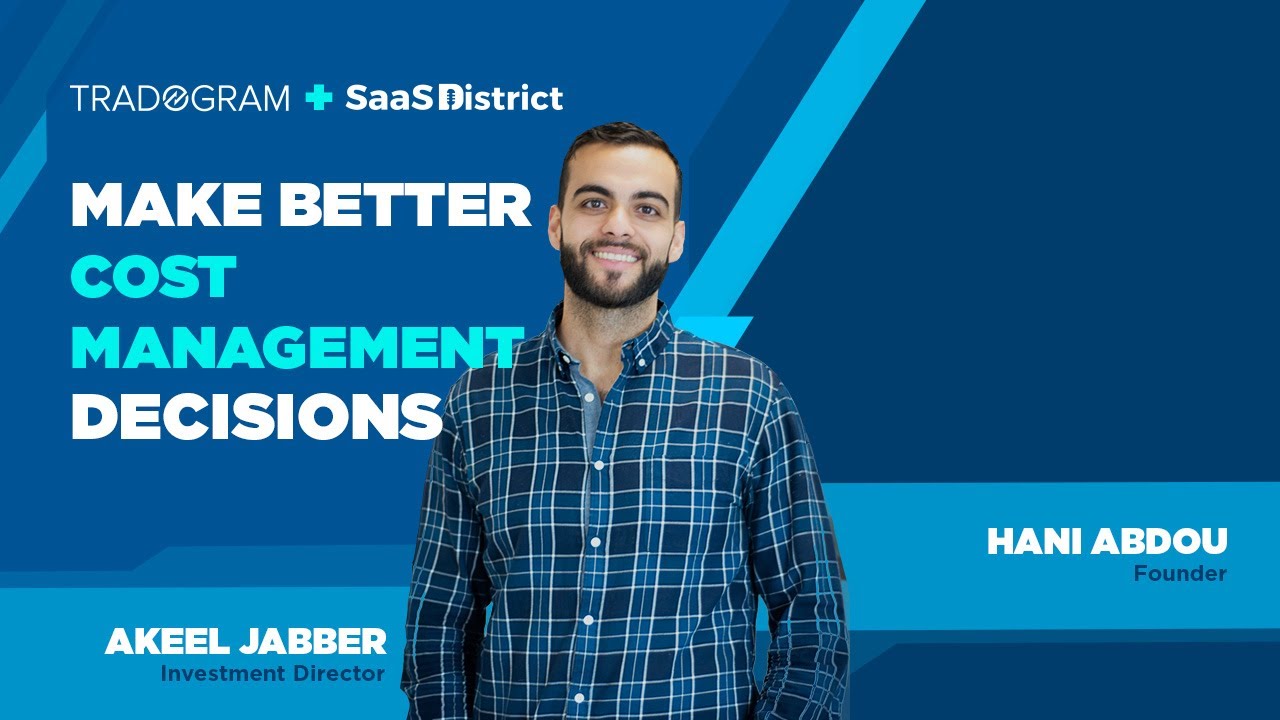
In this SaaS District episode, host Akeel Jabbar interviews Hani Abdou, founder and CEO of Tradogram, an online procurement and spend‑management platform. The conversation begins with Hani’s background—financial accounting degree, MBA, and decades of experience in wholesale, food processing, and ERP implementation—followed by the story of how he transitioned from managing a family‑owned dry‑food business to launching Tradogram in 2009 as a procurement service and later as a SaaS product in 2015. Hani explains that the idea stemmed from his own frustration with expensive, complex procurement software, leading him to develop an affordable, cloud‑based solution with a small development team. He discusses the challenges of building tech without deep technical expertise, emphasizing a business‑focused approach and learning from ERP projects. The interview then moves to the impact of COVID‑19, noting increased remote work and added users on the platform, and the heightened expectation for faster procurement cycles. Hani outlines how Tradogram improves procurement through two pillars: accessibility (cloud, multi‑device) and automation (auto‑fill, workflow configuration). He describes the consulting services Tradogram offers, detailing common procurement policies—procure‑to‑pay (P2P), strategic sourcing, supplier relationship management, contract management, and spend analysis—and notes that many midsize firms still rely on spreadsheets, email, phone, or even hard copies, leading to inefficiencies. Hani shares a three‑part cost‑saving framework: (1) lower purchase costs via better supplier negotiation (5‑15% savings), (2) curb maverick spend through approval rules and spend‑analysis policies, and (3) reduce procurement task time by 60‑80% with automation. He advises startups to establish a spend‑management strategy, select appropriate software for visibility and control, and negotiate with suppliers regularly, maintaining a list of approved vendors to keep competition alive. Regarding growth, Hani highlights product‑led growth: continuously adding features based on customer feedback and expanding integrations with other ERPs. He stresses that building for customers, not for oneself, drives adoption. For founders with VC‑backed runway, he recommends a disciplined spend‑management process and realistic runway planning, warning against over‑optimism. Finally, Hani reflects on 2020, noting COVID‑19’s push for remote accessibility, and provides contact information (website, email) for listeners interested in Tradogram.
Chapters
Hello, hello everyone. This is your host, Akeel Jabbar, and welcome back to another episode of SaaS District. On today's episode, we'll be talking about how to make better decisions around your cost management. Today we have a special guest with us, Hani Abdu. Hani is the founder and CEO of Tradogram, which is an online purchasing system that helps businesses manage their purchasing process and control their business spending. Tradogram also offers advisory and coaching for organizations on the implementation and development of a better procurement process. Hani holds a degree in financial accounting and an MBA from Azusa University in California. Prior to Tradeogram, Hani was the manager at the Magdi Store Company, an importer and wholesaler of dry foods, and was also partner and managing director at Magdi Food Center, where he was able to manage several large projects such as establishing a new factory, conduct business analysis, implementation, and configuration of a Sage ERP system. He played a major role in negotiating the deal and in planning the entire setup when the company was acquired. By another large corporation. Finally, Hani has more than 30 years of experience in the business management, including working in the wholesale supply, food processing, and business service industry. So welcome, Hani. Glad to have you on our show today.
Thank you very much, Akhil. Well, I'm surprised. I'm kind of impressed by the amount of information you've gathered about me.
It's crazy what you can find online these days, eh? But for those of you who don't know, is there anything else I missed? All right, is there anything else you want to add?
Uh, well, basically, um, yeah, you've covered almost all the major parts of my experience and my education background.
Okay, now I know you worked, uh, you know, several different management positions. Could you share a bit about your background and when you decided to take that leap from going You know, management to, you know, become an entrepreneur, whether that was Tradogram or a different business prior to that?
My father was an entrepreneur, so I grew up dreaming of being a successful entrepreneur like him. I always wanted to do that. As you just mentioned, I graduated as a financial accountant in 1981, completed then my MBA program program in around 1985. And then, you know, I've taken a number of positions in different industries around the financial accounting and managerial positions until my father, my brother, and myself in 1991, we decided to start a new business. For processing and packing dry foods, mainly spices and herbs, which you also mentioned. The name of that company was Majdi Food Company, and we did great. The brand has become prominent in that field, and it's still doing really well. In 2008, I decided sell half of my share in that business because I felt I wanted to start something new, basically.
So you sold your shares, is that when you started, you know, building Tradogram or what was the story on how you came up with the idea of building Tradogram?
Yeah, this is when I wanted to, like, decided to, wanted to have a new business and that was in procurement, basically. This is where I found my passion mostly. So around, yeah, May 2009, I established this company to provide international procurement services. I had a number of connections and I was able to leverage on these connections and the experience that I've had in the field. So we did really well. To the point that I started to realize that there is a need to use a software to help me in communicating with my customers and suppliers effectively. Now, this leads us to like the story where we got, you know, to think about or decided to start this software. So at that time, I looked at all the options and I found that they were too expensive and too complicated. So I started to look into developing this system in-house. At that time, I found out that it was going to cost a lot of money. So I thought, why not build it in a way that I would be able to sell it to others? Especially that the market was in need for something like this, you know, and a simple and affordable solution like that. So, I moved forward with that idea and hired a team of highly qualified developers for this project. In 2004, my son Majdi— I named him in the name of his grandpa— so he joined me after he graduated from business school as their entrepreneur. Program, and he joined us, the company. And at the same time, we were able to launch a beta version for testing the system. It took us almost a year until we finally were comfortable to officially launch our software Tradogram at the beginning of 2015. And this is how it started.
Yeah, I love that when, you know, people are trying to solve their own problems. So you were, you know, in that industry for a couple of years, and you just realized that, you know, this is an inefficiency, or you saw the solutions out there for your own problem were just too expensive. So you said, hey, let me, let me try to, you know, solve my own problem, and I can probably do it, you know, better and cheaper. And maybe this is another problem for somebody else. Did you have a— do you have a background in technology prior to that? Because I know you have your MBA, you did your business Your finance degree, and then, you know, your son was also in entrepreneurship. I know there's always a challenge when, you know, managing developers, and maybe you don't understand tech as much. Did you have any challenges at that point when you were starting?
You don't need to have, like, too much technical knowledge. I learned a lot from implementing the ERP on our previous business. So, and I've always been, you know, interested in using technology, and like, this is the management style I like, to always use latest technology and ideas. So I've always been looking into this, but from this business side, you know, of things. all I need to know about technology as a business or as a manager. But yeah, it's my previous experiences, as I said, helped me a lot in like looking into this, and my passion about this also drove my— drove me to, you know, or inspired me to look into this deeper and be interested to learn more about it.
And I see you work with different, you know, industries. You work with education, you work with healthcare, and you also work with retail. How would you say that procurement volumes and processes have been affected by, you know, the current COVID-19 situation? Because I know some are probably thriving and others are, you know, completely shut down.
Yeah, you're right. We do have customers using Tradeogram for almost every industry since procurement processes tend to be kind of similar across most verticals, you know. But we do not collect information about the activities performed on our platform by each industry. Our role is mainly to facilitate these activities for our customers to be processed in a highly secure environment. We have noticed, however, that many of our customers have added more users to their accounts recently, which could be due to the fact that companies have decided to let their employees work from home because of the COVID-19 issue.
And would you say, like, in general, I know, like, the procurement process, there's a lot of red tape, you know, you need many decision-maker buy-ins. I used to work as a project engineer, so I understand, you know, when people were coming to and you needed to start a new procurement process, it just took, you know, a long time to get it through. Do you see any trends there around risk and challenges that businesses are facing? Maybe more specifically, say, government? I know that's usually one that takes a little bit longer.
Yeah, yeah. Procurement has always been a complex and a very sensitive matter, as you probably imagine. But it's become a lot more challenging now because everything is expected to move at a much faster pace. Typically, a procurement process involves a big number of stakeholders working on a tight timeframe and exchanging a large amount of highly sensitive information. So, you know, and a transaction like this used to take a week or 2 to complete in the past. Now it's expected to be done in one day. Therefore, it's become critical for managers to use an effective system that can facilitate a smooth flow of information among these stakeholders and provide all the information needed when and where decision-makers need them.
Makes sense. Yeah, I remember when I used to work as a project engineer, and, you know, I used to work in oil and gas. And you're managing a $10 million facility, and you're going out for procurement on certain, you know, bidding. If I had a tool like this, you know, how would the technology you built enhance or streamline that procurement process, whether it's suppliers or buyers in this case?
Basically, it's— I can put it in 2 terms: accessibility and automation. So, by using the cloud computing technology, we're able to offer our customers full accessibility to their accounts using a desktop, tablet, or cell phone anywhere with internet service. In addition, the autofill function saves the users a lot of time and effort in completing the forms based on the previously fed data. Also, configuring the account properly means automating the workflow of the process according to the established policies, which removes confusions and eliminates unnecessary delay.
So I know you're— you mentioned at the beginning your team or your business offers coaching and consulting to organizations to help them improve their process around procurement? Because I know there's a lot of, you know, maybe internally, maybe your tool can help them, but maybe internally there's some processes that maybe that they need to fix and it's not the tool that's going to solve that. What does that process look like when you're speaking to these organizations to help them improve typically?
Frankly, to answer this question, we need to explain how to set up a complete procurement strategy, which is Sure. But, in brief, this strategy basically is an administrative document that contains policy.
Yes.
Policy mainly, like you can mention some of the main policies or regularly used policies, a policy to regulate what we call P2P process, which is procure-to-pay.
Yeah.
This is a very common process that, you know, takes the whole purchasing or procurement steps one by one, starting from requisitions all the way to paying for that order. And then the policy that regulates the strategic sourcing process. It involves, you know, RFQs, RFPs, RFIs, you know, basically a form that you use to communicate with your suppliers and receive offers or receive information to help you negotiate a good deal with them. Third common policy would be the supplier relation management, supplier onboarding, evaluation, rating, and all these things related to our relationship with, with our suppliers. There's also the policy to regulate contracting or the contract management. Some companies or organizations, they use a lot of contracting in their procurement process.
Right.
Or procurement strategy. And this requires, of course, to clarify all procedures that come under this process. Last, I can say a policy to regulate spend analysis and control, where you can just put budgets, approval routing, and Of course, of course, all kinds of reports that needs to be like regularly available to decision makers. So generally these policies are made of a number of procedures explaining how to perform each part of the process.
And from those different policies, what do you see? Do you see a pattern that most organizations get wrong specifically in one of those areas, or is it, you know, know, varies across each industry or each business?
Like the way they implement them?
Yeah, yeah. Like when you go in and you say you're coaching or you're consulting them and say, hey, like, and then you're, you know, are you finding a repeated pattern that, okay, it's the supplier relationship that, you know, usually needs to be worked on first? Or is it just, you know, you go through all the steps and then you find, you know, a little bit on each that generally needs to be improved upon?
Frankly, we try to avoid getting too much involved in these decisions because they're very much depending on, you know, the business structure and management kind of model or philosophy that they would like to use for managing this business. So, but generally, you'd be surprised to see, unfortunately, that we see a lot of medium-sized businesses, which is not small businesses, still using very old traditional ways to do their work. in procurement, which is usually costing them huge amounts of money. They can save a lot of money once they start implementing the right policies and procedures in their procurement.
And what is some of those older processes that you see there? Is it like a spreadsheet or pen and paper?
Yeah, spreadsheets. Sometimes they just communicate through Phones, emails, which is something that is not easy to track at all. And, uh, not, uh, it's, uh, it's very difficult to gather information in, in one place and be able to, to, you know, uh, exchange this information among, as I mentioned before, among a huge amount, a number of people. Uh, so, uh, these— And, and some of them even, believe it or not, they still Use hard copies, you know, delivery, delivering hard copies, which is a huge waste of time and resources.
Yeah, yeah, 100%. Yeah, it takes a while for some businesses to catch up and start using technology, right? Can you share some tips on, you know, if one business is looking to make— a startup is looking to make better decisions around managing their costs in business, is there any tips you can share? some things and what they can do?
Yeah, absolutely. Generally, the cuts or the savings can be grouped under 3 main categories. The first one is lowering the cost of purchases, which can be done through improving negotiations with the suppliers to be able to get better deals on products or services being purchased. Studies actually show that companies applying good supplier negotiation policies end up lowering the cost of their purchases by 5 to 15%. And as I just mentioned about strategic sourcing, usually this is where most of the functions or the tools that are being used to negotiate with the suppliers and lower the cost of these purchases. So that's number one. Number 2 is to mitigate Maverick spending, and this can be achieved through applying effective order approval rules to ensure a better control over what's being purchased and avoid unnecessary Necessary spending. And again, we mentioned that when we talked about the policy to regulate spend analysis and control, where we can use, you know, budgets and approvals to keep control over this, this money going out. The third part is cutting down on the time needed to perform the procurement tasks. On average, time saving that can be achieved has been estimated at 60 to 80% when implementing the proper procurement system. So, and again, you know, as I just mentioned, some companies that are still using their emails or even hard copy memos There's a huge amount of savings can be achieved by replacing these old systems with the new technologies that are available now.
Makes sense. And that first point, so you're going back and negotiating with the suppliers, how often do you suggest, you know, a business to do that? Because I know with So, for example, you're a startup, you have, you know, 10 different platforms you're using or different, you know, suppliers you're working with. Are you doing this like once a year, you're doing a review and going out to them to, hey, can you give us a better rate? Or what kind of policies do you think could work there?
There is definitely— this is a very wide range. It's not one answer to everything. Like every company, they have their own Even within the company, there are items that you need to negotiate once every year to create a contract for that. And some others you need to negotiate every time you order the— you want to place an order. Usually, in some cases, they have for every item, it's recommended to have 3 or 4 approved suppliers. They call it a list of approved suppliers for each item.
Right.
So they can either just go ahead and buy the item from either one of them, or they can, whenever they want to purchase this item, they can send a request for code from these 3 or 4 suppliers, approved suppliers, to get their codes. And it's actually recommended to sometimes distribute this order among these suppliers to keep them all interested in keeping the connection, you know, and continuing to compete over our business.
Yeah, yeah, I remember we had the same thing. We had some approved vendors, and then we'd try to share it among those 3 that, yeah, keep them on their toes and then also keep them, you know, their rates, you know, what do you call it, the challenge. Yeah. And then do you see any difference between the different industries? For example, do you see challenges around education industry versus say oil and gas on how they're using the platform to manage their cost and whatnot?
I generally don't prefer to assume that every industry follows the same procurement strategy because in each industry you'll find a number of subcategories and each one of them works in a very different environment. So in my opinion, the business structure and the management style are What really defines or defined the many variables in every procurement process.
Got it. So it's not the actual industry. I just, well, the way I asked that question, because I know some industries, I know for like, for example, oil and gas, they're always far behind when it comes to implementing technology versus, I don't know, maybe an education startup who's looking for the latest and greatest and is always on top of the stuff, just as how you are, right? Looking to use the latest and greatest for your own process.
Yeah, exactly. This is what I was referring to when I said management style, you know, so it's very hard to like put it as a one-size-fits-all, you know, every management style, and, you know, there's so many variables that really, and factors that have an impact on it. on how to decide the procurement processes.
Makes sense. And regarding the growth, so I said, I think you mentioned, you know, almost 10 years now, I think when you first had your first launch in 2011, I believe, you know, the growth of TradeOgram to where you've built it today, what have you found to be the most effective growth channels for you guys to acquire more clients to use and start switch over to Using your system, I just have to go back a little bit.
You know, it's yeah, we Tradergram was started established as a procurement services and company in 2009. But Tradergram as a software was only launched on 2015.
Okay.
So yeah, just to clarify.
Sure.
And then going back to your question, I can say that the first channel is to continue adding more features in response to our customers' needs and notes. And the second channel, the main second channel, would be to integrate with more software and other ERP systems.
So it sounds more like product-led growth or product-led marketing. So we really, you know, you have your existing core businesses, you're not too worried about bringing on more, but by creating and developing new features, new integrations, you can actually, you know, charge them more, go back to them and actually, you know, increase the value of your company by doing that versus trying to get more clients, right?
I mean, the best way to build a system is to build it based on what your customers need. They're the best people to tell you what they want, and you don't want to build a system for yourself only, you know, you want to build it for your customers. So they're the best ones to lead this growth or this improvement or upgrade.
Yeah. And as a, let's say, as a startup founder, we're talking about, you know, cost management here. startup or SaaS founder, let's say they have less experience in being able to manage their costs in general, but they've raised a high amount of VC capital for their startup, let's say, you know, $1 million, $2 million, a couple million dollars. What suggestion or balance would you suggest these founders on better managing or controlling their costs, if there's any you can give?
I strongly suggest establishing an effective spend management strategy, naturally. And I, you know, as I explained before, how the strategy works, and then to find the right software that can help them in carrying out this strategy effectively and provide them with full visibility and proper control over their spending.
Hmm. Yeah, I mean, imagine, I mean, what I mostly see from founders is they put together maybe a financial spreadsheet of projections of what they're going to hit, and then they build their costs around some exponential growth, which barely ever happens perfectly in line of how the spreadsheet looks like or the graph. But I like that idea of actually creating a spend management process or policy, which I think a lot of people probably don't take the time to put together. So that's a really good point.
It's good to be optimistic, but I would say usually startups, they start off being too optimistic.
Yeah.
Things take time, so you need to be prepared for that.
So just plan for extra runway, more than you hope for, yeah. You know, I know saying no sometimes is more important than taking on every opportunity that comes your way, so you guys could obviously be going out and getting more clients, But maybe you're saying no to that and just focusing on the product, developing more features, developing more integrations. But, you know, early on, would you would you have done anything differently if you were starting Tradogram today, or or is there something you would have said no to early on that would have helped you you know grow a little faster?
I can say like this is an extension of maybe or Very much connected to the previous question. So I would say establishing a new business is like growing a tree. It needs a great amount of caring, hard work, and patience. Adding water and nutrition is very important for it to grow healthy, but you— if you add more than you should, it will not make it grow faster. It will most likely hurt it. So, yeah, you need to be careful, try to learn from your mistakes. No one is always right, you know, but the key is to always evaluate what you're doing and make sure that if what you're doing is not the best thing or it's not achieving the best results, to be able to correct it. and amend things to make sure that you're on the right track.
Awesome. And what does 2020 look like for you and for Tradogram? And what are you most excited about for the rest of the year?
Well, 2020 has been working really well, you know, but of course COVID-19 has had, of course, its impact on our business like any other business. But obviously, people have started to realize the need and the importance of being able to— the mobility in the system, and being able to work from anywhere. And definitely this goes well with our theme and what we are offering.
Yeah, I think we're all excited for this to be done with and just kind of go back to something different, whether it's, you know, working remotely as we chatted before the show. Where can our audience get in touch with you if they want to learn more about yourself or what you guys are doing at Tradogram?
They can always go to our website. That's the easiest way. And through our website, you can learn everything about Tradogram. Tradogram, almost everything about Tradogram. And if you need more information, they can easily schedule a call or a demo to ask any questions they might have about the system. And if they have any suggestions that they would like to send to us, they can use our usual like telephone number, emails, and, and I'm always available. You can even send me directly emails. My email is hany@tradergram.com. Very easy and straightforward. So I'll be happy to hear from any of our prospects or customers or any other interested people out there to learn about spend management and procurement software. We'll be very happy to answer all.
Okay. Okay, awesome. We'll make sure to include those links in our show notes so people can check that out and get in touch with Hany. Thank you so much for being here today, Hany. Anything else you want to add before we wrap this up?
I just would like to thank you very much for hosting this podcast and I would like to wish you all the best and all luck and success.
Thank you so much, Hany. Have a good morning. Thank you all for listening in to today's episode. Don't forget to join us for another episode where we interview top leaders and experts in the business and SaaS industry. If you enjoyed this episode, I ask that you please give us a 5-star review on iTunes. That would be really, really appreciated. Otherwise, if you have any feedback, suggestions, or improvements for this podcast, please feel free to send it directly to me on our website at horizoncapital.com, or you can just tweet me @akeeljabbar. Thanks again, and hope to see you guys on the next episode.
Thank you.
More from Akeel



Get a mentor as soon as possible — and make sure it’s a mentor in your space.




Keith Gillispie: Why Most New Investors Fail & How to Avoid the Common Traps #250 | SaaS District



