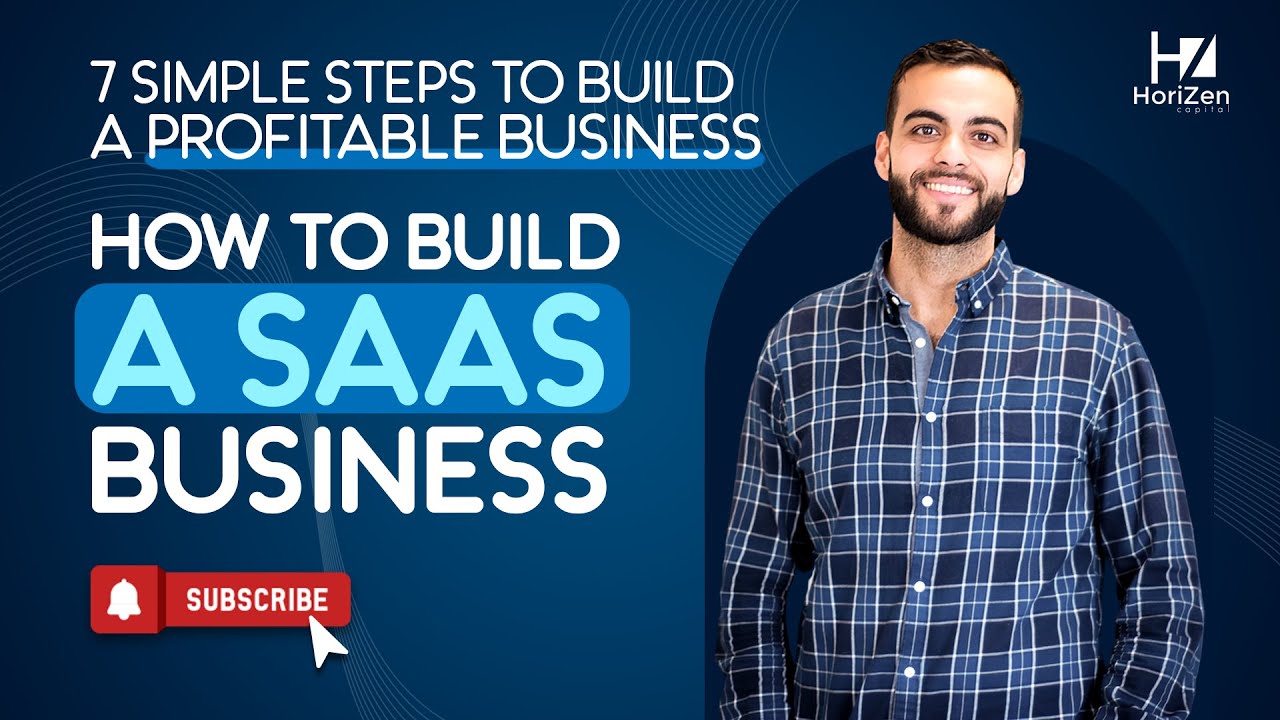
In this instructional video, Akeel Jabbar, investment director at Horizon Capital, walks aspiring entrepreneurs through a practical, seven‑step framework for launching a B2B SaaS company. He begins by framing the appeal of SaaS—recurring revenue, scalable code, and larger markets—then emphasizes that the foundation is solving a real problem. He advises founders to secure a technical co‑founder rather than outsourcing development, and to craft a Lean‑Startup‑style blueprint. Before any code is written, he stresses primary customer research and direct validation, warning against reliance on secondary market data. Next, he explains SaaS pricing models, the importance of subscription revenue, and calculating customer lifetime value to guide pricing. Finally, he outlines financing options, recommending angel investors and leveraging early traction to raise further capital, with the ultimate goal of building a sustainable, high‑growth business that can exit or IPO. Throughout, he uses a conversational, enthusiastic tone and encourages viewers to engage with the SaaS District community.
Chapters
You probably hear about all the hype in the news about all these hot tech companies getting these million-dollar, billion-dollar valuations. And you're thinking, how can I get to be part of this? How can I be part of this tech ecosystem and start my own SaaS company, right? You hear about high valuations, recurring revenue, exponential growth, larger international markets, right? All these key and buzzwords gets you excited. And once you get And now you're thinking about, hey, how can I start my own SaaS company? And that's exactly what I'm gonna talk about in today's video. So stay tuned. Hey guys, my name is Akeel Jabbar. I'm the investment director and GP at Horizon Capital, where we work with B2B SaaS companies only. We help them take their business who are doing okay, mediocre, and take it to the next level through our growth strategy and roadmap. So what I'm going to talk about today is a lot of people come to us, a lot of these entrepreneurs we work with on a daily basis, and they're like, hey, I'm looking to start my first SaaS company because I hear how great it is. I want to quit my job. I want to move from my service company that I have, and I want to get into SaaS. Just to compare it to a service business, right? If you have a job, you're doing all the work manually, right? Or you have a team of employees who are doing the work to deliver the work for your clients. But when it comes to SaaS, you do all the work of creating the code, and then the code is working. You have these ninja, an army of code that's working 24 hours to deliver the solution for your end product. So once you build it, it continues to bring in the recurring value and recurring revenue, right? So that's what makes it so attractive. And you can, you know, your market is a lot bigger versus you're selling to a local market. So that's the big attraction when it comes to SaaS. I'll break it down. I'll break this video down into a couple of steps of what you should be doing if you're looking to start your first SaaS company. Now, the most important thing you need to think about, it's not about the technology, it's not about how this big, beautiful app you're gonna create. When it comes to SaaS, it's just like any other business, you're developing a solution for a problem, right? Simple as that. You need to find a solution for a real problem that's out there. Because remember, if you don't have a problem, you don't have a real business, all right? So before building your team, before diving into pricing and branding and the team strategy and who you're gonna target, Figure out what is the problem you're going to solve. Second thing I would suggest, and this is a mistake I see very often with a lot of founders who maybe don't have that technical background, who don't have a software engineering degree, is they try to outsource everything to, to another country and they think they're going to be able to easily build their product for them. What I suggest you do, find a technical co-founder, maybe somebody, a CTO, somebody who knows how to build a vision of a product and knows how to manage a technical and development team. And knows how to execute at the highest level. Don't overskip this step. That's super important if you want to build a solid and scalable SaaS solution. Once you have that, you have your, your idea, you have your technical co-founder. The next step is to build a plan and a blueprint. This is my idea. This is my vision. This is the problem I'm looking to solve. This is me and my partner, and this is how we're going to do it. And if you haven't read the book, I highly suggest you check out the book called The Lean Startup. By Eric Ries, super popular, love it and highly recommend it. Every SaaS founder needs to read it. And then you go out and start validating and building your product. So that actually goes into my next step. So before you actually go and build all the code and write out all the algorithms on the backend and building your website and all the investment that takes to build a SaaS, I would suggest you validate your idea. And one of the best ways you can do to validate your SaaS business is to go out and speak directly to your customers. Okay, whether you're in B2C or B2B, it doesn't matter. You probably defined that, you know, this is a problem, this is who it's gonna solve the problem for. Go speak to those people who you think it's gonna solve them and ask them. Do the research directly with them. Okay, and that's a mistake a lot of people do is they look at secondary market research. And what does that mean? They're looking at what is the total addressable market, meaning, hey, there's a million people out there who I think I can sell it to. Or they look at, this is a growing market, this is a keyword that's growing, a lot of people are searching for this, or there is demand for this product and it's expected to grow because of this factor, right? For example, you can see in COVID, right? With COVID right now in these days, something that's a trend in industry that's growing is actually the pet space. A lot of people in the last year have actually adopted or bought or taken in pets because they have a lot more time at home. But that's based on an industry trend, right? So that's the research they're seeing, and, you know, maybe they'll build a business specifically to adopt to that trend. What we need to do is talk to the people specifically, talk to the dog owners here in this case, right? Or talk to people who are thinking, for your demographic, who are the ones that are actually going out and buying them? Why are they buying it? What's the reason? How much would they pay? What are the breeds they're looking for? What color? What are the sizes? How often are they going to take care of it? And you can do this a couple of ways. The best way obviously is going to be face-to-face. If you know who they are, try to get on the phone with them, do it digitally over a Zoom call. There's so many ways you can do it. And if you don't have those people around you, like you're reaching out or you're talking to people, get into Facebook groups, create a simple landing page and run some ads to it. Target those people and just ask to speak to them. Get some research, incentivize them, create a contest. People are willing to speak and share their opinion if you give them something in return, right? Pretty simple. And that's going to save you a lot of time and that's going to help you Create that roadmap and validate if you have a real business here. And that's the most important part. You might have the best idea. If you're not going to sell it, remember, if there's no problem you're really solving that people are willing to pay for, you can't build a scalable business. So that's, that's a simple way I suggest before you build the code, validate, do your primary market research with your, with your audience, the people you want to sell to, and then move to the next stage. And the next phase, which is super important, is figure out your pricing plan. And counterintuitively, what we're used to when we go and buy a product at the store, we buy it one time and we use it and that's about it. Right? And if you remember in the olden days, I don't know if you remember with the computers, you used to go to the store, you'd buy the CD-ROM of the software that was downloaded or ripped onto that CD. For example, Microsoft Office. You would take it to your home, you pay $100, $200, $500 one time. And you would use it until you decided you wanted to upgrade and get the newest one. But it was a one-time payment. Whereas now, if you go on, if you're looking to get the latest Office or Microsoft, you have to go to their website, you have to subscribe to a SaaS, and it's everything done digitally. And you have that monthly recurring revenue, or you have the monthly recurring pricing model. So the difference is when you go now and you want to download the newest Microsoft Office or the Microsoft Word, whatever it is, you're paying on a monthly or annual basis. And that's the beauty about SaaS is you get that subscription service and it's an ongoing business. You build the product once, people pay you every single month or every single year. And that's why it's so attractive. Another important thing you have to look at when you're building your pricing model is understanding lifetime value. How long do these typical users stick around, right? So lifetime value is like, let's say they're paying $10 a month. For example, you download Microsoft Office. Are they going to pay for the whole year? Do they typically stay around for the whole year? In that case, your price is not $10 a month. It's your lifetime value is $120, right? And that's where you have to— it helps you just understand what is the real value. And then you can build based on that pricing structure, which is your lifetime value. So obviously the longer your customer sticks around, the higher the value, the stickier your product is, the more they need it, the more integrated it becomes. The longer the lifetime value and the better your product is. Okay, so remember that, don't sell for one time, sell for the long term and build something that'll last for 5 years, 10 years and become so critical that people can't live without it. That's how you have to think about when you build your product. All right, cool. So you've got your product, you've got your pricing, you've got your team, you've got your idea, you're ready to execute, you've got your plan. The last step, get financing and get funding. How are you going to build all this? You obviously need money. Right? You need to get a website. Your users, you validated your product, people are ready to pay for it. You've built your website, you're developing your product now. Let's go all in and build the product. So you can do this a couple of ways. You can actually check out my video. I recommend you go out and find an angel investor. Okay? So I actually have a video on how and where to find those angel investors. You guys can check them out on our SaaS District channel. Find an angel investor who will give you that initial money to go out and build a solid product, they can go back to all those users you already spoke to who've done— that you've done the validation with and say, hey, I've got the product here that we've talked about, we've discussed. You said you were interested to pay for it. It's a real problem. Here it is. Happy to get you to sign up. Here's our pricing plan. Let's get you set up. And that'll help you build and scale the SaaS company that you're hoping to build from the beginning. Once you have the product, you've got the sales, you've got the revenue, it's a lot easier to go out and raise more and more money. You know, and eventually hopefully you'll get your dream exit or IPO like a lot of the other businesses you see out there. So there you have it, guys. Very simple. If you want to get started, just follow those 5 steps. And I hope you guys success in building your next SaaS company. If you guys like this video, make sure to like, subscribe, smash the bell button and let me know what is the next SaaS idea that you guys are looking to build upon. I'd love to hear your ideas. Happy to give you guys feedback and share anything that, you know, from my experience of working with so many founders. on how it can help you guys succeed with your SaaS company. All right guys, thanks again and see you guys on the next video of SaaS District. Bye.