Jagger Lucé: Creating Custom Digital Funnels to Raising Capital for your SaaS #232
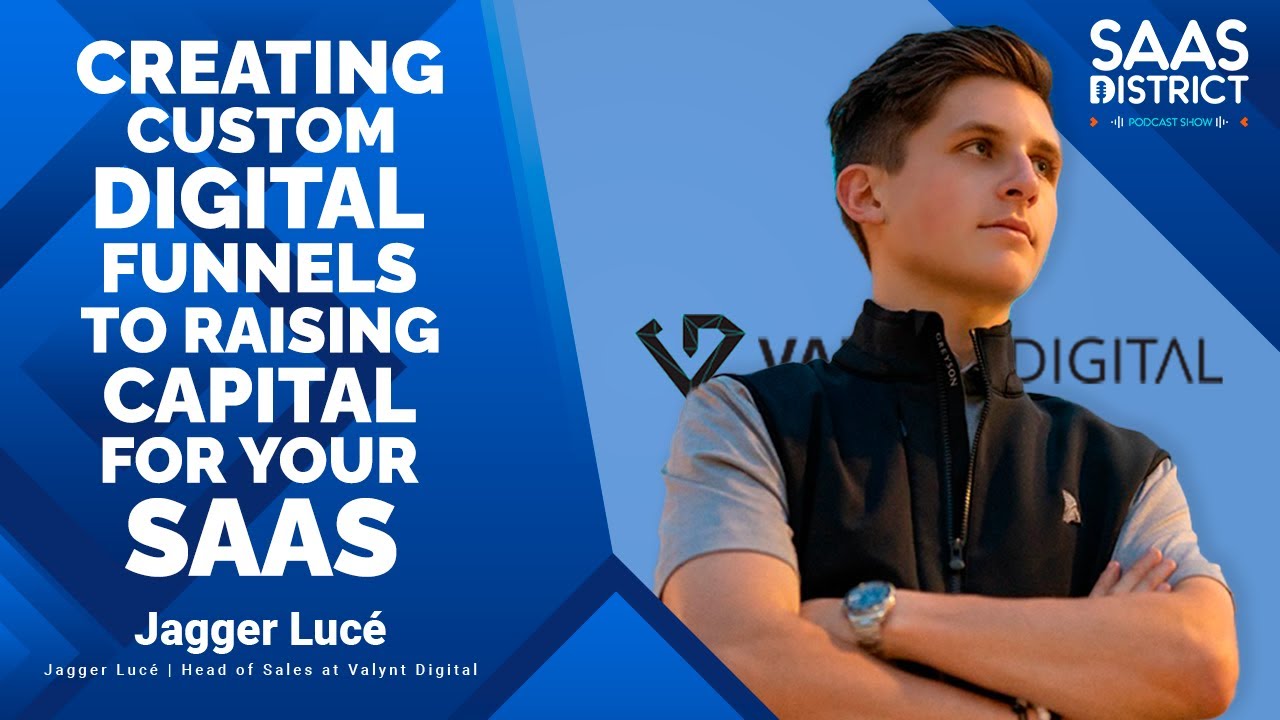
Jagger Lucé, Head of Sales at Valiant Digital, explains how the agency uses AI and a proprietary investor database to run paid-media campaigns that put ads directly in front of accredited investors. One client raised $50 million from $160,000 in ad spend; another raised $5 million in 30 days from $15,000.
Chapters
Hello, hello everyone. This is your host, Akhil Jabbar, and welcome back to another episode of SaaS District. In today's episode, we'll be talking about creating custom digital funnels to raising capital for Today we have our guest, Jaeger Lucit, joining us. Jaeger is the head of sales at Valiant Digital. They're a full-service digital marketing agency specializing in paid ads, video production, copywriting, graphic design, as well as AI-driven automation. At Valiant, they have created a revolutionary capital-raising solution through innovative digital marketing funnels, helping founders raise anything from their Series A up to the Series D. with their advertising campaigns. So Valiant Digital's approach eliminates cold calling through advanced automation solutions powered by AI, streamlined processes, and efficiency across all sales and industries. So welcome, Jaeger. Super excited to have you on the show today.
Glad to be here. Thanks for having me on.
So I'd love to, just before we get started, give a quick background to our audience. Tell us a little bit about your agency and how do you work with SaaS founders to help them raise capital?
Yeah, absolutely. And really our entire value proposition and foundation is built on our proprietary data. We've got a massive database of investors, accredited investors, family office contacts, VC and private equity firms. And so we're able to utilize that and leverage that data to put our clients' offering, what they're looking to raise money for, put that offering in front of match-made investors and match-made investment opportunities. So if you think of us in, in 3 words, we're, we're an investor acquisition agency. Our job is to, to come alongside our clients and help get them connected to those investors so they can help deploy and build out that SaaS in, in this particular example.
Love it. And then, you know, in terms of strategy, so you have this database of all these investors, some of you narrow it down to, are these investors we should target and work with? Um, how are you— what is your strategy to reach out? Kind of, I'm assuming, is it Is it email? Is it phone calling? Is it paid ads? What have you seen work? Is it a mix and match of everything?
Yeah, so we run our ads on pretty much all social media platforms. To answer your question, it's via ads. So rather than cold outreach or cold calling, cold emailing, we're putting our ads in front of them. And the idea is to put these ads in front of them wherever they are. So we can run them on pretty much all websites online, on what's called the Audience Network as well. And so to the investor or to the potential investor, it's Kind of this subconscious breakdown. It seems completely coincidental to them that they're coming across this particular offering across our client, but in every way, shape, and form, it's calculated on our end of things. We're very specific with who we're going after. And so we're putting ads in front of them, and the idea is to develop trust and credibility and ultimately develop that sense of curiosity and get this investor to go ahead and enter their contact info. And so for our clients, That then enables us to basically hand these investors to them on a silver platter, investors that know who our client is, know who's running the company, know their kind of company thesis, and ultimately know that they're raising money. And we're able to deliver to our client an investor who's requested to be contacted about that specific deal. So ads are run online to get them to opt in rather than cold calling or cold outreaching, which is something we eliminate for our clients.
Love it. And are you guys, you know, combining videos? What are these ads? Have you found videos working well? Are you throwing them to landing pages? And I know from my understanding, you work with folks, you know, raising from anywhere from $2 million up to $50 million. I'm curious to know, like, what are some CPA numbers, any data you can share that just to give people ideas like, hey, we're raising $5 million, this is what it's going to cost you to probably get an investor that's going to invest in you.
Yeah, absolutely. So all of those metrics are very closely tracked. It very quickly turns into a numbers game of, okay, you're putting this much cash into the marketing engine, it's generating this amount of leads. This is your conversion ratio on that amount of leads. And so that very quickly turns into an equation of, okay, you're putting X in and getting Y out, right? And so we've got the clients that have been with us for 3+ years because every single month we're just consistently dumping more cash into their back pocket than they're bringing to us. And so it enables this, it's very clear when there is success and it's also very clear when there's not success, which is great for us because It's just very transparent with our clients. It's nothing that is speculative or biased, right? It's not one-sided. It's, hey, we're bringing you more money than you're paying us, or we're not bringing you more money than you're paying us, right? And so we're able to change things from that point. As far as the content that we curate, yes, we are a completely full-service digital marketing agency. We do everything across the board, completely white glove service, video production. We host our clients typically in Dallas for that. But we have flown out to multiple of our clients for that, bring our video teams up. Graphics, many graphics, copy is kind of, those are our 3 main pillars of content that we're curating to then implement into those ads and launch anywhere from 150 to 250 ad variations for each of our clients online.
Love it. So, you know, we're in February, almost close to March 2024 recording this. You know, it's been obviously a struggle and challenges. that a lot of maybe SaaS founders are facing right now in terms of raising their next round, and they're trying to make some decisions here. But if you're working with companies who are looking to raise secure capital right now, at what stage do you find is the right time to come to you guys? Or what are you seeing that they're coming to you and say, hey, we need help, we've tried to do it this way, we've raised in the past, but right now we're struggling? Like, when's the right time to come to you?
It really is the, the commonality between pretty much all of our clients is an exposure issue.
Right.
And not just in an exposure issue in general, right? So not just a company could still have an exposure issue if they have millions of followers throughout their different social media platforms, because when you're raising money, you don't just need exposure to everyone, you need exposure to very specific people being those investors. And that is the direct exposure that we're able to provide. Where, to answer your question as to when clients should be coming to us or when groups should be coming to us to get some funding knocked out. You mentioned earlier that we've got clients raising from as little as $1 million all the way up to $50 million. I will correct that. We're actually up to right at the $350 million mark for a few of our clients. So to answer your question, it really is, if you have an exposure problem, if you need to get connected to investors, investors at an accelerated basis and/or raise money, we're gonna be able to help you, whether it be startup, whether you are a— a 5-month-old startup or a 5-year or 30-year-old real estate firm that's consistently raising and bringing LPs into your different funds, whatever it may be, we're able to come alongside you and get to work. So it doesn't have to be any certain maturation of a company in any way, shape, or form.
And how long are they— when they're coming to you, you know, just for people to think if they have some kind of runway planning and they're trying to think, okay, when's a good time to approach you guys? How long have you found that, you know, your process takes to get them up and running, get the campaign going, and then start, you know, getting leads coming in so they can start, you know, closing them? Just to help people paint a picture of how long to plan for.
Yeah. So from a macro perspective, the day we engage our clients or we get our clients engaged, 21 to 31 days later, their campaign is live, launched, and active. So about a month timeframe to build out completely everything immediately after that campaign launches. 24 to 48 hours. Within 24 to 48 hours, you're gonna have investor leads flowing in for each of our clients. So that's kind of the timeframe. Most of our clients we're working with for right at 6 months, just depending on how long the raise takes. Very simply put, some of them will be 3 weeks, some of them will be a month, some of them will be 6 months. And then we've also got the clients that are just consistently always raising, and we've had clients with us for 3+ years now.
So if I'm a founder and I'm looking to scale my startup or raise and I'm trying to do this myself, what strategies or tools maybe do you recommend? The first thing I think is more important to identify target potential investors. These are the right fit people. What do you tell to them and helping them narrow that down rather than, you know, or do you think kind of going, you know, spray and pray, go wide and then hopefully narrow it down from there?
Yeah. So we actually, we detest that pretty strongly, honestly, the spray and pray methodology. And yes, it is great to simultaneously be able to ping and contact and interact with thousands, if not millions of people at once. And we obviously leverage that technology being a digital marketing agency, but we are actually very specific, granular, and meticulous with who we're going after. So typically what we're able to do is sit down with our clients and say, okay, client, I need you to share with me the 5, the 10, the 15 things that you either want or need to be true about every single investor that we connect to. And so it's kind of a segue to answer your question as to what are some of the metrics that we're able to identify. We have anywhere from 50 to 550 data points on each of the millions of accredited investors that we have. Some of those data points are what they've invested into recently, whether it be what company or industry, what their recent check sizes for their investments have been. Oftentimes a peek into their portfolio to see what their assets are allocated into, what their typical investment thesis is. On the flip side of that, on kind of the more big brother side of things, if you're familiar with that term, what they're reading, what they're watching, what they're learning, where they spend their time. And so what we're able to utilize to craft that ideal investor persona and identify that target audience is very specific things, their investment criteria, how much dry powder they have to put into the markets, what their due diligence time period typically is, how quickly they move on their investments, all of these things to where we're able to really matchmake them with our clients. And as you get into the nitty-gritty and details of the data, it's, it's not only surprising how granular and specific it is, we— the data we have on these individuals, but honestly, to be quite frank, sometimes it's, it's a little bit alarming and you start questioning how, how can you get your hands on that data. Um, but we make the joke that, hey, don't worry about it, we use our powers for good. Um, we're not, we're not looking to, to sway, sway any, any, anything negative. So. But those are some of the metrics that we're able to utilize to identify that ideal investor persona.
Okay, so once you've identified that persona, you've narrowed it down, it seems like very data-driven on making your decisions on who to go after. The next step is driving them to take some kind of engagement, right? These are VCs, these are family offices. Maybe they're not as active online on some of these platforms, but You know, if you can capture their attention while they're there, obviously you can get some results as you guys have seen. Can you share any specific techniques or any strategies you found that just seems to work well to engaging them and take action?
Yeah, absolutely. I would say that there's, there's, I've got multiple answers for you. I would say probably one of the most valuable techniques that we utilize is really taking a very agnostic approach to where we place our ads. So in no way, shape, or form are we Identifying a target audience and placing our ads onto 10 different websites that we have agreements with and hoping that this target audience goes to those platforms. So we're— we've got a— what we coined it as a platform agnostic approach in the placement of the ads. So we're not targeting the platforms and hoping the individuals come to the platform. Rather, we're targeting the individual specifically. And because our data is consistently updating, we oftentimes see where these individuals are. We're able to see where they are live. And that enables my data strategy teams to ensure that our ads are being placed in front of these people wherever they are online, whether it's Forbes reading an article or ESPN checking a score from last night or Weather Channel checking the weather for the day or anywhere in between. We're able to solidify that fact that none of these investors in our target audience are gonna be falling through the cracks of our marketing outreach, even if they're not active on TikTok or active on X or active on Instagram. Right. So it's really ensuring that we're able to saturate and really hit that target audience, I would say, is something that is definitely Valiant is separated from many marketing agencies in our ability to execute on that.
Nice. And, you know, a lot of things that a lot of agencies are tapping into and, you know, most companies now, even the SaaS space, are really tapping into AI to build in that as part of their sales process or part of their All kinds of processes, right? So curious to know how you guys are using AI right now or, you know, recommend others to seamlessly integrate into the sales process, especially for, you know, some of these high-ticket deals or high investments, what we're talking about here, right?
Right. Another question that we've got multiple answers to as to how we're using AI in a day-to-day process. I would say especially on the kind of interaction with prospective clients and/or active clients, we give our clients access to this software as well. We've got a, we've actually got a software platform, a SaaS platform in-house that we're launching this month. And basically what it is, is it's one place that allows you to send out emails, texts, voice drops, LinkedIn connection requests, and LinkedIn messages and InMails all in one software. That technology in and of itself is not very fancy or very cool. And how the AI is integrated into that is what makes it very unique. So basically this platform will, you're able to identify that target audience. We can either load our data from our databases. And/or we can identify target audiences really using LinkedIn's targeting mechanisms within this platform. And you identify target audience, set up your messaging and set up your kind of cadence and funnel. And what this platform will do is go to these individuals' LinkedIn, scrape information about their experience, about their bio, just about themselves. And it will write a specifically tailored email based on their LinkedIn, their experience and their expertise. And then under that, we'll also obviously insert whatever the, the processes, whether you're selling an investment into a SaaS company, whatever it may be. And so this is something that's very cool for us because each of these messages have a personal touch, right? They're not just, it's not just completely automated, or it's not seemingly automated to the recipient. Obviously for us, in regards to a workload, it removes a lot of a workload because it is automated. the aspect of it being AI integrated to tailor the emails and to tailor the text messages, the LinkedIn messages. And we're also actually working on an AI, basically a salesperson to be able to insert a bunch of data into this AI program and it will be able to make a phone call, answer the phone call, answer a couple kind of preliminary questions and potentially get prospects booked. So it's, it's It's definitely something that we're utilizing as a stepping stone and, and we see it as something that, that should be utilized. It doesn't— there's many ways that you can utilize that and still keep the creative nature that I think can't be necessarily truly replaced by AI. Right. So many different ways that we're getting implemented and, and I'm glad that it's here, needless to say.
Yeah, it's interesting that you guys are kind of going kind of further down the funnel, right? So from top of the funnel, getting them in, But then also helping them kind of, you know, build some automation and AI to improve their chances of success, you know, down the line and closing the deal. Is there any other things down the line when it comes to, you know, automation or things you can think about down the line for maybe it's part of the onboarding process or, or even, you know, you said you hand them into like a plate with here's all the information, they fill out a lead capture form. How do you get them to success to actually closing the deal? Right?
Yeah, absolutely. So it is a process in tandem with our clients. Typically they have a broker-dealer or an investment banker or a placement agent or an in-house investor relations team, whatever it may be, a team there to be able to have these conversations with the investors. And so we're able to identify the investors, bring them to our clients, and then it is on our clients to actually field those conversations and close those investors out. Because we're not a FINRA-licensed broker-dealer, we can't take that position.
Mm-hmm.
The reason why I bring that up is as these investors see the ads we're running online, they're able to enter their info, request to be contacted by our clients' team, And whenever that happens, that info gets sent over to our client's team. But we have an entire sequence of automations that is built out to further educate and inform these investors. So Investor A requests to be contacted about the deal, day 1, day 3, day 5, day 7, et cetera. They're gonna be getting emails with pitch decks and executive summaries and further information, videos to check out, text messages with a calendar link to book on our client's calendar. And we send out voice drops, which are kind of the ringless voicemails. out to these investors saying, hey, this is Jericho from over at Valiant. Thanks so much for requesting to be contacted. We're looking forward to discussing this opportunity with you. And so that is very integral and it very quickly becomes our client's best friend because it removes so much of the workload that's typically needed from them calling an investor 2 or 3 times to get a hold of them. And just because they're busy people, right, even though they've requested to be contacted, they're taking little Johnny to soccer and jumping to a meeting right after and doing all of these things. So that is, is huge, the follow-up automation with these investors to help nurture them and ultimately close them out for our clients.
Yeah, that makes complete sense. Just staying on top of the communication and nurturing the lead as much as possible. And then the last part I think is really thinking about how to scale these campaigns, right? People are thinking, okay, maybe you can bring one investor, You know, but how do you really scale this, especially if you said you're raising like $350 million, you know, a couple hundred million dollars. So you're looking at the kind of the whole process of your digital sales campaign and you're paying attention to certain metrics because you're, you know, like you said, you're very data-driven. So what, what are you looking at? What are you paying attention to that like gives you insights? Okay, I'm now ready to scale this and it's working well for your company.
Yeah. So I mean, for example, I mean, if we're, we're 2 months in and we've brought in Call it 300 leads and we've got a, call it 50% conversion ratio. So you converted 150 leads. If you've— this investment opportunity's got a minimum offering price or minimum investment of, call it $50 grand, just for sake of example, then it very quickly turns into, okay, well, we've been able to bring in and we're paying Valiant this price. We're paying this for ads. This is what it's consistently turning into. And so kind of like I mentioned earlier, just very quickly turns into an equation of, okay, we've spent this much. It brought us this many leads. This was our conversion rate, and this is the money that we brought in the door. So based on, we basically just reverse engineer that and say, okay, if in the past 2 months we've been able to bring in $6 million, in order to hit that $75 million mark within, call it 6 months for sake of example, then by reverse engineering that equation, we know you need to spend this and up your spend to this scale at this number. So it's really, it really is. It's, it's very black and white, which is. Something that's not always true in marketing, right? And with kind of brand awareness and brand development campaigns, it's tough to see a finite number of, okay, this is what we're spending and this is immediately what we're getting back. But with us, it is very much so the case. And it's great because it allows for conversations with clients to just be very clear. Like I said, black and white, concise and straight to the point of, hey, this is working great. Or this isn't working and we need to tweak this and optimize this and fix this. So very, very helpful for conversations with clients.
Nice. So you're very, you're kind of looking after for that predictability. Once you find the data that supports it, you know, okay, this is going to, we anticipate this to continue. Let's double down on what's working and let's scale. And then when it comes to the kind of like CAC to, you know, we can call it CAC to LTV ratio, right? That's kind of what you're saying, this much money in, you know, ROI, you get X amount out. Any numbers you can share of like, okay, you know, that from some of the campaigns you've ran, how effective it's been, just to give some people some idea of what they can expect?
Yeah. So I mean, we've, we've raised, we've got dozens of case studies to be able to share with groups and reach out to me and if you'd like to learn any more about them and/or check out our websites. And group that comes to mind, just to give you hard metrics that I know I can share and I'm not bound by NDA in any way, shape, or form, a group that we were able to bring in just right at $50 million, $50 million in 8 months for. 100% of that was derived from our marketing outreach. And over that time period of 8 months, that client had spent with us right at $160 grand. So as far as kind of returns and ROAS, ROI, all of those metrics, that's a cool one to be able to share of, hey, $160 grand brought them $50 million and they're actually working on going public right now via SPAC. So, but there's many, many groups like that. We've closed out $5 million crowdfunding raises in 30 days where they've spent right at $15,000 for us to be able to get that knocked out. So, the leveraging the power of digital marketing to utilize, to raise money is something that you really can start compounding very quickly.
Mm-hmm.
And it's very exciting to watch that happen. It's what wakes me up in the morning. I love watching that happen for our clients. It is so exciting. But the saying I like to share with people is, hey, the groups that understand that raising money is changing from cigars and scotch at the country club to digital marketing are the groups that are going to be on the forefront of a changing industry with the JOBS Act and all of this kind of democratization of investment notion that's being pushed out everywhere. Now is the time to understand you're going to need to be utilizing digital marketing to raise money.
Yeah, I agree. And last question before we switch kind of to the rapid-fire personal questions, which is around You know, for these specific cases where you've seen really high success from raising, you know, really high ROI on their investment, is there anything that's particularly stood out with these founders, whether it's the product, whether it's their, their team, or is it their sales team? Like, what have you found that if you have this in place, you're more likely to succeed? You know, regardless of where, you know, we're going to set up the funnel, we're going to set up the campaign, get you done. But how do we succeed here with you guys?
Yeah, there's another question with many answers. There's many variables that go into a successful raise, as we all very well know. I would say the thing that sticks out to me most is the idea that when you have an offering out in the market, you're offering equity or debt to these investors, right? You got to realize that you're really selling the person rather than selling the investment, right? So to answer your question, it really is on that sales team, that investor relations team, that broker-dealer, whoever's working on soliciting the deal and selling these investors, the ability to have someone that is To have somebody there that has the ability to have a sophisticated conversation with the investor, to tailor to their needs, what they're looking to do, what the investor's wife is saying that he should be doing with his money, and listening to all of these things to be able to matchmake their needs with what you're able to provide. If you have that team in place, obviously we're biased because we have the process down to identify and attract the investors. But if you have that in place, you're going to be so much more successful. I feel like companies are so focused on having the correct product, developing the correct product, developing the correct offering, putting the correct preferential terms and cap table together. And all of that stuff does matter, but you need to also be focused on the investors and what the investor needs and how, rather than just trying to shove this in their face and get them to buy it, it's more of, hey, what are you looking to buy? Let me see if I can go to the back and find that for you. That type Type of mentality. So I would say the investor relations team, simply put, is extremely integral.
I agree. Yeah, fantastic insights. Appreciate you sharing all this, Jag. This is great. Love to shift gears and talk a little bit on the personal rapid-fire questions. You ready for those?
Yeah, hopefully so. We'll see.
Jag, what's one activity you enjoy outside of work that gets you into a flow state?
Ooh, it's a tough one. I've got 2 answers. One is spending time with my baby boy. I just had my first son back in November. And there's just something about it. I can get lost just looking at him, just goo and gah and do nothing for 4 and 5 hours at a time. And it's just, it is just absolutely, it's just calming. Second answer is golf. I love to golf. I grew up playing baseball, ended up blowing out my elbow and shifted into golf when I realized that I wasn't gonna be in the MLB. And I just— everything about golf I absolutely love. Just the getting out there early on an early morning and just being out there alone and just kind of listening to the birds and the trees move and, and just having a calm, tranquil game of golf. I absolutely love— I think there's too many allusions from the game of golf to real life. Which is a conversation for another day. But I think that that's really cool to observe and also play.
Yeah, absolutely. Well, first of all, congratulations on the trial. That's huge. I know the first year is forever. It's a fun experience, so I get it. And yeah, I mean, I know, understand the flow of, you know, just you and the ball out there and you have to focus. There's nothing else. You got to hit this thing or you're— yeah, you have to focus. So love it.
Exactly. Exactly.
What's, uh, Jagger, what's one piece of advice, uh, you wish you had known? And if you can go back, you would tell your— I mean, you look like a young guy, but let's say 20-year-old self.
Yeah, uh, um, I would say probably the fact that time is where a person is supposed to be at a certain time in their life is completely relative. Understanding as a kid, I was always, I was always Trying to figure out how to kind of put my life to the next level, how to, how to bring in some more money, how to get to that next step at a very early age. Kind of ambition, I guess, is a way you could coin it. And it very quickly came to this place where I was 18, really kind of upset that I wasn't where I wanted to be, and realizing that, golly, when you take a step back, I'm actually, I'm ahead of most people my age, but also— Whether I am ahead of people my age or not, I'm right where I'm supposed to be. And having that understanding of not looking to the left and right and seeing what he's doing and she's doing and comparing, but realizing that if you are consistently just putting one foot in front of the other and doing your best to execute on the things that are put on your plate every single day, you are right where you're supposed to be. And that's, that's, that's the best you can do. That's the most you can ask of yourself. This is a mentality, that perspective that I wish I definitely would have had.
Yeah, it's fantastic advice, right? Not being able to try not to be able to compare to others, but just compare with yourself. It's your own journey and don't worry about other people.
So fantastic. Exactly.
Yeah. Diego, what are some of the biggest challenges you guys are currently facing in order to continue to grow and scale Valiant Digital? Meaning, you know, what's keeping you up at night these days, if anything?
Yeah, I would say as we are growing very quickly and I've been with the company right at 2 years now, And we have almost quadrupled in size since then. So I would say that the biggest challenge right now for us is onboarding new employees and getting them trained. And so what we've been doing is building out the standard operating procedures because we know what we're going to— we have expectations of what we're going to look like in a year. And we know that we're going to be needing to intake a lot of employees and we're going to, in order for that kind of machine to be well-oiled and running well. We need to have many standard operating procedures in place to be able to intake these employees, get them trained up, get them up and running, and ultimately kind of get them out in the field as quickly as possible. So it's been a new challenge for us. I would say it's one of the best challenges that you can have is that you're growing too quickly. But that is definitely one of our main focuses and was one of our main challenges back in 2023. For sure.
Nice. And is there any roles you guys are looking for right now for anybody listening in and maybe looking to apply or join you guys?
Yeah, we are always growing in regards to people that can build ads, whether it be in Meta, Google Ads, TikTok Ads, X Ads, any of— if you have expertise building ads and managing ads, sales team members, if you have any background in kind of the financial space and primary markets raising money and/or with digital marketing. And we're looking for both of those consistently and always. That's, that's 2 kind of heads of talent that we're always trying to bring in. Other positions as well. We make most of our job listings on LinkedIn so people can always check us out there. But sales and then for account managers, people that can build these ads.
Nice. Awesome. We'll add those. The link is showing up. If you guys want to check them out on LinkedIn, make sure to check that out. Uh, Jagger, who or what are some of the best 3 resources? These can be books, mentors, or maybe people you follow in the space who you'd say have been most instrumental to your success over these, you know, last 2 years, I'd say.
Yeah, absolutely. Um, a couple books that come to mind. One book is Extreme Revenue Growth by Victor Ching, a very great book that I've read multiple times now that I've really stuck to. And another, another cool one that I did come across, um, is one called But Blue Ocean Strategy, you may have heard of it by W. Chan Kim and then Renee, I believe Marborg is her last name, or Marborg, Marborgny. There we go. But Blue Ocean Strategy is great. Extreme Revenue Growth is great. As far as other individuals that have really helped me grow, I would say one, our CEO and founder, Dan Spotsville here at Valiant Digital. I work in tandem with him. Every single day. He has been able to really kind of put those stepping stones in place for me to be able to take them and then start placing my own stepping stones for myself to step on, which is cool to be able to say. And so he's given me, definitely given me a boost in ability to make sales and conversate and learn in this space of digital marketing. And definitely need to give him the kudos and give the credit where it's due, for sure.
That's awesome. Good to, to, uh, give credit where it's due. So appreciate that.
Yep.
I'm sure he appreciates that. And Jagger, what does, uh, success mean to you today, whether personally, business, financially, life? I guess there's no right answer.
Yeah, I would say success for me is just bettering everything that I can every day, right? Kind of the, the 1% better kind of idea and notion. Um, if I can If I can be 1% better with my wife and my son at home, and I can be 1% better with my colleagues at work and my leadership team at work, then every single day I'm going to be bettering and people are going to be noticing that I'm consistently kind of compounding in a positive manner. So success for me is just slow and steady wins the race. And when you look back, you realize that you, you've been moving pretty darn quickly oftentimes.
Well, you get there and you're like, whoa, how did I get here? Right? And it was just—
Exactly.
It's awesome. This has been, this has been great. I think audience will get a lot of good insights here, lots to learn. So I appreciate you sharing this. Where can founders or anybody listening in get in touch with you to learn more about you or Valiant Digital? It's the best place.
Yeah, just, you can just head to our website, valiantdigital.com, scroll to the bottom and fill out one of the forms to contact us. And I and/or one of my sales team members will reach out to you directly.
Awesome. Thank you. Thank you so much, Jagas. It's been great and I appreciate you sharing all this.
So absolutely, Akeel. Thank you so much for having me on today.
Thank you. Cheers. Thank you all for watching this episode and joining SaaS District today. Don't forget to like, subscribe, and hit the bell for future episodes where we interview top leaders in the SaaS industry. If you're a SaaS company looking to grow and unlock the true value of your business, Get in touch with us at Horizon Capital, and myself or one of our consultants will provide a free assessment to help you get there and hit your goals. If you have any feedback or suggestions for this podcast, please comment down below and help us improve our content for you all. Thanks again, and see you on the next one.
Thank you.
More from Akeel



Get a mentor as soon as possible — and make sure it’s a mentor in your space.




Keith Gillispie: Why Most New Investors Fail & How to Avoid the Common Traps #250 | SaaS District



