Krzysztof Szymko: Scaling Employees From #2 to 140 People and all the Lessons in Between #248
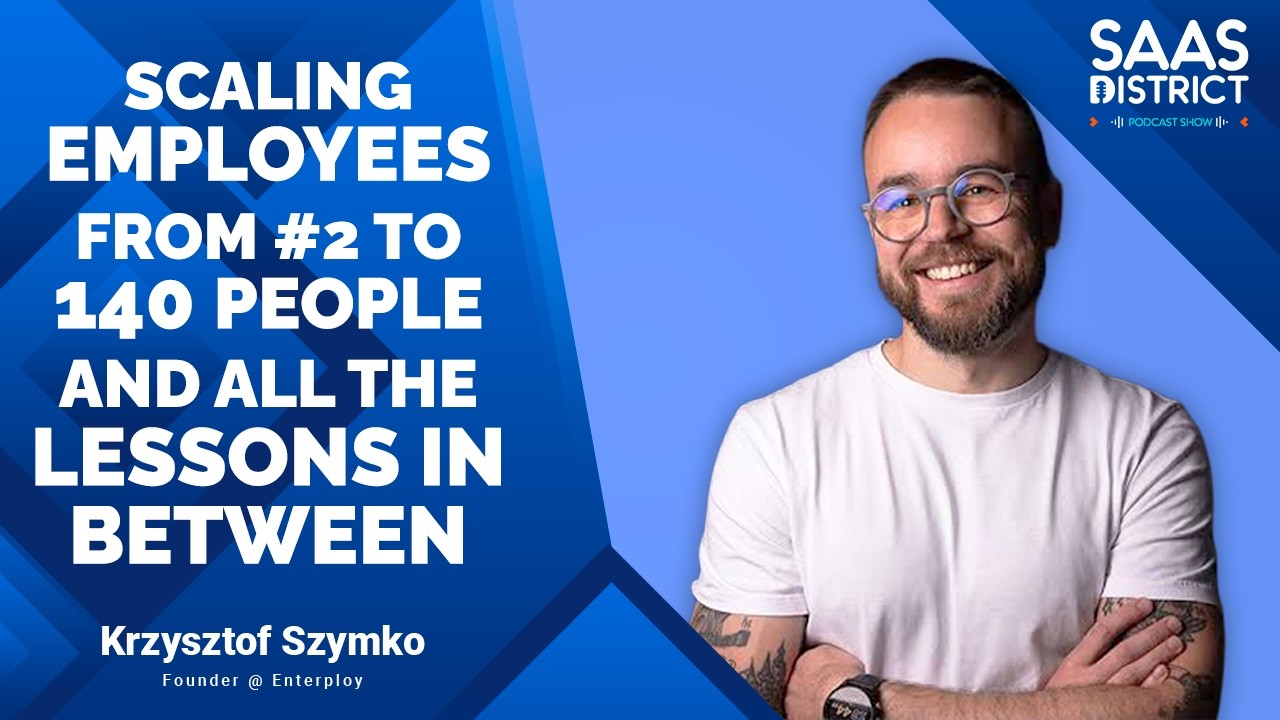
In this SaaS District podcast episode, host Akeel Jabbar interviews Chris Szymko, founder of Enterploy, about his decade‑plus experience building and scaling SaaS teams. Chris recounts his early roles at Proof HQ and Zyflo, highlighting how recruitment directly impacted product delivery (e.g., building a QA automation team to speed up releases). He explains the dual importance of technical skill and personality fit for early hires—emphasizing enterprise‑ready architecture, ownership, and adaptability. The conversation moves to the challenges of rapid scaling, describing how his company grew to 140 employees, then over‑hired and had to lay off staff, teaching him to hire for the current stage rather than future projections. Chris shares concrete hiring mistakes: hiring senior talent without cultural fit, ignoring red‑flags, and focusing on titles instead of capabilities. He outlines his interview technique of asking candidates to narrate past ownership stories. The discussion shifts to remote hiring in Poland, noting cost savings (40‑50% lower than US engineers), high technical rankings, similar work culture, strong English proficiency, and the legal simplicity of B2B contracts. Chris stresses the need for a local recruitment partner to navigate cultural and legal nuances. For founders raising seed or Series A rounds, he advises prioritizing the right people for the stage, hiring incrementally, and monitoring results before adding headcount. The episode closes with rapid‑fire questions revealing Chris’s personal flow state (powerlifting), career advice (choose learning‑rich roles and mentors), current challenges (balancing many founder tasks), favorite resources (Pareto principle, Alex Hormozi, mentor Matt), and his definition of success centered on his family. Contact details (enterploy.com, chris@enterploy.com, LinkedIn) are provided.
Chapters
Hello, hello everyone. This is your host, Akhil Jabbar, and welcome back to another episode of SaaS District. In today's episode, we'll be talking about scaling employees from number 2 to 140 people and all the lessons in between. Today we have our guest, Christoph Schimko, joining us. Chris Schimko is the founder founder of Enterploy, which is a recruitment and talent partner that helps SaaS companies across both the US and Europe build and scale teams in Poland. He holds more than a decade of recruitment experience in the SaaS sector, where with Enterploy, he connects growing businesses with top talent. He helps companies access the expertise they need to scale efficiently. He holds a background in technical recruiting and over 12 years experience in SaaS. And Chris has built teams from the ground up, along with the HR, and the recruitment process required to support rapid growth. So he works closely with founders and CEOs and helps them develop their, you know, the people, the hiring strategies that help align directly with their business goals. So welcome, Chris, super excited to have you on the show today.
Great. I'm really happy to be here today.
Awesome. So maybe you can share, you know, a lot of our founders in this stage where they're looking to scale, looking to hire, and maybe they need some help. So we'd love to hear a little bit about your story. You spent over a decade, right, building SaaS teams, And you were also one of the first early employees at a company called Zflow, if I'm correct. And maybe you can just share for our audience, what did being inside a startup from the ground floor teach you about scaling companies?
Okay, so I've been in a recruitment business for, I would say, like 15+ years right now. And as you mentioned, 12 in a In those two startups I was working with, and there are two stories really. So the first startup I joined was Proof HQ, and it was about twelve years ago, and we deliberately were hiring in in Poland, and it was just like a very new thing here, like. Pretty much no one worked remotely at that time and definitely not for international companies. And I had this assessment, pretty much that's why I joined the company to build a QA automation team. So, and it's pretty much, it was the first lesson I get as an insider because we needed to, you know, speed up the delivery of the product. And to do so, we needed faster QA cycles at this stage. So building this automation team, QA automation team, just thanks to that, we were able to scale there and speed up the delivery of a product. And this was like the first lesson that I learned that recruitment pretty much is very much linked with the business outcome. The second story, I think, is a little bit more interesting and robust. So I joined as a person number 2. I joined Zyflo or as a person number 4. I think it depends on which founder you would ask this question. And I was building the engineering teams from the ground there. And there was like one very particular lesson in terms of skills and in terms of the personality of the person joining. So in terms of skills, you always need to think about how your product would be used in a round. 5 to 7 years, even if you are building your MVP and pretty much you would presenting that to 5 clients, like the architecture behind that needs to be ready for what would happen in those 5, 7 years with like million queries to the database and so on. So you need a type of person that was very much familiar with how to build an enterprise-ready product. If that's, of course, your goal, and that was our goal at Zyflo to be enterprise-ready. And the second one is that you definitely need someone with a lot of ownership. You know, everyone says the same thing. A startup is a place where you wear multiple hats and so on. And actually you do. And that's why you need people that, you know, are comfortable with change, are okay with the fact that plans can change and even like ditching like part of their work to the trash bin, that they need to be okay with that. Because that's a very particular stage of building the company. So you need this combination of skills and also the personality that goes with this person. So that would be that like a very early stage situation and advice. And of course it changes with time and, you know, you are starting to build specific features. And then you hire people with deep experience in those exact roles and exact technologies, for example. And yeah, so that's very important on the later stages. And then usually after the MVP is ready and you know that the product has been tested by the market and there is a financial round coming in and then like everything, everything changes really. So you start scaling and usually in our case, it was scaling really, really fast. So we grew a recruitment team to 5 people, like including me. And we were taking care of hiring and culture and we got to about 140 people very quickly and like everyone felt this rush, like it's a right moment to build, to grow and—
Yeah, it's a great excitement feeling, right? In the startup world, yeah.
And, uh, and then it was this one gloomy day when you, you had realized that we scaled hiring ahead of where the business actually was. And pretty much, uh, then came the hardest part of my career at this stage because we had to walk some of it back. Back. Yeah. So, uh, to Pretty much that was the hardest thing I have ever done. And it taught me more about hiring than any success ever did. So it was even more painful because those people hit the culture we built. They hit it so well. So the culture was no genius jerks allowed. You needed someone who you actually want to to work with and people would be comfortable working with. And, uh, that was even more painful that, you know, uh, it, it happened at this stage. And so the full arc would be hire for the stage and stay obsessed with the quality of, of people there.
At this stage you're at, right? Versus, you know, finding too much investment in the culture.
At the stage you are at. Yeah, you need to be very aware about the stage. where you are currently.
Of course. So, you know, I understand. So you guys are building your MVP, just kind of going back at the beginning moments, focused on enterprise. So, you know, maybe people listening in, they're also working on B2B enterprise clients, and they're thinking about hiring their first few hires. So maybe you can share who were your first few hires and what roles did they play that you thought were critical in terms of the success of what led to Zyflo scaling after that?
Yeah, so I think there were 3 crucial roles. So one was more of a, like, very good cultural fit that defined pretty much the way forward for us of what kind of person we would like to have on the team. So it was Agnieszka. She was our web developer at that time. So I approached her at the time she was working at Uh, Szczecin University of Technology, and pretty much she was teaching people how to build websites. And, you know, we pretty much encouraged her to join us because she really wanted to work remotely and she loves to travel. And, uh, you know, that would give her the freedom, uh, to, to do that. And that was a big leap of faith, of course, for for her and, you know, she has been, uh, in Zyflov for last 10 years. So she's still there. And, uh, yeah, that was, uh, that is very impressive. But Agnieszka pretty much defined the cultural, uh, you know, scheme that, that we want to, to follow of that kind of people. The second one was Paweł. He was a senior frontend developer at that time, but working with like enterprises really and architecture and software for enterprises. And he left this good corporate job to take, yeah, as well, a leap of faith and start building something new together. He pretty much like grew very rapidly. He's also still there. So it's another person and he's a frontend lead right now and pretty much one of the principal engineers making the most important decisions in terms of tech. And there was a third person, Shimon, and he was a— a backend engineer. So he was the one on the backend side to, you know, build the structure of a product and the stage and made the most important decisions. So it was like, you know, very typical approach. So it, like full stacks, like weren't that popular at At that time. So it was more of a frontend backend build with—
Yeah, it was really about like the technical team, right? Having the right technical team, strong, you know, frontend backend, but also really match the culture. I think that kind of set the tone for everything else.
Yeah, for the next 10 years, really. So we, those guys were like pretty much the blueprint that, you know, we were thinking about once, like hiring further.
So you weren't just recruiting, right? Like you mentioned, you were involved in product and project management, and then also the team building. You mentioned one experience of like, okay, lesson is do not, you know, hire more than the level at where you're at, right? Like, this is where you're at, this is where you're gonna hire, don't overhire. Is there any other maybe experiences that you learned along the way that changed the way you think about hiring today?
So I think that I will tell about one common mistake. I don't know if that's that common at this stage right now with AI, but so, but I am really focusing on the mindset behind the you know, fundraising and when the finances really come in and like, it's very like obvious for everyone. You feel this excitement and energy. And when you learn that the funding round was coming and it's pretty much the framework that the PE tells you that you need to grow right now. You need to build the ARR there and you build, you want to build ARR and you build headcount because of this. And that's the equation everyone worked with and that's what was expected. And at that time, we learned the hard way that it was a big So I believe one important aspect is you need to look at your numbers. By numbers, I mean customer acquisition cost, for example. So usually people are the biggest cost for the company, the payroll. You need to look at the lifetime value and you need to assess Like, what is your pipeline for the next couple of months and really to decide on a strategy on, because usually at, we know at the round stage, you start hiring sales and yeah, and like the problem could be you don't have a right strategy. And to just build a repeatable pipeline. And because you don't have a right strategy, you start hiring in the wrong areas. For example, that the sweet spot for you could be content and that's where you should focus on. But for some reason you decide that like cold outbound, cold calling would be the best way to approach your potential customers, and then you just build a team in a wrong direction. So you need to figure out a couple of things before you put a pedal to the metal, really. So, and remember this mind shift. So I work with companies at seed or Series A. And they have the money and the investor want them to grow. The team is very excited. And that's where I need to say, like, slow down, guys. So before we start accelerating, let's think. So yeah.
Let's talk a little bit more about that in terms of speed of hiring, because I think that's maybe a big question maybe people think about of like, okay, maybe they raised their Series A or a round. And then, you know, you said at one point, you know, the team rebuilt an entire product in 7 months. So maybe you can share a little bit about your experience about, you know, what do you teach about hiring, you know, for startup speed? And what are the type of people you need to require to make it work? And what's the strategy around that?
Yeah, so I will tell this story as a background maybe, and then I will like address this question directly.
Mm-hmm.
So pretty much Zyflo started with building automations for marketing teams, and it was very well integrated with Dropbox. And pretty much the main thing was to deliver the automation to get rid of the mundane tasks for the marketing teams. And we built the MVP, we went to the market and very quickly we realized we won't be able to sell it as a product, as a standalone product. It's a good feature. People would like to have this in their workflows, but it's still not enough for a product. So, and then we were lucky enough to have this 3 people on board. So I mean, 2 founders and our CMO at that time. And those are the guys who pretty much built online proofing. So created online proofing. And for those who don't know, like proofing being a tool that lets marketing agencies share and review content where everyone can comment, give directions, and have everything in one place. So, and before that, agencies relied on like endless back and forth email and tasks got lost and those project managers were going crazy about, didn't know where the project was and stuff like that. So the idea was to, let's take this automation that we built already and let's add this online proofing component to that. And thanks to that, we can create one product that will deliver much more value. So, and the idea was to build it in 7 months. So I remember myself sitting at the all-hands meeting and I was thinking, yeah, guys, sure, we're gonna build it in 7 months. Of course, no problem at all. And I was like extremely skeptical about that. And fortunately for everyone, I was proven wrong and I was proven wrong 100%. So the team did an incredible job there. Like all the technical and product people had this like amazing passion for creating something new. You know, they really want to deliver real, like, benefits for customer. And this energy was inspiring. And what it, like, taught me was that I saw how quickly a startup can move, how fast decisions get made when the leadership is focused on a target and they are steering the ship directly at you know, edit and everyone is on board. So, as far as I remember, it was done in 6 months and I'm very glad I was proven wrong, but that's when I learned about the power of motivation, shared goal, and people with great sense of urgency and ownership.
Mm-hmm.
What was really important. So ownership was always a very important aspect for us. So I'm telling that to all my clients. You don't hire people to tell them what to do, at least not senior people. You hire them to tell you what to do and you need to give them space.
Absolutely.
So I think micromanagement is one of the biggest diseases of of management currently. So that's what I was always advocating against.
So how are you assessing for that? I mean, you know, you help SaaS companies, you know, build teams in Poland, right? So one thing that maybe comes to mind is, okay, how do you look for, you know, ownership and urgency, right? Like, how do you assess for that in early stages? I mean, you have to see, you know, maybe test them and see how they work to be able to see if they take that ownership, right? It's kind of hard to assess during interviews, right?
Uh, so, so usually you need to ask the right questions and by right questions, you need to focus on their previous experiences and on a very particular event. So you ask them to, you know, tell you about a story where they needed to, to do something. And based off this, based on the story, You can pretty much assess, you know, what was their approach, how serious they were about it, how passionately they can tell about this story. So you need to refer to the previous experiences. I think from, for an experienced recruiter, you could tell it, just talking to someone, you can get the sense and the feeling of that, but it's mostly based on the questions. So that's the approach. Nice.
So, you know, can you share a little bit more, you know, so after raising Series A, your company grew, you said rapidly, 140 people. Other than hiring too quickly, is there any other big hiring mistakes that you said you've made during this growth phase that you've learned and now adopt and include in your process as well of helping SaaS founders so they can avoid making those mistakes, right? Which is the most important part because it's expensive, right?
Yeah, it's very expensive. I believe there is some data that the wrong hire, like a senior hire at the beginning of the your journey. And I mean, an engineering team hire can cost you around $90,000 at least 6 months of your time. So there was one where we, it was very early stage. And I believe that was a second backend developer that we wanted to add to the team. The guy was like very senior with, with a great experience, but, you know, uh, and we pretty much knew that he, he's not the easiest to work with. And, uh, but we hired him anyway. We thought, okay, this experience is so much valuable for us that we need this guy. And the moment he joined, there was this clash between, you know, our like current backend developer and our new backend developer. And you could like feel the energy in a Zoom call, not a very good energy between them. And then we realized that pretty much no one can, you know, communicate well with that person. Like, really, in terms of technical skills, he was like, I believe top 1%, but, and then we learned, so it's pointless to have someone with that kind of knowledge, which you cannot really use because it's very difficult for the team to work together at this stage. So we lost more time having this technical brilliant person, even getting someone a little bit worse, but, you know, with much more capabilities to work with a team. So just don't compromise. Like, don't. If you feel there is a red flag, even orange flag, and you have this feeling that it may not work, just don't go for it. You need to trust your instincts.
Absolutely. And yeah, it's not just about talent, right? It's like cultural and values, right? And like, that's the biggest issue is if you don't have that cultural fit or the values align, you just can't move forward. It doesn't matter how smart and, you know, urgent you have, or maybe ownership. But yeah, that's also a big block as part of that. You're absolutely right.
Yeah.
So that is also one thing. And especially if I think it's important for, for like director of talent acquisitions or recruitment leads, Because you need to be very clear about what we want to do in terms of communicating it to your team. Sometimes, you know, there is a need to fill the role and fill the role quickly. So even your recruiters can bend the reality a little bit and you need to You know, talk a lot about that and make sure that we are on, we are all on the same page. You know, it can take a little bit longer, but you cannot just push for a successful hire just for the sake of, you know, the position being closed. So that's also important in terms of managing your team. Yeah.
Absolutely. So today you work with SaaS founders around the world, companies, founders who are looking to grow, and you build teams for them in Poland, right? So you have probably a pool of talent that you work with. Maybe you can share a little bit. What do maybe founders consistently misunderstand about hiring one internationally and building remote teams, right? So if you're in the US and Europe, sometimes maybe you're hesitant of hiring remotely and then also hiring from different country, different culture, and you don't understand If they can fit into your business, into your culture, and maybe there's some things you tell them that like, why is it a good idea to consider it?
Okay, I will use Poland as an example here. That's why I work with Polish talent really, and I think the biggest misunderstanding is treating this offshoring as a cost-cutting move. So yes, The savings are real. So for example, for technical roles, you can expect 40 to 50% less comparing to the fully loaded US engineer, but you can get amazing skills here. For example, those HackerRank ratings. So Polish developers are In the number 3, uh, so like all over the world, they are number 1 in Java, they are top 2 in algorithms and Python. So you get like amazing skills here, which are cheaper as well, which is a great benefit. It can really prolong your runway for a couple of months.
Mm-hmm.
Uh, in terms of Poland, you have a very similar working culture to US. So people are really hardworking and they want to take ownership. They, they want to deliver something innovative and they understand that it takes hard work to deliver good results. And this alignment is like very important because you can communicate. In the same language in terms of what you want people to deliver. The third one would be English, and I think that's something that is extremely important. Like for senior hires in Poland, you know, they usually speak like C1 English, and that's important from for one very important thing. So you want a sparring partner. As a tech lead, you want a sparring partner. So you need someone who can communicate like in a flexible way and really, you know, provide their point. And, you know, Polish people grumble a bit. Some would say a lot. And, you know, that's a good quality really, because they can look at what you are proposing in a, you know, very fair way, if you will. And then you have a really good discussion about that. And there's another one, for example, in Poland, you know, a lot of teams, they do like a lot of senior engineers, they work on B2B contracts. And so that's important from one perspective that you don't need entity here in Poland. So pretty much the only thing you need to do monthly is to pay the invoices they would send you. So you don't pay taxes from it or you don't— pay social security and that's very important. You have like EU protection in terms of like intellectual property. I mean, the laws around it. So, I think to hire right, you need a partner on the ground that can explain you the environment. I remember, at our Zyful times, we were looking to hire in Latin America and we always were looking for a partner on the ground to do that.
Yeah, absolutely.
We decided, let's keep it in Poland. We are very happy with the team. We know how it works here and that's where we ended up, but I would say you definitely need a partner on the ground.
100%. Yeah, I mean, we've hired talent from India to Argentina to Mexico to Brazil, US, obviously, and Europe. And yeah, every country has its culture, its way of working, the way of people understanding how business works, how to operate. So having somebody on the ground who can just manage that and communicate that clearly and just hold it together is extremely important.
So I agree.
So Chris, last question before we jump into the rapid fire questions. Maybe say there's a founder who's listening in, they've just raised their seed round, their Series A round, they need to hire quickly. What's maybe a hiring advice you wish you had, someone had given you when you were employee number 2 at Zyflo, and you go back and tell them today?
Okay, so I know like everyone tells that speed is the most important, but really speed of hiring is It's not a goal. It's about the right people for the right stage. And you need to be really aware of what you want to achieve and who would deliver those results. It's not about hiring quickly. And you need to hire for the stage, not the title. So especially in those startup areas, like the titles don't don't matter. So there are only just 2 requirements. They need to do the job, they can do the job and build the architecture for the next several years. But at the same time, they need to be a startup fit. And that's also, it's quite unique, but definitely you can find people like that. And then like really hiring for culture. So that's also very important. And whenever you have this urge to like really build the team quickly and just add people like person after person, just imagine having to lay them off because the numbers didn't hold.
Mm-hmm.
Uh, at that point, it, it really gives you a, a different perspective. So hire, like watch the results, then hire again and watch the results. It can definitely, this adding headcount, like, uh, in a stable way. I think that's, that's the most important.
Absolutely.
It also lets people to get accommodated with your company and then you can train them a little more easily and then you can move to another—
Absolutely.
Yeah, another part of hiring.
Also, I mean, you also have the pressure, right? You have all this money in this bank account, you have VCs maybe breathing down your neck to like, okay, we got to move now, move results. But I think, yeah, it's maybe able to like slow down and just not let that affect you, right? And just hire more smartly than letting the pressure get to you.
Yeah, exactly.
Love it. Yeah, great advice, Chris. So let's shift gears. Let's move to the rapid-fire questions. You ready for that?
I don't know. Let's see.
Let's do it. All right, Chris, what's one activity you enjoy outside of work that gets you into a flow state?
Oh, powerlifting. Definitely powerlifting. I've been doing powerlifting for a couple of years right now. And That's, you know, that the biggest kick you can get is like, you know, carrying a heavy weight. So yeah.
Feeling strong, feeling powerful. Love it. Chris, what's one piece of advice you wish you had known? And if you can go back, you would tell your younger, let's say 25-year-old self?
Oh, don't go to recruitment, man. So definitely.
Okay.
Uh, so, so, uh, no, to, to be honest, I think the most important is You need to be very particular in terms of building your career. Just like picking the places where you can learn the most and you can really bring quite a lot to the table is very important. And I can see like a very like brilliant people, but they just structured their career in a very odd way. Sometimes it takes just, you know, one wrong place and one wrong title and, you know, it can all go to the drain. So you need to be very careful in terms of building your career. I think there were a couple of positions I wanted to take. Unfortunately, I didn't get them. So ultimately, I was lucky with the places I picked and definitely like I work with Matt and Anthony, they are both behind Proof HQ and Zeitflow for a very long time. And just having someone that could mentor you and just, you know, uh, just push you in the right direction. It's, it's very important. I think like One of the most important things.
Love it. Chris, what are some of the biggest challenges you're currently facing in order to continue to grow? Meaning what keeps you up at night these days?
Oh, so you need to learn so much in terms of this entrepreneurial journey. So you need to be all over the place. So you learn sales, you learn generating leads, like, building this, the story, even just showing up on, on camera. So, uh, you know, it's just, you, you have this, uh, you know, feeling that you can miss out on, on something if you just not keep going and keep working like steadily. So it's just like finding the right balance.
So.
That's what it would be.
Love it. Who are some of the best 3 resources? These can be books, mentors, or people you follow in the space who you say have been most instrumental to your success over these last few years.
Oh, so in terms of the books, there is this book which talks about the 80/20 rule. I don't remember the author.
The Pareto Principle? Yeah.
Yeah, yeah, yeah, currently. But, uh, so that, that was very important. I like Alex Hormozi a lot, maybe not in terms of the grinding till you die at your desk, but definitely you can learn a lot about building companies from from him. And one of the most important mentors for me was Matt, one of the founders of like both companies. And even after, you know, my time with Zyflo is over, like we talk very frequently and the amount of knowledge he can pass to you and just bumping ideas from him is amazing. So, uh, yeah, that, that would be the 3.
What does success mean to you today, Chris? Whether that's personally, business, financial, life, there's no right answer.
Uh, so the success for me is, uh, you know, to, to, to raising my son in a, uh, in a good way. And like recently he said something like, I can accomplish that because I'm trying. Like, he is 3 years old and it's that, that's what I always wanted to pass to him, that if you try and you try hard, you, you will get there. And him understanding that at being 3 years old was, was very important for me. So like main, my main focus, uh, yeah, I, I know I probably should business and growth and say business growth and things like that, but just raising my son is the biggest one.
That's beautiful. Yeah, family. I mean, that's your success is defined by your family and how you're passing your legacy. So amazing. Chris, this has been great. I enjoyed this podcast. Where can founders or anybody in your audience get in touch with you, learn more about you as well as learn more about Enterploy?
So website enterploy.com. Very simply, or my email address is chris@enterploy.com. So yeah, so that's the easiest way. You can always find me on LinkedIn. So yeah, as well.
Okay, cool. So I'll put your email, your website, as well as your LinkedIn link in our show notes. If anybody wants to reach out, make sure to reach out to Chris. So thank you so much for your time, Chris. I really appreciate you joining today.
Thank you guys. So I really enjoyed this one. Thank you.
Thank you.
Cheers.
Thank you all for watching this episode and joining SaaS District today. Don't forget to like, subscribe, and hit the bell for future episodes where we interview top leaders in the SaaS industry. If you're a SaaS company looking to grow and unlock the true value of your business, get in touch with us at Horizon Capital and myself or one of our consultants We'll provide a free assessment to help you get there and hit your goals. If you have any feedback or suggestions for this podcast, please comment down below and help us improve our content for you all. Thanks again, and see you on the next one.
More from Akeel



Get a mentor as soon as possible — and make sure it’s a mentor in your space.




Keith Gillispie: Why Most New Investors Fail & How to Avoid the Common Traps #250 | SaaS District



