Leon Barnard: Education as a "Feature" of Your SaaS Product # 156
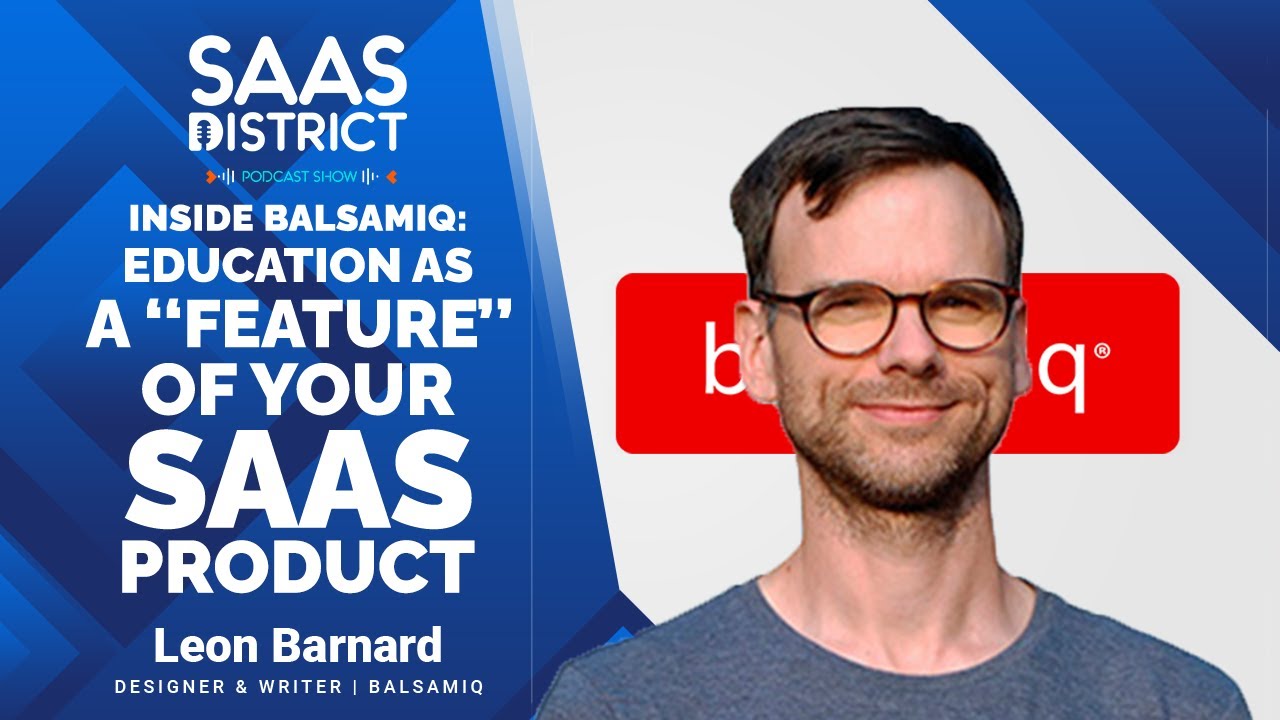
In this SaaS District interview, Leon Barnard, designer, writer, and educator at Balsamiq, explains the company’s unconventional marketing and growth strategy, the "whole product" philosophy, and how education functions as a core product feature. He describes Balsamiq’s small, low‑growth marketing team that relies on word‑of‑mouth, sponsorships, and education rather than aggressive advertising. The conversation delves into the "whole product" idea that the company’s values, sustainability, and customer experience are part of the product offering, illustrated by playful in‑product easter eggs like the "What should I make for dinner?" feature. Barnard outlines Balsamiq’s four pillars—product, company, giving back, and education—and how each supports the mission to rid the world of bad software. He details the Wireframing Academy, a free, in‑house education platform that creates content, drives SEO, and serves as a marketing channel, even though the team does not track conversion metrics closely. The interview also covers the importance of high‑touch customer service as a marketing tool, advice for other SaaS founders to focus on non‑copyable experiences and relationships, and personal motivations such as customer interactions, a culture of trust, and his hobby of DJing. The discussion provides a holistic view of how Balsamiq integrates education, community, and company values into its SaaS offering.
Chapters
The following message is brought to you by Balsamiq. Balsamiq have decided to support the SaaS District community by donating their sponsored airtime to some of our listeners. This episode is sponsored by ShoutOut, a 2-way text messaging and campaign management platform that provides analytics and facilitates conversational messaging that delivers, engages, and converts more. Send personalized campaigns from unique phone numbers to the message content itself, letting you brand your campaign to promote yourself and create your messages in a way that users are made to think you sent it personally for them. You can then monitor and improve your campaigns over time with real-time analytics. Start reducing messaging and campaign costs with cost-effective bulk SMS. Scale efficiently without having to worry about high costs. If you'd like to start using mass texting services with simple packages to choose from, visit getshoutout.com today. If you'd like to receive a promo code for a 90-day trial of Balsamiq, or even just thank the folks at Balsamiq for supporting our community, visit balsamiq.com/go/saas-district.
Hello, hello everyone. This is your host, Akeel Jabbar, and welcome back to another episode of SaaS District. In today's episode, we are back on our special episodes as part of, as part of our miniseries for the month where we interview different team members of a SaaS company to learn their expertise as part of their overall business strategy.
On today's miniseries of Inside Balsamiq, we're talking about education as a feature of your SaaS product.
Today we have our guest, Leon Barnard from Balsamiq joining us. Leon is a designer, writer, and educator at Balsamiq. He uses his 10— over 10 years of experience as a UX designer to teach users how to use UI design basics and wireframing to all of Balsamiq's audience of mostly non-designers. He loves helping people and technology get along better. So welcome, Leon, super excited to have you on the SaaS District show today.
Thank you very much, I'm really excited to be here.
Awesome.
So I want to hear about your marketing strategy because you guys have something unique going on here. Tell us, you know, inside Balsamiq, what does the current marketing team look like? What does that strategy look like? And how does your team run things differently than maybe traditional SaaS companies?
Yeah, I think actually we're quite different from a lot of SaaS companies. Um, our marketing team is very small, um, although our marketing efforts are quite large, um, because most of the marketing we do is not really traditional marketing. Um, I think we're actually quite lucky in a lot of respects in that our, our product kind of had a very natural product-market fit and it grew quickly through word of mouth early on. We kind of had a really good position in the market, so we didn't need to do a lot to grow initially and gain that traction. So a lot of our marketing now is really focused on maintaining and just kind of refining our brand and our message. It's not so focused on growth, which is kind of a nice luxury to have. So we do a lot of indirect marketing. You could call it inbound marketing, but also we try not to be too in your face about it. So we don't do a lot of direct advertising. We do a lot of marketing through things like sponsorships, education, which I'll talk about, and some of our other things that we do just to help people become better users of the product or help the community, and not a lot of direct in your in-your-face, um, uh, kind of the types of marketing that you see a lot of SaaS companies doing these days, because we already have an established customer base. And, you know, our goal is not just to gain as many new customers as possible.
And that sounds quite counterintuitive, right? Like most SaaS companies, like, you know, growth and SaaS, you know, if you don't put those 2 words together, like it doesn't make sense. Right. But I know, you know, speaking to, to Peldi before, right, like he's happy with, You know, single digit, you know, very, very small growth, but just focusing on keeping existing users happy. But just, you know, curious from your perspective, why do you think Balsamiq wants to take this atypical approach to marketing?
I think a lot of it goes back to Peldi and his vision for the company. I mean, when he started it, he thought it was just going to be a one-person company for life. So growth is kind of anti-growth. Every time we hire somebody, it feels like, uh, you know, he's kind of resistant to it. So, you know, now we have 33 people, uh, and And that's after 13 years in business. And I think that feels like a huge company to him. So it's just, he never imagined being a company that would be so big, quote unquote big. And so I think there's always kind of, we're never aiming to grow. We're just, maybe he talked about this idea of kind of your product's natural size. And clearly there's a, Clearly, there is a market for a wireframing tool, and we're really lucky that, you know, with the growth of UX, a lot of people want this tool. But, you know, this is not going to be a $100 million company, or it's not going to be something that's necessarily a household name. So we're happy just to, you know, our goal is basically just to try to get it in the hands of anybody, of everybody who would want it or possibly be interested in it and not necessarily try to sell it to every single person on the planet. And he focuses, I think, or talks about sustainable growth. We're all self-funded, profitable. We don't have investors who are asking for a return on their investment. So that really gives us a lot of freedom to not have to grow rapidly.
Yeah. And I love that kind of thinking, right? Because, um, you know, I think most founders think if they need to start a company that they have to grow fast and they have to follow this certain path, they have to take outside capital. You know, there is no right way of doing this. And, you know, I think what I love about Peldi is he's sticking to what he wants to do. He's like, look, this is what I want. I don't want a big company. I don't want a big team. I'm happy with this. And he's okay with that and accepting that that's a hard thing and not, you know, giving in to, to, you know, outside pressures or what people think is the right way. So there's no right way. And I respect what Pelli's doing, what you guys are doing. So that's awesome. Can you guys talk about this concept of the whole product concept? How do you go about making the marketing one feature of a broader product, if you can speak about that?
Yeah.
So our product is pretty simple in what it does. The messaging for it is pretty clear, but features are relatively easy to copy. So, you know, Peldi understands, and as a company, we understand that if we're going to stay in business and if we are going to, you know, continue to succeed and grow at a, you know, a moderate pace, we have to offer more than just the code that we ship, you know. And so a big part of that, for example, is just being, you know, staying in business. You know, I mean, somebody can come out with a a version, something similar, or some version of a tool that offers everything that we do and something more. But if they don't have a business model that's going to keep them in business, I think we've all experienced using tools that are really, really cool, and then 2 years later it goes out of business and you're frustrated because you have to migrate all your data or you've gotten used to it or you have to learn a new tool. So The core, the foundation of that whole product is just that the company is a part of your product too. And building a company that is sustainable, then it's going to last, is as important as the product that you sell. And then also, you know, that includes the values of the company and trying to, you know, define what those values are and stick to those values and be the kind of company that we would like to work with ourselves. So that's— it's kind of behind the scenes, and that's not necessarily— you don't necessarily see that in all of our marketing, but it's something that we try to kind of embody in the little ways, like when you contact us or in all of the kind of touchpoints. We try to be just kind of good people or real people, or, you know, just kind of— we want people to have a good interaction with us. And, you know, that I think we've also all experienced. both extremes of that where you maybe like a product and then you have a terrible experience, customer service experience or whatever, and it really turns you off or vice versa. There could be a mediocre product and if everybody's friendly, then you want to keep doing business with them. So that doesn't sound like marketing, but it actually is if you're looking at user experience or customer experience, thinking about every touchpoint. Um, it goes way beyond the product.
Yeah. And I think that's, that's an important thought, right? A lot of people think, you know, the features is what makes your business, but the business is beyond just features because those are easily replaceable copy. Um, and you can't just build, say, okay, we're going to copy the next guys and just build more features. Cause that's, you know, what typically people say, right? It's like, we're going to build more features and just be cheaper. And I think we'll win the market, but that's easily, there's no moat to that. There's nothing that, that'll keep customers happy. And I think what you're saying is, You know, as part of that is just, you know, there's features, but there's a whole, you know, other part of this, which is what really makes your business valuable. And that's what you guys focus on. Um, and, you know, that ties into something that was an interesting story. I think Peldi mentioned in his first interview with us, which is you added this feature where something pops up where it says, uh, that feature, what should I make for dinner? Um, where did that idea come from? And what's kind of the impact you've seen from, from, you know, that specific feature in the company and with the clients? How did that impact that?
I think it's a really good example. And it's funny that— so I've been with Balsamiq, yesterday was my 9th anniversary. So I've been here for 9 years, and that feature has actually been here longer than I have. So it was, I think it was just an idea. One of our, I think the 2nd employee that Peldi hired, she loves— she's a great cook, she loves sharing ideas. And so she just has a bunch of recipes and I think it was, and there's kind of a food connection. It's an Italian company and food is a big part of our culture. And so I think at the time it just seemed like a fun idea. And since it happened early on, we might be reluctant to do something like that now. And I think probably a lot of bigger companies, it feels they're afraid to do something silly or lighthearted. But at that point, like I said, Peldi never imagined this company growing to more than a small handful of people. And so you kind of have this attitude like, why not? You feel like you're just making the product for you and some friends or something like that. So I think it started from this place of just kind of like, why not? Let's have some fun. But it's something that we're really proud of over time because we get tweets and comments about it all the time, people discovering this cool, what should I make for dinner feature in our product, which seems to have nothing to do with wireframing. And it doesn't, but it's just this idea of, hey, life is more than just wireframing. Or maybe you're super into wireframing and you ran out of time to make dinner or whatever, so you want a quick recipe. And so it kind of embodies this idea that software can be playful and that there's more to life than than software. And, you know, that, that this means that we're kind of a friendly, approachable product, or, you know, more than anything, it means that there's real people behind it, you know. And so we keep trying to kind of replicate that idea or think about that idea when we're evolving the product. And people— I mean, the feedback we've got from it, on it, has just been, you know, universally positive. Everybody loves that idea. Nobody doesn't like it. And it's not in your face. It's just a little thing in the help menu. You know, probably 90% of the people who use the product don't even know it's there, but that's fine. It's just kind of a nice little fun thing that kind of conveys this message that, you know, we're real people and we don't take things too seriously, I guess.
And you mentioned something interesting, like, you know, there's more reluctance now when you're a little bit bigger. You know, I can't imagine, like, you know, like in LinkedIn or Instagram where, hey, you've been sitting on this app for the last 3 hours, you know, maybe you should get up, you know, pop in your face, hey, go for a walk or like go have a drink of water and get off your screen. You know, I don't think It seems like they'd want to do that for their specific reasons. But from your perspective, is there a reason why you haven't tried more things like that recently?
Well, we talk about it all the time, actually. I mean, there was a long period where we were rewriting our application from scratch. It was written in an old format and bringing it to a new format. And we were just really focused on the features and the functionality and stuff like that. Now that all of that is stable, we are talking a lot about these in-product ideas. And our discussions now are more about how can we build in some of these things to help people become better at wireframing, or it's a little bit more focused on the product or making the product experience more enjoyable or more engaging or more helpful, thinking beyond just the— the core features of the product, but thinking more within— still staying within the scope of the work. How can we make the work better? Or how can we help people tell when their wireframes are getting too complicated? Or, you know, we would love to have something where we could kind of have a little built-in usability gauge in there or something like that. So trying to think beyond core features, but staying within this idea of helping people do their jobs better or, or get their work done faster so that they can go and have dinner or something like that. Um, so we're thinking about it a little differently, but still trying to think beyond, you know, what are these core features, things that are going to be kind of unique and, you know, and fun and, you know, a little bit outside the box.
Yeah, that makes sense. That's cool. Um, and then going back to kind of the question of growth, I know you guys mentioned you have Um, you know, something called the 4 pillars of Balsamiq. Can you speak a little bit? What are those 4 pillars of Balsamiq's success and what that actually leads to what you guys call, you know, sustainable growth?
Yeah. And so that kind of evolved over time and we've, you know, as we've grown, we've been able to invest more in those pillars. So the first one is, uh, is the product itself. Um, and then the second one is the company, as, as I mentioned, and then, you know, our original mission, which we still stick to, is We want to try to rid the world of bad software. And so in that statement, it doesn't say anything about our product necessarily. So, you know, we can do that by making a product that helps people design software that's easier to use. But we can also help people just become better designers. We can help people who are aspiring to become designers do that, people who don't necessarily have access to all the resources. You know, we can help the community. So our third pillar is giving back. So just being supportive of the community, we do a lot of sponsorships, sponsoring conferences and meetups and events, and donating our software to a lot of people. And so just making it kind of widening UX and making it more available to more people. And then in a related way, the last pillar is education, which is helping, which is kind of being very deliberate about helping people become better designers, because our core audience is not UX designers. It's maybe product managers, founders, a lot of SaaS startup people who don't have a designer yet or don't have a design team and they want to get their idea out there. So they don't have a background in design. So just helping them become better designers independent of the product that they use, or they can use a different wireframing tool, but it's still related to our message of you know, helping improve software overall. So those 4 pillars of the product, the company, giving back, and education are all ways that we're kind of supporting our, our mission. And as we've grown and been able to add more people, we now have dedicated people to each of those pillars.
So you have somebody who actually leads those. So product, company, giving back, and education. Now, um, so obviously I can see how, you know, all this ties into overall, you know, the company's success and Maybe if some, you know, a founder is listening in, right, you know, other SaaS founders, even marketers who are thinking about maybe implementing something similar in their own SaaS company, do you have any advice or thoughts that, you know, they can start thinking about?
Well, like I said, we are in a very good position in that we have an established user base, you know, we have an established name and brand, and, you know, we got really lucky with the timing early on. And, you know, with word of mouth. And so we're not— we don't have to be focused on growth. And so if you are in a position where you're really trying to get people build awareness, you know, then you probably do need to invest in more growth marketing and the product and those sorts of things. But if you are in a place where maybe you, you feel good about, you know, your adoption and you want to maybe find a way to stand out, or you feel like you're in a kind of a stable place, then I would say just try to think, well, think about things that are hard to copy. So features are easier to copy. What are some ways that you can create that just feel unique or personal to you and ways that you can help people become better at what they do? How can you give people a good experience with your product that goes beyond the features? So that may not necessarily be the same ways that we do things with education and giving back. I mean, certainly building a sustainable and long-lasting company is going to be a very important thing. But I guess just in general, pay attention to the things outside of the product that are going to give people a memorable experience, that are going to make them feel good about, about themselves after using the product. So, you know, maybe they spend less time in their product because you've designed it so well that, you know, they get their job done quicker or whatever.
That's—
that should be a win. What are some ways that you can teach them about things related to the product or talk to people in their industry? You know, who do they look up to? You know, think about these things. You know, try to talk to real people and listen to their stories and talk to them about the other products they use and the things that they want to learn and they're interested in. We do a lot of— we don't do a lot with analytics and data. We do a lot of one-to-one user interviews and conversations, long conversations with people. And so that really helps build a whole picture of your customer. And, you know, they spend a lot of their time not in your product. So find out what other things they care about and how can you help them do their overall job. Yeah.
So it sounds like, you know, what I'm hearing repeatedly is that this is all about, you know, the people kind of getting into the other people's, getting into their, their you know, their shoes, understanding them, really, you know, getting into them, getting in their face, talking to them, understanding them. And I heard this several times across, you know, different members we talked to in the series, part of the team who talk about customer service being a big part of your overall marketing and just being there. Can you talk about why maybe customer service is the new marketing and how that works well for you guys?
Yeah, that's, um, I think that's a phrase that we've been using for a long time, and that was, it was a way to convey this idea that You know, the product is not the experience, you know. And so customer service is really, you know, now we think of that even broader. So it refers to any interaction that you have with our, with our company. And so a lot of that, a lot of people's, their primary interaction with us as a company after just downloading the product and using our website is if they have any problems with it or if they need to talk to support or sales or talk to anybody on the phone or by email. I mean, those opportunities are, uh, are really rich for, you know, making or breaking, um, uh, the success of a customer or a good interaction with them. And so if you really focus on having personal, high-quality, uh, interactions from your customer service team, then that's really going to, uh, you know, help your product. So that is probably more powerful than any type of ad you might run, um, you know, or AdWords or any kind of, you know, website ad you might run is just having top-notch customer service, having every interaction that a customer has with, with you, uh, be, you know, be helpful and be, you know, feel, feel personal or however you want it to be. Um, but, you know, that's going to probably go a long way. to your success if you focus on that.
Love it, love it. And then I guess kind of the core of this episode, you know, I wanna talk about more about the education piece of the overall 4 pillars. Can you go more specifically in more detail of how you guys are using, you know, education? I'm assuming you're a big part of that as a feature for Balsamiq and what you're seeing there and how you approach that.
Yeah, yeah, so that's something that has evolved over time as well. In the beginning, we, you know, we We had our core of the product and the documentation and good support. And then, you know, it was a while before we felt comfortable or felt like we were ready to add kind of this education piece as a main part of our company and our offering and our marketing. So now, if you go to our website, you know, one of the links you see is, is Learn to Wireframe on the top. So it's kind of— that's reflective of our Our pillars there. One of them is just all about helping people learn how to become better at wireframing. And so I lead the education team. I was a UX designer for a long time, and so I'm kind of a subject matter expert. I was a big fan of the tool and of the approach that we take, focusing on kind of low fidelity, not pixel perfect, you know, just getting your idea across rather than creating something that's, you know, looks great in your portfolio. And so, and we have another— full-time educator now too. And so we have people who have kind of lived the lives of our customers and done wireframing and UI design as a job. And now we're basically in-house experts who just write about all the things that we've learned. And we try to focus on real stories, not just theoretical things that you might learn in a bootcamp or something about how things should be done or in a user experience guide about all these tools and techniques. But we've lived a lot of these stories of working in real environments. And so it's a lot of stories written kind of from firsthand or talking to people that we really respect and appreciate. And it's basically, if you've heard of this book Badass by Cathy Sierra, she talks about this idea of basically just It's not about your tool, it's about what people can accomplish with it. And so we create this tool, which we think is really good, but if you don't know what you're doing or you don't understand enough about UI design, you can still create a really crappy wireframe or output with it. So teaching people how to use it. So if you're selling tools, you teach classes on how to do construction or whatever. I mean, if you're Home Depot or something like that, your website should be all about how to do home improvement projects. So it's kind of that idea of helping people get better at our tool by learning how to— focusing on the outcomes that they want and not just how to do— how to use all the features.
Yeah, this is fantastic. So Balsamiq Wireframing Academy and all these courses you have listed here, they're all free, right? There's no charge to go into it?
That's correct.
Well, yeah, I mean, I love this. I mean, the kind of control guidelines, you guys go even to the detail of, you know, how to set up a button or a checkbox or, you know, on/off switch. These are just guidelines for every piece of the overall puzzle, right? And a lot of people may get stuck on that and this kind of gives you a good framework. So I love this. I mean, I imagine this probably took quite a, a while to put together. So you have somebody full-time, you know, one person who's constantly creating content, or—
We have 2 full-time people, me and another person, and then a part-time person who splits his time between this and actual UX design on the product. So he's actively doing UX design, and then another person who helps us specifically with the marketing for this, this site. So this is kind of where a lot of our marketing happens is through this education site. And we don't feel as bad about pushing it on people because it's all free and it's all stuff you want to learn. So it's not like, hey, buy our product. And none of it is focused on our product. I mean, we use Balsamiq wireframes in all of our examples, but it's as a way to communicate how you should be building or what a wireframe should look like or whatever. But yeah, it's evolved quite a bit. It started out as just a little, a small section of our help and documentation site. And now it's grown into its own website. And so we've slowly evolved it and added more and more content, and we're adding courses, and we're working with other people to help us create content. And so it's really grown a lot, and it's been a big investment over the last several years.
Yeah, this is fantastic. And there's one here specifically, I think I'll Guide people listening in. There's a page called SaaS Website Design Lessons from Real Users. So I'll put that link to our show notes. And I think you guys go over a list over some of the top SaaS companies, I think 10 of them. Um, and you guys kind of break it down and just show why it's converting. And so this is a good maybe tool I'll add to the show notes for people to check out if they're looking to improve their website design. And just one last question around this is, you know, how much is, uh, does this play into your kind of SEO and, you know, content strategy On that end, are you finding like this drives a lot of traffic and leads and on the backend as well?
Well, the shorter answer is we don't really know. He really doesn't like looking at the analytics.
It drives me crazy you saying that.
I know, I know. We don't have any kind of funnel set up, so we have no idea about conversions. I mean, sometimes we dig around in the Google Analytics, we want to, but we don't even really know which articles or which links people are clicking on the most, which is kind of funny. Sometimes we'll peek in, just curious. But we do actually invest. We spend the most time on the SEO for these articles because we really want people to find them and really trying to get the SEO right and accurate too. We want it to be a good description of what the article or the course is about and not necessarily whatever keywords are trending or whatever, because we want this We want this content to be visible, but we have no idea if it leads to conversions. There's not a lot of links in our articles saying, if you like this article, go buy our product. And so Peldi said a long time ago, we're leaving money on the table for sure, and we're kind of okay with that because we don't want to be too pushy. So Our revenue continues to grow at the right rate, but we really have no idea if the work we're doing on this education front is actually converting people into buying our product.
Yeah, I think I might have to edit out that part where you said you don't know how much traffic is going to each page because that's—
I'm kidding.
I'm kidding. Oh man, that's okay. I mean, that works for you guys, but yeah, my controlling engine Engineering mind is like, no, we have to look at the data.
It's very— some, some of us want to look at the data more and probably he's just not interested at all.
So, okay, that's funny. Cool. Um, so Leon, I think this has been fantastic, super helpful, I think, for, for our SaaS audience. Kind of, we want to move gears towards kind of a little bit of, you know, personal rapid-fire questions. You know, you can take— it could be short, as long as you like. It's just a Like to make it a little more fun and easy. Um, so we'll start off with the question is, what's your favorite hobby outside of work that you find gets you into flow state?
Great question. Um, so I, uh, I have 2 kids now, so they keep me very busy, but it is, uh, I have carved out a little bit of a hobby. I took up DJing when I was in my late 30s, um, which is something I think I kind of always wanted to do and I finally went for it. And it's nice because there's another employee in our company who does it as well. So It's something I do in my spare time for fun that feels like a very different activity, and it is something that can help me find that flow state.
Awesome. Awesome. What's something people usually learn only after it's maybe too late?
That is a good one. I think probably something about doing things for yourself or knowing who you are. I think we don't realize so much. So many of our things we're doing because we think that we should or we're supposed to or we're trying to please somebody else. And it's like if I knew what I knew now when I was younger, I might be a little bit more adventurous or a little more bold or something like that. So I really look up to people who really believe in themselves and just take big risks or do things that way. That's one thing I really like about our company is that we're not, you know, embarrassed to be different or to really show who we are as a company. And I find that kind of inspiring, allows me to try to do that, you know, more in my everyday life as well.
Yeah, yeah.
Being able to ignore the noise and kind of pressure and just following what you want to do.
Yeah, exactly.
Yeah. What's, uh, maybe, you know, do you have any career path tips for maybe professionals looking to develop their own careers in getting into your professional area or any software, soft skills or hard skills you think they need to have or education if they want to get in the job?
Yeah, I mean, I would definitely say soft skills. I do some mentoring and coaching for people in the UX field who are new to UX and they're going through these boot camps or whatever. And they're talking about, you know, which tools do I use, which techniques, and they're focused on, you know, they're really focused on the designs that they're producing. And then in the real world, it's just so different. It's all about communication and finding out how to work with people and doing what it takes to get your work into the product. Or a lot of people just create these great designs and then they haven't even talked to the developers about them and the developers just go and build something else. So it's not about getting the perfect design, it's about getting the good enough design and building a good relationship. So I would say in work, just building relationships with other people is such an important part of any job. And that's also going to help you get new jobs too. So, you know, it's not even just people skills. It's just building relationships, finding ways to communicate the right way with people. But, you know, work and life, it's just, it's all about connections and relationships and communication. You know, those things are so going to take you so much farther than any, you know, abilities you have as a designer.
So you mentioned that you, you know, just passed 9 years anniversary of working with Balsamiq. What keeps you motivated to continue working hard and, you know, being involved in the business?
You know, my favorite thing is talking to customers. We, a couple of years ago, we started doing an office hours program where people can just sign up and spend an hour with Several of our employees talking about whatever, or we list some of the subjects that they're familiar with. Like me, for me, it's, you know, some UX coaching and career paths or working remotely. And then we also do live wireframing sessions where people who work for nonprofits who get our product for free can spend an hour with us, you know, as kind of their own wireframing expert and seeing real problems that people are working with and real ideas and real people, that's always really motivating to me. And also, even though we're not a rapid growth company, the work is always changing. I started out doing documentation and customer support, and now I'm doing this. And also, as we're growing, there's other responsibilities. So the work is always changing and evolving. And so that keeps it interesting as well.
Nice. Leon, final question before we wrap this up. What is the number one thing you love most about working at Balsamiq?
I think it is the mutual trust that we all have. If I was running a company, I wouldn't give as much trust to people as Pelli does, but it's kind of like we default to trust. So it's like he trusts us until we make some big mistake or whatever, but it's like failure is accepted. Also, so it's just this feeling that everybody kind of trusts everybody and treats each other as as people. That that makes it really easy to to come to work every day.
Awesome, awesome. This this has been great. I really appreciate you jumping on the SAS District Show today, Leon. And well, best of luck in working there. Thanks.
All right. Cheers.
Thank you all for watching this. Episode and joining SaaS District today. Don't forget to like, subscribe, and hit the bell for future episodes where we interview top leaders in the SaaS industry. If you're a SaaS company looking to grow and unlock the true value of your business, get in touch with us at Horizon Capital and myself or one of our consultants will provide a free assessment to help you get there and hit your goals. If you have any feedback or suggestions for this podcast, Please comment down below and help us improve our content for you all. Thanks again and see you on the next one.
Thanks for watching.
More from Akeel



Get a mentor as soon as possible — and make sure it’s a mentor in your space.




Keith Gillispie: Why Most New Investors Fail & How to Avoid the Common Traps #250 | SaaS District



