Mason Cosby: Unleashing Big Results on a Limited Ad Spend #210
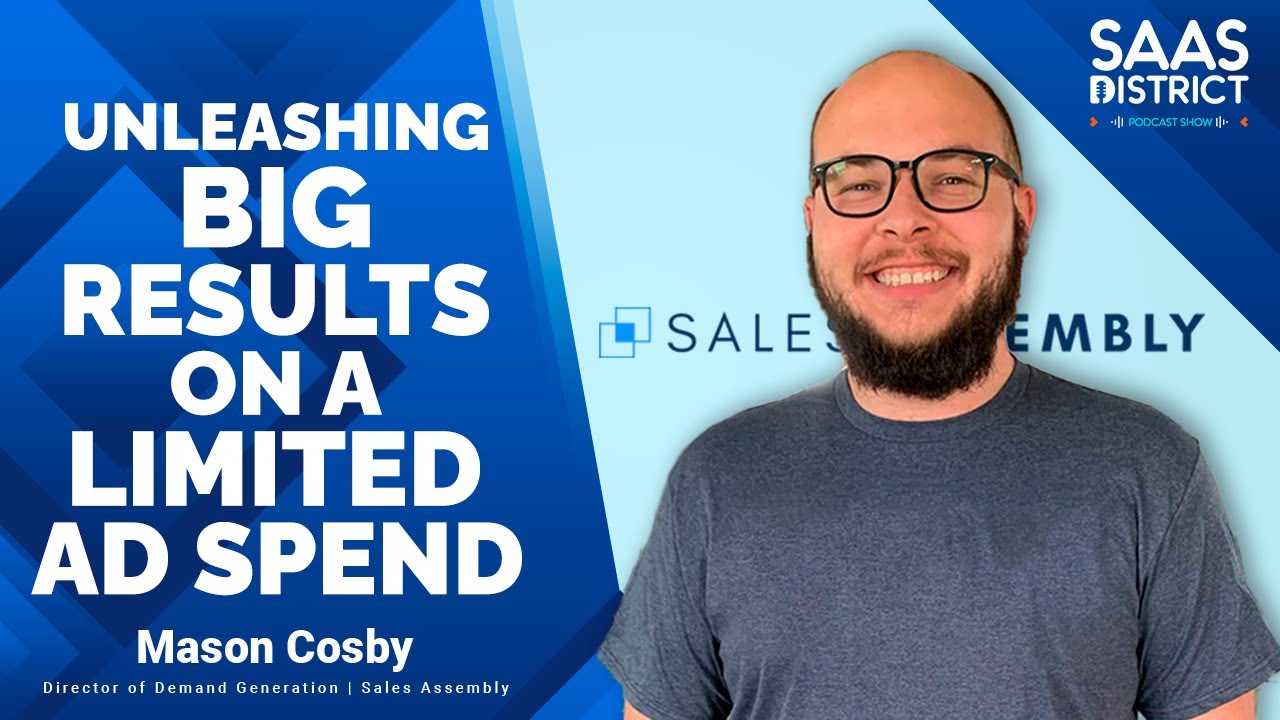
In this SaaS District interview, host Akeel Jabbar talks with Mason Cosby, Director of Demand Generation at Sales Assembly, about how to drive B2B growth on a shoestring budget. Mason outlines a sub‑$200/month tech stack that powers a scrappy account‑based marketing (ABM) engine: a basic CRM, a low‑cost podcast host (Spreaker), live‑stream tool (StreamYard), AI‑enhanced editing (Descript), transcription/repurposing tools (PodSqueeze, Repurpose.io), and cheap ChatGPT‑Google‑Sheets integrations. He explains how he leverages a podcast‑plus‑LinkedIn (and occasionally TikTok) workflow to build one‑to‑one relationships with target accounts, achieve an 80% guest‑booking rate, and generate inbound pipeline without any paid ads. Mason shares concrete results – $1.6 M in marketing‑sourced revenue over two years, $500 K pipeline in 112 days at Sales Assembly, and a closed deal within a 90‑day sales cycle. The conversation covers measuring ROI against salary and tool spend, scaling the model (hours per week, episode cadence, inbound guest requests), the importance of tying podcast content back to product value, and how to convert relationships into SQLs through follow‑up and light asks. He also discusses the role of AI for content repurposing, recommends three thought‑leaders (Donald Miller, Chris Walker, Stephen G. Pope), and shares personal advice about writing a eulogy and balancing work with family. The episode ends with practical tips for founders looking to adopt a low‑budget podcast‑driven ABM strategy.
Chapters
Hello, hello everyone. This is your host, Akhil Jabbar, and welcome back to another episode of SaaS District. In today's episode, we'll be talking about unleashing big results for your SaaS with limited ad spend. Today we have our guest, Mason Cosby, joining us. Mason is the Director of Demand Generation at Sales Assembly, a leading organization that offers elevated learning and development for go-to-market teams, where he leads the development of impactful B2B programs. He also hosts the Marketing Ladder podcast and serves as a GTM ambassador at GTM Partners. So welcome, Mason. Super excited to have you on the show today.
Akeel, I'm super pumped to be here and really excited to dive into our conversation.
So let's, let's get right into it, right? I mean, people are here to learn. They want to know what's— what can we do? Not only with limited ad spend, but with limited budget, right? We're in 2023 here. People are getting a little bit more resourceful. They're trying to be a little bit more mindful of their, their spend. I want to start with your tech stack. You mentioned before the show, you, you're generating sales, right? You're a marketer. You wear an I heart sales hat. You're kind of a, you know, a, you know, a bit of everything, right? So what does your tech stack look like? You said you're only spending $200 per month. And what have you seen work with that, with that budget?
Yeah. So I wanna, when I talk about $200 a month tech stack, what I'm typically referring to is when you look at launching an account-based program, most people think about like, I need an ABM platform, I need a data enrichment provider, I need a gifting platform. And you kind of look at all of the different technologies that you need and you're like, awesome. So this is gonna be $200,000 in just tech to even get started. So I wanna take a step back of, yes, like as I look at my dedicated like account-based marketing tech stack, it's actually about less than $200 a month. That is with the caveat that like you've got some of the foundational pieces of technology, like you have a CRM. So like if you are running a sales org, most sales orgs at least have a CRM. So I want to start there. And then as I look at like the specific pieces of technology, you know, I used to call this my $32 a month ABM program. So it was, I use Spreaker, which is a podcast distribution platform. That was $7 a month for up to 100 hours of content, which means you're, you know, if you're doing 30-minute conversations, you have 200 conversations right there. And then I used StreamYard to actually do live streams to LinkedIn. And what I would do, I would pull up my target account list on one screen, and that was kind of my CRM and what I was using. And then I would pull up LinkedIn on the other. I would copy and paste names and I would go and connect with all of my target accounts. And I did that. You get 100 connection requests a week. Once you're connected with them, you can say, hey, really been enjoying the content, or just looked at your job experience. You look like you know what you're talking about. Love to have you come on this show to just build that one-to-one relationship. So that was where it started. And then what I'm recognizing is with a lot of the AI tools that are available today, you can take that podcast and then actually build this fully fledged content program that actually provides additional touchpoints past the conversation. So I'm using things like Descript that It's a lot of AI video editing. It costs about $15 a month. I'm using things like PodSqueeze. That is, you can upload audio and it will give you the full transcript. It will give you timestamps. It will give you like a newsletter and it just essentially disseminates down audio content into a really easy to digest format. So I'm using that. Also costs like $20 a month. So that's an additional, again, we're looking at like additional $35. So we're like $70 a month right there. Then the other things that I'm starting to use would just be ChatGPT integrations with Google Sheets so that I can streamline the content repurposing process. And again, that's a couple cents, literally cents every time you use ChatGPT in that way. So it just depends, like that's the biggest variable cost, but you're not looking at more than probably $20 to $30 a month if you're creating a ton of content using it. And then again, we kind of Round the whole thing out with starting to use some more specifically content distribution and repurposing tools. So there's a thing called contentrepurpose.io or repurpose.io, and it connects all of your different channels. So when you upload it to one place, it then automatically puts it in this dashboard so you can actually click the button and it will send it to that specific platform. So I'm looking at actually combining all of our executives' LinkedIn profiles into that one tool. Costs about $15 a month. So when I upload a video into Google Drive, I can then have it to where it's queued up in all of their different profiles, and I just press the button when I want it to go to their specific profile. So that way, as I'm creating all this content, it goes that way. And then again, you know, most people have a Google Drive or have some form of a cloud-based storage. So you then upload all your content into a Google Drive folder, and you share that with the guests on your podcast, and then they go and share it. And you can then actually prospect into those that are engaging with their content to invite them onto your podcast, build that 1-to-1 relationship, or if you have something that's a high-value offer, you can route them towards that. So that is in a nutshell, like a tech stack of what you would need to actually build a really scrappy ABM program.
Nice. So just, just to clarify, so if I'm a B2B SaaS founder listening right now, I'm looking to grow my reach, I'm looking to grow my audience. I'm going to— essentially what I'm trying to do is drive more SQLs to my team, to my business, but I have a limited budget. Maybe I can't spend on ads or I don't have that kind of budget. Now you're recommending, you know, podcasting as a channel to focus on in 2023, or is there any other ones that you recommend? So just so people who are listening—
Yeah.
Can think. Yeah.
So to give additional context, like in the past 2 years, I've done about $1.6 million in marketing source revenue, not spending a dime on ads. So like everything that I'm talking about, Is the strategy that I've personally used. So far, about 112 days, actually exactly, I counted earlier today, 112 days in my new role at Sales Assembly. We've driven $500,000 in pipeline that is marketing sourced. We've already had one closed, one deal with a 90-day sales cycle in our current economic environment. So I want to be clear, like, no ads, just really scrappy, creating a ton of content. So that's where we are today. For me personally, where I've seen the most success is that podcast LinkedIn combination. I think a lot of people are starting to use that more and more. The one that I'm not personally seeing as much that I also know that I'm also not using as much would be also TikTok. There's a lot of B2B people that are on TikTok as well. And I know that people think I'm crazy when I throw that out, but like, I've actually personally bought from people that are showing their expertise because LinkedIn is primarily a written content platform. To this day, it doesn't do as well with video en masse. There are the exceptions, but TikTok is almost exclusively a video platform. They do photos now, but again, if you're trying to showcase your specific expertise, TikTok is a platform that really does only use video. So then obviously video is going to do better there. So if you can get kind of those 3 platforms together, podcast, TikTok, LinkedIn, I think you're going to do really, really well with the overall B2B content strategy.
Nice. So I agree with that. So those are super underrated. I mean, people don't look at that. They want to go straight to ads. Seems like it's just easier to track and measurable and I guess scalable. So that's my kind of question from there. So what— so you've seen one potential deal come through in this 90 days. How would you kind of measure that in ROI? And then second is, is this scalable? Right. Those are people going to ask, yeah, sure, I can do— how many podcasts can I do in a month and in a week and in a couple of months? And is that going to generate, you know, can I double down on that if it does work?
Yeah. So there's a couple of thoughts. One, the ROI is now going to be measured up against specifically like my salary. So what they're paying me and then the tools that I've specifically requested. So again, my overall tech stack is less than $200 a month at this moment. And yes, there are some additional asks of potential additional pieces of technology. But again, I'm a big fan of shipping an MVP and then recognizing where your gaps are and where things fall down and saying, look, we can either insert more manual compliance with our internal team or we can buy a piece of technology that automates and scales this specific piece. So there's that piece. And then the other side of it is, I hear the question around how scalable is it to go on a podcast? Let's be really blunt about this. This is going to be a 30, 45-minute episode. Like we did a little bit of back and forth in a LinkedIn DM. I show up and like, I'm not doing a ton of prep because I'm literally just talking about what I'm actively doing today that works or doesn't work. And then honestly, somebody else will do the vast majority of the work for all the repurposing. I just have to click the button that says post.
Yeah.
So from that perspective, I mean, do you have an hour a week or maybe even 2 hours a month if you want to go that extreme to just show up and have a conversation That then educates your market and showcases your specific expertise. So that's from the perspective of guesting. And our executives bought into that. We've had our executives already go in the past 100 and some odd days. Our executive team has already had 14 podcast guest appearances air. So I mean, they're bought in on that strategy and we spread that across about 5 different people. So we're just setting them all up on specific niche podcasts and they're going, then we take that content, we repurpose it for our own podcast. So we launched a podcast 6 weeks ago. We've already got 13 episodes out and we've already got content lined up to do 2 releases a week through the end of August today.
Yeah.
So I mean, from that perspective, you just get really scrappy about repurposing. And then the final thought is, you know, if you're thinking about hosting your own podcast, you're inviting your target accounts onto a show where you have a one-to-one contact. I mean, from my experience, I've had an 80% booking rate. So when I ask somebody, 4 out of 5 times they say, yes, I would love to come on your show.
Yeah.
And like, I've been doing that for 2 years. And, you know, when I started that, I only had like 1,000 connections on LinkedIn. Like, I did not have a following. I did not have any content I was creating. Like, people just enjoy showing up on shows. And if you think about that through the perspective of, again, 80% booking rate for a podcast, Versus what is it, like 1 to 3% for an SDR?
Yeah, like cold outreach. Yeah, let's say 3% on the high end. Yeah.
And again, if we're talking especially to startup founders, your goal is likely not, I need to close 500 deals this year. You're probably looking closer to like 30 to 50.
Yeah.
So again, if you look at it through the lens of, I can have 30 to 50 conversations on a podcast if I just interviewed one person a week and I'm building a one-to-one relationship and then I follow up with great content and then they're actually posting publicly about me and my brand and my company. To their networks. And what I found, especially in B2B, is it's a small world. Like the people that are in the in know each other. So if you can actually leverage your target account's social profiles and networks to then get in front of their audience, you are then actually driving further demand within people that are also likely in your target accounts.
That's right.
Again, we're also frequently targeting like businesses and like, and when I was agency side, CMOs of like businesses knew the other CMOs of like businesses.
Exactly.
So I just— it's, it's, it makes too much sense not to do it.
So you're inviting these guests, you know, the list you have, you have a targeted list. These are your folks you want to engage with, to work with, build relationships with, and eventually do business with. Now, the initial conversation starts with, hey, would you like to jump on our podcast, share your expertise, and highlight what you guys do? Now from there, so you spend an hour with them, You now provide them content, they share it with their list and their audience on LinkedIn, their post. Now you have a face-to-face and you know who they are. From there, how do you then drive them to an actual SQL conversation to sale? Are you having at the end of this podcast, are you having a month down later and continuing that conversation and relationship and hoping that it turns into, hey, are you interested in this product or where do you bring in You know, your pitch at this point?
Yeah, that's a great question. So it ties back to what you actually talk about in the podcast and the function of the podcast. So again, in my experience, I hosted a marketing careers podcast, The Marketing Ladder, and I worked at a marketing agency, and that podcast was able to source about $1 million in revenue. Like, it was a massive driver because what I ended up doing through that podcast is inviting people off of my LinkedIn network. They happen to be target accounts. From there, I was interviewing them on the roles that they were also actively hiring for. So what I would do is then actually place talent in my target accounts' organizations from my network, and they would land a job. So the decision maker for an account-based marketing program that they would inevitably want to buy liked me because I helped them find talent. And then that talent liked me because I helped them find a job. So I had 2 internal advocates for Mason Cosby as a person. That then whenever they needed support around account-based marketing, they would say, hey, Mason, like, I'm really struggling with this and you seem to be well connected. Like, do you know anybody that's like an ABM agency or like anything like that? And I was like, yeah, me. Why don't we go talk to our salesperson? And from there, like, those relationships happened really naturally because I provided so much value on the front end. Like, do you know how much it costs to source talent? It's like $10,000 to $15,000.
Right.
So what I did is instead of charging them anything, I just kindly and never asked for anything in return. So again, I gave so much value on the front end and built so much trust in that relationship that when they needed me for the $150,000 or sometimes $300,000 ABM program, because I worked at the world's most awarded B2B agency, like this was in a past job, they They trusted me. They knew that I had their best interest at heart. So again, from that perspective, like, that was really natural. But that comes back to how do you frame up the podcast? Like, what's the main purpose of the podcast? So for example, you know, one of my team members went on a podcast earlier today in which there was a proposal teardown, and the company that was hosting it was a proposal company that like automated and streamlined your whole proposal process. So they were tearing down a proposal that they had both been sent. And then I'm sure after, in a couple of weeks, they're going to say, hey, it was so fun to tear down that proposal with you and really make it better. Just wanted to see after we showcased the ways in which our company can make a better proposal, do you think that would help increase your win rates? We went over the data. So from that perspective, when you have the content of the podcast actually relate directly back to your business, Creates a really natural intro. From my perspective, and just in my experience, the longer you can go without making an ask and the more value you can provide on the front end that's genuinely valuable, the more likely you are to get a yes. So what does that exactly look like? Standard consulting answer, it depends, but it really does tie back to the way in which you actually set up your podcast to provide value to the guest more so than extract value from the guest.
Okay, so maybe let's look at this specifically. So I have, uh, I'm a founder, I've decided now to launch my podcast. I'm, I'm bought in on this idea. I've got my tech stack, I've got my list, I start inviting folks on. I want to start having conversations with them, and, you know, 80% accept to jump on. Now I've got this, we got this recorded. What, what am I doing here to maybe maximize my reach, the impact here? And make the most of this. We talk about repurposing. I think that's kind of one angle. Can you maybe talk about what does that look like post-recording? Yeah, that process there. And then how do you get the most value? And what do you see it's working and what's not working?
Yeah, so 2 things. One, another way to really get more value is specifically saying, hey, who should I interview next? So again, like I had mentioned, the B2B tech community in my case is really well connected. So what I find is that I have an even greater success rate booking guests when they've been introed to me from somebody else. And by the nature that my target accounts know my other target accounts, it creates another opportunity to create a new conversation. So that's like super practical nuts and bolts. And then the other side is, again, my recommendation for any startup founder is to specifically tie your podcast back to your product and the service you actually provide, through which you can then actually talk through specific data points and the ways in which what you do actually benefits them. So Prime example, Sales Enablement provides skill development for the go-to-market team. There's been a lot of data that's come out recently that's shown 70% of employees don't feel like they have the skills to do their jobs, which is a massive problem and that impacts revenue. And just a really tactical sales example is that 7— there's been a 7.5% increase in win rates when companies prioritize sales skill development and sales enablement. So if you're looking at it through the lens of, okay, my average sales cycle right now is closing at 20%, how much more revenue could you get if you increase that to 27.5%? So you can talk through that in a podcast and say, you know, recent data has shown X, Y, and Z. How are you specifically developing and enabling your teams? And then what you can do is they give an answer, and that answer is probably going to be a great answer because they're on a podcast and they want to showcase the ways in which they're really investing in their team and helping their people. Follow up 3 weeks later and say, hey, I've really been chewing on your answer to that. And like, that's what we do is we help people with their skill development. And the ways in which you're doing it, like, clearly you've got it nailed down. But I just know, like, you're also connected with a lot of people. And I know a lot of organizations would love to have a you in their organization, but like, they can't because you're already working somewhere else. Would you know anybody else that needs help getting the specific skill development And the specific sales enablement training that would actually benefit their organizations in the same way that you're benefiting your organization. So again, it's not saying any— you're not ever calling their baby ugly. You're just saying over and over and over again, you're doing this right, you're great at this, you're killing it. Unless they said like, actually, no, I suck at enabling my teams. I don't know how to do it. Like, and their answer is something to that extent. But what naturally happens is 2 things. One, they're either like, Thank you so much. You're right. I am great at this. Let me refer you to somebody else that I know that's really struggling with this. And the other thing that happens often is they say something to the extent of, actually, I don't have this perfectly. And based on our conversation, I think you know something. Could we talk about potentially partnering up? Or they just say, I don't know anybody. And great, they're not even in the market. But what you've done is you planted the seed, and those typically come back around 6 months later. That's like little message I did at my former employer when I got a promotion. And I outbundled to about 100 people with that message of, for example, I just got this promotion and I appreciate your support. You know, I'm really looking to help more people with their HubSpot instances and with their account-based marketing programs. If you know anybody that needs help with those 2 things, would you just send them my way? Again, I really appreciate your support. Over the past couple of years. Send that to 100 people. I got 30 meetings from people that were saying, actually, I'm really struggling with one of those 2 things. And then we ended up going through the sales process and had a fair number of those convert. So again, I'm a big fan of the light ask, of asking, do you know anybody that struggles with this? And by the nature that you've built relationships with your target accounts, they're normally going to opt in because they trust you already. So there's one angle.
So when looking at the list of, you know, of what you're building, right? So one is your ABM list. Of contacts that you want to build relationships and potentially do business with. And there's the other side of some folks, you, you know, that target, you know, influencers to get on the show to, you know, target their reach. How impactful do you think that is? And then the other audience that I've seen work as well is, um, inviting existing clients or users to your, uh, to your podcast to, you know, enhance the relationship further, and then also maybe, you know, upselling them. So how have you seen You know, that those lists work as well. Yeah.
I mean, to put it bluntly, all of those approaches work, but the question is just like, what's the purpose and the goal of your podcast? So, you know, I've talked with a number of people that specifically run podcast agencies that never even report to their team or to the clients that they're working with the number of downloads, the number of listens. They don't ever report on it because it doesn't matter. The goal for that is the one-to-one relationships. It is the like the expansion opportunities, to your point. So again, like if your goal is to build a large podcast that becomes like the top 10 business podcast on Apple, like totally different goal than somebody that's like running a startup organization trying to just build one-on-one relationships with their target accounts that they can inevitably close. So that's the first, first point. So I mean, I make that point just to say, like, you never have to have a massive influence or you never have to grow an audience for your podcast for it to be successful. You have to figure out what your goal is with the show. If your goal is to grow a massive audience and to become a thought leader and to drive a ton of awareness for the fact that like you as an individual exist and that your organization exists and you want to be the main source of all information that somebody thinks about for that specific industry, I think the influencer play is fantastic. The thought process there. And I got this advice from somebody that is way better at podcasting than I am. It was a friend of mine over that was at Sweetfish a couple years back. And Sweetfish actually ended up getting— I don't know if you're familiar with Gary Vaynerchuk. A lot of people know Gary Vee. They got Gary Vee on the podcast. And they were like, this is incredible. We're super pumped about it. Gary never shared it. Like, because—
Of course.
Sweetfish.
Yeah.
In the B2B tech space, massive influencer in the world. Really small fish, no pun intended. So like, from that perspective, the recommendation is you, you get influencers that are quote unquote on your same level. And I hate to say that bluntly, but like, if you invite somebody on that has 100,000 followers and you have 2, they are unlikely to share your content.
Correct.
And even from my perspective, like I've had, I'm not gonna, not gonna name names, but If you go look through my podcast, I've had some really, really massively influential individuals. Most of them never shared it, but even more, most— they're often the least listened to episodes.
Interesting.
Because those people are so frequent. So they're not a new name, they're not a new voice. So I'll be blunt about myself even. a generally decent podcast guest because I got my talk tracks down. So like, if you listen to 10 episodes with me in like a really recent time frame, I'm probably saying very similar things, right? So like, there comes a point where there's a— it's not going to be as impactful because you've already heard it. So that's just one other quick thought. So if you're looking at audience growth, I would find influencers that are at your same level And then you can essentially, as you grow, you can increase the level of person or increase the level of influencer that you're asking to come on your show. Because then again, from that perspective, when you build a larger audience, they're also honored to then share that content. So that's kind of a thought process there.
Yeah, that's a good point. What I like about having some of these influencers, so we had folks like, you know, Rand Fishkin, Neil Patel on the podcast, but I think what it helps is, you know, if you want to go to other influencers and have them on the show, it just kind of gives you a little bit of Um, I guess the— what's the right word there, right? To say, hey, like, um, credibility, right? So the credibility is a little bit there, and you're able to basically get anybody you want on the show. And, and, uh, shows that, especially if you have a lot of episodes, right? I think that's the key here. A lot of folks, if they say you only have like 5 or 10 episodes, they're not— you know, influencers may not be interested. I've actually had some influencers say, hey, come back when you have 100 episodes. So it's just like, like, hey, let's see if you're actually going to last this long and you'll actually be a You know, consistent, otherwise it's a waste of their time. So I understand that. What do you see as like, if you know, so, you know, before getting into some last questions, if I'm looking to make an investment decision here and look at investing in podcasting as a channel, how long do I have to give this as an experiment to really see some results or see some kind of payback?
Yeah, again, I hate to say it, the standard consulting answer is it depends. So if you're going the thought leadership route, I was talking with somebody yesterday and he does a weekly podcast that is literally 7 minutes. It's called Account Based Beverages. His name is Jim Gilkey. He's incredible. And he said, you know, for the first 6 months there was nothing. And then in month 6, I got asked to speak at 3 conferences and I got asked onto 10 podcasts and I was a salesperson that sourced an extra $500K in month 6. It's the most insane story. Like, very rare. I want to be clear on that. Like, it's typically That dramatic, but he was like for the first six months I saw nothing. Like there was no impact. I just people would come on the show and they'd say like oh that's nice. For me personally, you know I saw the first start of an impact around month three or four. We had somebody come in balance said hey I've been following Mason Cosby really like his content would love to have a conversation with somebody about account-based marketing. It was really and I hate to. Again, people want faster results. Um, it was really about like month 16 to 18 where I was able to, you know, I actually ended up transitioning into a sales role for about a 9-month period. And in that 9 months, I personally closed, separate from the other $1.6 million, in that 9-month period, I closed $1.7 million. And about $1 million of that was sourced through my own personal LinkedIn network. So again, it's because I had done the foundational work for 16 to 18 months to truly get that level of impact. So I also want to be clear though, I never did any outbound.
Yeah.
All of that was entirely inbound. I never built a dedicated step-by-step new business development process post-podcast interview. I just provided a lot of value, tried to be super helpful, and knew that when the time was right for them, people would come to me because I'd already built the trust. So I give all that context to say, though, that experience is valuable and valid. We are in a different economic time today. Like that, I closed my last deal on that front 5, 6 months ago when money was a lot cheaper and people were spending. Right now what we're seeing is you do need to do some level of outbound. So I would recommend from that perspective, when you build your podcast and associate it back to your actual specific product, You build about a 3-month cadence after the podcast that is, again, value-add, but keeping touchpoints and keeping people engaged. And then trying at some point to hop on a call with the intent of a light ask of, hey, it's been awesome getting to know you for the past 3 months, past 2 months, whatever that needs to look like. Like, this is what we do. I was just wondering if you knew anybody that would need support with us.
Hmm.
And they'll either opt in or they'll give you a referral.
That makes sense. Yeah, I mean, um, we kind of— just to give you context on how we did when we did our podcast, we started off with 2 podcasts a week when we first launched. And then I think we, we were all outbound at the beginning because we chose our guests. But now we get, you know, 5 to 10 inbound requests a week, right? People wanting to be on the podcast, and we didn't expect that. And then the other thing was, I think it was around after 30— I think it was up to 30 episodes or so— we had like our first proper engagement that turned into a sale. But we didn't expect that. It was more just to build relationships. So I think maybe just average, I think like every 30-ish episodes, I mean, from our end anyways, we turned it into, you know, some kind of engagement. But even then, that wasn't very targeted list either. We were pretty broad. So I'm pretty sure you can get that down if you're very targeted.
Absolutely.
Mason, last question before we get into the rapid-fire questions. What's your thoughts and your perspective on the future of integrating, you know, AI into all this and What are things you recommend if people start using or testing out?
Yeah, I mean, if you go listen to— I was on a podcast that was called Distribution First with Justin Simon, and I literally walked through step by step the ways in which I'm currently using AI to generate all of our content on a weekly basis in about 5 hours. So I'm a big believer in AI, not for the purpose of content generation, but for content repurposing and reformatting. So I'm never going to go to ChatGPT and say, can you make me a LinkedIn post? What I'm going to say is, here's a transcript from a recent podcast episode where I talk through X, Y, and Z. Here's the intended audience. This is what I want people to see as the main point of this post. Can you reformat this post for me? And then what I've also done is fed it all of my top performing posts for the past year and a half so it has my same style, tone, and voice. And from there it gets me about 70% of the way there. And if you think about that for an executive, like that replaces ghostwriting in a large way. And I've seen ghostwriting contracts, they're roughly $3,000 for an executive to get, you know, 10 posts a month. Like they're not cheap.
Yeah.
So from that perspective, you know, if you can pay ChatGPT $20 a month to get you 70% of the way there, and then you can do some minor editing, you're able to create a lot of content at a pretty significant scale at that point.
Nice. I like that. Cool. Mason, you ready to go into the rapid-fire questions of the show?
I'm ready.
You ready? All right. What's one activity you enjoy outside of work that gets you into a flow state?
Jazz.
Jazz. Singing, listening, playing?
Listening and playing. I play saxophone. I don't play saxophone as much as I used to, but I've been getting— been trying to get more into the Indianapolis jazz scene. So Been going to a couple concerts and trying to do more of it.
Awesome. Love it. What's one piece of advice you wish you had known? And if you can go back, you would tell your, let's say, 20-year-old self?
Yeah, I've been thinking about this a lot recently. Expecting my firstborn kid in about 2 months. So thinking on that, and I mean, it is truly write your eulogy and then live life in reverse.
I like that. Write your eulogy. I haven't looked at that, but You'd write it at 20 years old. You think that it'll be a lot different than it would be now, right?
Well, if you write it early and you recognize that it's a creative device that is not set in stone, but you can come back and revise it. But again, I just think I've had a lot of friends, and this is a theory of mine, that I think we've seen so many people go back for master's and PhDs because they entered into the workforce and there's not a clear season of life. Whereas when you're in college, like, You've got semesters. So they go back to what's familiar and they end up racking up $100,000, $150,000 in debt because they were just trying to find some purpose in life. And I think if you actually wrote down a eulogy of what you want your life to turn into, and at least if you head in a direction, it's easier to steer a dock that's in motion. Sorry, it's easier to steer a ship that's in motion than one that's sitting at the dock. If you just head in a direction, when you realize it's not the right direction, you can easily pivot as opposed to just sitting there figuring, trying to You know, just guess and hope. What is my life supposed to be about?
I wonder if you should give that advice to folks who are entering prison, right? I mean, it sounds like, you know, they also have that similar problem, right? They leave, they get free, and then they're so comfortable and feel more in that space of being back in jail and they end up back. But probably similar of, you know, any environment that feels comfortable, right? It's hard to get out and break out of it.
Yeah.
Cool. What are some of the biggest challenges you're currently facing In order to continue to grow Sales Assembly? Meaning what's keeping you up at night these days?
Yeah. So again, I started about 112 days ago. We've sourced about 28 inbound opportunities. And I got asked the question recently of like, okay, what are the specific channels and tactics that are driving that as a solo marketer? I'm 100 and some odd days in and I'm building it from scratch. They've never had an acquisition marketing person. So I mean, there's only so much time in the day. So the biggest thing right now is just trying to figure out, okay, we're doing a lot of things. What are the things that are actually driving these inbound opportunities and how do we do more of those specific things? And also then with freed up bandwidth, invest in helping and supporting some outbound activities.
Who are, what are some of the best 3 resources that can be books, mentors or people you follow in this space who you'd say have been most instrumental to your success over these last few years?
Yeah, I'm going to give you in order of the ways in which I would think through them. So for me, like, I got my start in marketing because I was a StoryBrand certified guide, and StoryBrand is a whole messaging framework and methodology. And I mean, to put it bluntly, you can do incredible, like, paid ads, you can do the best graphic design, but at the end of the day, like, people buy something because they read or heard words that convinced them to buy something. Like, that's as simple as it gets. So Donald Miller is the CEO of a company called Business Made Simple. His first book that was in the marketing space was called Building a StoryBrand. So I would just say anything really from Donald Miller specific to business. He also was a memoirist before he became a business guy. So don't agree with all of his memoirs, but from a business perspective, it's really practical. It's really tactical. It's super helpful. From there, you will get to a point where His advice is probably the first 10%, 10, 15% of what you need to really build a more robust and complex and truly integrated strategy. My next listen would be Chris Walker, and he's got his podcast Revenue Vitals. I've had the opportunity to have a conversation and interview Chris on my own podcast. Still to this day, one of the best episodes I think the Marketing Ladder has produced. But just the ways in which he is able to break down A lot of the, lack of a better word, like tech-focused messaging of like, you need this, this, and this in order to be successful. She kind of breaks it down and says, actually, here's what you need. And it's pretty clearly high-intent conversions and pipeline. So that's the next one. And then I would say the most, I would say complicated, but then in that complication is also really simplifying a lot of difficult things would be Stephen G. Pope. He is a genuine master when it comes to content repurposing and content automation and AI. And how do you actually then scale out content? So he's like a single guy, he takes 2 hours a week and he's creating upwards of 80 pieces of content across 7 different platforms, most of which is automated and super scalable. So again, from that perspective, lots of automation, lots of zaps, lots of ability to actually get the best analytics. So like, that's the order in which if you know nothing about marketing, start with Donald Miller. If you want to get up to speed on modern-day B2B, go to Chris Walker. And then if you want to figure out how do I scale organic content in such a way that will drive revenue, go listen to Stephen G. Poe.
Stephen G. Poe. Awesome. I'll, we'll add all those folks to our show notes if you guys want to check them out. Yeah, I'm familiar with Donald Miller and he has that pretty good course. If you guys haven't checked it out for story branding, I highly recommend that. Mason, what does success mean to you today, whether personally, business, financial, life? I guess there's no right answer.
Yeah, I mean, I'll give you 2. One, success is eventually for Sales Assembly, if I got hit by a bus or won the lottery, they'd be okay without me. You know, again, being as early in my role as I am and building as much as I am, we were having this conversation earlier today. When I go out for pat leave, if I haven't documented things well, This thing will just fall apart because it's a lot on my brain and the ways in which I think. So I want to make sure that with any organization that I'm a part of, they are going to be able to sustain if I ever got hit by a bus. So that's professional. And then I would say personally, I'm, like I mentioned, about to have a kid in about 2 months. I don't want to be the workaholic that focused so much on gaining financially and being super helpful in my industry that I missed my kids growing up. So, um, just figuring out at this point, I've, I've been on a bit of a grind for about 3 or 4 years to, to get to this point. Um, and figuring out how to, um, appropriately take off the gas just a little bit to where the results don't suffer. Um, but neither does my time with my kids. Yeah.
Yeah. Your life will change. I mean, give you 2 months, enjoy it while you can. You can plan all you want, but the moment that happens, you won't even know what's hap— what, what hits you.
Oh yeah.
So, so we'll have another conversation next year and we'll, we'll ask you that question again.
Heck yeah.
Love it. Awesome. This has been great. Where can people listening in, founders, marketers, sales folks get in touch with you, learn more about you and what you're doing?
Yeah, I'll send them 3 places. One, if you just want to stay in touch with me, LinkedIn's my main platform, so feel free to connect me or connect with me there. 2, if you are a marketer looking to grow in your career, we've got about 120 episodes on The Marketing Ladder, just interviewing a ton of different people on how they grew their careers. And then lastly, you know, I talked a fair bit about like the specific messaging around Sales Assembly as an example, but like at the end of the day, if you're in an organization where your sales team doesn't have foundational skill development, doesn't matter how much technology you throw at them, how much money you invest in like the one-off SKO, like people need ongoing skill training and development. So sales, that's what Sales Assembly provides is Essentially, the idea is we know the skills that each role needs across the go-to-market team. In the course of a year, you can have content that touches on every single one of those skills so that you can ensure that your team members are getting either the refreshers or many of them actually the first-time intentional skill development on the foundational skills of being a seller or a CSM. So you can go to salesassembly.com to actually book time directly with our sales team to have a further conversation about that.
Awesome. So salesassembly.com. There you guys have it. Thank you so much, Mason. Appreciate you jumping on the show today.
Absolutely.
Thank you.
All right.
Cheers. Thank you all for watching this episode and joining SaaS District today. Don't forget to like, subscribe, and hit the bell for future episodes where we interview top leaders in the SaaS industry. If you're a SaaS company looking to grow and unlock the true value of your business, get in touch with us at Horizon Capital and myself or one of our consultants We'll provide a free assessment to help you get there and hit your goals. If you have any feedback or suggestions for this podcast, please comment down below and help us improve our content for you all. Thanks again, and see you on the next one.
More from Akeel



Get a mentor as soon as possible — and make sure it’s a mentor in your space.




Keith Gillispie: Why Most New Investors Fail & How to Avoid the Common Traps #250 | SaaS District



