Rand Fishkin: An Unusual Round of Founding & Unusual times to launch a Startup | SaaS District
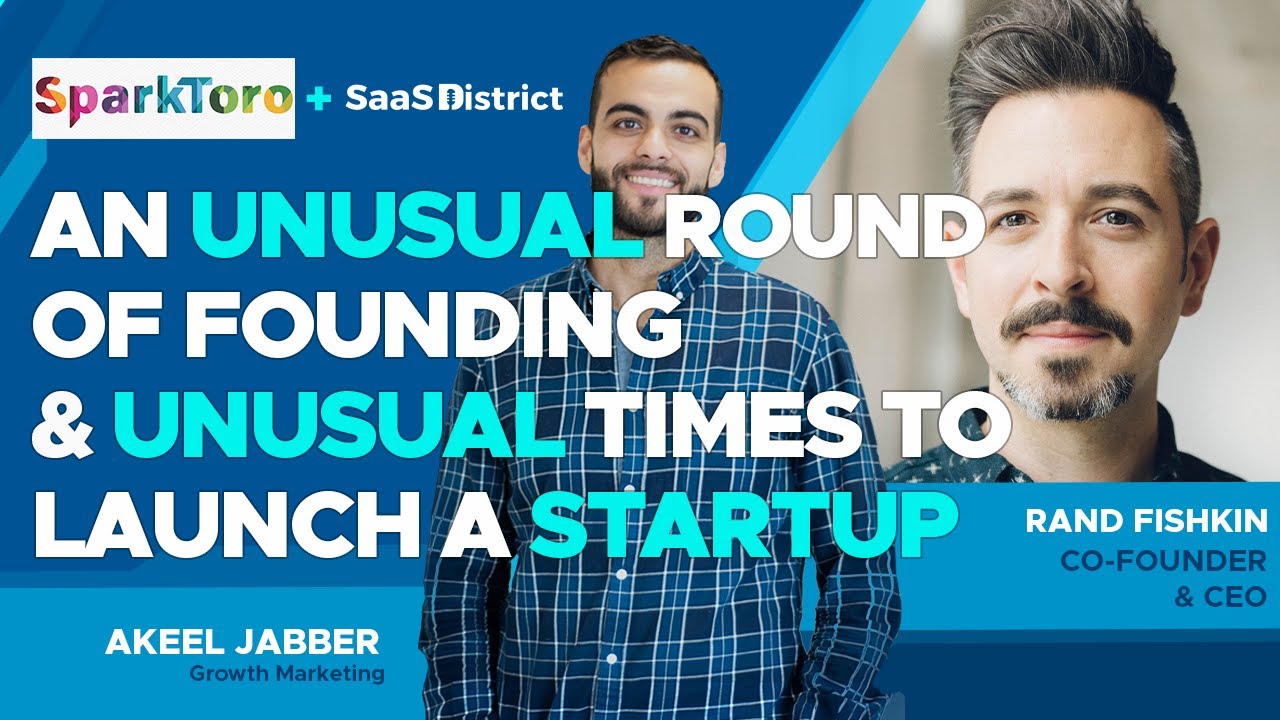
In this SaaS District podcast episode, host Akeel Jabbar interviews Rand Fishkin, former Moz CEO and current founder/CEO of SparkToro. Rand reflects on his departure from Moz, citing mental health struggles and regrets, and explains how those lessons shape SparkToro's mission. He details SparkToro's atypical $1.3 million angel round involving 37 investors, structured as LLC units with fixed founder salaries and a profit‑sharing model that avoids traditional venture capital. Rand critiques venture capital as an asset class that fuels inequality and argues for alternative financing. The conversation moves to launching SparkToro during the COVID‑19 pandemic, describing early‑access conversion rates, market headwinds, and why they chose not to delay the launch. Rand then shares a three‑criteria framework for choosing initial marketing channels—personal passion, unique value, and audience reach—and warns against spreading effort across too many tactics. He champions episodic content (podcasts, video, newsletters) as a powerful, under‑invested marketing vehicle, and discusses modern SEO challenges, emphasizing competitive keyword analysis, the need for amplification, and the role of YouTube and podcasts in search. Rand recommends the "Content Fuel" framework for turning ideas into resonant content, mentions a book by Melanie Dezio, and shares his personal habit of aggregating news via Reddit, Hacker News, and Indie Hackers. Finally, he muses about a potential simple‑analytics startup as a new opportunity. The episode ends with practical calls to action for listeners to try SparkToro and follow Rand on Twitter.
Chapters
Hello, hello everyone. This is your host, Akeel Jabbar, and welcome back to another episode of SaaS District. In today's episode, we'll be talking about an unusual round of financing and funding for your startup in unusual times. Today we have our special guest, Rand Fishkin, joining us. Rand is an author, co-founder, and the CEO of SparkToro, which is a company focused on allowing software to be able to connect with audience intelligence at every marketer's fingertips. Rand is a tech entrepreneur, blogger, and leader in the field of SEO. He is a frequent keynote speaker for events around the marketing and startup world, as well as a bestselling author of Lost and Founder: A Painfully Honest Field Guide to the Startup World. So welcome, Rand. I'm super excited to have you here today.
Yeah, thanks for having me, Akeel. Good to be here.
Yeah, awesome. So I don't want to talk too much about Moz. I know that was kind of in your previous life, but I do want to hear a little bit about that story. Um, you know, what was the story and decision process you made of stepping down as the CEO of Moz? You know, you raised over $29 million of venture capital, you built the company over 14 years. Um, you know, what was the reason there?
Yeah, uh, let's see. So I, I, um, I've written about this a little bit. I actually— I think probably not a good decision to step down as CEO. I, yeah, have a lot of regrets around that. I think it's one of the reasons that I started another company because I wanted to, yeah, have a chance to prove myself again. But at the time, at the time that I stepped down as CEO, I, yeah, I was going through a lot of mental and emotional health challenges, pretty significant depression and I think that it felt like the right move in the moment. So that was, yeah, maybe not a great decision overall, but felt like something I had to do when I did it.
And looking back now, would you say you've done anything differently? Would you maybe have taken a time off for a little bit and then recharge and come back?
Yeah, I think, to be honest, what I would have done is just delegated more of my more of the responsibilities and duties that I was feeling overwhelmed by to other people in the company and retained the CEO title and role. And yeah, I think I would have done a lot of things differently. I hope that with SparkToro, I'm able to execute on some of those hard lessons learned and Yeah, build this company in a more sustainable and more— what's the right— more happiness-producing way.
Sure. Yeah, it makes sense. I mean, it's all part of the lesson, part of the game. And I guess now hopefully you can apply it in a better world in SparkToro, right?
I hope so.
So in 2018, so about 2 years ago, you decided to build this new company SparkToro, which I absolutely love. I think what the value provides is Amazing.
Um, thanks.
Yeah, what's the story behind these? So I saw that you have the unconventional $1.3 million angel financing round from 47 different investors. Um, what was that structure, if you can share with our audience, compared to like a normal angel round that another founder would usually look at?
Yeah, so, um, we— so we raised money, I think, I think it's actually 37 6 folks who participated in that round, all of whom put in between $25,000 and $100,000. And that angel round, that $1.3 million, is for units in our LLC. So we're not a C corp. We didn't raise through AngelList. We don't plan on ever raising venture. In fact, we want to avoid it like the plague. Literally, literally now. Uh, and, and, um, our, our goal is to build a company that can be successful for our investors, for ourselves, uh, and for our customers, uh, even if it never, you know, gets to sort of what would be interesting revenues for a venture-backed company.
Amazing.
Um, and the crazy thing is that's very, very possible. But the venture world really doesn't want you to believe that's possible. Right? Because I think if you start— if you take a hard look at venture capital as an asset class, what you realize is, gosh, only about a fifth of the venture funds beat the market returns. They only really beat the market returns because they are able to use long-term capital gains as a tax dodge.
Yeah.
That asset class furthers income inequality and creates monopolies because That is what they need to have success. It is bad for founders, bad for employees, bad for customers of most startups, because they are going to go under, bad for the macroeconomic situation, because it is going to create inequality, and then bad for society, because it creates a few powerful, wealthy people. Who is it really good for? Well, it is good for a small number of those asset managers.
Yep.
I, I don't think we should put their welfare above everyone else's. They're already rich and powerful.
That—
but let's, let's forge our own paths. And, um, and so what I'm hoping with SparkToro is to, is to build an example of that, right? A company that if SparkToro gets to $2 million in revenue or $20 million or $200 million, it is successful at all those numbers. And that is something, that is something that is Patently untrue in the venture world.
That's true.
Um, and the reason, the reason it works is because, uh, we essentially have a structure whereby the founder salaries are at a fixed level. Uh, they're fixed to the Seattle software engineer average.
Okay.
Uh, if and when we make enough profit to pay back our investors the $1.3 million, uh, then we also get to participate in profit sharing. And then everybody participates in profit sharing pro rata. If the company ever sells, just like a venture-backed deal, right, you get your percentage of ownership. The only thing you lose out on, the only difference that you really lose out on, is the long-term capital gains tax versus ordinary income tax.
Right.
So as long as you don't mind being fairly taxed the way you're supposed to be, as opposed to this tax loophole that got created in the '70s, You're gonna be great, right?
Yeah.
Like, SparkToro is a phenomenal structure. And I don't know, my hope is that that tax loophole actually gets closed. I doubt it will because there's too many rich and powerful people who influence both parties. But I really do believe that we can build an alternative structure that can be really attractive for a lot of folks. And so we've taken our documents, the SparkToro funding documents, and open-sourced those. And a number of other startups and startup funds have used SparkToro's funding structure for their own investments.
Yeah, I've seen that. Don't you mean that like every kid's dream growing up is to make rich people richer? I mean, isn't that what you thought?
Yeah, it's weird. I mean, I know that I, you know, as a white American male, right, I was told that my job in life was now there's even more powerful white rich people and you need to make them richer and more powerful. so that they can oppress minorities and destroy the environment. And if you don't do that, you are not living up to your potential. And exactly, that was drilled into us. I'm not sure it was right, though.
Yeah, exactly. That's funny. I was speaking to somebody, a firm owner yesterday on one of our podcasts, and she mentioned, like, if you come to her and try to raise capital and looking to exit, like, they say, look, the only purpose of you coming to us, if you're going to IPO, anything Other than that, we're not interested. I was like, what?
Great. Awesome.
Wonderful. Great pressure. No pressure.
Well, it's not just no pressure, right? It's also structurally speaking, that mentality and that model contributes to so much of, I think, what we all easily can identify as what's wrong with the world. That I think, I think you have to have in order to be one of those fund managers and, you know, a partner in those firms, you have to live with a ton of cognitive dissonance every day.
Hmm.
Right. When, when you look at, um, the structural inequality of wealth distribution and how that contributes to all sorts of other evils in the world, and then, and then you, you participate in the venture ecosystem. That's rough. I have a lot of empathy, right? Because I think those people have to do mental gymnastics in order to convince themselves that they're not bad people.
Yeah.
And they probably are. They may not be bad people, right? But they are supporting, amplifying, and furthering a world that creates more evil and less good. And there's no amount of charitable giving that can make up for that, right? We have to start redirecting our efforts towards a better world. I don't see how you can live your life otherwise. So I hope to convince lots of folks like your guest that there's another way.
Sure. I love it. I love what you've kind of prepared there. But in retrospect, why did you decide to still raise capital? You still did go out there and find some investors rather than bootstrapping. And do you anticipate you'll require a future round again? Because you've done it before with Moz, right?
Right. Yes. I mean, my hope is no, we don't require a future round. But I will say we've had so much inbound interest from other angel investors like the ones that we did that if we want to, I think we would have a reasonably good time doing that. And certainly our structure allows for raising more money in the same way that we did. The other thing that is definitely true is that we raised money for, I think, for 2 big reasons, right? One is because we wanted to be able to be patient.
Mm-hmm.
We did not wanna rush a product out the door, and we had a lot of risk in building the product. Like, I think what would've happened if we hadn't raised money and tried to bootstrap is that I probably would have done consulting for a while, and Casey would have stayed at his job, and we would have very, very slowly tried to validate this idea. And instead of rolling it out in 18 months, getting from sort of funding to launch in 18 months, we probably would have taken 4 or 5 years, maybe even longer.
Right.
Neither of us really wanted to wait that long. Casey's in his late 30s. I'm in my early 40s. we want to get this going. We believe in this product and we believe it's the right time for it to be in the market. And I think there's also secondarily, I wanted to prove that you can make this work, right?
Mm-hmm.
I want to show other entrepreneurs who need to raise money because they can't self-fund and show other investors that instead of putting your money into AngelList funds Instead of putting your money into deals that you hope raise venture and become unicorns, stop it. Stop funding that system. It is— it's not good for any of us. It's not good for founders and entrepreneurs, right? Because 90% of us are gonna go bust.
Yeah.
It's not good for the employees or teams. It's not good for the customers of those companies. It's not good for the world. Like, stop it. Put your money into different forms of investing. And I think if SparkToro and a few of these other folks who are passionate about creating alternatives can have success, we can start to shift that conversation. We can start to shift those— the mentality of investors.
Yeah.
And so, yeah, that's why, you know, what I want, I want 35 investors who for, you know, the, the next 10, 20 years, go out and tell people, you know, the most successful investment I ever made was not in a venture-backed company. That's what I want.
Nice. Well, we'll share that, that template that you, you share with other entrepreneurs. Um, I'm actually jealous I didn't get to invest in SparkToro. Maybe in the next round.
Very kind.
Yeah.
If we do another round, I'll drop you a line.
Thank you. Thank you. I appreciate that. Um, Yeah, that's why we're not in the VC world. We don't like VC. We know it's full of sharks. We get that world, so we stay away from that. So 50 Cent coined the term get rich or die trying. You have this term succeed on a massive scale or die trying when launching SparkToro. Can you share that?
What that was about? I mean, yeah, that's the opposite of what I want to be, right? So I think the right thing to do is Right. When I think about what is good and evil in the world and what is something that is worthwhile to put your life toward, I think it's very obvious that everyone on the planet should be thinking, how do I make people who are suffering suffer less? How do I make people who have less opportunity who have less of a voice, who have less wealth? How do I give them more of all those things? And if you are doing good things in the world, then you are helping to do those. And if instead what you're saying is, I want to make the difference between the powerful and the less and the not powerful greater, if I'm trying to increase that gap intentionally or unintentionally, I'm doing the wrong thing. And therefore, get rich or die trying is a very problematic, very problematic statement. Right. I don't think there's anything wrong with desiring to grow wealth, to grow your own wealth.
Sure.
I think that capitalism can, if well regulated and well structured, It can increase the income of everyone, right? Because we all find our specializations. We all trade the work that we want to do for the kinds of work that other people want to do and are willing to invest in. Right. And capitalism, when well regulated, does a great job of that. It's better than any system human beings have previously come up with. Maybe there'll be an even better one in the future. I don't know. But it can be great that way. What's not great is the mentality that wealth is personal wealth gain at the expense of everything else is the end-all be-all. I think that's a really unhealthy, negative, terrible way to live your life and try and build a company and try and exist.
That's a very selfish statement, right? I look back to like, you know, hundreds of years ago, if we were out there hunting, I think look at capitalism. I, you know, I don't talk politics here, but it's like you're trying to go out there and hunt and you're trying to build the biggest wall, uh, for yourself, right? Versus like where before, you know, go on tribes and you go out and, you know, hunt together and share food and everybody would eat together and, you know, we'd enjoy whatever we go and hunt, right?
So, um, well, and I think inherent in the idea of like this get rich or die trying is that, um, the people who do get rich somehow deserve it, and the people who don't deserve that. And that is— we know that that's untrue as well, right?
True.
And so I think there has to be a deep recognition that most wealth in the United States and in most Western countries is inherited, right? It comes from our families, and that Like it or not, most inherited wealth can be traced back in the United States. Infuriatingly, it can be traced back to slavery. Right? Like, America became rich because it forced human beings into bondage who built up wealth and required no sharing. And that Systemic injustice obviously has still not been addressed. And so if you, if you value, you know, if you start to ascribe morality and ethics and, you know, laud and amplify wealth, you're playing into a historically ugly, ugly game, my friend.
Right. Yes. I mean, just pure luck, right? Born into the right place at the right time.
Yeah. I hate the idea that genetic lottery is How you, you know, um, is what we amplify and promote. Like, let's stop that. Let's stop that.
I love it. I'm sure I can have this conversation for hours, but this is super interesting. Um, you know, so after launching SparkToro, um, you guys launched in a, I would say, difficult time. Oh yeah, right, right.
What does the—
yeah, April 2020, right? So right in the middle of the pandemic, the situation when things were shutting down. Marketing budgets probably being cut. One of the first things, what is the trajectory or what did it look like for you launching?
Yeah. So we, we sent out our first group of early access emails at the end of February and our conversion rate in that group was almost 5%. So we were like, oh my God, this, you know, this company is going to be amazing. It's taken off like a shot. And then over the course of March, we just saw, you know, we just saw COVID take this, Incredible bite out of our conversion opportunity and out of the marketing world. I was, we were sending all these emails to folks inviting them to try the early access product and more and more of them every week were bouncing back with so-and-so no longer works here, right? So people were just getting, we were seeing these, like, I was literally getting, there was a day when we sent a couple thousand emails and I had like 150 bounces saying so-and-so no longer works here.
Ouch.
I was like, holy shit, right? Like marketing is just getting decimated, decimated. People are, you know, people are losing their jobs, budgets are being cut, tool budgets are being pulled. We were getting emails from folks. I still get emails from folks like, oh, I love your product, but corporate pulled our credit card earlier this year. We're not allowed to do any spending on marketing tools this year. Like, okay, well, wow, there you go. So yeah, very, very rough. Uh, despite that, You know, SparkToro is going, I would say, okay. I think our hope, you know, our sort of hope was to be profitable by the end of the year, and it looks like we might actually still be able to do that, which is fairly remarkable in a year like this.
Sure, yeah. So looking back now, obviously hindsight 20/20, would you still have launched in April? Would you have just delayed that decision?
Given that we took 18 months to launch and had to— we had to get out there and start making some money. I think we're cutting into our— we have plenty cushion, right? We've got a couple of years of runway to go, but I don't think waiting would have been the right decision. As frustrating and infuriating as launching in April was, I somehow wish we could have launched in 2019 or, you know, or that we had, I don't know, gotten funded in 2019 and 2020 was our development and building year. Like, sure, that would have been awesome, but it just, it just didn't work out that way.
Sure. So back to some kind of luck, right? And just timing and nothing you, nothing you did wrong that you could have controlled.
Exactly. And I will say right there, so there's a lot of examples of, companies that are— that start during economic recessions and depressions and, you know, become remarkable companies, become market leaders, uh, that, yeah, that is, is possible. Um, so.
Makes sense. Um, so I just, I just saw a recent article you published where you said, you know, uh, people always ask you where you should start Marketing your new product. I'm sure you get this all the time. All the time. Yeah, so you're saying content-based, you should post content based on the research of your audience, which I'm assuming SparkToro can help you identify, and then focus on 1 or 2 channels first and do it really well before going to the next channel, right? With our audience being mainly SaaS founders and marketers, what would you suggest to them to help them best decide where to focus their marketing efforts? So B2B SaaS, probably similar to your space. Yeah. How do I, how do I come up with that decision-making framework to, to start? Yeah.
Yeah. So in, in the post, I sort of detail like my, my big 3 criteria, which are an area where you have personal passion and interest.
Yeah.
Right. So if, if you, you know, if you tell me, ah, I hate LinkedIn, like I just hate using it, I don't like posting there, it might work well for a lot of B2B SaaS companies. It's not gonna work well for you.
Yeah.
Right? Like if you don't personally enjoy it, you don't have any passion, you don't have any interest, you don't like the channel, you don't like the tactics, it's not gonna work for you. Right? And so that is the first one on my list. Second one is an area where you provide unique value, value that is differentiated from what everyone else in the field offers.
Okay.
And that is, you know, that's gonna be tough. Like if you tell me, hey, I wanna start a, whatever, a B2B SaaS podcast, I'd be like, okay, well, there's a lot of competition out there. Like Akeel's running a great one. What are you gonna do differently? How are you gonna provide value that is unique from what all these other podcasts are doing out there? Or if you're, I'm launching a YouTube channel, fine. What's unique from all the other YouTube channels? Why are people gonna come to you instead of anyone else? I think SaaS founders are great at thinking about this when it comes to their product and their business, They're not great at thinking about this when it comes to their marketing.
Yeah.
Right. And you need that differentiation, that competitive advantage, that unique value proposition around your marketing as well, especially those first 1 or 2 channels or tactics. And then the 3rd and final criteria that I have for where to start your marketing is you need to find a place that actually reaches your audience. Right. If you love visual content and posting on Instagram and Pinterest and putting your visual content out there on your website and getting into Google Images, yada, yada, but your audience does not consume visual content around your— which is very unusual. Visual content is pretty universal.
Yeah.
But if your audience doesn't consume the content or doesn't use the channel or doesn't resonate with the tactic that you're employing, It's not going to work. So you got to hit these 3. You have personal passion and interest, you can provide unique value, and it actually reaches your audience and the people that are going to buy your product. Boom. Those are the channels and tactics I would recommend you consider for your first 1 or 2. And I would not start with 10 or 20 or 50 channels. I would start with 1 or 2. Maybe 1 is organic and 1's paid. I tend to recommend organic before you do paid because paid benefits so much from brand building and brand affinity. And if you can get people to already know who you are, like you, trust you, visit your site, retargeting and remarketing to those folks when you're in a niche like B2B SaaS is way, way better than trying to You know, um, get this, you know, spend thousands of dollars a month on Google Ads and Facebook Ads and draw people in who've never heard of you. That's, that's really tough.
And how do you— adding to that, how do you find the right balance? So, uh, between finding like content that I'm passionate about that I want to share and I'm a specialist in, um, and then there's like mainstream trending things. So you can go to, you know, BuzzSumo and do some keyword research. Obviously, there's some tactics around that. So you want to create content that's what people are looking for. And then there's stuff you're just trying to tailor it because there's a demand for it. And you could probably speak about it, but it's not something you really want to talk about for your specific audience in order to be able to recognize as an expert, but also balance of driving traffic to your content and page. Yeah.
And I mean, I'd say 2 things about that, right? One is Content marketing is not the only way to build up great marketing in the early stages, right? SEO is a fine channel and tactic. Content marketing can be a fine channel and tactic. Social media marketing can work well. PR and press can work well. Brand marketing can work well. Word of mouth marketing can work well. Free tools can work well.
Yeah.
Podcasts can work well. Videos can work well. Influencer marketing can work well. The list of tactics is insanely long, right? We could name them all day on this podcast.
Sure.
But the key is finding a set of repeatable tactics that you can continually invest in and improve and get better with time, right? So if you're talking about the content marketing practice and you're like, yeah, I'm gonna go see what are some words and phrases that might drive traffic to my site that Maybe I could get ranked in Google for— okay, that's a reasonable play, but I might warn you, like, hey, go look at those Google searches. Are there 4 ads above the fold and then a bunch of people with super high domain authorities and 10 years of link building and tons of content and they're sitting on page 1? Are you really going to dislodge them in a few months? Probably not.
Mm-hmm.
Maybe your early-stage tactic should be something else, right? Maybe you piggyback on the authority that those folks have built and you become a great guest contributor to other websites' content, right? And so instead of trying to rank your own site, you are basically contributing editorials to other publications that you know can rank really well in those spaces. Maybe you're just ignoring Google entirely and saying, no, you know what? The percent of people who are searching for the keywords and phrases that are going to bring me the right traffic, that's a small, small portion of the actual audience. My audience is chief information officers at these 5,000 firms. Every month, maybe 2 of them will ever search Google for the thing that we do. But if I can get on their radar by being the people that they listen to on the podcasts that they are subscribed to, or a guest on YouTube channels that they're subscribed to, or if I can get articles written about us in the press and papers and journals and publications that I know they consume, or if I can get amplified by the social media accounts that they follow on Twitter and LinkedIn and Facebook and I don't know, Reddit and Pinterest and whatever, right? Like that might be, maybe that's my in, maybe that's my opportunity. Find their sources of influence, go get attention through them, do some sponsorships, go do some podcast ads, go do some partnerships with those companies, right?
Mm-hmm.
There's just, there's just a ton of creative marketing opportunities. And Akeel, to be totally honest, the more creative you get with your early stage marketing, the more, the more you look at channels and tactics that do reach your audience, but are not yet saturated by your competition, the more marketing becomes a competitive advantage for you, the higher your return on investment and the lower your cost.
So I'm an engineer. You talk creativity. I'm like, what? I need, I need a strategy. I need frameworks. I need everything ABC. Otherwise I'm like, what? I get lost.
But this is, I think this is the challenge that a lot of, a lot of folks who are engineering-minded have with marketing, right? Is that it is a, it's a creative process. It's a storytelling process. It's a process that very much rewards kind of the, artistic side of our natures and brains and demands a tremendous amount of empathy. Like, you have to be able to put yourself in the mindset and the consumption patterns and the storytelling narrative processing patterns of your audience so that you can feel the way they feel when your messages are put in front of them, no matter how that's done, right? Whether that's through search or through ads or through media or through press and PR or whatever the channel or tactic, you've gotta be able to empathize with how they're feeling as they're consuming your stuff, right? Even a website visit.
Yeah.
I think a ton of B2B SaaS founders, especially on the engineering side, have this like, well, our audience has this problem and our product solves it at a cheaper rate than their other solution. So obviously they will come and buy it from us.
Yeah.
That is not how the human mind works, my friend. Like, I mean, look at how all you have to do is look at how Americans handle pandemic responses, right? And you can be like, oh, oh, people don't just take in information and then process what's the most logical thing to do and then do that. That's not how any mind works, not even yours.
That's true, that's true. We're emotional.
We think we're logical, but we are not.
That's true. So somebody for like myself, do you have any rules on, okay, deciding on a subject to produce? So you decide on the channel, and I want to create high quality— I'm not going to use creative, let's say high quality content— because, um, any frameworks or how to create high quality content on the subject you decide? Because I know you had like the Whiteboard Friday, that was creative. Even the content you produce now on your blog, I was like, well, this is really good and how you set it up. Anything you can share with me to help me?
Let's see. There are some frameworks that I really like. I actually have— oh, super convenient. This is not my book. This is a book from a woman named Melanie Dezio. Oh, you should totally have her on the show. I bet she'd come on. So it's called the Content Fuel Framework for folks who are listening. And this book sort of walks you through exactly those structural processes to turn kind of a creative idea into not just high-quality content, because I don't think that means anything anymore, but content that resonates with your audience, that narratively tells the story that is going to help people remember you, associate you with what you do, think of you when they have their problem that your solution solves, and does so in a way that is resonant, right?
Mm-hmm.
Does so in a way that is memorable and achieves your marketing goals, right? Which is, I want when people think of problem X, I want them to think of my solution as the solution to their problem. That's especially in B2B SaaS, right? You're trying to do that with generally a smaller number of people. It's not consumer product, you know, it's not CPG brands where they have to do that with everybody and they have to get people thinking about the branding of Adidas versus Nike versus Reebok, right?
Sure.
In B2B SaaS, you're like, oh, I'm having a problem. Like, Gosh, my accounting is getting so complicated. Oh, if only— what was that accounting software company that I heard about on that podcast? Oh, it was that person. Let me look them up. Oh yeah, they're this company. Oh sweet, let me go check them out, watch the video on the homepage. Ah yes, this will solve my problem. Sign up. Got it.
Right?
But you probably have to be in their mind, right, 5 to 7 times. This Content-Fueled Framework, really, really good for nailing that process. And Melanie's got a bunch of sort of patterns. And you can see it's not— this is not a thick book, right? Like, this is 100 pages or something. You can read it in a day and start applying it. So I definitely recommend that.
Love it. I'll definitely get that book. Podcasting. So I wanna talk a little about that because, you know, we started this a couple of months ago, and I know you're a big advocate for podcasting. I think you're Currently interviewing on a consistent basis across many podcasts. I think it's 2 or 3 a week or 2 or 3 a day.
It's 2 or 3 a week.
Yeah. Yeah. A week. Okay. That's a lot. Okay. Um, such as today on SaaS District. Why do you believe podcasting is a powerful tool, whether to build authority and build traffic or what's the purpose of jumping on a bunch of podcasts right now?
Yeah. Yeah. So I really like podcasting for a few reasons. I think that it gives a real opportunity for people to get to know someone and build a relationship with them in a way that, frankly, a blog post or even a long-form article or a research paper or all those potentially awesome things that get shared and amplified and bring lots of visits don't. So I found this weird thing when I was doing Whiteboard Friday at Moz, which is Whiteboard Friday, The video series that I did, which was around SEO education, when people consumed that content, right, it was an 8 to 12 minute long video, came out every Friday, just me standing in front of a whiteboard sort of drawing up stuff, teaching people SEO.
Mm-hmm.
When people consumed that content, it was, a different level of influence, a different level of memory and positive association with the person, you know, teaching the class, the video format, the sound of my voice. It created a connection that you cannot get through written text alone.
Right.
I like other channels. I like press and PR a lot. I think that has a ton of value. I think that can be wonderful for positioning a company and building authority and all that and brand. I absolutely like SEO and content. I like social media marketing a lot, but the video and audio content that is narrative and longer form, I would rather have 100 people who've listened to, you know, an hour-long podcast with me than 10,000 people who read a blog post.
Interesting. Okay, that's powerful.
The connection, the connection it makes is just so much greater. So much greater.
I agree. Interesting. Okay, well, I think we're on to something here then.
Yeah, yeah. I think, I mean, I think, I think it's also really powerful, like In my opinion, I need to write about this, but I think episodic content is one of the most underinvested in and most powerful ways to invest in. It's not really content marketing, it's content strategy.
Right.
Right. The idea of what am I going to produce on a regular basis with a regular cadence that I can consistently improve in, that will resonate with my audience, and that I will get better and better at. And over time, if people discover one episode and they like it, they'll go back and check out the entire content catalog.
Right.
I think about this with— I think the easiest way that I found that most people resonate with it is think about your favorite Netflix show or Amazon show or Hulu show, right? Like, you probably heard about that show 3, 4, 5, 6, 7, 8 seasons into it and you heard about it. Like, this friend mentioned the show and that friend mentioned the show, and then like, oh, my cousin was watching it. And gosh, here's this article that I saw on Twitter about it. All right, you know what? Enough of that. I'm going to give the show a shot. And you start with season 1, episode 1, and you're like, oh man, it's not— it's not— not very good.
Yeah.
Does it get better? And then it does get better. Right. And the more you watch it, the more into it you are. And then by season 3, you're like, oh my God, I just want to binge it all night.
That's true.
That's the power of episodic content, right?
I never thought of that because I know a couple of people who I listen to on podcasts. Yeah, I think once I like them and I listen to a couple, I'm a lifer, right?
You're a lifer. Exactly. Exactly. That's what a great podcast— that's what any great episodic piece of content can do. And it's not just podcasts, right? You can do that with video. You can do it with visual content. You can do it with a blog, but it has to have a narrative arc that runs through it, right? That connecting piece that makes the content consistent in something about its format and its voice and its structure and what it's telling you.
Mm-hmm.
And when it does that, whether it's B2B SaaS educational content or, you know, a story about some criminal in Albuquerque, like it, it will resonate with you. Right. And it has that power.
Interesting. So we need to talk a little bit SEO because you're known as one of the top leaders in the SEO industry and one of the SEO guys.
Which is so weird. I left SEO years ago, but—
I know, 14 years doesn't, doesn't go away that quickly. Right.
Yeah.
Yeah. Yeah. So for SaaS marketers looking to still leverage SEO in 2020, Are the unconventional strategies, what you call modern criteria, you know, doing keyword research, write unique content on your blog, and trying to attract backlinks, whether through outreach, relationships, or just, you know, naturally, still the best method and what you suggest? Or is there anything different now?
Yeah, I mean, so all that classic stuff does still work. I would say that, you know, SEO today is more complicated and more difficult than it's ever been. It's also more competitive than it's ever been.
Right.
So, you know, 10 years ago, 15 years ago, I was working my tail off to try and convince people that they should invest in SEO. Today, everybody's already like, yeah, I should invest in SEO, right? Like, obviously SEO is something I need to do. And, and I think instead, it is— the challenge is that when you do your keyword research and you prioritize what what content you should create and how you should go about this. I think you have to be more, more thoughtful about the words and phrases that you chase and how you chase them. Right. So 10 years ago, you just make a list of all the keywords, you target them all in order of volume, and you're good to go.
Right.
I get that. That is a reasonably— it doesn't work for everyone, but it's a reasonably adaptive solution, right, that you can apply.
Right.
Not anymore.
Okay.
You know, now when you're doing keyword research, you have to look at who's ranking in the search results. Do I have any shot in the next 2 years, no matter how well this goes, of displacing them from those results? And a lot of times the answer is no. And then you have to look at the search results and say, is Google prioritizing their own properties here? If so, I should not go after the words and phrases where Google is putting their own stuff first because it doesn't matter how awesome I am, Google will always put their stuff before my stuff.
Right.
Right? You've got to look at those words and phrases and you've got to say, oh, are there 4 ads above the fold and then a knowledge graph and an instant answer? Even though that keyword has a lot of traffic, I maybe shouldn't go after that. I should go after some of the longer tail stuff. Keyword research, just that practice alone has fundamentally changed in a ton of ways. This is why you see tools like Moz and my old company and Ahrefs and SEMrush and whatever, like all the keyword research tools, they now have prioritization scores and opportunity scores. They're trying to show you, hey, this might get a lot of volume, but you probably are not going to rank here. Even if you do rank here, you're probably not going to get a lot of traffic.
Right.
So that's changed. The content creation side has changed, right? Being able to stand out in a crowded field is way different from, hey, I made good unique content that solves the searcher's problem and I put my keywords in there, why aren't I ranking? Yeah, you and 5,000 other people.
That's right.
So if you wanna get to page 500 of the results, maybe you'll rank there, but sorry my friend, good unique content and quality SEO is not going to get you to page 1.
Right.
And I think that is really challenging for folks too, right? And so then they have to reflect on like, well, what is required to get to page 1? And often that is not only do you do a better job of solving the searcher's problem than anyone else in the results, but you also do it in such a way that you attract more attention than anyone else. Right? So anytime, anytime you're producing content, you've got to ask yourself, who out there is going to help amplify this and why?
Hmm.
And before you make the content, you better have a great answer to that and a specific list of people who will help amplify it and why they're going to do that so that you can reach out to them and get that amplification because you will need it. You're not, you are not going to rank without links and sharing and engagement and real people pushing your content and saying, this is amazing, this is the best solution to this problem out there, this is really unique. I'm sharing this because it helps me promote my perspective, point of view, business, something I believe in, some cause, right? Whatever it is, that's difficult to do, right?
Right.
And then the search engines, Google has gotten so good at machine learning off of user behavior that you're going to have to really delight and help everyone who visits that page better than anybody else in the search results, or even if you rank highly, over time Google will see you're not solving searchers' problems and they will push you down. Look, SEO, my God, it's gotten so much harder, so much more complicated.
Yeah.
We haven't even talked about all the technical stuff about SEO, which I we don't have to get into, but sure, a ton of startups do that stuff wrong too.
Yeah, yeah. Just, just a little follow-up question on that. What's your thoughts on, you know, written content versus leveraging search traffic through video like YouTube? And I think now even podcasting. I think Google is, uh, also listing the content there instead of going there.
Yeah, I think this is, this is part of how you've got to do your keyword research and your planning, right? So if you do, if you do some keyword research and you find, oh, Man, Google's putting a YouTube block at the top of the results ahead of, you know, result number 1 or between result 1 and 2. I bet I could use YouTube to rank for this before I could get that content ranking on my own site.
Right.
What I would almost certainly do is I would do both, right? Like, in general, YouTube will send YouTube— will send Google searchers to YouTube. Which maybe then you can start to build some brand affinity and those kinds of things, right? But you will lose conversion rate.
You—
so you should also be using the content you develop in YouTube to put it on your own site. Like, you can see what Moz did with Whiteboard Friday, right? My strategy there was we create the content, it launches every Friday on Moz's website using an embedded Wistia video.
Mm-hmm.
3 months after it's produced on our website, it goes up on YouTube. So anytime someone comes to the YouTube channel and it's like, oh, these Moz videos are great, I want to subscribe. Oh, I got to subscribe on Moz and I need to go to their website to consume the new episodes. That's what you want to do, right? You want to, you want to take people back to properties that you own and control where you can control that experience and that marketing.
Love it. Kind of last question here. What's, what's Rand a lifer of? What, name 2 or 3 things that you're a lifer of.
A lifer of?
Yeah. Podcasts, videos. Remember we were talking about like, uh, our podcast?
Yeah, yeah. Let's see, um, things that I am, uh, a lifer subscriber to. Gosh. Yeah, I am, um, I am pretty Malleable in terms of things. I would say I have, I have a little bit of a Reddit addiction.
Okay.
I definitely visit that a lot. I'm a big aggregator. So I, I check out SparkToro trending pretty much every day. That's sort of like what's, what people are talking about in web marketing world. I check out Hacker News, check out IndieHackers pretty much every day. I am visiting those places and Reddit as well. So I'm a big Yeah, big sort of— I don't know. I'm addicted to aggregation of news and data. I like to be very well-read on a wide variety of subjects.
Cool. Just one question. This was actually from a guest who was on our podcast. And he had a blog article where he mentions you as somebody he would love to have read his article. So he obviously looks up to you. But quick question was, His question was, what would you start again today? I know you just started SparkToro. He's also in the AI marketing platform. What would you start today?
One of the companies I considered starting potentially instead of SparkToro was a simple, relatively low-cost competitor to Google Analytics.
Okay.
I think Google Analytics has become so bloated and frustrating to use and difficult for most basic users that there is a serious opportunity for like a simple, straightforward analytics program that you pay, I don't know, $50, $100 a year for instead of Google Analytics free version, right? And you get not necessarily better data or all that much different data, but you get it presented in a way that is clear and straightforward and obvious about how to improve next.
Right.
GA has just become— you practically need a 4-year degree in Google Analytics to use Google Analytics effectively. It's become a real beast. I think there's a big opportunity to give simple websites and small and medium businesses something that's easy to use.
Cool. Love it. So I think that's very similar to actually his tool, Morpheo AI. So maybe check that out. Brian, where can our audience get in touch with you and learn more about using SparkToro for their own startup?
We are at sparktoro.com where anyone can You can sign up and run 10 free searches to instantly discover what your audience reads and watches and follows. And if you want to follow me in particular, I'm most active on Twitter where I'm @RandFish.
Okay, awesome. Thank you. Thank you so much, Rand. This was great. I really enjoyed it. And we'll share this with everybody so they can check you guys out. Cool. Awesome.
Thank you for having me, Akeel. Take care.
Thank you so much. Thank you all for watching this episode and joining SaaS District today. Don't forget to like, subscribe, and hit the bell for future episodes where we interview top leaders in the SaaS industry. If you're a SaaS company looking to grow and unlock the true value of your business, get in touch with us at Horizon Capital and myself or one of our consultants will provide a free assessment to help you get there and hit your goals. If you have any feedback or suggestions for this podcast, please comment down below and help us improve our content for you all. Thanks again and see you on the next one.
More from Akeel



Get a mentor as soon as possible — and make sure it’s a mentor in your space.




Keith Gillispie: Why Most New Investors Fail & How to Avoid the Common Traps #250 | SaaS District



