Richard Dackam: How to Build a SaaS Product in a Weekend Using AI #239
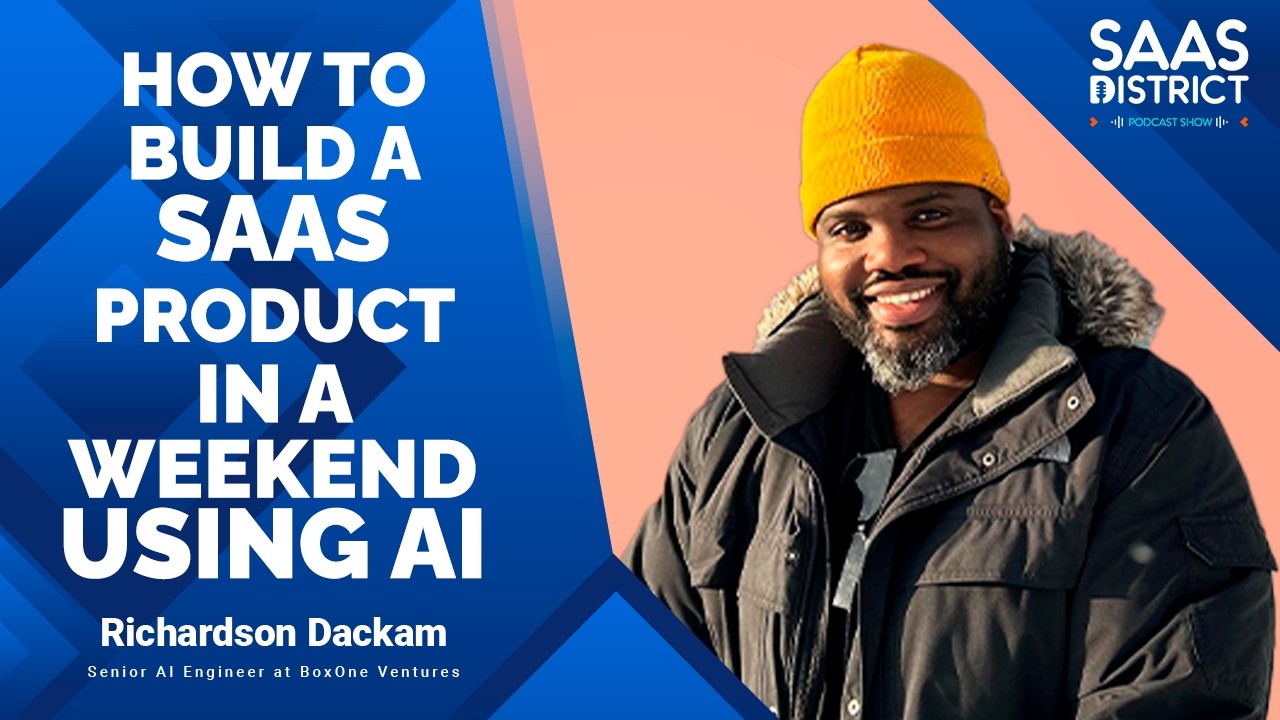
Richardson Dekam, an AI engineer at BoxOne Ventures, breaks down how to build a SaaS product in a weekend using AI. Start with a problem you personally face, write a detailed product requirements document, then use tools like v0 or Bolt.new to prototype. Don't skip the boring stuff: authentication, payments, domain setup, and SEO matter more than most founders think.
Chapters
Hello, hello everyone. This is your host, Akhil Jobar, and welcome back to another episode of SaaS District. In today's episode, we'll be talking about how to build a SaaS product on a weekend using AI. Today we have our guest Richardson Dakam joining us. Richardson is a senior AI engineer at BoxOne. Ventures, which is a privately held investment firm focused on early-stage companies in fast-moving sectors. He builds production AI systems that scale venture investing workflows across the full investment lifecycle, helping investors operate more efficiently using AI-driven tools and automation. He also runs N Shipyard, which is a one-person venture studio where he rapidly builds AI-first SaaS products. Known for his solo builder approach, Richardson focuses on identifying problem Practical problems and turning them into a functional product within hours, which we'll talk about today. So excited to have you on the show today, Richardson.
Excited to be here. Thanks for having me.
So Richardson, you build AI systems, you know, both for venture investing at BoxOne Ventures, and then you also work on yourself within your own studio. But let's start with that vantage point. Let's kind of understand what separates, you know, understanding people who are looking to build a SaaS product, what separates SaaS products that actually get built From the ones that many ideas that never get shipped?
I think that in the age of AI, especially now, a lot of things get built, but a lot of ideas don't get revenue. The ideas that don't get shipped is sometimes people have, especially I'm running this community of AI founders, and a lot of people sometimes don't even have the idea to get started. You'll be surprised, they don't actually have the idea even to get started. So this is already a blocker. And people that do have the idea have execution paralysis. They want to build something, but they don't know what steps to take. And even in an age of AI, they often don't even think about just asking AI what they should do next. So sometimes my recommendation is literally just ask AI, describe what you want to build, ask how to build it. So I think a good way is approaching things with a reverse engineer mentality. And if you're able to imagine the end product, you can try to figure out how to get there step by step.
So yeah, there's 2 different things. One is like the idea. I think you said a lot of people get blocked there. It's like, what is the idea? Is there any tips you have for people right now who are like, hey, I want to use AI, I want to build something, understand the power of it, but I don't know what to build? I guess that's what they're asking. Where do you start?
Yeah, so I think that idea is like a muscle. The more you try to think about solutions for a problem, the better you get at it. So, so I would say if someone is trying to look for an idea and they're struggling to find one, they should just know that that's okay. Over time, they'll get better at doing it. So one thing is to look for problems that you're experiencing every day. I've seen some examples of people literally looking at the credit card statement to see where they spend their money on so that they can find out ideas based on that. Other ways is to just look at problems that you're experiencing at work and, and really developing your mind for for thinking about solutions to frustrating problems. And then the more you do that, the better your idea muscle gets, and then the better you get at actually coming up with new ideas.
So you gotta work that muscle to kind of experiment in different areas of your life and see what problems are really bothering you. And you're like, okay, maybe I can try to build a solution.
Yes.
And I tend to recommend problems that you have because one thing that people underestimate with SaaS is that it there's a lot of obstacles that you're going to face. So if you're solving problems that you're experiencing, you're more likely to be resilient with the different obstacles because this is something that you're actually going to care about. 'Cause sometimes people see a world problem that they want to solve that is not something that they actually relate to, that they have experienced, and they get into this rabbit hole of trying to solve someone else's problem, and they oftentimes give up or don't go all the way to the end.
I wonder if it's a lot of people select products or markets, they choose what to build based on market demands, business, and money, right? It's like, hey, there's an opportunity here. This sounds like a problem I can solve. And even though I don't really care about the solution or what we're doing, it was like, hey, this thing will probably make money. And sometimes it works, I think, but a lot of times it backfires because you don't actually care about the problem you're solving.
Yes. And you end up falling in love with the solution when what really matters is falling in love with the problem. Because if you fall in love with the solution, you're gonna be so, your entire mind is going to focus on the solution itself, how the product looks, instead of figuring out what kind of question you can ask to solve the problem.
Hmm.
So I think that's kind of what makes this difference. People that really fall in love with the problem tend to find a solution because they iterate more, because they can ask people for feedback. they really want to get to the bottom of it. So they end up asking people questions and talking with customers is like one of the best things that you can do.
That's a good point. So you've worked with both startups and also, like I said, you run the one-person venture studio. What's some of the biggest misconceptions that founders have and how hard it is to build a SaaS product today? Is it that actually hard? It's like, I have my idea, I'm ready to build with AI. How difficult? What am I getting myself into here?
I think a lot of people, when they imagine SaaS, they think that it's just a website that you put on the web. that's doing some work for you. They don't, they don't visualize all the payment layer that you need to think about, all the payment complexity. They don't think about, you know, all the layers that you have to deal with, like authentication, you know, figuring out how to do the different integration. There are so many layers that are not really visible, and it is this big iceberg of things that you need to figure out along the way. And then oftentimes people get stuck throughout that process as well. So I think people tend to underestimate the amount of obstacles they're going to face, and they tend to overestimate how much they're going to get back from, you know, from whatever they're building. So for example, I used to do service for about like 13 years, and then a lot of people will ask me to build a SaaS for them, and they expect that as soon as the website goes live, that they're instantly going to get customers. And if they didn't get customers, they say, what's wrong with the product? I'm like, it's not the product. You're not getting—
Mm-hmm.
Traffic, right? Right, exactly. I also think that people tend to to think that they can create demand, but you but I think you cannot really create demand. Like there's demand or there isn't. So and and even when for example there's a new product in a new category, it's always an extent of a demand that was already there. So I think that people sometimes assume that if they have a cool idea that it's going to be enough for people to want to use the product, but they never even think about the demand and there's no demand and then. They're surprised that it fails.
It's just like a beautiful, beautiful thing, a nice product, but like, you know, nobody wants it. Yeah. So let's say, you know, somebody's excited, they're ready to build a SaaS this weekend. They've dedicated the time, they've blocked the space. Now before someone even opens up the code editor, you know, whatever, what are they using here? You know, I don't know if they're using Lovable, I don't know if they're using some ChatGPT, if they're using Gemini, if they're using Cloud Code Work or Cloud Code, what needs to be clear beforehand so that the project can actually move quickly once they decide to start coding?
I think the documentation of what you actually want to build. In engineering, we call this PRD, product requirement document. So figuring out exactly what your product do. So who are you building for? What kind of value you wanna give those customer? You also need to think about, this is something that a lot of people don't think about, is blank state. So like when you're building a product, there's always going to be day one where you have zero customer and zero experience. So thinking about blank state forces you to think about the onboarding. So you think about what's going to be the experience for my user when they use the product. So you kind of need to think about all those different details, but oftentimes I recommend to start with the core product of what do you want, what is the simple problem that you want to solve? And in your authentication, in your even integration, And what you can focus on is figuring out if I wanted to build a navigable prototype, what would that look like?
Yeah.
And if you can just start with that and you have the navigable prototype of the product, then you can add functionality and feature after the fact with AI. So when I build product, I always start with first the idea of what I want to build. And I do a lot of deep research with Google, with Gemini or with OpenAI. And once I have the idea of what I want to build, sometimes I even go the extra step where I put everything on NotebookLM Then I generate a critique of the product or a debate.
Mm-hmm.
And I really try to get as much information to really understand the, I guess, the problem so that I can understand even the marketing mindset that I need to have to build the product for the customer. And once I have this entire thing, this is when I generate the PRD. Because I think that when you ask AI to generate the PRD, if you already thought about the marketing, the mindset of your customer, the frustration, The way the PRD is going to be generated is going to take that into consideration.
Absolutely.
So once I have all of that, this is when I go on v0, Cursor, or Cloud Code and generate the navigable prototype.
So I have my PRD, I want to build, I have my product pretty configured, I know what I want to build. What does that— maybe talk a little bit more about the workflow that you suggest. And I have the idea, I'm taking it from Notebook LLM, Gemini, ChatGPT, now I've got it. And then I'm going into where do you suggest starting from there as a Replit or what tool or to launch? And then from there I was like, okay, I have this product, it's coded for me. What's the growth stage from there?
If you want something visual, I would recommend to use something like Bolt.new or v0. My go-to is v0 because I just love the experience that they've created for generating a prototype and deploying it on the same platform. And I'm able to iterate so I can iterate through the visual. add my API key without too much complexity. So I think this is a great place to start. And once you're happy with the navigable prototype, this is when you can commit your code to GitHub and move that inside of something like Cursor or Cloud Code. So usually I will move into Cursor or Cloud Code when there's more complexity that I need to add, or if v0 keeps struggling to do something, this is when I would move into Cloud Code. Also, the benefit of v0 is that I've created some product literally from my phone. For example, Index Lens, which was— so there's this company called Public that created this app called Generated Assets that allow you to write a prompt and get a basket of stock. So that tool became unavailable in Canada because of regulation in the US.
Mm-hmm.
I got so frustrated that that happened, so I wanted to build a prototype. So I just literally wrote the prompt inside of my phone, asked Gemini to generate the PRD, analyze the generated asset website, understand how it works, do the full breakdown. And then I took that PRD and put it into v0 directly from my phone and generated the first prototype. So you can literally do that from your phone. And I like— I would like to add that I tend to spend more time preparing the PRD than actually building this.
Yeah, that makes sense. Then it's easier. You don't have to go back. There's less back and forth and making changes. Like things are more clear for the input is a lot clearer, right? For the—
It's more clear. And also one tip I'll add is that you can ask AI to generate all the path, all the different endpoints, backend endpoints as well, because sometimes it doesn't include it in the PRD. And when you generate it, it's missing or it's not fully done. And then the other thing that you can ask is if you are pasting your PR inside of Cursor or Cloud Code, you can use plan mode. I, I think it's really important because it gets the AI get to think about what it needs to build. If you're doing that into something like Bolt.new or Lovable or V0, you can make sure to add into the prompt to make sure to generate a to-do list and track what you're doing in a markdown file so that you can, so that, so that the AI knows exactly what it's doing.
Mm-hmm.
As he goes forward.
That's actually a really good idea. So you have this product launched, you've built it within one of these platforms, and now you have a working MVP. What's the next step? Are you launching this? Are you building market around these? Are you running ads or are you just building them and kind of just letting them sit there?
But I always think that marketing should start before you even build the product. So I feel like if you start marketing when you launch, you're already a bit late. In my situation, I tend to build product to fix my own problem.
Mm-hmm.
So I don't usually start the marketing. I just want to really experiment. So in my lab, I just run experiment, try to see how push AI to the limits. So once I launch it, what I try to do next is like obviously publish it into a domain. And then usually I have a full workflow for all that. So I use GoDaddy for publishing to a domain and I have a workflow for creating emails, for my platform. Usually I use Magic Link for authentication, Stripe for payment. So I make sure to hook everything together. And I oftentimes spend a lot of time making sure that I have a payment setup. And to simplify my entire workflow, I created a way for me to integrate payment a lot easier. So I have an open source project that allows me to do that. And once I have payment and I've published it online, then I start to think about 3 things. So I need to bring traffic to my site. And there's different ways to do that. I can do content, inbound content marketing and posting on Twitter, talking about my project publicly, which I do on the regular. I can talk about it on my YouTube. And for traffic, I can either use ads or use SEO. I usually never want to use ads because I always wanna see my product growing through organic growth first.
Mm-hmm.
So one step that a lot of people always miss is actually registering your site on Google Index so that you can start indexing. So I always do that first and then I said, I make sure that AI helped me maximize my site for SEO, how it's going to be rendered on a phone if someone shared the link inside of WhatsApp. So I really spend a lot of time on the headers and the meta tag to make sure that when people look at it, that it has all the information For like a viral share or marketing.
So you focus on the SEO channel and then also some social media as well and then trying to get the word out there and start validating it.
Yes.
So many founders, when they want to build something, they get kind of stuck in trying to— this big vision, they want to build everything and all these features and maybe they overcomplicate what they actually want, but what the market needs is maybe something simpler and maybe you can start with something to launch a lot quicker. How do you maybe talk to founders and help them suggest what is the minimum features they need To get them to launch in the weekend and get it out there?
Yes. So usually my rule, for example, when I'm building product over the weekend, if I imagine a feature and I cannot build it over the weekend, I don't even build the startup. So that's all the ideas that I've had, ideas that I was confident I can build in a day or weekend. And if I can't build a core product, especially in the age of AI in a weekend, I usually don't want to build it. So that's, of course, if you're building like a much more complex product for a much more complex problem, that might take a bit longer. But generally for the base prototype, that forces me to be creative about the ways that I'll get to test the product with users. So sometimes if that's even a form, then I go with the form because I think the product might be much too complex to build. Maybe I can use uForm or one of those form platforms. or Typeform to create just a mini prototype of a form and make it look beautiful. So that constraint forces me to think in terms of one core feature.
So you really focus on the constraint. One thing, Richardson, that a lot of people are a little bit concerned about with building with AI, I don't know if you hear it, but now there's this defensibility factor of when you build your product, how do you build the moat around it? Because it sounds like the cost to build is super— we can build it over a weekend. It's easy to build. It's not as complex and time-consuming. There isn't a big investment. So the thought is that somebody can come in and rebuild your product and compete with you or maybe undercharge you. What's your thinking around that? And what are maybe some other risks that you see or kind of going forward with building with AI?
Yeah, so usually I don't, because the cost of development is so low now, I usually don't worry too much about that. What I've tried to think about is What are areas where as a small startup I can iterate that a bigger startup won't be able to iterate as fast? That's something I like to think about. The other thing I like to think about is what are features— so I try to look, for example, at OpenAI, Anthropic, and try to think about what are their core mission and goal. And if I were to build a startup, does that align with their core mission or goal? And oftentimes if it's not, they're very likely to build those features into their product. So I tried to have like this map of like what kind of product they tend to build for and for who. And it kind of gave me an idea of like, if I build something in this niche, they might not build it right away. Or for example, yes, they could build the product, but is there any way that I could iterate it in a way that it would be much harder for them to do so? But again, but usually it's not something that I really worry about.
Mm-hmm.
Because Because bigger companies tend to iterate much slower. So I just build what I need to build and just focus on building great product.
So just focus on the product, don't focus on the competitor. I mean, just keep getting it better, move quicker, ship quicker, and try to build the best product out there, right? And I guess that'll allow that to do itself.
Yes, like trying to build my own pool, like, you know, ocean strategy, blue ocean strategy, where I don't really think about the competition. I try to think about how I create a pool where I'm the only competition, where there's no one else in there.
Yeah, yeah, I love it. So, you know, someone listening in, um, they want to try this approach, right? They want to start building their product this weekend, but they, they want to maybe learn the process a little bit more, where to get started, uh, maybe understand it a bit more. Where's the best place to go and what's the simplest maybe SaaS they could really realistically build on the weekend to practice?
I think, um, they need to think about one core thing that they want the user to do with the tool. And I think that there's not really a limit on what kind of SaaS you can build. I mean, if you can think about, for example, if you want to build something for the government, this is going to take you a lot more time to build because you need to do the connection. And so you need to think about what's going to be the sales cycle once your product is built.
Mm-hmm.
And then, for example, if you're building something for biotech, You know, and you might need requirements. I recently built this tool for longevity, for example, and then biotech has all those regulations like healthcare. You cannot take users' information and all those things. So I had to do a lot of research preemptively to make sure that I could build in an angle where I wouldn't get stuck because of regulation and stuff like that. So those are all the things that happen during the product requirement document where you really plan What are things that are not going to block me down the road? So I always do that beforehand. So by the time I have the product, those are things I already thought about.
Love it. This has been great, Richardson. Anything you wanna add with our audience here who are learning about more AI or anything you wanna share about the future and what you think about AI going for the rest of the year?
I think that we're in an interesting time right now because a lot of companies are now seeing the benefit of having autonomous agents. I thought that autonomy would take a much longer time to come around, but now we're using all those scheduler cron jobs and so on to make it effective. And I feel that for the rest of the year, we're going to see a lot more autonomy agents. And I think that my bet is that this is going to be the defining term of this year. It's going to be autonomy, making agents that can do things for you on their own, that you don't have to wake up every time and send a prompt.
Yeah, love it. Excited to see where it goes. Richardson, ready to shift gears and move to the kind of personal, more rapid-fire questions?
Sure, let's do this.
All right, awesome. Richardson, what's one activity you enjoy outside of work that gets you into a flow state?
So whenever I work on an idea, I get into these like obsessive things where I want to consume content in different medium and format. So like podcasts, books. So I try to think, so I try to find medium where I can consume that content about that idea. And that really make me think about that idea in different ways. Like for example, when I wake up in the morning, I'm thinking about the problem or when I'm having dinner, it's in the back of my head because I'm watching videos about it, listening to podcasts. So I think like consuming content in different medium and format really put me into that flow state to be very productive with my ideas.
Love it. What are some of the biggest challenges you're currently facing in order to continue to grow your business and your platforms? Or, you know, what keeps you up at night these days?
I think there's like this, it's like the paradox of my marketing brand versus my engineering brand. So as an engineer, before I want to automate something, I want to make sure that the manual process is working correctly. And as a marketeer, you want to iterate, right? Marketing is all about trial and error. So you want to try something, see if it works, change it. So the problem with that is that I want to make workflow agents that can do things for me, but then I have the paralysis of not knowing that it works correctly and not building the system correctly. So This dichotomy is a really hard one to deal with because I never know when I should automate things versus actually doing it manually first.
Yeah, I guess there's 2 different mindsets. One was like the experiment of the scientist and the other is the testing out manually. Who or what are some of the best resources? These can be books, mentors, or people you follow in the space who you'd say have been most instrumental to your success over these last few years.
I would say a lot of people that I'm reading on Substack, I find it very inspiring. I really, I follow Not Boring on Substack. I find that there's a lot of value into what Patrick McCormick posts because he really covers industries and startups really well. He gives you the history, the strategy behind what they're doing, so it helps you understand the business as well. So definitely That's one that would definitely be on top of my head. I think also there's Trang Phan. He has a blog called Read Trang, has really good posts about various topics, really big deep dive. I follow the podcast My First Million. So Sean Perry and Sam, I find I have really good hosts that I learn a lot from. So I will say that those are like really good podcasts that I like to follow on a daily basis. Even like, you know, Diary of a CEO, I think has a really good, a lot of information that are super helpful to apply on a daily basis. A lot of the content that I read now that I consume tend to be books about a single topic. For example, like I read a book about salt or a book about chips. So I love books that are focused on one single topic so I can do a really deep dive on it. Like right now I'm reading Vaclav Smil. He's like the world-renowned expert on energy. And so, so doing those deep dives is where I really get the most inspiration because I can really dive down into someone as an expert about a single topic and really understand that topic in different angles. And through that, there's always moments where those different ideas sometimes converge and help different things that I'm doing. And I can borrow ideas from different things that I read about. So I think—
Absolutely.
Those are probably like the, The highest leverage thing I will say into what I'm doing.
Love it, Richardson. What does success mean to you today? Whether that's personally, business, financial life, I guess there's no right answer.
That's probably just doing doing doing something I love with freedom. I think I think that will be well how define success, you know. Even better, I could say doing something I love with freedom with people that I love doing it with.
There you go. Yeah. You're not doing it alone, right? Yeah. Love it. Richardson, this has been great. Where can founders listening in, they want to get in touch with you, anybody listening from audience, they want to get in touch with you, learn more about you and your company, where's the best place?
Yes, I say you can find me at richdekam.com and nshipyard.com. which is my lab where I have all the things that I've built, is probably the best way to see what I'm building on a day-to-day basis. And obviously on X, Richardson DX, where I build in public.
Awesome. So we'll make sure to add all those links to our show notes. Make sure to reach out and connect with Richardson. Thank you so much for your time today. Appreciate it.
Yes, thanks. That was great.
District today. Don't forget to like, subscribe, and hit the bell for future episodes where we interview top leaders in the SaaS industry. If you're a SaaS company looking to grow and unlock the true value of your business, get in touch with us at Horizon Capital, and myself or one of our consultants will provide a free assessment to help you get there and hit your goals. If you have any feedback or suggestions for this podcast, please comment down below and help us improve our content for you all. Thanks again, and see you on the next one.
Bye!
More from Akeel



Get a mentor as soon as possible — and make sure it’s a mentor in your space.




Keith Gillispie: Why Most New Investors Fail & How to Avoid the Common Traps #250 | SaaS District



