Srikrishna Swaminathan: How Ads, AI, and Intent Signals Drive B2B SaaS Revenue #235
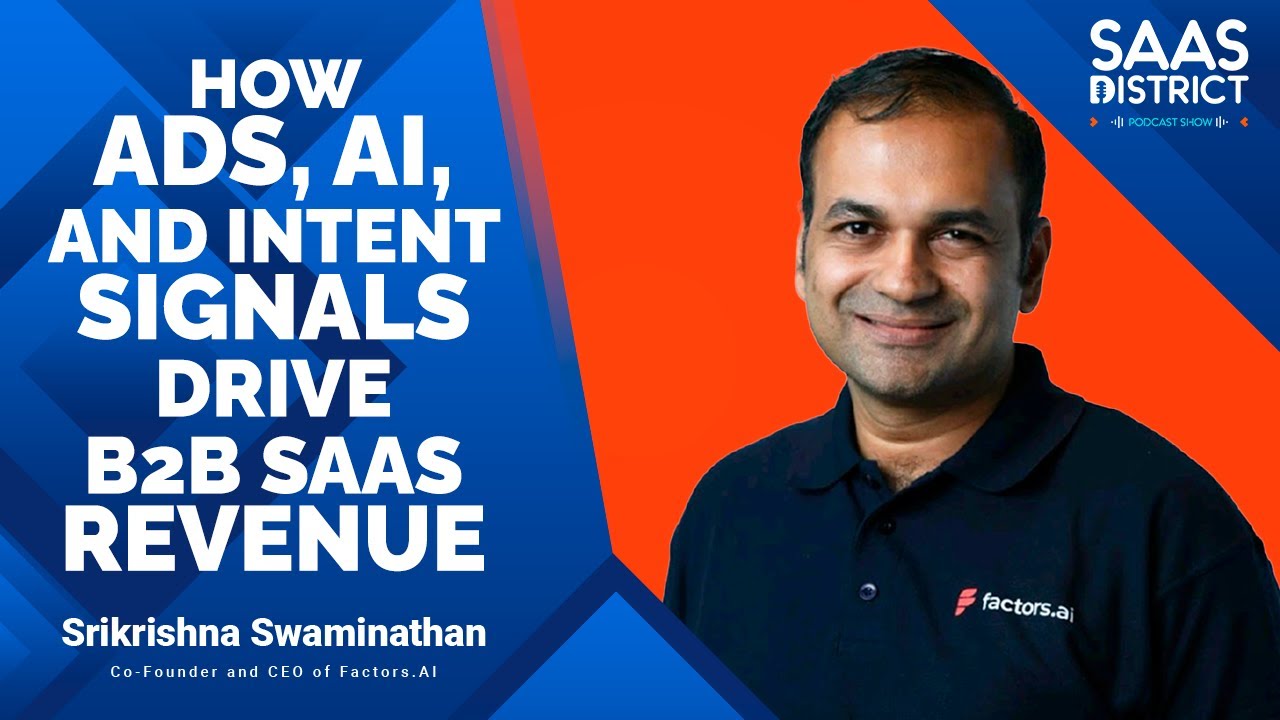
In this SaaS District podcast, host Akeel Jabber interviews Sri Swaminathan, co‑founder and CEO of Factors.ai, about turning ad spend into measurable B2B SaaS revenue. Sri explains that marketers must map the entire multi‑stakeholder buyer journey—from first‑party website visits, through marketing automation, to CRM records—and stitch together first‑, second‑, and third‑party data (including intent sources like G2, Bombora, and LinkedIn) to create a unified account‑level view. This unified view enables true revenue attribution, ROI calculation, and data‑driven budget decisions. He outlines how AI is reshaping the execution layer of campaigns (bidding, audience management, creative optimization), while strategy and intuition remain human‑led. Privacy‑safe personalization is achieved through first‑party SDKs, dynamic landing pages, and walled‑garden ad platforms such as LinkedIn. Sri demonstrates how intent signals from G2 can surface high‑intent accounts before they visit a website, allowing proactive sales outreach and campaign activation. The conversation then shifts to the emerging GTM engineering role—an evolution of RevOps that combines operational ownership with engineering automation—to orchestrate data pipelines, real‑time alerts, and automated campaign actions. A high‑performing GTM motion is described as a loop of unified data, insight generation, and real‑time action, fostering alignment between sales and marketing. The episode concludes with rapid‑fire personal questions revealing Sri’s flow activity (watching his daughter’s Bharatanatyam classes), advice to focus on direction over sheer effort, current growth challenges (brand awareness and storytelling), favorite resources (a16z blog, Ben Horowitz’s The Hard Thing About Hard Things, and Indian/World history series by Abraham Meralli), and his definition of success as building a must‑have product that fundamentally changes B2B ad operations.
Chapters
Hello, hello everyone. This is your host, Akhil Jabbar, and welcome back to another episode of SaaS District. In today's episode, we'll be talking about how ads, AI, and intent signals drive B2B SaaS revenue. Today we have our guest, Sri Swaminathan, Joining us, Sri is the co-founder and CEO of Factors.ai. They are a platform that helps B2B marketers understand, attribute, and optimize their go-to-market performance through data-driven insights. Sri has built and scaled high-performance teams, including a $100 million business unit at InMobi, before turning his focus to marketing analytics and revenue intelligence, which we'll talk about today. So welcome, Sri. Super excited to have you on the show today and talk more and learn more about what you're doing.
Thanks a lot for hosting me, Akeel, and great to be here. And to your audience, hi everyone, this is Sri here from factors.ai. I've been a founder for the last 5 years, primarily working with B2B companies to help them drive more pipeline efficiently. And great to share whatever knowledge I have, also the mistakes which I've made so that it helps the rest of you. Thank you.
Awesome. Awesome. I appreciate it, Sri. So let's dive in today. Let's get into some of the meat of it. We have people listening in, they want to learn about B2B marketing, they want to improve their performance. And many B2B marketers, I believe, you know, they're as they connect their ad performance on, they struggle, right? They struggle between understanding their Google actual revenue and LinkedIn revenue. They might be seeing, you know, CPC, CPA, but then if they drive it back to revenue, they kind of maybe struggle to understand what the real picture is. Maybe what maybe you can share some ways of how we can maybe help close that gap between, you know, ad spend and the actual impact on their pipeline.
Yeah, thanks a lot for bringing this, Aki. Primarily, a lot of companies spend on ads, specifically Google Ads and LinkedIn Ads, and they stop at measuring till form fill-ups and signups only. And in some cases with brand ads and all, they just look for impressions and number of accounts reached rather going below. But end metric for almost every single marketer is like amount of revenue generated. And that is the true north star. And that's the only way where like you can actually define like, whether the work you're doing across marketing is actually impactful or not. And to make this happen, what is primarily necessary is mapping the whole buyer journey. This is something which has been prevalent in mobile ad tech specifically. If you see gaming apps or if you see even e-commerce apps and B2C, this thing, they have the very clear concept of, let me trace the buyer journey. When did a user come? Where did the user come from? Which keyword? How did they sign up? How much converted? The same thing also applies to B2B. The only difference in B2B is it involves multiple stakeholders. It's not just like one single person buying a shirt. In B2B, it's like a whole team buying a CRM or a cybersecurity software. And more importantly, the deal happens over multiple months across multiple channel touchpoints as well. So there'll be offline touchpoints, there'll be sales touchpoints, there'll be emails, there'll be LinkedIn ad views, there'll be Google touchpoints. Connecting all of this together to have the integrated buyer journey is very important because only if you are able to measure, you can actually improve. And that's something which really stands out, and that's what we would really recommend people to do.
Right. And so I guess, yeah, that's the idea, is to first understand where the leads are coming in from, where the sales are coming in from. They typically integrate with some kind of CRM system, I imagine, and then from there they're able to track their leads and And look at the actual revenue when it goes down the line. But yeah, tracking it back to actual specific ad, the specific keyword, as that's when you know where is actually what, you know, what's actually working and then you know where to scale, right?
Yeah. So what we do at factors.ai is like, there are 3 levels of data. One is your first-party systems, which is your website, which is where your users will come and see whether your product works, your blogs, your review sites, including your pricing pages, et cetera. That's where any user comes. Nobody's going to buy your product before coming to your website. Then comes to your marketing automation where you send your emails, and then is your CRM, which is where your sales records all the details. Your teams also record your MQL, SQL data, every single deal status stage, everything is recorded. This is first-party data. Then comes the second-party data, which is what, like engagements in LinkedIn and other social channels, review sites like G2 or Bomba, etc. And then comes the third-party intent data, which is like account de-anonymization, which companies are coming to your website. Who's actually showing interest on which keywords or category of keywords on general internet search? You bring in all this data, layer this, and then you do it. That's what we do at Factors today. Now we are able to say like someone showed interest, then they saw this ad, this account saw this ad, then they came to your website, signed up on a form, they reviewed these blogs and these pages, then eventually they responded to an email and then they converted. You are able to map this whole data journey. And even during the conversion, if there are multiple other touchpoints, you're able to account for that as well. then you're able to very clearly say like, I invested so much on these campaigns and these activities, and this is the kind of revenue I generated. So many customers converted for this segment of activities. Hence, I can say like, I invested X, I have delivered X plus so many dollars. So this is my ROI. That's very powerful.
Now you can make better data-driven decisions in your investments. Exactly. And as you know, we're talking about AI, AI is getting integrated into everywhere in our world today. But now it's getting more integrated into our ad platforms as well. You know, Google has their own Max AI platform. You know, there's all these other, you know, tools you can use to optimize your campaigns these days. So how do you see it changing maybe the way B2B companies are going to manage and optimize their campaigns going forward? What's your opinion there?
So a very simple basic thing across the board is like what marketers do is 3 main things. Strategy, which is like they decide on which campaigns to run, which channels to allocate budgets on, what is the positioning of the campaign, et cetera. Second is intuition. They would've run multiple campaigns across the years, so they have an intuition of what works, what doesn't work, which is it. And the third part is execution. Execution is changing bids on a day-to-day basis, removing and adding audiences, making sure a specific segment of audiences get a specific type of ads. All the campaign execution, including landing pages optimization, creative optimization, et cetera. All of that falls into the execution part. Where we see AI very, very clearly taking a huge share of work away is in the execution part, which is of course close to 80% of the work and time spent, maybe even 60 to 70% of the manpower also spent on, which is primarily on the execution side. And that is something which is going to be completely transformed by the AI, and it's going to make marketers far more easier for them to execute and run campaigns. But the strategy and the intuition part still remains a human thing. Because you exactly know for a particular company, for your target kind of customers, whether you're targeting companies in APAC or EU or in US, whether you're looking at enterprise companies, whether you're looking at Fortune 100 companies, whether you're looking at SMB companies, you exactly know what is the kind of segment you're targeting, what positioning actually works, how you actually allocate budgets based on what channels, how you want to do it. That is still a human job. So this is where we see a huge change which is happening there. things which are completely human-based and humans who use software to deliver outcomes. What is happening is humans deliver oversight and they have strategy and intuition and they have agents which start executing those campaigns.
Right.
And in a sense where we are also seeing a good positive outcome here is like, this is basically taking away the most, I wouldn't say irritating, but the most time-consuming and grunt work within marketing. So in a sense, what marketers, it actually binds what marketing people as such is like, they want to be more creative. They can actually focus on being more creative. They want to work more on strategy, they can actually work on being more on strategy. And more importantly, directing AI to be more faster and efficient on certain aspects because they have that intuition very well. So what this would eventually lead is instead of running one campaign in every quarter or 3 months, you'll start running one campaign every week. And that is what AI is going to actually give you the whole benefit. So the feedback loop is better, the whole iteration is much better. You can do A/B testing much better also. And that's something which we all can look forward to from a B2B perspective.
So you think more on the optimization stage. So what you're saying is, you know, they're running and executing and optimizing the campaigns, they're changing ad copy, they're probably changing keywords, they're changing images, they're generating them and they're creating them and they're testing them. I mean, I think it's a— I don't know if speed would change, I guess how fast the things change, but sometimes you need to wait for results. And that probably doesn't— you can't force results quicker, maybe.
In a sense, it's like always, it's like campaign from— to start campaign is one part, but even deciding to launching the campaign takes sometimes 3 months. And if you see larger B2B companies, even large technology services companies, they plan campaigns quarters in advance. It's like, this is what we are going to launch and then we are going to— once the campaign hits the road, still the normal sales cycle takes for a deal to convert. And that exists, that doesn't change. You can't change the nature of the deal conversion cycle because people have to take time. But how many more campaigns you can launch within a certain amount of period? If there is some feedback loop, something is not working or working, how do you scale that up faster? How do you remove your bids, change your bids? These are all minor tactical sub-execution parts. It's like moving bids from campaign 1 at the X level to Y level. So changing $10 to $20, or if it is something like Cutting down a particular campaign and scaling up another campaign, moving budgets from a channel to another channel. All these things are something which is primarily execution work. If that was done automatically instead of manually, it relieves a lot of stress in the thing, and you also can do it at scale. So instead of just doing 3 campaigns at a time, you can actually do 25 campaigns at a time. Right.
So the marketers then focus more on really on the monitoring of the result as they're managing the robot and they're kind of directing it, I guess, over the keywords.
In a sense, it's like you, instead of having a 3-member team, if you have a 30-member And would you be happy? That's the thing.
It depends if you like big teams, right? But I think, yeah.
I mean, in a more sense, like, I would say not from a managing pain point, but more importantly, in terms of like having more hands at work to get things done.
Yeah, efficiency, right? I guess we're definitely way more efficient. Absolutely. So also speaking about privacy, I guess that's something that's also been changing. There's more restrictions happening, more tightening around there. On the ads, how can marketers maybe think about continuing to still deliver, you know, we want relevant personalized ad experiences without, you know, compromising the compliance?
So privacy has been a major shift over the last 5 years, or even I would say in the last 8 years. Third-party SDKs are out one way or the other, it's continuously going out, and you have seen the likes of Safari and you have Mozilla Firefox, Chrome is still holding on, but most other browsers remove any third-party SDKs. You don't have people who are collecting your data, using that for ads and that data for other audiences. That's something which is basically really shunned upon and that's moved out, which is where first-party SDKs start. At a company level, you choose your own analytics partner to collect your data and then give feedback to that only, that data only to your ads. You don't want your data to be used for other ad channels and your other ad ads of other companies, etc. You want your data to be used only for yourself. And that is something which is very, very clearly coming in. And that's a very welcome part which is there. Second one which is there is like you have seen multiple advances in personalization, which is also happening. LinkedIn, for example, recently launched personalized ads. LinkedIn is a walled garden within itself. So they have the control over the whole data and they can say like, hey, Akeel, I have this ad to show you for your company and talking about you and your company and very specifically monitored for that. That is something personally talking to me. That is also very clearly privacy compliant because it takes very clear permissions from you and then chooses that and then runs it. Second, with the first-party SDK and with stitching of— excuse me, I'm sorry.
No problem.
First-party SDK and connection with the CRM data, you have a very clear, complete account-level view. So when you have an account-level view and you also are able to identify at an account level based on IP, that is not invading personal privacy, but still at an account level, you can give very clear account level personalized landing pages, which is also another advancement recently because you have the likes of Webflow with APIs, which you can change dynamic landing pages. So earlier to make one landing page, it used to take a week and then do it. Now you can dynamically change your landing page based on which visitor is coming from which company. So that gives personalization while at the same time giving speed and also at the same time making sure it doesn't become creepy for you.
Right.
Interesting. And the last part is like even your websites and your other journey, what is the kind of messaging? It's also, you have the context, you have the buyer journey context, which is something which we collect, which I spoke about earlier. You have the first-party data, second-party data, third-party data. You actually are able to see like what is the account interested in? What are the key product aspects they're interested in? Where they're spending time? What is it that resonates with them in terms of messaging? You're able to dynamically capture this data And with AI, you can combine this data, have a GenAI summary either into ad copy or you can push it into a creative and dynamically update your landing page, just as I mentioned earlier, to create a very clear personalized experience. That is something which is now possible with AI.
Yeah, that's incredible. I mean, the power that we're seeing here through Google Ads and now with the personalized LinkedIn ads. Beyond those ad campaigns that are running, There's also intent data from sources such as G2. I know many SaaS companies are successful generating hundreds and hundreds of leads just through G2. They also give teams new ways to understand buying signals, which we're trying to understand here. How can maybe marketers contribute or combine those insights with their ad data a little bit to better target higher intent accounts? So we have all this data, we have Google, we have LinkedIn, we have G2. How do we take all that and Yeah, look for the best.
So G2 is a very important source of intent signals because it's a review site. Just like if you're buying a refrigerator or anything on Amazon, you'll surely go into your customer reviews and seeing like whether this is a brand which actually works or not, what people are saying, whether it's for LG or Samsung, etc. The same thing happens in B2B as well because you're buying software for tens of thousands of dollars. You definitely go and look for reviews. G2 is the largest review site. They have close to maybe 3 or 4 million reviews in that listing. They have more than 160,000 products listed in that. So what this gives us, like, for every single company, whenever people are buying software, they're going and checking out their customer reviews. But not just that, they're also looking at alternatives for that particular product. They're also looking at competitors. They're looking at the category reports. They're looking at multiple other things. All these are the signals which are captured by G2. So if you have a G2 paid plan in terms of signals plan, which I said, what it gives us is not just who's coming to your page, it also gives who's going to your competitor pages. How much, when did they first start seeing their RFP process? Are they looking at the category pages? Are they looking at multiple other signals? So in essence, what this primarily gives us, like even when the time when the RFP process starts, that is when they're thinking about buying a software, with G2, you'll start getting signals on like which companies are actually looking at it. Which companies are looking at your competitor? Which companies are looking at your pages? Now, if this signal comes into you and plus you add that with your website data, your CRM data, why I'm saying website and CRM data, the company which is looking at your G2 comes to your website, it's a very good signal because now they are solution aware and brand aware. If the company which is looking at your website is currently there in your CRM as your target account list, or this company which is looking at your competitors also in your target account list in your CRM, Then you can easily deduce like this company is looking for a solution like factors.ai and they are in my CRM ICP list which I want to target, but for whatever reason they haven't come to factors.ai website, which means now I have to alert my sales and marketing team to run campaigns and call them up so that they can bring them back into our website or into our— the same. So what this accelerates is like much, much in advance before the user eventually signs up into your website, you get a signal like this company is interested in a product like Factors.ai. You are able to reach them out in advance, sell them your proposition, or more importantly, at least get into the RFP stage. You get a chance to be at the table, which is there. So this is the importance of G2 signal. So what you do now is take the G2 signal, get your website signal, get your CRM data, build audiences based on the stage of that audiences. If it's very top of the funnel, where they are not aware of factors today, you just push them into a LinkedIn Ads campaign directly.
Okay.
If they are bottom of the funnel where they are aware of your problem, they're also looking at your reviews, they're coming to your website, then directly push it to sales team, ask them to set up a call, which is very easy. So you can take this data in dynamic and much in advance and then push that into both campaigns on ad side with the marketing or in the email and calls and the sales activation, which is there. To get them interested in you. And what this actually generates is like, without G2, you would have had 100 visitors and 2 people converting per month. I'm just putting a number. With G2, since you know so many other 98 of them, some, at least 20 of them have actually checked you out on G2 or your competitors on G2, you are able to say like 2 of the another 20 you can actually bring in. So instead of having 2 customers, you actually double the number of customers to 4, which is a huge improvement. And which is why knowing these signals and Purchasing these signals becomes a huge value on top of what you are already doing.
Right. Because to be able to do that manually, it would take a lot longer. Here, you're basically increasing velocity on how fast you can use the data, analyze the data, and make a decision, which usually would take a week of someone's time to do. In this case, you have the data instantly, and it's pushing out automation too.
And manually, it's not a problem just of time. It's not like it's going to take a lot of time manually. Manually, it's impossible to do it. I mean, a company using some signal which is based on your G2 page, they're looking at your G2, immediately you have to construe whether they are in ICP or not. Look up your CRM, who has sent the last email, check out whether they have come to your website. It's impossible for any human to actually do all of this. He has to have context of all, he has to have the CRM in his brain. In essence, he has to have that data. He has to have all that context. That is impossible to do. That's where a platform like us comes in. We build the whole company B2B brain or in terms of the whole customer journey stage so that to give the context saying that this customer, which is in your ICP, in your CRM, which you have spoken to 12 months back, is now back in G2 looking for an alternative or looking for a similar category product. Now you reach out to them, you have a higher chance of conversion. Thanks, Lekhmanan.
Right. Makes sense. And others speak about, I think you spoke about before, we've heard the term before about G2M engineering as a new type of role. How do you see that kind of function help teams orchestrate tools such as, say, we're talking about G2, LinkedIn, CRM? Yeah, exactly. To create a more kind of connected growth engine here.
Yeah. So GTM engineering is a new concept thanks to both development through wipe coding and the whole workflow tools which has emerged over the last couple of years, which have made it so easier. But earlier what you used to have is like in companies, there used to be a RevOps or a MarOps person.
Right.
This person owns all the tech stack. He owns the CRM, he owns the CRM hygiene, he owns purchasing multiple intent tools and all that data. Manually, he used to bring about just what you said, is like take downloads of what's happening in G2, take downloads of what's happening on website, identify what's there in your CRM and build lists on a day-to-day basis so that he can give it to the sales teams to go and reach out and call. He can give it to marketing teams so that they can build campaigns and run it. But thanks to white coding and thanks to the whole emergence of very solid workflow tools like Zapier and n8n and others, GTM engineer is a MarOps person plus an engineer in one box. So I own the tools, I manually own, I also intuitively understand what is my ICT, what is the messaging, what is the context where my signals are coming from. Now I basically have an engineer in me also who can actually orchestrate all of that Put your tech stack together and create automations through it. So earlier, what used to be maybe a two or three percent job, that's actually constrained into a one percent job doing multiple things. And thanks to AI, he's able to do it very, very well also, and also generate in terms of follow-ups, generate in terms of immediate alerts, generate the seriousness regarding the intent data and other parts as soon as possible. That's the GTM engineering role, which has newly evolved over a period of time thanks to multiple industry-level shifts or. platform-level shifts in AI which has happened, but this is something which is going to stay. So in a sense, what we are basically saying is like all ops people who used to be there will also become engineers.
Right.
In a sense, and that's what we call as a data engineer or a GTM engineer.
So let's take that role. If we have that hire, he's managing these campaigns and he's connected growth engine, what does a high-performing data-driven GTM motion look like when ads, intent signals, and all the internal analytics work together? When they're doing their job great, what does that look like?
In our view, and when I look at it, the thing is that the first basic thing for it is like the complete unified data view. So you need to be able to take your first-party data, CRM, your website, your marketing automation, emails, your ad channel data, your LinkedIn and social and other engagement, review sites like G2, and also third-party intent like Bombora, et cetera, you are able to have all this data together in a single place, stitched together at an account level. It's not like a data warehouse. You don't just dump all the data, but you pull in all the data and stitch them very clearly at an account level and have a complete data platform visibility in terms of what's happening when. And that's the only way where you'll get context at an account level. So it's in a sense like you see the whole history or the journey which is there. Once you have that, you have a very clear awareness of which companies are most likely to convert. You can do scoring, you can see the paths and patterns to say that these companies are more likely to convert because they have done these actions, because earlier companies which have done these actions converted. These companies have the risk of falling off the stack. These are the companies or accounts which need to have sales activation. These are the companies which need to have marketing activation. You bring about all this data together in a single place, And all in a single dashboard for people to then have not just data in one place, but also intelligence and insights for them to make better decisions. In essence, every single decision-making, right, from any technology, if you see whether it's cellular or radar and so many other things, when you get data in fast and more importantly, you also get insights propped up to you, you are able to decide faster and take next-step actions.
Right.
And most important, it's not just taking faster decisions, you are taking aligned decisions. Sales and marketing sits in the same plane here. Where marketing says like, these companies I have shown ads to, but they have never been reached out by sales teams and they belong to our ICP. Can you make sure your sales team go and reach out to them? Sales team come back and say, these are the companies which are in our ICP we want to target. You have not shown ads to them. Why don't you show ads to them? All the data visibility, everything is in a single place. It's one, democratized. Second, it also makes people far more accountable and aligned. The last part is like how you use the data action, which is insights is there, but insights stops with the last mile. The last mile is taking action on the data. Now I have the insights automatically, how I can actually push that into audiences and campaigns, change bids or move budgets and run campaigns automatically and have the continuous feedback loop of what is working, what's not working so that I improve. That is the last part in terms of like Taking real-time action. So I would say data unity, the complete ability in terms of insights in one single place so that everyone is aligned and accountable. The last part is like taking real-time decisions with feedback loop.
Love it. That's a beautiful system. If it's running like that and smoothly and continuously automating, I think every B2B SaaS founder would be pretty happy having that as part of their business.
We are actually getting towards it. We are actually getting towards it. And with the GTM engineering role and other things, and thanks to AI, it's so continuous shift on what I would call as a B2C-ification of B2B. In B2C, all the data resides in one place, in a single app or a single website, which is there, and people are able to do it very fast. That is now coming into B2B as well, where sales and marketing don't think of themselves as separate silos. You have so many signals, so many activities. All of that data gets captured, unified, and insights to action comes also.
Yeah, makes sense. Love it. Love it, Sri. This has been great. I appreciate all the questions you've answered here today. I'd love to shift gears and move to the personal and rapid-fire questions. You ready for that, Sri?
Yeah, I'm ready for that.
All right, let's do it. Sri, what's one activity you enjoy outside of work that gets you into a flow state?
I really enjoy my daughter's dance classes. Okay. Every Thursday, my daughter goes to dance. It's South Indian dance from Bharatanatyam, and She learns that. And it's very calming to see kids, like 10 kids of 8 to 9 years old dancing together. And more importantly, dance as such is like too much of a lot of rigor and a lot of coordination. And how they learn to dance at a very young age in terms of hand-eye coordination, the whole part about physically being fit, making sure you are in the right poses, you have rhythm in your dressing, and you smile. all the time because that's the most important thing. You face an audience, you have to smile. All of that in a single place to see kids doing, it's also inspiring for me to actually have a better kind of alignment and rhythm for myself and then work. And that's something which is fully coming. So no phones, nothing. All I have is a notebook looking at her moves and other things because she also demands me, like, I have to give her feedback on how she performed, what happened, what doesn't happen so that she has to practice. So that's something which I really enjoy on a day-to-day basis.
Love it.
On a weekend basis.
Yeah, I love it. There's nothing better than seeing your children grow and then being able to observe it and see it and witness it.
Love it.
Love it. Sri, what's one piece of advice if you could go back in time and tell your younger self, let's say your 20 or 25-year-old self?
In a sense, it's like one thing which Direction matters more than hard work or even discipline. And that is something which I didn't know as a child. It's like basically you just come from a more traditional middle-class background where the focus is on work, education, getting into engineering, getting into the right B-schools and other things and getting into a right career. But what you Don't think about it as like, what is your skill, where you are, where your skills can work very well, and align your direction within that. So this is the place where I think I can shine very well and keep that direction and keep that focus very clearly. That's something which I would have really benefited from that kind of advice if I'm now, because it's like I ended up doing a lot of things because you tend to do things which are fancy and which are considered cool, like more engineering analytics or more into certain kind of aspect or getting into certain kinds of jobs, et cetera. Rather, if you're focused on like, this is what you would kind of eventually want to be, and these are your skills, which you intuitively know, this thing, you could kind of like keep the direction straight. Don't go all over the place because it takes a long time for you to change directions and come back. There is an inertia component also, which is there. So always get the direction right. If your direction is right, whatever you try to do, things will fall in place better. And more importantly, the struggle is also lesser. You wouldn't sweat so much to get to where you want.
100%. You can move a lot faster and go a lot deeper as well.
Exactly. Yeah.
Sri, what are some of the biggest challenges you're currently facing in order to continue to grow factors.ai these days? Meaning, what keeps you up at night these days?
So, primary thing is B2B. market out, especially SaaS market is highly competitive and it's like what we call as a martech assets. It's like a lot of red ocean and a lot of confusing signals on like what company does what. And within marketers themselves to say like, I do this expert and this is why we are better. That's something like running your LinkedIn ads efficiently, running your Google ads efficiently in one sense, taking all the signals takes a long time. If you go into one step further into investors or people who are in B2B ad tech, for them to understand the difference between companies like HubSpot versus companies like us will take a long time. The general public is even further, which is what I mean by general public is enterprises, CEOs of companies which we want to target and others. It's even more harder. So the most important thing which actually keeps me awake is the storytelling and the brand recognition. How do I spread word about my company? Not just brand awareness, but more importantly, problem awareness, what we actually solve for, to top of the mind to, let's say, 20,000 to 25,000 B2B companies which are there in the market is something which is a hard task. And that's something which can't be automated by AI, can't be changed by AI. And this is something which we have to break through the noise. And that's the only thing which actually keeps me awake. So in a sense, it's like you have things under your control in terms of technology, product, product delivering to whatever the promises which are there.
Right.
But the things which are more harder to control is your brand awareness and how people think about your product and when they think about your product. That's something which It's the large storytelling and the distribution game which we need to master.
Absolutely. And educating, right? It's all about educating the market and getting them aware about the problem. Exactly.
Yeah.
Sri, who or what are some of the best 3 resources or people? This can be books, mentors, or maybe people you follow in the space who you'd say have been most instrumental to your success over these last few years.
So one thing is like I constantly follow Anderson Horowitz's blogs. And Hard Things About Hard Things was one book which I read before starting up. And more importantly, I keep rereading over a period of time. And that's something which also grounds you to all the problems and it also helps you think a little more clearly on what exactly happens and how it happens. And that is something which I would really recommend to any entrepreneur and even specifically B2B SaaS entrepreneur on how you look at it. It's not Esoteric. It's not something like playing from a place of success. It's playing from a place of like where there has been a lot of ups and downs and how you still are able to deliver what you do. That's from a more business side, which is there. Other things beyond that is also like I read a lot of history and history gives us a help in terms of like how nations have evolved both from all the ancient history all the way how kings have handle different levels of conquest at different points in time, how people have reacted to different kinds of items. That also helps you take out of the tech bubble and also see the world in a much better picture. Like you build for the long term and how you take decisions for the long term. So some of the books is like, of course I do Abraham Meralli, which is the 5-book history set about from ancient India to modern India, which is there. That's something which I constantly read. That's more of an Indian history, but I also read glimpses of world history from multiple other books as well. That's something which I really follow. It keeps me grounded in many ways.
Absolutely. So, yeah, that's a great book. The Hard Things About the Hard Things. It's been a while since I've read it. Probably a good time to refresh on that. What was the name of that other book you said about the history of India?
The history is Abraham Aureli. It's a 5-part series. It starts with ancient India all the way up to Mughal India.
Very interesting. We'll add those to the show notes as well for people who want to check that out as well. So appreciate you sharing that. Sri, what does success mean to you today? Whether that's personally, business, financial, life, family, there's no right answer.
I mean, so there are different ways. The primary way how people try to quantify success, and that's something which works, is like how much you're able to increase the valuation of the company, the amount of revenue you generate, number of people which you're able to expand into, et cetera. But one thing which I would really look upon is like what you are building, is it kind of fundamentally changing the subset of industry which you're working with? In a sense, like, are you really revolutionizing the ads or how ads are run within B2B? That is something which is a place where we want to get into with our product and technology because that's real value impact and that can actually run for much more years than just valuation metrics and the thing companies can change. I wouldn't be CEO of a company for so long. It'll be like someone else is going to take over, though I'm a founder and all of this thing. But how would the value actually differentiate and how people are like, are marketers and companies able to use our product and say like, this is a must-have in my tech stack and this is something which I need to really use to actually scale up better and this thing. If that happens, then it becomes a huge impact. So for example, that's why I'm really kind of inspired by what Slack has done over a period of time. It's become a de facto communication channel. On the consumer side, it's like WhatsApp or tools like even HubSpot, the CRM product which we're doing, or project management like ClickUp and Notion, which we use on a day-to-day basis. These are tools which have, irrespective of the revenue and the numbers, they have actually clearly impacted how people generally go about their lives and becomes a must-have within this thing. And that's where I would define a success. And that's what I'm actually— Love it.
Sounds like you're trying to make a difference, trying to make an impact in the world, and it seems like you're doing a great job in—
In your micro segment. It's not something like I'm not curing cancer, I'm not eradicating poverty, but in a very, very simple level, it's like, do marketers use or B2B marketers use us as a very clear must-have tech stack or not? If that happens, then we have solved for a very large— Exactly.
You've done your job. Absolutely. Well, thank you, Sri. Appreciate you joining today. Appreciate you sharing all your information. Where can founders or marketers get in touch with you, learn more about you, as well as learn more about factors.ai?
I'm very active on LinkedIn, so my LinkedIn profile is open. Please do connect and share your DM. I'll also share my email ID, srikrishna@factors.ai. S-R-I-K-R-I-S-H-N-A@factors.ai. You can reach out to me over email if you'd like to talk to me or if you have anything to let me know or even check out factors.ai. We have a free trial and free plan, so please do. Check it out.
Awesome. We'll add your your email, your LinkedIn, as well as the website link on the show notes. If you guys want to check it out, make sure to say hi, Sri. And thank you so much for joining today. Appreciate joining SAS District, Sri.
Thanks a lot, and much obliged for hosting me, Akhil. And hopefully we'll be in touch for more.
Thank you. Absolutely. Thank you. Thank you all for watching this episode and joining SAS District today. Don't forget to like. Like, subscribe, and hit the bell for future episodes where we interview top leaders in the SaaS industry. If you're a SaaS company looking to grow and unlock the true value of your business, get in touch with us at Horizon Capital and myself or one of our consultants will provide a free assessment to help you get there and hit your goals. If you have any feedback or suggestions for this podcast, please comment down below and help us improve our content for you all.
Thank you.
Thanks again, and see you on the next one.
More from Akeel



Get a mentor as soon as possible — and make sure it’s a mentor in your space.




Keith Gillispie: Why Most New Investors Fail & How to Avoid the Common Traps #250 | SaaS District



