Sufian Chowdhury: Building, Scaling and Fundraising A SaaS Company #205
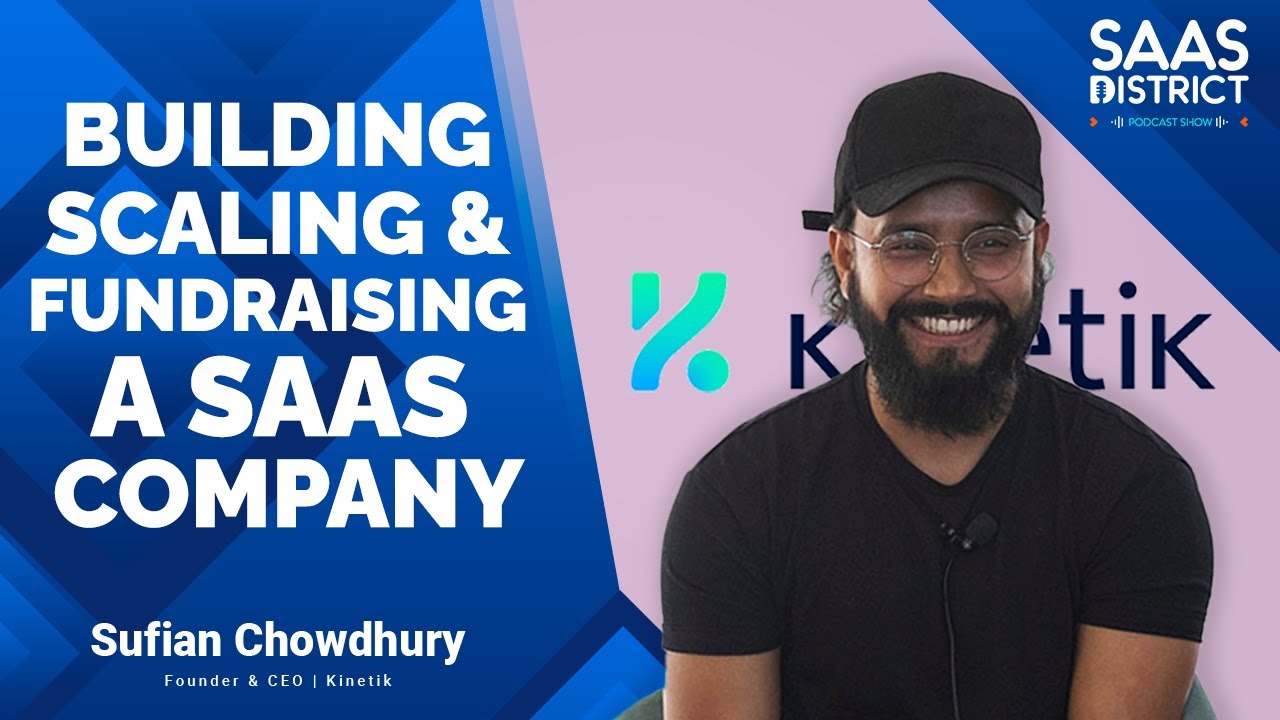
In this SaaS District interview, founder and CEO Sufian Chowdhury walks host Akeel Jabber through the creation and growth of Kinetic, a SaaS platform serving the non‑emergency medical transportation (NEMT) industry. He explains how a frustrating Excel‑based billing process in a Brooklyn transport company sparked the idea for an aggregated revenue‑cycle‑management (RCM) solution, leading to the launch of Kinetic six years ago. The conversation covers the evolution from a pure RCM product to a broader scheduling platform that lets health plans dispatch rides across a network of 250,000 drivers and 20,000 transport companies, aiming to collapse a 72‑hour booking window into a few hours with real‑time insurance billing. Chowdhury details strategic choices such as rejecting an exclusive deal with a major rideshare firm to preserve ecosystem flexibility, and how that decision enabled non‑exclusive partnerships with all major rideshare providers. Funding strategy is highlighted: a $20 million seed round (one of the largest for a seed in the $10‑12 billion NEMT market) and a planned $50‑60 million Series A, emphasizing capital as a lever for industry transformation rather than bootstrapping. The impact of COVID‑19 is discussed; a 70 % drop in ride volume forced a pivot to the scheduling platform, expanding the total addressable market from $200‑300 million to $2‑3 billion. Growth metrics are shared – 120 corporate staff, a driver network exceeding a quarter‑million, and over 250 transport‑company customers, with rideshare accounting for at most 10 % of volume. Chowdhury shares operational lessons: the importance of patient financial strategy, patience, networking, mentorship, and maintaining culture while scaling. He also outlines future SaaS opportunities in healthcare (ancillary marketplaces, prior‑authorization automation, democratized financing) and offers personal advice on reading, writing, and the long timelines of building a mission‑driven company.
Chapters
Hello, hello everyone. This is your host, Akhil Jobar, and welcome back to another episode of SaaS District. In today's, we'll be talking about building, scaling, and fundraising a SaaS company in the non-emergency medical transportation industry. Today we have our guest, Sufyan Chowdhury, joining us. Sufyan is the founder and CEO of Kinetic, which is a platform where they offer a suite of products and API solutions to organizations in the non-emergency medical transportation industry to streamline and automate billing. Through their platform, they help streamline day-to-day operations for brokers, managed care organizations, and local transportation providers. So welcome, Sufyan. I'm super excited to have you on the show today.
Thanks for having me. I'm excited for this.
So just before we get into the nitty-gritty of it, I just want to give a little bit of context for people to understand. When did you start or found Kinetic? How big is your company today, and have you raised any external capital? Are you guys completely bootstrapped?
Sure. Yeah, I started the company about 6 years ago. I have 2 other co-founders. I did this for the first 6 months, then found a couple of co-founders to build this thing out. It started— so the roots of the company, it started in the back offices of local transport companies in Brooklyn. So we're based out of Queens. It's right there. I was in the— a friend of mine calls me and he's like, hey, I need help with the database. Can you help me out? I go in, it's the biggest Excel sheet I've ever seen. I'm like, what is this? And he's like, yeah, I work with all these insurance companies and I have to bill them. And I work with each of these insurance companies require a different mechanism through which I have to bill. I'm like, you're telling me there isn't an aggregated way of billing? Prior to this, I built out a couple of other companies and products where I'd sell the IP, and it was in healthcare space. I was familiar with the healthcare space. And he told me that, I was like, what they really need is this aggregated billing platform. And so thus began the journey where all the other projects I was working on, I stopped and I sat in the back offices of taxi companies and transportation companies for about 12 months. And we built out the first revenue cycle management platform for this non-emergency medical transportation industry. A couple things, revenue cycle management platform, RCM, abbreviated way of saying it. It's how, if you're working with insurance companies, health insurance companies, you use an RCM to manage the claim cycle because it's very complicated and convoluted. You need technology like this. And this just happened to be that this industry did not have an aggregated billing platform or an RCM product. And some more context around the industry, NEMT, non-emergency medical transportation, it's this $10, $12 billion marketplace primarily funded by Medicaid, Medicare Advantage. Almost 400 million rides a year take place that's fully subsidized by insurance companies. And then there are 20,000 local transport companies. So you see these ambulettes going around there, but 20,000 transportation companies, hundreds of thousands of vehicles throughout the country that do this. And it's dialysis center that they're going to or mental health clinic visits that patients need or It's pretty crazy. And I didn't even know about this industry until I sat there. And so that's how we started the company and it evolved, which we'll talk about the evolution of the company as we go through this. But that's how the company started. We raised $20 million in funding so far. We raised $20 million seed round. We're going for external institutional round of funding and we're raising about $50 to $60 million. And the company today, We started off with myself and then a few months later, a couple of co-founders. Today we're at about 120 people in the corporate headquarters here. And then obviously through our network, we have our driver network is well over a quarter million drivers that we've established. And I'll talk to you guys about that.
Wow. Is those drivers just in the New York area or are you guys all over the US?
Oh, nationwide. Yeah, we're nationwide.
Amazing.
We're enterprise solutions, so it's not necessarily an end user. We're not direct to consumer, so it's not something that you could just download off the App Store. It's a product. So, you know, again, I was talking to you about a revenue cycle management platform that we started for these transport companies. Over time, we started working with, you know, rideshare companies, et cetera, and we built out a scheduling platform as well. And scheduling platform is used by health plans. So typically, let's say I need a ride, I'm a patient, I'll call my health plan. The health plan can use our scheduling platform to schedule directly into whether it's any of the top rideshare companies or over 3,500 transport companies in our network, they could schedule dynamically. And then when that trip is completed, Then we're able to automatically bill the insurance companies on behalf of the transport companies for the transport providers to get paid.
Got it. And I guess early on, there was a story in terms of when you were— you had an opportunity to strike a major deal with a ridesharing company where you had to turn it down. And it seems like that kind of led you to your business today. Can you speak a little bit more about that?
Yeah, so that was— I mean, building a company, a tech company, The stories are crazy. Some of them I can't share right now.
Maybe yours.
Yeah, I hear you. Right now I'll share, I guess, a clean version of this. For me, building a company is all about leverage, right? And as a small company at that time, it was just 4 or 5 of us in the company. And to work with major organizations, you've obviously got to look much larger than you are, especially the first couple of years when it's just a handful And we did just that, did my pitch. The idea was, you know, the rideshare companies had a very hard time penetrating this marketplace. It was filled with local transport companies who provide higher levels of services. One of the main reasons rideshare companies have a hard time penetrating this marketplace is because rideshares only do curb to curb. They'll pick you up somewhere, drop you off. Higher levels of care require wheelchair transportation or gurneys or other modes of transportation that are a bit more complex and the driver really needs to be involved with that patient. And that's what this industry really is. Rideshare companies can't necessarily do that. They have, they don't necessarily train their drivers to know that this is a healthcare ride and you have to do X, Y, and Z. And so that's really why transport companies that are local have an advantage over rideshare companies. They understand the domain, they understand the patient's needs, And it's carefully curated programs. And so that's one reason why rideshare companies have a hard time penetrating this marketplace. Second is they can't generate claims. In order for you to work with health plans, you must be able to bill them through claims. Health plans don't take traditional invoices. Health plans, to reduce fraud, waste, and abuse, for many reasons, in 1996, they came up with protecting healthcare information. And HIPAA came about, et cetera. And, and so for a lot of the rideshare companies, they don't get into that space simply because of the compliance complexity, et cetera. And how we positioned it is that Kinetic will enable them to do this. Kinetic will enable them to work directly with health plans because now they can send claims over. to the health plans. And so in order for me to kind of get one of them in, they saw it, they liked it. The biggest one in the country, they saw it, they loved it, and they wanted to sign, but only in an exclusive manner. They wanted an exclusive deal. And for a tech company, it would make a lot of sense for us to sign these big deals right away. because we could raise funding off of it. But we chose not to do it because we knew that in order— we couldn't compromise our longer-term vision for some short-term gain. What happens is if you sign exclusive deals, you now are beholden to that particular company.
Yeah.
We can work with so many local transport companies. Today we have over 250 customers on that RCM. product side, we wouldn't be able to go after because we signed this national contract. Although it would've been good for the interim, it would've been very bad for the future of the company. We'd have to sell out to them, et cetera. So that was one of the reasons we didn't do it. The other thing that came out of it is when we started working with rideshare— oh, by the way, I started Penningham and we actually got— we work with every rideshare company now on a non-exclusive basis. So we got what we wanted over time.
Awesome.
And that's the power of not giving in, even though So it makes so much sense to just give in and take the money and take the investor's money, build a hyped-up story, but ultimately there would be no substance to the business. So we had to give that up, but we were able to do what we did to get everybody to sign on with Kinetic. But the other thing that came about it is it showed us the need to build out a scheduling platform because rideshare companies and their scheduling portals did not store a lot of the patient information that's needed in order to request these rides, as well as to then generate those claims. 'Cause healthcare claims have, again, insurance information or specific information that's related to that particular member or patient that when you're requesting a ride on your phone, you don't necessarily have to put all this in, right? So it's a specific scheduling system designed for health plans in this space. And so we were able to come up with it. And today, over time, What started out as a revenue cycle management platform evolved into a vision where we see that every patient should be able to request a ride on their mobile app. They can see how many rides their insurance covers for them. They can choose whether it's a gurney or an ambulette or an ambulance or whatever the mode of transportation it is that they can choose. And when that ride is completed, it charges their insurance in real time as opposed to a credit card of some sort. And so that's the vision we're building towards. It was not our original vision, but it is today. It's evolved a lot. And, you know, one of the things we're challenging in this industry is that historically, if I was a Medicaid patient, I would have to request these rides 72 hours in advance. And that's because the industry and all the stakeholders in this industry operate in silos. So I'll call my insurance company, insurance company call a brokerage that calls a transport company that calls a driver. Who then has to find the patient. And it's almost impossible because everything is done manually, telephonically, via email, et cetera. And that's why the patient needed to request these rides 72 hours in advance. Assume you forgot, now you're done. You can't get that ride. But you can't miss a dialysis ride or you can't miss these important healthcare appointments that are needed for the patient to be taken care of. And I think That's what we're solving for today. Our goal is to collapse that from a 72-hour process to just a couple of hours where you can request it, get it, and bill these rides in real time for that particular member or patient.
Got it. I mean, that's pretty brave of you. I mean, the idea of forgoing easy cash and easy revenue at the early stages, especially then where you have a large contract and easy to get excited, and then getting investors and forgoing it, and then eventually It paid off, but it was a gamble, right? You could have, you could have lost that and you could be in a different situation today. But luckily you have, you know, these larger, larger share— uh, uh, curious how much percent of the rides are coming from some of the major, you know, ridesharing groups. If you say overall, right?
It's 10% max. Really? Yeah. So, you know, we, again, it paid off, I, you know, plenty well for us simply because, again, when you analyze the marketplace, vast majority of these rides were provided by transport companies. Rideshare companies, healthcare is not their primary focus, whereas these transportation companies, that is their only focus, right? For the majority of these folks. And so our gamble paid off very well, but we were also able to get the rideshare companies we needed. We have, again, contracts with every rideshare company and The top 2 everybody knows, but there's so many local rideshare companies that we also work with, and we work with almost everybody on a non-exclusive basis.
Nice. So 6 years in, you know, you've made some big decisions and you've obviously shown great success in terms of how fast you guys have grown. What would you say are some of the most kind of— if you could share some stories or strategies, most important strategies for you seeing that's helped you guys scale and led to your success?
Yeah, I think every company needs a very sound financial strategy. Raising money is complicated, and I think oftentimes if you haven't raised money, you're eager to raise money and just kind of go through that experience, et cetera. And it's complicated, but there's so much strategies associated So, you know, in terms of raising the funding, who you raise from, understanding the risk profile of that particular investor, understanding where you are and what you can deliver on a 12-month runway, the complexity of fundraising is very daunting for many. And I think Kinetic, that's been one of our strengths, strategically raising money. We've raised A $20 million seed round. I think last year was one of the largest in the nation, actually, when we raised our seed round. That's a hefty sum to raise for a seed. That's most people's Series A or Bs, especially in a market that's TAM is about $10 billion. You're not seeing a ton of funding in this space. But what we were able to do is have this massive vision where it's around the patient's experience and that we could get it into the hands of a patient. And so they could have a similar real-time experience the way we do when we order rideshare from our rideshare apps. And that vision was big enough for investors to truly believe in it and pump in the money that they did. Also, we're raising a very, very large Series A. You're looking at a $50 to $60 million raise. That's also unheard of. But again, it's all relative. And again, funding strategy, has been our biggest strength. And then also just product strategy, listening to the market, not thinking we know everything. We sat in the back offices of local transport companies, of health systems, of health plans, of brokers for years. It took us 6 years of just operating in stealth mode. This— we have yet to spend, you know, a dollar in marketing yet, we're approaching almost low 8 figures. We're at high 7 figures in ARR, booked ARR. So everything was done very quietly, stealth mode, not bringing too much attention to ourselves, very methodically. And I think that's been just patient, right? Patience. Being strategic with funding, being strategic with the market itself, understanding market dynamics. Those are the things that have helped us get here.
Yeah, I mean, that's an interesting perspective. I mean, most founders think about strategy and execution, but you guys really focus on the capital allocation and being smart with how much you guys raise and when you raise and from whom. So there's also this battle. A lot of founders listening in are always thinking of bootstrapping versus raising. I imagine you guys wouldn't be able to be where you are today if you guys decided to bootstrap as kind of your strategy.
Yeah, we'd be so far behind. You need capital infusion to accelerate growth. That's just a fact. Owning 100% of something small is not worth it compared to owning a small piece of something absolutely ginormous. Right. And I think that's preference. Do you want a lifestyle business or do you want to change an industry? First, we want to change an industry, and we can't without funding.
You couldn't live without that decision. Yeah. So if I'm a new SaaS founder, maybe in that dilemma, how do I know if my company is ready to scale? When did you guys say, all right, this is the moment, it's time, or I'm ready to seek VC funding?
I think understand the market really well, right? If you are understanding what you want out of it, right? If you're in it because you want to make a couple of million dollars a year and it allows you to live a great life, it's very— think about it, a few million dollars salary or profit or whatever, very successful, very different approach. You don't need funding. You can build it slowly. You'll have a great life. And there are endless businesses that will get you there.
Right.
Endless amount of businesses. If you are mission-driven and you want to change and shift how an entire population thinks, then your approach to raising capital is going to be very different. And you need mentors who've raised money. Get yourself a mentor who raised money. Founders do this a lot. They will help other founders. Get yourself into a founder community. In your industry or wherever you could find a network of founders and just have them as an advisor. Give parts of your company away. Oftentimes founders work literally for free to help people. Like, they will because they know how hard— we know how hard it is to build companies. And even for me, if anybody requests anything, I'll make time. Honestly, as busy as my day might be, If it's another founder that reaches out, I actually pay attention because I know how hard it is to do all this. And so surround yourself with people who've done it is the fastest way to understanding whether you need money or not. Surround yourself with people who've successfully exited companies. Go to just network, network, network, especially this day and age with LinkedIn, social media, et cetera. Very, very easy to get access to these networks. It doesn't matter who you are. It doesn't. So, like, yeah, I can't find somebody or this. You can find it. Trust me, I came from nothing, you know, and I was able to build my way up by networking. And so others can do it as well.
Did you find that, you know, being in the— you're based in the New York area, right? So, you know, do you feel that was kind of a good move? And would you recommend that for maybe founders moving to a more strategic place for fundraising? Do you think that's part of your success as well?
Yeah, I think New York helps a lot. If you're in a major city, it definitely helps a lot. So if you can't afford to live in New Jersey, maybe live in the suburbs of a major city. It really depends on what you're trying to do. We also live in a day and age where you can fly to networking events and you could build really strong rapport when you go to a conference. And so I just, I don't think there's an excuse to not, not be able to build what you need to build.
Yeah, it makes sense. I'm curious to know in terms of timing. So, you know, COVID happened, you know, in between, you know, 2020 to, you know, say 2022. So those last 2 years, how did that impact your, your guys' growth trajectory, plan and strategy? And if so, did you make any repositioning? I'm assuming You know, I heard that we was talking to a founder earlier. He was a 5-time CEO and his first venture was his most successful venture. Now he's on his 5th one. He's like, you know, he's still trying to make up for what he did, even though he has more experience now. But he, you know, being in the right market at the right time was a big part of that success. So I'm curious to know, how did COVID impact you guys and how is that affecting you in a positive or negative way?
COVID impacted us, had a massive impact on our business. One of the reasons why we pivoted and built out our second product line is because when we were building our revenue cycle management platform, our TAM was about $200 to $300 million, meaning the market that we were going after for just the product based on the price that we were charging was about $200 to $300 million, and it was strictly off of selling our product to transport companies. And so during COVID what happened was the industry, there was a reduction of about 70% ride volume because almost no one was going to the hospital unless you had COVID. And so the industry suffered mightily and we weren't able to build, you know, sell our product into the marketplace. So we raised money to build out additional products at that time, knowing that when the industry volume normalizes, We can then go back to, you know, all the customers on, on, on the revenue cycle management side. So that was huge for us, strategically pivoting and building out another product line that the industry needed using that time, because at that time everybody was scrambling to find something. And for the first time in a market where historically no one worked with one another, everybody was open to partnerships. And we leveraged that to build out our scheduling platform. And by the end of COVID we were able to survive that, built out another product, and now we have 2 product lines, and now we have a $2 to $3 billion addressable market because we pivoted and strategically built that product. So again, that was another one of those strategies where raising more money, diluting yourself, but that's okay because the business survived and now it's a 10x bigger opportunity for us. Again, being very strategic with how you raise money. Being okay with giving away parts of your company, knowing very well— yeah, I see that a lot of founders don't do that. A lot of founders have a hard time saying, well, I want this percentage. Forget that, it'll come together. Get a successful exit out your way, everything else will work its way out.
Yeah, yeah. So it's a lot funner when you can, you know, build the art as, you know, your masterpiece without kind of— without the restraints, right? And then I guess some founders like that, right? They don't want to give up control and they just want to be the only person, you know, doing everything. And, you know, they're okay with that too.
So, well, you know, the thing is, a lot of people think they'll just lose control of their company. That's not true. It depends on how you build your job. If you want a well-funded company, you need to earn the respect of investors. Why should an investor put money into you? That investor is parting ways with, with their money, right? And So you've got to see the world through their lens. And your job as a founder is to become the very best thing there is. It's to become the very best CEO they can invest in and work really hard to be that and use that as leverage to say, well, I'm irreplaceable, or look at what I can do. And they can see it. Investors see they're seasoned. You go towards seasoned investors, They could read you in and out. They've seen a million of you, right? So you need to stand out in that crowd. And so your leverage as a founder needs to be that you're so good at what you do that they want you to have control over it. Because as an investor, if you invest money, they want you to grow their money. They're not there to micromanage you. That's not what they're investing for. Investors only take over companies When the founder has misled them, or the founder has lied, or the founder has misappropriated funds. Other than that, investors don't want to deal with the mess that you're dealing with day to day. They understand the complexities of building a business. So you got to understand, be okay to part ways. You could keep control of the company. You might dilute yourself out of the majority ownership, but you can still have control of the company and the direction of it. And investors, good investors want you, the person who's operating your business, to be the one in control because you see things that they don't. Yeah. And that's the other thing with investors is really important.
Yeah. The other side of that that I hear is that people just don't want to, you know, have to— it's a responsibility, right? So you give you $10 million, now I have to deploy it and put it to use. Now you have to hire a bunch of people and manage, you know, a big team. You said you have 120 people now. So managing, it comes with its own downsides or, you know, responsibilities that maybe some people are not willing to take on. Right.
Yeah, exactly. So there's, again, you have, there's got to be a level of risk tolerance that's involved when somebody's investing, whether it's $1 million, $20 million, $60 million, $100 million, whatever it is, they're trusting you with their money. You know, for me, I always treated investors' money as if it's worth more than mine. Because what happens is you'll go recoup yours. If you invest, good investors understand that a good CEO will do everything to make a company great because that's their livelihood, right? And that CEO is invested to become very great, very great in themselves, in the company, et cetera. So investors understand that, but it comes with a sense of responsibility where for you as a founder, need to run the business with tremendous integrity. where they trust you, where if you fail, they're okay with it. They know you've given your all. So you've got to be okay with taking on the responsibility of that. And with high risk comes high reward. You're not going to get the same reward by bootstrapping that you do if you raise $50 million, but you have $50 million to lose if you don't bootstrap, right? So it's, it's a weird balance and you've got to be okay with taking massive risks. You've got to be okay with Pivoting and the pressure that comes, it's unreal. And as a CEO, for me, I'm the CEO because I think I deserve to be the CEO and I'm okay with taking that. And if that's anything, it's just got to be very real with who you are. You can't dream of becoming this mega successful person and have a risk tolerance of— I don't even want to say anything because I don't want to hurt anyone's feelings, but you get me. Your risk tolerance has to equate to what your outcomes in life are, right? Simple risk-reward balance.
Good point. Yeah, I think there's a lot of fear around, you know, the responsibility of the money. So I spoke to a founder the other day, and he was saying how, you know, he bootstrapped for about, you know, I think 9 or 10 years, and finally, you know, he got an offer on the table. He said, okay, he entertained it, and he cashed out for, you know, $50 or $60 million of the company. And now he's starting his new company. He's like, no, I'm, I'm gonna raise money from day one. I'm not even gonna bother It's just like, it's a no-brainer. He's like, let them hire the best talent. Like, it just did help them do so much more that they were like, why were we not doing this earlier?
You're so limited. Like, I would never build a company bootstrapped. The only way I would build a bootstrapped company is if I want to build like a lifestyle business where I want to make a couple of million a year and I'm okay with it, have a few employees, I don't know, real estate business, you know, like that. But that's just not— I'm not in the business to Money is not my biggest motivator to be a tech CEO. I want to change an industry. I want to be able to bring meaningful change to the lives of people that the technology serves. So it depends. You got to know who you are as a CEO, and that should drive all your decision-making.
So last question before we get into the rapid-fire questions, Soufiane. So you're obviously pretty embedded in this space. So you understand kind of the future of the health industry. Are there any kind of investment opportunities that you see or problems if I was looking to build a SaaS from today, or if you could tackle today if you had the time that you'd love to work on and maybe suggest to someone else to work on?
Oh, there are so many problems in healthcare. I mean, just honestly, the revenue cycle management platform, there's so many ancillary marketplaces, whether it's home health, telehealth, etc. Start building it there. A lot of them don't have really good solutions there. Even scheduling coordination of patients and what they need, whether there's prior authorization, that's really hard to get because every— everything that needs to be eligible for an insurance to pay for needs to go through this prior authorization process. Very complex, very complicated. Then there are more creative things where If you want to democratize financing, and if you look at startups, if you want to invest in a startup, you need to have a million in liquid assets, this, this, this, this, this. And then there are ways to democratize that by collecting or pooling money. There's endless things you could do, but start super small, super simple. Find a whole bunch of people with the same problem, solve it with technology, and then eventually scale it up.
Yeah, yeah, it makes sense. Cool. All right, ready for the rapid-fire questions?
Let's do it.
Let's do it. All right, Soufiane, what's one activity you enjoy outside of work that you say gets you into flow state?
I work a lot. It's intense how much I work, but reading and writing, it helps me a lot. Helps me think a lot, helps me understand the perspective of others. Probably the biggest key to my success thus far, reading and writing.
Awesome. What's one piece of advice you wish you had known? If you can go back, you would tell your 25-year-old self today?
That it takes way longer than you think it's going to take.
Be patient.
Be very, very, very patient and see the world through the lens of others from day one. And I learned it the hard way.
Yeah, that's great. What are some of the biggest challenges you're currently facing in order to continue to grow Kinetic? Meaning, you know, what's keeping you up at night these days?
A lot of different things, right? We're signing major deals, making sure we implement. We're on the precipice of shifting the way an entire industry works and thinks, making sure, you know, we stay the front runners here, right? Once you're public and everybody sees what you're doing, you're going to have a whole bunch of other folks trying to emulate you and build out their products, and they'll get market share to stay ahead. Most importantly, continue to build this incredible, incredible culture that we've fostered here at Kinetic at scale, right? About 100, 120 people, we'll double, triple, quadruple over the next 12, 18 months. How do you scale your organization's culture as the company grows? Absolutely, absolutely important. Making sure we have a very high retention rate the way we do right now. Yeah. Nice.
Who or what are some of the best 3 resources? It can be books like you mentioned, or it could be mentors, people you follow in the space who you say have been most instrumental to your success over these last few years.
I'll name the 3 people. My 3 board members, just incredible, incredible human beings. Barry Peters, Tom Turner, Jim Bellinson. They've taught me, they make me look smarter than I am. They've bridged my experience gap and they've collapsed my learning curve by decades by being incredible humans and mentors to me and taking me under their wing.
At what point did you bring them on into your journey?
They've been on for almost day one.
Day one? Nice. Smart. What does success mean to you today? Whether that's personally, business, financial, life, there's no right answer.
To bring this to the hands of millions of patients nationally, there's so many people who can't access care simply because of how complex it is to schedule a medical ride. I learned, you know, when I especially built this company, I went to rural parts of America where they don't have transportation or access to transportation. It's very, very difficult. And to be able to build a product where anybody, irrespective of where you live, can request a ride, get the adequate mode of transportation, and not have to pay for it because your insurance will be able to pay for it. That's going to be the ultimate definition of success for me.
Love it. Awesome. This has been great, Soufiane. I appreciate you sharing all this. Founders listening in, maybe they want to get in touch with you, or anybody listening in, where's the best way to get in touch, learn more about you and your company?
Yeah, a couple of ways. I think LinkedIn is the best way. We're very active now. We're building out my LinkedIn presence. I've been in stealth mode myself forever. I don't have social media. Very old school. So I just have a very, very private life. But LinkedIn is the best way. And my email, sufyan@kinetic.care.
Okay, awesome. We'll put those links to the show notes. And if you guys want to reach out, say hi to Sufyan. Thanks, man. I appreciate you jumping on.
Yeah, for sure. Thanks for having me.
All right. Cheers. Thank you all for watching this episode and joining SaaS District today. Don't forget to like, subscribe, and hit the bell for future episodes where we interview top leaders in the SaaS industry. If you're a SaaS company looking to grow and unlock the true value of your business, get in touch with us at Horizon Capital and myself or one of our consultants will provide a free assessment to help you get there and hit your goals. If you have any feedback or suggestions For this podcast, please comment down below and help us improve our content for you all. Thanks again and see you on the next one.
More from Akeel



Get a mentor as soon as possible — and make sure it’s a mentor in your space.




Keith Gillispie: Why Most New Investors Fail & How to Avoid the Common Traps #250 | SaaS District



