Top 3 Mistakes New Founders Make (How to Build a Successful Startup)
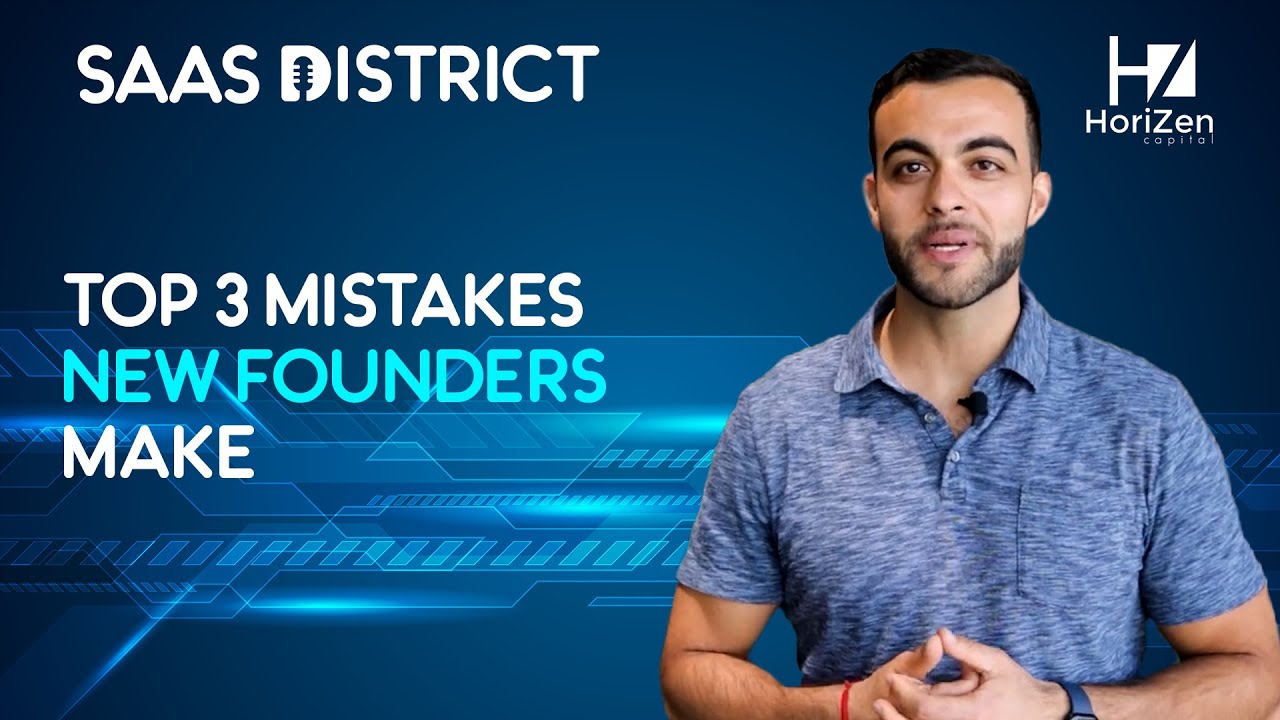
Akeel Jabbar, Investment Director at Horizon Capital, breaks down three costly mistakes he's seen SaaS founders make: skipping a clear Ideal Customer Profile, which leads to wasted leads and high churn; pricing too low or without a strategy; and launching without a go-to-market plan. He walks through a framework for each.
Chapters
We all make mistakes. We're human. But when it comes to launching a startup, every time you make a big mistake, you're not only setting yourself back, you're setting back your team, you're setting back your investors, your partners, and most of all, your confidence in yourself is what's taking a step back. The reason why investors love investing in experienced founders is really for the experience they have of making those mistakes already. and that they won't make again. They'll continue to keep making mistakes again, and that's part of the process. What will happen is they believe that they'll make less of those costly mistakes, that rookie mistakes that'll cost them a lot of time and a lot of money. So myself as a founder of several companies during the last couple of years, including my first startup, which was Delta Staffing, I built that while I was in university studying engineering. I also worked as part of a founder of a delivery-based startup called Let's Feed You based in Canada. And I made a lot of these mistakes at least once. And in this video, I'll uncover these 3 mistakes, these top new mistakes that I made so that you can avoid them in your new startup. Hey guys, Akeel Jabbar here. Welcome back to another video here at SaaS District. I am the investment director and GP at Horizon Capital, where we work with SaaS companies looking to take their business to the next level and grow where they've plateaued and don't know where to go next. So before I get into today's episode, make sure to smash the bell, subscribe to our channel where we release new videos like this every single week. So let's get into the top mistakes that SaaS founders make. So number 1, not clearly defining your ICP. So who is your ideal customer or company profile? Right? This is a mistake I see often, and I've done it several times myself. And the problem with that is if you don't know who your ideal customer is, the first thing I always hear from founders is I ask them, who are you selling to? They say anybody, any service company, any business. And that is the biggest problem. I'm telling you, it sounds good because you'll take anybody's money, right? Anybody who comes to you and say, I'm going to like your product, I'm going to pay for you. But the problem is, you start attracting the wrong type of profile, the wrong type of customers who are not going to be the customers you want to work with in the long term, who know exactly the value of what you're building and who are going to give you the feedback you need to build a scalable and big business. Those customers who are going to come to you who are going to give you the money and are not the right ideal profile, what's going to happen is they're going to become problematic and you're going to find that most of those customers might turn. They're going to get frustrated. They're going to demand a lot of your time. And because you haven't, you haven't defined that they are the right ones of who you're trying to build your business for. So you need to think what is the type of company or person specifically that is going to need your product enough to want to pay for it and see the value of it over the long term. Now you have to look at a couple of things. Okay. When you're, when you're looking at the ideal company profile or the type of business you want to work with, be very, very specific. Okay. The industry, what kind of industry are you focusing on? Uh, the geography, are you focused on Europe? Are you focused on North America or is it Canada? Is it US? Is it California? Is it San Francisco? Be very, very specific to understand where they're located. What is their revenue size of the business you're working with? So I'm talking about B2B here. Is the company, you know, at the early stages, are they doing at least, you know, a million in revenue? Are they doing at least $10 million in revenue? Are they, you know, a Fortune 500, a Fortune 50 company? What is the employee count? How many employees does this have? This is a huge indicator of how big a company is. If you want to know how to categorize the size of the company, if you don't know the size in terms of revenue, Look at their employee count, go into their LinkedIn profile, their company page, and see how many employees they have. Are you working with people from 10 to 50 employees, 50 to 100, 100 to 250, or 1,000 plus? Understand that and define it very clearly. What are the key challenges they're facing? I try to understand that. What is their tech stack? What are they using in their company right now? And how are you going to be able to integrate or work with similar, build a similar business or similar product in which they're already working with. So make sure you define that very, very clearly. Now people ask me, should I just focus on one specific profile of one person? Let's say a marketing manager from, you know, Houston who's, you know, working with a mid-level company who's exhausted. Their team size is 50 to 100 people. Now what I say is focus on maybe 2 to 3, okay? And you don't have to be, you know, completely different. You can have the same profile, but let's say the US And maybe your other one is based in Europe and maybe everything else is the same. And the reason why is what you'll find is the culture of how people interact, the working interaction of how they'll work with you or the way they do business is completely different in how they approach your offering, whether you're in the US or whether you're in Europe. You know, that's something we find, for example, Horizon Capital, when we're talking to different founders who are looking to sell their company because we do acquisitions and investments. We find that when we talk to founders in Europe, we get a lot more response, a lot more engagement, a lot more interest to have conversations. And we have the exact same process in both ways. We're looking at the same companies, same type of profile. The only difference is because in the US, you know, think about how much more attention that they're getting, how many more investors are reaching out to them, how much more capital is available there. So, you know, there's little things that you probably don't think about from the outside. But, you know, you can see that just by changing the geographic, you can have completely different outcomes. Another thing to add on that, on top of that, with different geographical locations is you actually have a different cultural fit. There's a way of doing business when you're doing business, say, in Mexico, in Brazil, versus going to Italy, right? The way people do business is completely different. You might click with that type of geography better than the other, and you'll just be able to find that you have better results by working with those type of profiles and cultures. And just to wrap this up, I want to add another point here is Don't be afraid to say no to a client. Okay? If you define your ICP as, you know, this profile, and let's say, uh, you know, you're working with companies who are midsize, you know, they're doing, let's say, $5 million plus in revenue and somebody comes to you and they say, look, I'm just starting off. Maybe I only have, you know, $100K, $500K in ARR. You're not at this ideal profile. Don't be afraid to say no. Like, look, sorry, we only work with companies who are doing $5 million plus. And You know, our product is just, you know, over— is too big for you. It's over-engineered for you. You won't get the real value out of it. Because what's going to happen is if you, you know, take them in, they're going to get frustrated and they're going to churn anyway. So you're just going to be wasting your time, your team's time, and all your resources working on somebody who's not the right fit. But that being said, don't be— you know, you can say no politely and you can refer them to one of your competitions. Maybe they'll appreciate that. Maybe there's a competition who actually focuses on on these smaller businesses and feel free to refer them. They'll appreciate that. And one day, maybe when they do get to that point where they are $5 million plus, they'll come back and think of you and appreciate that, you know, now they're the right time to work with you. So that's number 1, avoid that mistake, clearly define your ICP. Number 2, poor pricing or positioning of your business. And there's a couple of things here. So this is what I'm going to say for B2B SaaS. I've seen this with a company I've been working with recently. What I saw is, They have a 30-day free trial. They're offering a freemium product— sorry, 30-day free trial. And they're offering packages of $19 a month, $49 a month, and $79 a month. Sounds good, right? But the problem is for every one of those clients, what they're doing is they're offering them demos. They're actually putting in the resource and, and, and, uh, they're putting in the resource and the team to actually do sales calls that takes an hour long just to push these users to $19 a month plans. Now that sounds okay at the early stages, but the problem is that's not scalable. Typically you want to have a demo and you want to position yourself. If you're focusing on SMBs and your self-serve model and your freemium model, and that's your pricing and your positioning, focus on how to automate that, make the whole user experience as easy as possible, and use the product to sell itself. And that's the part of You know, being a self-serve model is that the product, you've— through your trial, they're going to be able to try it out, use it, interact with it, and then they make a decision if they want to buy. Versus the other side, if you're going more enterprise, obviously you need a lot more integrations, onboarding, needs a lot more people to set up the actual platform. Then in that case, when these contracts are, you know, $10,000 a month, $5,000 or $100,000 a year or more, then you know that it's worthwhile having a whole team kind of dedicated to building that. Make sure you match that out, right? So a couple of things there I want to make clear. If you're thinking about how to position or how should I price it, obviously you can look at your competition. Okay, the first thing you can do is look at your competition. Who are your top 5 competitors? How are they pricing their features? How are they pricing their, their business? Are they focused on SMB? Are they doing demos? Are they giving freemium? Are they giving free trials? And then, you know, use that as a starting point, but don't copy them. Okay. And then from there, try to go a little bit higher upmarket. I always recommend, you know, you don't go, you know, lower end, try to be cheaper because that's, you know, people are going to not going to value as much. Don't undervalue your offering. If you're offering something really good and if it's not better than your competition and what they have and you believe in it and you know it's a good product, don't go cheaper than them just to win their business. Create something, you know, equal or even higher because you know the value of what you built. So they've actually done this study several times when it comes to pricing. You can actually check one of my other videos. I talk about all about how to, value and set up your pricing, check out that video. I'll put it in the links below. So for example, I think there's a whiskey company. They were selling a bottle of whiskey and it was selling cheaper than everybody else. And the value, it just wasn't selling as well as they thought. All they did was literally double the price and their sales started skyrocketing, you know, just by changing the value that they made it more premium. That market just seemed to like more premium type whiskeys. Exact same thing, exact same thing in the bottle, same bottle label. By doubling the price, just the perception of the value became a lot higher for the user there. So you have to be able to test and test all the time your pricing. Don't be set in stone that this is my price. We test, you know, every couple of months we do A/B tests, running different conversion rate optimizations to see what actually works and keep increasing until you see that there's no demand for your product. All right. Number 3, third mistake that people make, not having a go-to-market strategy. And I see this a lot with product-led founders. So people who are developers, coders, CTOs, engineers, where they're really focused on building a fantastic product. And this is where we love working with founders like this because they build great products, but they don't know how to get it to the market. They don't know how to take it to the market. They don't have a plan on how to reach their target customers, who their ICP, achieve that competitive advantage, and actually take it to that next level of their business. So the purpose of the go-to-market is really on building that blueprint. How am I going to go out there and take it out to market? How am I going to distribute this and how am I going to execute on it and do it in an efficient and scalable way? So it might sound like you're talking about a business plan, but it's a little bit different. With a go-to-market strategy, you're building specifically a timeline on how you're going to hit certain metrics and goals based on your marketing and growth plan. And you'll say, I'm going to run ad campaigns, I'm going to run it for 3 months and I'm going to spend this much budget. This is what I'm going to target. This is how much I expect to achieve. This is going to be my results. You're going to do an outreach campaign. Okay, well, this is what we're going to— who we're going to allocate to the team, how we're going to do it, who we're going to target. Have all that clearly defined, all your budget, your resources, your team that you need, and then you're going to go out and hit it hard. So your clients will be ready to buy as soon as you hit them with that offer. So overall, I mean, having a go-to-market strategy, if it's effective, you built it properly, You're going to have a clear plan on how to get your product to market. You can have the best product in the world, and if nobody knows about it and you know how to get it to them and communicate it properly, then, you know, there's no point of building it. That's half the battle. And that's part of what we do really, really well at Horizon Capital. And we love taking good products to market and getting the attention that they deserve. So it will reduce the time to get your product out there, you know, do experiments quickly, get the— get feedback quickly and help you take your business to that next level. So there you have it guys. Those are the 3 mistakes that I see often made by startup founders. And I hope you guys can take these lessons and apply them and hopefully actually get good results with your business. So obviously number one, you know, define your ideal client profile. Number 2, position your product and pricing accordingly to what your business is made for. And number 3, make sure you have a go-to-market strategy. All right guys. So if you enjoyed this video, let me know. I want to know in the comments below what mistakes Have you guys made with your startup? It's all about learning here. Mistakes are common. You're going to make it. Like I said, we're human. I'm not going to judge you. No one's here to judge. I'm going to delete any trolls that make fun of you, but comment below. What are the mistakes you've made? I want to hear it. Maybe we, you know, we can all learn from this. And that's the point of this is to learn from mistakes and continue to grow and become successful entrepreneurs. All right guys, hope you guys enjoyed this video and we'll see you guys on the next one.
More from Akeel



Get a mentor as soon as possible — and make sure it’s a mentor in your space.




Keith Gillispie: Why Most New Investors Fail & How to Avoid the Common Traps #250 | SaaS District



