Vlad Hu: The Secret Psychology Behind Building A High-Performance Team #186
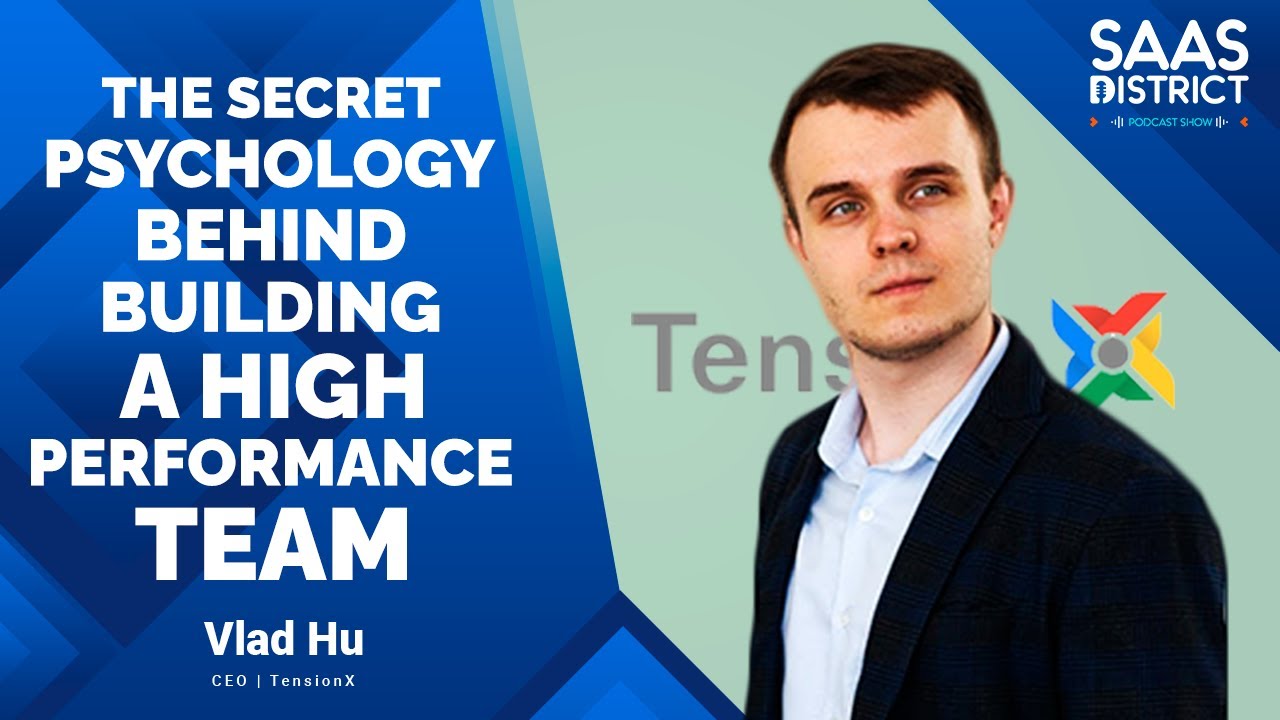
In this SaaS District podcast episode, host Akeel Jabbar interviews Vlad Hu, CEO of TensionX, about the psychology and practical tactics for building a high‑performance SaaS team. The episode opens with a sponsor plug for Flying Cat Marketing, then moves into the core discussion. Vlad introduces a "team quadrants" framework (A, B, C, D, F players) and argues that early‑stage SaaS founders should prioritize hiring B‑players—candidates with strong cultural fit, high motivation, and growth potential—rather than trying to attract top‑tier A‑players before the organization is ready. He outlines a concrete hiring workflow: recruiter screen, a custom technical test designed to prevent copy‑pasting, and a cultural interview that probes past high‑performance experience and future aspirations, with the CTO joining the final interview. Leadership challenges with A‑players are explored; Vlad notes that A‑players demand strong, accountable leadership and can become disruptive if the leader is weak. He describes how he measures team performance through realistic personal and professional goal‑setting, coaching when targets are missed, and encouraging team members to continuously raise their own standards. A clear distinction is made between training (skill gaps) and coaching (mindset gaps), with a "coaching with consequences" process that includes open dialogue, self‑set expectations, limited remediation cycles, and, if necessary, parting ways. Recognition is presented as a three‑tier system: verbal praise, peer‑to‑peer written shout‑outs, and occasional financial bonuses for extraordinary results, with a caution against over‑reliance on money. Vlad likens a high‑performance SaaS team to a sports team, shifting language from "employees" to "team members" to foster competition, unity, and a win‑oriented culture. Personal development influences are highlighted: the books E‑Myth Revisited and Principles, and mentorship from Dan Lok, which shaped his entrepreneurial mindset, process‑driven decision‑making, and personal‑brand strategy. Vlad shares his current biggest challenge—marketing and visibility—stemming from his technical background, and defines his present notion of success as peace and freedom: financial stability for his family and the ability to choose his work without external constraints. The episode concludes with rapid‑fire personal questions (flow‑state activities, advice to his younger self, biggest challenges, recommended resources, definition of success) and contact information (LinkedIn and YouTube).
Questions this video answers
Spending time in nature—fishing, mushroom picking, or sitting by a campfire—helps him disconnect from work and enter a flow state.
Invest heavily in personal development; your own skills and growth are the highest‑return asset.
Marketing and visibility; his technical background means he hasn't focused enough on getting the company seen.
The books *E‑Myth Revisited* and *Principles*, and his mentor Dan Lok, who taught him about personal branding.
Peace and freedom: having financial stability for his family and the ability to choose his work without external constraints.
Chapters
We all know that organic content marketing and SEO is one of the most important growth channels for a SaaS today. It's a real struggle for most growing SaaS companies to find the internal bandwidth to get all the content done that you need for your SEO. Plus, how do you prioritize your actions to get the fastest path to results? The trick is finding the right agency to partner with, and that's why today's sponsor is Flying Cat Marketing. I really like the way they approach SEO and content marketing. They're full service and they have content experts, technical SEO experts, And a team of absolute rock stars. But what I really love about their approach is the following. They have a process for working with internal experts so their content sounds like it's written in-house. They follow a proven framework, which means they get results way faster than any regular in-house team. And they do everything. They don't just provide you with the strategy and let you figure it out. They actually execute it for you and hold themselves accountable for results. Plus, they know B2B SaaS, which is what we're talking about today. Their clients include ActiveCampaign, Mixmaxx, Hotjar, and many other big names in SaaS. If you're ready to dip your toes into SEO and content marketing, please speak with them today at flyingcatmarketing.com.
Hello, hello everyone. This is your host, Akeel Jabbar, and welcome back to another episode of SaaS District. In today's episode, we'll be talking about the secret psychology behind building a high-performance team for your SaaS company. Today we have our guest, Vlad Hu, joining us. Vlad is the CEO of TensionX, a software development company that specializes in web apps, and Google Chrome extensions development. The company helps common, common people find technical solutions to help them get away from routine and save time to focus on the really important stuff. So Vlad is known for his expertise in building SaaS, optimizing business processes, and automation. And in addition to being the co-founder of a handful of cloud SaaS apps, he helps entrepreneurs in their SaaS business journey. So welcome, Vlad. Super excited to have you on the show today.
Hi, Pete. Thank you for having me today.
Yeah, so interesting topic today. We're talking about building a high-performance all-star team, right? Like, we've got the LeBron James, we've got the Messis. I don't know what analogy we want to use, right? Obviously, we want the best of the best on our team to help us win. But if we're building a scratch, you know, I'm a SaaS company, I'm building my team from scratch today. What should I be looking for, right? Like, I mean, there's a lot of things to look for, a lot of characteristics. Characteristics, a lot of personality types we look at. What do you typically look at as a common feature among them that helps you build a high-performance team?
So I think when we start building a team from scratch, a lot of people have the misconception that you've got to start from James LeBron, as you said, right? The first person who needs to join is James LeBron. So we're only going to look for those people, and anyone who's a bit lower, like I'm just fooling, right? The problem with this thinking is your company might not be ready for this kind of people. So if I were to start building a team from scratch today, I would say, if you're familiar with team quadrants, like A players, B players, C players, like D players, F players.
Yeah.
I would say B players would probably be something that I would be looking for when I get started. Just get started because those are the people that you can train on skills and they can perform and grow with you. You see, your company might not be ready for A players yet, but B players might be one way to start.
That's interesting, right? I mean, most people think that you always only hire A players, but yeah, I guess that's— I mean, you only become an A player when you have to start somewhere, right? Not everybody's an A player from the beginning. But okay, what would be some You know, if you have a group of B players, what would you look for to say like, oh, these are B players? How would you define them?
Normally, there are a lot of aspects of the person and how they perform on a team. But if we break it down to simple terms, it's basically soft skills and hard skills, right? How they're good at what they're doing and how they're good at simply interacting with other team members. What is their culture? What are their beliefs? What are their core values? B players would be someone who has high culture, high values, someone that can grow their technical skills, grow into the company. If we're speaking SaaS company, right? Developers, for example.
Right.
Someone who might need to get a bit more training on technical skills, but, you know, they're motivated. The motivation is here. The culture is here. They want to succeed. They want to achieve their goals. They just need a bit more training on that. That's what I define to be a B player. that is worth considering to join your company.
Yeah, I guess the most important part, right? I mean, let's talk about a SaaS company. I mean, if you're, you know, let's say you're hiring a CTO. I mean, your CTO would most likely be your co-founder, and I imagine you want that person to be an A player, right? I mean, you want the people leading the company to be A. And then I guess the A player can, you know, CTO can hire, you know, developers. And I don't think you want to hire senior Google engineers or whatever right off the bat. So what would be like, so you said B players, I'm looking for developers, like, Am I looking at, you know, two to three years experience? Somebody who has a, you know, who's maybe worked in this industry, but who just fits the culture, good communication, or you know, maybe maybe tell me a little bit more about that. Specifically that situation.
Yeah, yeah. Yep, yep. So what I found to be working is, so the way you can get edge over Google, for example, right? Google can focus on hiring only experienced people because they can afford it, right? They can afford the hiring, the process. They can afford. 50 human resources people, 50 recruiters, they can do it day and night. You simply cannot compete with that. So the question you should be asking yourself when you're building SaaS company is, how can I make the same person that's working in a different company and works from 0 to 10, like at a 5 level, how can I make the same person perform at level 7 or 8? What I can do with my team, how I can coach them, how I can give them the proper training and the proper coaching to make the people to perform better. It's basically how can I make mid-specialist, mid-developer perform like a senior? Like, what kind of tools I need to give them? So that's how we really look at this. But generally, hiring someone extremely experienced would probably be only relevant for the CTO kind of positions where you just need them to be the best that they can be.
Awesome. Yeah. So let's talk about kind of the different stages, right? So first you've got your, maybe your Your CTO working with you, he's hiring his kind of initial first B players to help him. Walk me through what is that kind of different stages to building them out, that entire team?
So there are a few things here, especially when you're hiring the person. It is important not only to vet them for technical skills, but also vet them for personal skills, for the culture. So what we currently do in our process, for example, when we hire someone is, first of all, of course, is they just speak to our recruiter with some basic questions to validate whether they even make sense, whether they want to work with us. If so, they go for a test assignment, which is usually a dev task, which is usually some pretty, pretty interesting dev task, make sure you cannot copy it from GitHub, you know, just copy paste and then just—
Okay.
We want to make it tricky. If they do it right, we invite them for the interview. And what we want to ask them is not how you do something in React or in Node.js and some technology. The questions we really want to ask them is, have you worked in a high-performance team before? How do you work with people like that? What are your goals for the next 2 to 3 years? To know, and both personal and career-wise. I want to know that this person is striving for something that is aligned with the company, and I can actually give them what they need to be happy, to be fulfilled. I want the work for them to be more meaningful than just 8 hours per day for a paycheck. I want them to come there because they want to, not because they have to. And I think in general, this is the process that allows me to attract the people who are like-minded, and it basically just cultivates the culture. So we have this process with a CTO, and the final interview is usually me, CTO. We also have the recruiter and me myself. I know it's not going to be scalable when we have like a 1,000 people team. But currently we're at 20, and I still manage to get on the last stage of the interview to personally see how the person will perform.
And when they're coming to speak to you at that stage, what are you looking at at that point? And what are you checking for?
You know, I really try to understand whether I see this person with us in the next few years. Not for now. We're not looking for immediate solution. We need someone to build this, this kind of software, to build this product, to build this and that. We're looking for, okay, can this person contribute not only to product but to the team itself?
Hmm.
Will it be the person who will lead the team through the hard times when there's going to be tough times and he'll be the one who'll say, hey guys, we can do it. Here's what I suggest we can do. Is this, this kind of person? If it is, let's talk. Let's see how we can work together. If not, it might be a temporary solution, but it's not what you should be looking for for the long-term plays.
Got it. And then once you kind of build out that team, obviously it's nice to have a team of high performers who are working together. They're producing well, they're happy at their job, but obviously there also comes with its own problems. What have you seen as kind of some common problems you see when you've got a team of all these all-stars, but you've got to— it also comes with the cost as well, right?
You got to keep up with them. That's the biggest problem.
Okay.
A players, they don't tolerate you being a weak leader as well. If you invite the best ones in your team, you got to perform at the same level, and they will keep you accountable. Like, just this week, As I was transitioning in my journey to US, a lot of stuff was missing because I didn't have proper focus on the company marketing aspects and some of the internal coaching aspects. And my team challenges me with that. They say like, hey, Vlad, I think we're missing something. Let's see how we can help you be a better leader, what you need from us to make sure it's done. So they see that where you're slacking, they keep you accountable for that. And it's also, it's one thing. The second one would be the problem with A-players. It's kind of, I would say your responsibility is to make sure they don't kill each other.
Okay.
Because it's really high energy, high skills, high culture, and they keep each other very accountable for every single step. So you want to make sure they don't get conflicting with each other because they all perform kind of like alpha. They're all leaders internally, and we want to make sure they know how to collaborate with each other. We want to manage that the fire doesn't spread.
Right, right, right. There's a lot of inner fire and they're all pushing to grow. And then if you have them all together sometimes, and I guess if you as a leader, if you're not able to manage that, then you're going to get some disappointment, you're going to get frustration. And they're going to get a lot of pushback as well, right?
If you are not an A player, you cannot have A players behind, like, under you. That's—
Yeah, absolutely.
That's not going to happen.
What would you say are, um, you know, if I'm trying to track, right, keep and, and see how my, my high-performance team is now performing, right? I've got them, you feel you've, you've got them under, you know, managed properly, um, you know, they're performing well, but, you know, it sounds kind of hypothetical. What are some— are you keeping track of certain metrics to say, Okay, yes, they are actually high performers and they're showing improvements in terms of overall team performance.
So I think it depends on the business that you're in. If we're speaking about SaaS in particular, we want to measure which goals we're setting and whether we achieve them on time. Simply put, if this is a high performance of a developer, We're looking to see how they set goals for themselves in terms of personal and professional growth and whether they get them on time or earlier. If not, there'll be a bit of a coaching. So what I'm looking at is for a person to be, how do I say this, is to be realistic. They need to understand what they're capable of because I don't want the person to say I'm going to do something in a week that actually takes a year. I want the person to be realistic. so that they can tell the world what they want to achieve and the world can keep them accountable and they can actually succeed at that. And secondly, I'm constantly looking for my team to set higher goals for themselves.
Yeah.
Because if I'm the only one who kind of raises the bar for them, it almost looks like I'm a coach in a kindergarten with kids trying to tell them how to do pushups. What I want to do is them to be challenging themselves. And I think the moment you see them setting higher standards for themselves over and over, That's how you kind of see how they're growing.
Okay. And that's them setting it, or is that you as a leader setting it for them generally?
My goal is to start the process and make them set their own goals. So usually what I like to do is we're going to achieve this project, or I want to do this or that. It's, hey team, what do you think is realistic? How we can do that? And see what they have to say. Of course, I have my own understanding my whole vision, how it's going to look like. But I really want to see how they are thinking so that maybe we can tweak some things in their mindsets that the next time they're much closer to what I would like them to be in terms of setting their own goals.
Yeah, yeah, it makes sense. And then we talked about kind of the overall kind of secrets, right? I think that's kind of the big thing because we talked about kind of high level of what we do. But what would you define as your top secrets to building and coaching a high-performance team that can deliver results, stay on top of their own goals, and hit their metrics on a consistent basis for clients and customers.
You've almost revealed one of the secrets in the beginning when you mentioned LeBron basketball. You were speaking about sports team.
Yes.
I think this is thinking of your team in business as sports team is probably one of the best ways to position it for your people. in your mind, because a lot of times when entrepreneurs start out, even if it's a SaaS company, they hire the first employee. It feels like a family, like we're building something together, like let's be nice to each other. This vibe doesn't stick when you want to scale it and you want to have a real high performance. So the closer you get to be a sports team, the better, because I think that's how I define my team. And the moment I realized that, I've never said the word employee towards my team members ever again. Because the moment you call someone employee, they start behaving like one, meaning they have a job they need to do. They have tools, they need to go for their shift, and then they come back. If it's a team member, it's also about how can I make my team win? Because team is a competition. It's always a competition internally, but— Most importantly, externally with the outside world. And training your team to think like they are a sports team is, I think, one of the biggest changes I had with me that brought me the biggest results I could imagine.
And I guess maybe flipping it from the other angle, which is, I think this kind of ties into the coaching process and understanding the difference between coaching and maybe realizing you don't have a high-performing worker, right? What I'm speaking here is Let's say you hire somebody and you assume that they're a high performer, but then they start missing their goals. They're not hitting their targets. They're not performing at a level that maybe you thought they would. So your first goal is, okay, let's maybe see, maybe he needs a bit of coaching or he or she, and you need to talk with them and maybe that's what they need. But how would you approach that? And then at what point do you say, okay, coaching is not the issue. This is something else and maybe we need to change the person here.
So there is a very distinctive difference between training and coaching. Training is for people who lack skills. We need to give them training on particular topics. How do you achieve this? How do you achieve that?
Exactly.
Coaching is when their mind is not set the right way, when they're sabotaging their team, when they don't believe in themselves and in the team themselves. when they doubt that we can achieve this, achieve that, it's more on the soft skills of the person. So what I call it is coaching with consequences. So when a situation like this happens, we have a very open conversation and see like, hey, I think you might not be doing the right thing to this person in the team. Like, how do you feel about it? And what we do is we set expectations How this is going to change? What do we need to make it right? And I usually like them to set their own rules. Oh, I actually need this kind of help. I also need this kind of person to help me, and then I will feel I will feel more secure about it. I said, okay, let's do that. When do we revisit this conversation? In two weeks. Okay. So in two weeks, if all is resolved, we celebrate. If it's not, we need to see again what is missing right now. Usually I give them 2 to 3 rounds of trying to improve the situation. I like to see myself as a mediator. I don't necessarily want to push my ideas onto person to make them like, do this because I said this, because I'm the CEO. I want to kind of them to realize what they're doing because you can only make the person believe in the idea. If you kind of pull it from them, meaning if they said it, if they said it, it means everything. If you said it, it means something.
Right.
So what I really like to do is to make them realize the actual problem themselves and work through it. If they are not capable or if they're not willing to, I don't feel particularly bad about letting the person go. Because they might just not fit the culture.
Makes sense. One last question is around the— you mentioned the word celebrating, and I think that's something maybe even myself, I would say, I'm probably not as good at. And something I want to improve is learning to celebrate wins a little bit better. And generally, we're like, we set these goals, we achieve it, and we're like, all right, great. Good job, guys. We just set a new goal, and then we just keep moving. But that's super important. What you said is like, look, we said something, we said we're going to do it, and then you did it. Awesome, let's celebrate. But what does that actually look like? What do you do?
Yes, that's, that's one of the hardest things for myself as well. I'm all about achieving the goal. Achieve it, okay, let's go next, next, next, next. You know, it's, it's, it's, it's kind of common. You, you expect yourself to achieve goals, but when it comes to other people, it's— they're also motivated by recognition, because the one thing that people love more than money and sex is recognition and praise. I forgot the quote, who said it, but it basically means that people love recognition because that gives them motivation. It gives them an understanding that they are achieving something great. If we make it simple, if we break it down, the recognition can be verbal, meaning me to the team member. Right? Like supervisor to the worker. It can be peer-to-peer, meaning team member to team member. Now, while the first one sounds like more official, it's actually much more important to have your peers to motivate each other, to recognize each other, because this gives them the sense of unity. And the moment they start building these bonds, it's just they operate on a different level. They treat each other not like coworkers, but more like actual team members. They vouch for each other. It can be written. It can be in a format of like a postcard. It can be written in our general Slack channel of the company. Like, hey, I want to give a quick shout out to these 3 people who've actually achieved these results this week. And this is why it's important and this and this and that. And all the team is like, yeah, congrats. Yeah. Yeah, man, let's go, let's do it. It gives them a sense that, well, it gives them like positive hormones in their mind because they feel good about it.
Right.
Like when you achieve something, you want to feel good about it.
Right.
When you're a founder, you're kind of self-motivated in this sense and you have much bigger goals you want to achieve, you know them. When you're a team player, right, it's much more granular. So you would need a bit more like this. I would say the third one would be materialistic financial recognition, which can be in the size of a bonus, in the form of a bonus for achieving a task. It can be a gift.
Okay.
What I like to do is not to overdo the last one, the financial one, because I really don't want it to turn into the goal. into the motivation, into the habit. So the person expects this every single time because, because it becomes a pattern, a habit. And the next time you don't do it, they will feel like you— they will demand it simply, you know.
Right.
So what we want to do is to combine the first 2, written and verbal, and occasionally do the financial one for some, for some, I would say, Outstanding extraterrestrial results.
Yeah, it's kind of a carrot, right? You want to you don't want to give it all time, and yeah, so the praise, you know, the sex, the money. I mean, you can give them the money, and then obviously, obviously, you can control, which is giving them some some verbal praise, which which makes perfect sense. Yeah, I love it. Okay, I'll try that. I mean, I think I need to just maybe be a little bit more thoughtful. Yeah, I think the money part, you know, we usually try to incentivize people and think that's the best way, but also. Celebrating by saying, you know, great job. And, you know, and also celebrating among people as well, right? Not just one-to-one, but among people and sharing that the win so that they feel the recognition from everybody, right?
It's not always the money that people go to, they come for. You can think that money is the ultimate motivator for people. But what I found about some of my team members, they're actually more about recognition, they're more about their self-development. And they use the financial resources just to complement it. And if I give them a bonus instead of giving them the opportunity to grow, it's actually a disservice to them. So one thing I do is I simply ask, what would you like to achieve? We would talk about financial ones, what are your goals, but also about your personal life. What would you like to do in the next 2, 3 years? I want to go there, I want to learn this skill, I want to do that. I said, okay, let's see how we can make it happen. So this way, they know work is more than just a money-generating machine for them. They know it can be more fulfilling than that. And recognition can be a process. It's what I found, Akeel, is especially when you're a small team, it's easy to recognize people because it's on autopilot.
Yeah.
You just say, hey, great job, man, because you talk to them directly.
Yeah.
When you grow from 1 person to 5 people to 10 people to 20 to 100, this has to become a process, meaning it literally can be written down for the management team how to properly recognize their team members when they achieve something. When it's a process, it can be improved.
Yeah, yeah. I think you need like a A weekly pop-up just says, hey, don't forget to celebrate. Hey, don't forget. And then just like, oh yeah, I need to go. Who should I go out and recognize today for their hard work?
Yeah. We can start weekly meetings with simple, like, let's share our wins. Who achieved something great this week? And we can recognize that and we can celebrate together, right? Something that is on a recurring basis and keep adding on that.
Love it. Love it. Awesome, Vlad. This has been great. So we— this is, you know, I think there's a lot of useful tips here for people who are looking, you know, building out their team and how to scale it out and maybe think of ways of what— how to approach it. I want to move to kind of the second part of the interview, maybe a little bit more, more fun and interesting, which is the more personal rapid-fire questions. So are you ready for that?
Oh, yes. Yes.
All right, Vlad, what's one activity you enjoy outside of work that you say gets you into flow state?
I would say activities in the nature. So it can be fishing, it can be mushroom picking, it can be setting up a campfire and just looking at it. It's something basically getting into the nature. What it does to me, it just disconnects me from my work. This is the only way I can disconnect, by the way, because when I go cycling, I go something, I'm working. Here I'm working. Like, my body is not, but my brain is. In nature, I can disconnect from that. And this is probably one of the times, except for sleep, where my head can rest. So I think this is what gets me in a flow state. This is what gives me the perspective. I can go back and see from a different angle what's going on.
Exactly. Keeping the mind calm and disconnecting. What's one piece of advice you wish you had known And if you can go back, you would tell your maybe say 25-year-old self?
Well, I'm 23 now, so I would say you did a great job.
You did a great job.
But if, for example, 20-year-old one, right? Sure.
Let's go 5 years ago. Yeah, 20 years old after high school. Yeah.
I would say heavily invest in your personal development. Like, there's not going to be any asset in the world that you can invest that's going to give you more returns than you yourself, especially in your beginning of your entrepreneurial journey. So when it comes to training your sales skills, training your coaching management skills, money skills, everything, like, you are your biggest asset. And keeping investing into that is the sure way to get where you want to get.
Got it. What are some of the biggest challenges you're currently facing in order to continue to grow your company, TensionX? Or meaning, what's keeping you up at night these days?
I think my biggest challenges are marketing related. Me, myself, I come from technical background. I worked as a software engineer before I started running a business. In my head, it's all about systems. I build systems. Like when I train my team, it's a system. When I grow my team, it's also a system. When it comes to marketing, I think this is the skill I didn't pay a lot of attention to, and now I suffer the consequences of it. So I think marketing, getting visibility, I think, is what keeps me up at night. Because anything you do in this world means so little if no one knows about it. Like, you're the best, but you're invisible, right? People just cannot find you. So marketing is what currently keeps me up at night.
Yeah, makes sense. Who or what are some of the best 3 resources? These can be books, people, mentors, or people you just follow in the space who you'd say have been most instrumental to your success over the last few years as you built your company?
I think the first one that changed my understanding of business was a pretty common, pretty famous book by Michael Gerber. It's called E-Myth Revisited. You probably know the book. Yeah, it just, it showed me that I'm thinking from the perspective of a doer. Rather than an entrepreneur, and there is much more to to business than just doing the actual work, than delivering the service or a product. This was the first one that totally shifted my understanding of how I should run the business. The second one was probably a book by Ray Dalio called Principles, also a pretty popular book, pretty big one, pretty big one. It taught me that. Any decision-making in your company can be made into a process, meaning that you can make educated decisions and you can pass this knowledge to your team to operate without you if you make the process. Because if it's something that can be measured, it can be improved. I think this gave me the foundation of what I have today, IntentionX. And the third one will be My mentor, my mentor, Dan Lok, he is the one who opened my eyes for the personal brand and importance of it.
Okay.
And this is because you simply, you simply cannot exit the company if you don't have a personal brand, because what happens is all of your social currency, social capital is left in the company if that's the only asset you are promoting. However, if you're promoting yourself as a person, as an expert, simply as a human being who's interesting to follow. When you go to the next venture, you get the social capital with you. So it's the asset that stays with you. It aligns with what I said about investing in yourself, investing in your personal brand. And my mentor greatly contributed to my understanding of it.
Okay, okay, great. I haven't read that one, but the other 2, yeah, Principles and E-Myth Revisited, awesome books, absolutely recommend it. Um, Vlad, what does, uh, success mean to you today? I know this kind of changes over time, I guess. You at now 23 years old, how do you define it?
Uh, with, uh, with all the recent changes happened to my life, um, okay, the ones who are listening, um, I was in Ukraine half a year ago, uh, then something, something happened in February and I'm now in the United States. Okay, I think Through the journey that I went through, I define peace as the new success for me.
Peace.
Peace and freedom in the meaning that I'm peaceful that tomorrow happens and my family is okay. And at the same time, the freedom is I can do what I'm interested in doing. I don't need to be dependent on the current circumstances, on the current political events, on anything. If I'm peaceful, meaning there's food on the table for my family, there's all the resources for us to live a comfortable life, and I have a freedom to choose what I want to do, or to be more precise, freedom is to choose what I don't want to do, is an absolute success for me. Yeah.
Yeah, yeah, that's awesome. I mean, that's— I think that's a huge way of looking at it, is like, it's not what you can do. There's a million things you can do, but being able to say no and not feel bad or feel, you know, that there's disruption inside that you're missing out on something. Yeah, yeah, awesome, awesome. This has been great. Um, you know, just to kind of wrap things up, where, where can, you know, founders or anybody listening in who want to get in touch with you, learn more about you and IntentionX maybe, where's the best place?
The best place would be currently my LinkedIn and my YouTube channel. So on LinkedIn, it's linkedin.in/vladhu-sasconsulting. On YouTube, just Google Vlad Hu and you'll find it.
Okay, okay, awesome. We'll add your LinkedIn and your YouTube channel to our show notes as well if anybody wants to check that out, and we'll also add those books you recommended as well. So awesome. Thanks for joining today, Vlad. Really appreciate you sharing all this, and it was great.
Akeel, it's been a pleasure.
All right, cheers. Thank you all for watching this episode and joining SaaS District today.
Don't forget to like, subscribe, and hit the bell for future episodes where we interview top leaders in the SaaS industry. If you're a SaaS company looking to grow and unlock the true value of your business, get in touch with us at Horizon Capital, and myself or one of our consultants will provide a free assessment to help you get there and hit your goals. If you have any feedback or suggestions for this podcast, please comment down below and help us improve our content for you all. Thanks again, and see you on the next one.
Thank you.
More from Akeel



Get a mentor as soon as possible — and make sure it’s a mentor in your space.




Keith Gillispie: Why Most New Investors Fail & How to Avoid the Common Traps #250 | SaaS District



