Welcome to our live show!
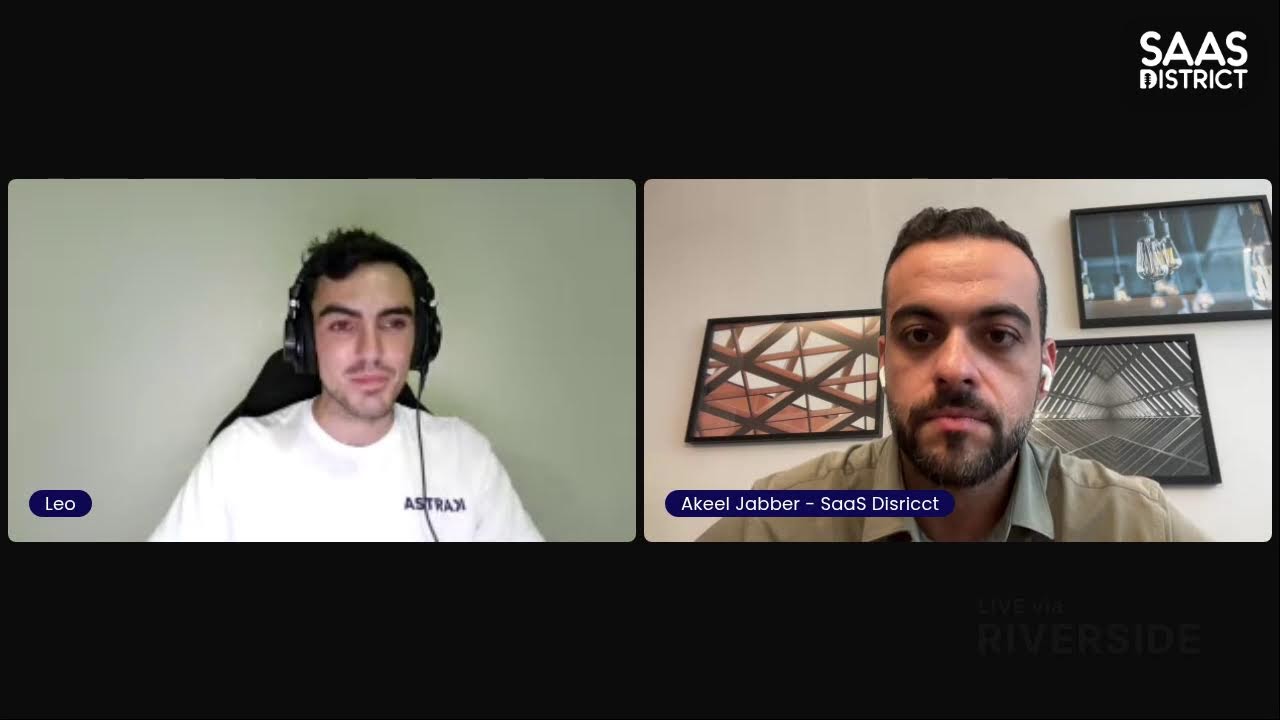
Leo Poitavin, founder of SEO agency Astraq, explains how generative AI is transforming search for SaaS companies. Traditional SEO isn't dead, but optimizing for ChatGPT, Gemini, and Perplexia requires highly specific product pages, detailed company info, and presence across podcasts, Reddit, and YouTube. He walks through a 12-month action plan starting with crawlability and ending with ecosystem-based authority.
Chapters
Episode, we'll be talking about why AI recommends your competitor instead of your SaaS. And today we have our guest Leo Poitavin joining us. Leo is the founder of Astraq, which is an SEO agency that helps ambitious SaaS companies build sustainable organic growth through SEO strategy, content production, and link building. Now, before launching Astraq, Leo led initiatives for SEO across international companies and helping brands improve their search visibility. as well as organic performance. Leo also shares practical insights on SEO and link building through his YouTube channel, which we'll link in the show notes. And he helps marketers and founders better understand what drives sustainable search growth. So welcome, Leo. Super excited to have you on the show today. Yeah.
Thank you, Akeel, for having me on the show. I'm really happy to be here to chat with all the SaaS owners and everything because it's like, yeah, type of business that I love. And so really to discuss about everything. And one, I think, note that you perhaps don't know, by the way, but so my main activity is definitely the agency, but on the side I have a second activity, which is a backlink marketplace, which is like a marketplace but really closer to the SaaS than to Amazon. So really interesting as well. And so definitely more on the agency side, but also SaaS owner.
Super cool. So super mixed in SaaS and agency owner. So best of both worlds.
Exactly.
So Leo, before you found Astraq, we mentioned you worked on SEO for many international companies, which then led for you to then build your own agency. Before we get started into the meat of the interview, can you share maybe a few lessons that you learned from some of the experiences that shaped your approach to growth today and how you approach SEO?
Yeah. So I think a few stuff that I learned when I was head of SEO in this big company marketing agencies and everything that I used to work before I set up my own agency is that first I was really performance-based. So I was mostly working in the gambling industry before that I do that. So gambling industry is kind of heavily regulated and there is a bit of the gray gambling industry, which I was often being in. So it's really performance-based because you cannot have a long-term view. So everything have to be performing on a day-to-day basis and you cannot hide behind visibility or kind of blurry walls that you can hide behind when you are in a normal agency. So it was a really big lesson about being competitive and performing on day-to-day as fast as possible. That was something that was really interesting and that was really important for me later to be focused on performances and to not hide behind, I wouldn't say lies because they're not lies, but just Just trying to make the stuff pretty. The second lesson I will say that I learned during all this time that was really valuable for me later is all different markets tend to work. So what I learned on French market will not be the same for the US markets, will not be the same for Japanese markets, et cetera. So trying to work on Italy, Japan, South Africa, like a lot of different markets, it teaches you a lot of different lessons and you understand that you cannot operate on every market in the same way because habit of consumption will be different, because algorithm from Google will be different, because A lot of stuff will be different overall, media landscape, et cetera, et cetera. So that was a big lesson as well that still is super useful for me on the day-to-day basis. And the last one will be that I started to post a lot on Twitter, then started to speak at a few conferences, then started to do some YouTube video on the side and everything. And I learned that speaking a lot about what you do and publishing content about what you do is really a good way to build some people following you, having an interest in your content, having an interest in what you say. And that's an asset which is really interesting in the long term. So that's also why now I'm sharing as much as I can on podcasts and everything, because that's like something that is super interesting that creates a good value for the people, I guess, and for me as well. So that's as well something that I learned through the years. I started that at the beginning when I was still a student, and I keep pushing, keep publishing, keep telling, even if that's like random stories of my daily life, what's interesting for people. And so definitely it's like, I mean, I think that's the 3 main lessons that I learned during my 5, 6, 7 years as a head of SEO in different big companies before to jump on my own adventure.
Love it. Now, a lot of people say SEO is dead, especially now with AI coming out. I don't know if that's true. So I'd love to hear, one, is SEO dead? And if no, now we have this new term, which is GEO. Maybe you could share a little bit what's changed differently today when it comes from traditional SEO link building. Does it still matter? Does SEO work or what's changed in this world in that space?
Yeah, I think one important thing is that everybody says SEO is dead since at least the last 15 years or something like that. But I mean, for once they kind of, I will not say true, but I don't see people searching in Google in something like, I will say, 10 years, most probably people will not be searching so much on Google anymore. And so I think a lot of stuff will be done via AI, definitely, and via most probably different way of searching and different way of finding good content and good solution and good providers and everything on the web. So I think there is some change definitely going on. I think it would be lying and it will be hiding behind my truth to be like, yeah, no, there is no change and everything. There is definitely changing. The stuff that changes that we used to be like we do a search on Google, we click different blue links, we you know do all the syntactical work and read everything and being like okay the solution that I think is good for me or the advice that I think is good for me is this one according to all of what I heard and read. And now what happened is that ChatGPT or AI overall is doing this job. You know, is reading the ten links that you have on Google because More or less what happened on AI when you do a search is that it's searching some terms on Google, picking a ton of different web pages, reading all of that, mixing and synthesizing all of that and telling according to what I know about you and what you told me in this prompt and everything, the good solution for you seems to be this one. You have also these alternate options and everything. So a lot of the job that was before the people's job of reading and everything have been delegated to AI, which is kind of the assistant now. And so there is a lot of decisions that before we were doing all stuff and now AI is doing for us and we trust a lot AI. So what we can see, for example, as data is that the leads that are provided by AI tend to close at higher rates, tend to close with a higher average basket and everything. And the source of acquisition overall is really strong. A few things that make it super complex is first, it's almost impossible to track exactly the volume of leads. that are coming through AI, where your brands have been recommended by AI, et cetera. So all the classic tracking, data analytics and everything is super tricky to do. And by tricky, I mean almost impossible. So generally you just have to be like, I trust that this channel of acquisition will be important for me and you have to jump in it. I mean, right now some people are in this situation where it's important for me. For most of the SaaS, I think it is really important because a lot of SaaS decisions are made with AI and everything. And the other side is like, perhaps it's not important right now for you, but it would most probably be important in 2 years or something like that. So better to prepare the field and to start to build some maturity and to build some recommendation in AI. Then we can deep dive into different topics, subtopics of SEO, how they are affecting, because I think some are really affected, some are less. So for example, all the technical aspects of SEO, is not so much affected because in the end you still need Google to crawl your website, you still need AI to crawl your website. So you still have a lot of stuff about crawling and indexing and understanding the website, rendering it, et cetera, et cetera. For content, definitely all the informational content that we used to publish, like 10 tips how to grow your SaaS type of content that is not really interesting anymore, doesn't really get so much clicks anymore. AI overview is stealing a lot of clicks. ChatGPT, people tend to do that with ChatGPT now. So all the informational content is naturally interesting, but a lot of new content open as well. So all the use cases you can do will be super interesting for ChatGPT. All the pricing, all the details, all the about us, all the details about the team, all your data, this type of stuff that ChatGPT will love. And for the link building, we can deep dive a bit later on into that because it will be some topic which is super interesting. Where we have an approach which is a bit weird for some people, but we use a lot of link building, classic marketplace and stuff that we used to have for SEO initially to promote GU as well. So we use all of that to do listicle on different websites to promote your solution. And generally that's one key element that tends to deliver the best results for us and for your clients, for our clients. So yeah, definitely link building for me is the one that is in its traditional way less important now than it used to be. But in the new form that I discovered in my way, it's the one that gained the best buff. So it's something that I do way more now than used to do before.
Yeah, I love it. Seems like you're at the cutting edge of what's going on, what's working, right? Things are changing so quickly, right? So I think nobody truly understands what works yet, but I think it's over time we're learning in these last couple of months. So You mentioned GEO, right? That's the big term that a lot of people are optimizing now, not as much as SEO. So maybe, Kishore, what is GEO? And then, you know, what— maybe help us understand, like, what makes brands consistently show up now? How do you stand out and show up in ChatGPT and Perplexity and Claude and other of these AI recommendation tools where maybe, you know, a lot of the competitors are staying invisible even though they're maybe running some kind of classical SEO strategy? And, you know, what's working?
Yeah, so GEO stands for like generative engine optimization. So I think that's the, the, the, you know, terms that people use. Some also use AIO, so like AI optimization or AI visibility optimization. Anyway, you know, a lot of different slang terms that come out from a lot of different countries and a lot of different, um, yeah, people tend to agree on different terms, but anyway, it's optimization overall for AI, you know. LLM and everything. So we will count in that AI overview in some way, which is like at the top of Google, the small AI summary that you get, that will count. So that's one which is a little bit different than the others. And you have as well AI mod that will be a little bit different than the others, which is like the new Google feature that Google will push more and more and more in the future years. And then you have all the classic LLM. So we'll say Gemini, we'll say ChatGPT, Cloud, Perplexity, all of the stuff that tend to do search for you in some ways on the web and to give you a bit of the synthetic way of all of that. So then the big question is like, why my brand is not coming in ChatGPT when I ask the best SaaS for accounting or something like that? And why it is always, I don't know, QuickBooks coming in there for that? So to understand that, the best is to understand how ChatGPT works. And I say ChatGPT, but I say all LLM because more or less they all work the same. So there is 2 big type of queries. On one side, we'll have the queries that are directly answered by the model. So for example, if you ask ChatGPT, how long do you need to cook an egg? It will tell you like you need 3 minutes. It doesn't need to go on the web to search stuff like that. It doesn't care. You will never be cited in that because it's not something that it will need to search on the web anyway.
Right.
The second part will be like the specific solution. So generally we'll be like, what is the best accounting SaaS for me because I'm a agency owner and I need to do my accounting and I'm set up in Thailand, so I need something which is reliable for that and everything. So that's really specific generally in terms of queries. But even if you need something a bit more short tail, let's say, you can have something which will be best accounting SaaS for the US in 2026. On this type of queries, because ChatGPT doesn't have all the answers immediately, he's like, I better search on the web to get the good documents, the latest up-to-date stuff. And then he takes all the documents that he finds on the web. Generally, when he will search for something like that on the web, he will search for reviews of the one that he knows. He will search for listicles. So typically, who has done top 10 best accounting SaaS, who has done review of the different SaaS, who have done VS page of QuickBooks VS other accounting SaaS, et cetera, et cetera. So typically he will have done all of that. He will do like, I don't know, 3, 4, 5 different searches on Google, take like a total 50 documents, for example. He will grasp, let's say, the 5 documents that looks the most reliable for him. And generally based on that, he will do his own listicle. So he will do his own list that will be for him the most reliable and the most interesting. And then because he took a lot of documents on the web, The big short answer for you is that if you want to be present on ChatGPT and to be present on different LLMs and to be performing in geo, the most important stuff is to live in your ecosystem and be promoted by the influential people in your ecosystem. So it means that if somebody is doing top 10 of your category or promoting some different apps of your category, you need to reach out. to this guy to be sure that he will be included in this top 10 as well and do that for as much as possible, top 10. And generally at some point you will get out in ChatGPT. One of the complex stuff is that, for example, if you're a CRM, being in the top 10 of the best CRM is not easy. So perhaps some categories sometimes you need to niche down, perhaps being in the top 5 best CRM for the woofers, that's okay. That's something that is doable. You need to niche down and to climb up the classic stuff. Like being the best CRM in SEO was really complex. Being the best CRM in GEO is also complex. So yeah, a big overlap between both. And generally it's something that with a lot of work on the ecosystem, you generally end up by having some stuff citing you.
Yeah. I think it comes down to really being very specific right now. I think instead of previously where you can be more generic with your content that you created, And you've gotta be very, very specific because people are looking for very specific use cases for their own use versus a more generic answer. Yeah.
And I think that something which is really interesting when you're saying that is that before people naturally, or me personally naturally, I would not have searched best, for example, best accounting SaaS or best CRM, especially for SEO agency, but an SEO agency that does between $1 and $5 million a year. And you need to have a lot of details to have something that's really suited to your use case. And you can be searching by industry, you could be searching by overall size of team, by a lot of different ways of searching. And so that's quite complex initially. And when you used to search on Google, I was just doing my search like, yeah, I need the best CRM and I will read a lot of stuff and I will make my mind. The good point with ChatGPT is because it has all the history or all the LLMs. And by the way, because it has all the history that you are doing when you are searching for something, He knows already all the context. So he knows already the industry where you are working on. He knows already the country where you're based. He knows already the size of your team, et cetera. So when he will do the research, he will automatically take all the stuff and do some really specific search. So generally do super specific search, more specific than people used to do. So typically I really do for a lot of clients some super specific pages because I mean, if ChatGPT is doing specific searches, that's in one of your ICP. We can do specific pages that will be interesting, that will be picked up by GPT and way better chances of ranking overall. And so yeah, ChatGPT will do all this work. And even if you are more general and you have all these details in your general description, GPT will be able to pick them, et cetera. So the good point is that it will put you at the top. But the bad point is that if you're already the first one in your category, and you're just like super generalist and trying to address everyone, sometimes some outsider will come and steal your place because ChatGPT will be like, yeah, no, that's more relevant because he told me that he's specialized in SEO agencies. So I'm picking this one definitely because my clients, the guy prompting me is an SEO agency. So yeah, I think specificity is really something that was underrated and will be way more important in the future in the world of LLM.
Absolutely. So if I'm a SaaS founder right now and I'm looking to adapt my SEO strategy, right, I'm thinking about technical SEO. My website is optimized, it's fast, it's efficient. I have my on-page SEO optimized. I've got my title, my description, everything optimized for the keywords that I'm looking to rank for. And then from there, I'm looking to create content, right? Which I think is the big piece here. We're running a traditional SEO strategy. How should they think about maybe adapting or shifting their growth strategy as they're being shifted towards discovering on the search engines for AI? Is it their content? Are they writing content similarly? Because previously you're writing, let's say, a 2,000-word blog article and you're just trying to rank for certain keywords or help me think through if I'm a SaaS founder how to make that shift.
Yeah, so I think the first thing is that what used to be SEO have a really big lap with GEO that we're speaking about. So generally overall, if you're really rocking it in SEO, you generally have really kind of great results in GU as well. So that's first, all the stuff that you have done in the past and all the strategy that you had was not wasted and it's something that you can keep doing and it's not waste of time. However, if you want to optimize stuff a little bit better and a little bit more, I will give you a few advice. First advice is that it's better to not focus too much on the informational content that you yourself, you will search on GPT or type of stuff that people will not search anymore. So some of them, they still have volume of searches that you will see in Ahrefs and Semrush and in SEO tools. But between AI overview that takes a lot of space and the CTR that overall is decreasing and the volume of search that overall is decreasing on informational content, generally it will not be something that I will invest in the future thinking about an ROI that will come in 2 or 3 years. Because it's stuff that is global overall on the decline. Second thing is that there is a lot of bottom funnel pages where you need to have a lot of content so you will be able to influence the last touchpoint that ChatGPT will come to check. So typically on a SaaS, I will tell you the most important pages that I do every time for SaaS that I work with. First thing is that I do the best of the industry. So typically best, I work for example with a SaaS which is doing like AI girlfriend. So best AI girlfriend, what are the best? Number 1, generally my clients, number 2, et cetera, et cetera. So I will do this type of stuff to be sure to have my own listicle and to push my own narrative about my own brand and everything. Then in terms of bottom funnel stuff that I like to do as well, there is all the review of different competitors and clients. So typically I will do review of my different competitors to be sure to push a little bit of my narrative around that and to be like, yeah, they are really good for that, but they're not so good for that. And for that generally is the one that we are serving and everything. So that's something where I would try to create my own place into that to be sure that I'm saying that I am the most relevant for certain niche and certain topic. And even if you know some other brands and we will surf on these brands by creating all these reviews, I am a good alternative to that. Speaking of alternative, alternative is really good keywords as well. So alternative to a brand which is really super known and everything, it's something that's really interesting and tend to bring good value in SEO overall. And that's typically the type of keywords, the best, the review, the alternative, and the VS as well. So my brand VS my competitor's brand or something like that, that will be the most important in SEO and that will bring the most value in terms of conversion rate, number of visits, et cetera. So all this type of keywords generally, they're the one bottom funnel that I really like to do. Then one thing which is really important as well on the main page, I will say, is that we have a really clear about us. We describe the team clearly, we describe the offers clearly. If you hide your offers and your price behind a paywall, it's something that really turns on the AI overall. And that will be super complex for them to understand. And then I will try to have super clear details about all the data of my company, the technology that I use, et cetera. So as much details as I can generally about, and the process and the team and legal stuff and everything. So more details you have about you, yourself, your offers and everything, more it gives clarity to the AI to be able to dive into your data. And even if users were not doing that so much, AI is doing it a lot. So that's something that AI tends to do a lot and that will be super interesting. And then what I tend to do is try to focus as much as possible bottom funnel keywords. And the last one I will say in terms of content is typically all the use case as well as type of pages that AI will love and that will dive into and everything. And trying to decline out of, how to say that? To differentiate all the different features that I have to have landing page specialized by features and then to have landing page by features plus ICP, for example, et cetera. So trying to be more specialized than I used to be in terms of features, trying to be more specialized than I used to be in terms of what I'm serving, et cetera. So like that, you can multiply all your pages. That will be the interesting one. on your ICP, the size of company you're targeting, the industry you're targeting, et cetera, et cetera. And with all of that, generally you can increase the size of your website without betting too much on the informational content that will tend to decline in value where all the specialized pages will tend to increase in value in the following years.
Love it. That's super helpful. I mean, if you have all those pages and you're able to set that up, I mean, you're golden. Yeah. A lot of people don't have that. That is a lot of work. Yeah. Yeah. And that's why the agency's probably being super successful and I'm sure a lot of people use your help. So I understand. So one part is, okay, I'm a SaaS founder. I'm now starting to have the strategy of building my content very specific. I have this massive list of content that I have to now create. But the other piece of that from understanding is building authority, right? You can have all the content, but if nobody knows your domain exists, If you're not relevant. I imagine building authority has always been important for search rankings. Now in AI-first internet, GEO, what does trust and building authority actually look like? And what do the link building strategies look like there?
Yeah, exactly. So I think that's really something that's, I will not say is really, it's shifting definitely. Where authority before used to be really about links. More backlinks you have, more authority it shows to Google, and more it tends to be like, oh yeah, this guy have a lot of authority because a lot of other sites are linking to them. That's a lot of backlinks, and that means he's trustworthy. So that was really the most important stuff, I will say, in the past, in the last, I don't know, 20 years, something like that. And since 2023, it started to change a little bit. So I will say that a new branch of authority tend to show up. Which is like the brand search and brand volume and brand knowledge. So how much people know about your brand, how much people come to your website by searching your brand and everything. That was something that started to show up, I will say, in 2023, end of September 2023, when it was the helpful content update in SEO. We started to see— so backlinks was not ineffective. It was not not effective anymore. It was not like You cannot just overdo backlinks like we used to do, and it will not patch all the weakness that you have. So now you need a bit of brand notability as well, more than only backlinks, more than only one-off stuff. So you need to be more complete and more 360, I will say, than before. Then the last stuff is also in the age of AI. So brand knowledge and brand search and brand volume and brand stuff around your brands and how much time they're searched by people and everything was something that was really Google-focused, I will say. And then LLM took, I would not say a different approach, but kind of like funny approach that we didn't saw before. So the way that they did it is that when you search for a solution, so I search for the best accounting stuff, generally what they will do is that they will search themselves for the best accounting stuff and they will search like some signal of trust as well, but generally they just extract the top 10 of Google and they will review like 2 or 3 different top 10 goals. So you will have, I don't know, 20 results, um, and they will review all of that and it will be like, oh yeah, the most important, the most interesting one is definitely this one. So now when you want to show up and to have like some authority in AI, generally the interesting thing will be to be in this listicle, to be into, you know, the easiest way to do it is like Type, you know, best whatever service you're providing. So for me, for example, is best SEO agency. And then I check all the listicles that there is in the top ten, and I'm like, yeah, man, you know, I'm one of the best. You know, perhaps I'm not the number one, but I'm not out of number ten. You know, so please cite me. Admin that. Generally, it will be something that people, you know, will sell. So what I try to do to not be the one buying the stuff, I will tell them like, yeah, I can, you know. I, I think I'm not a really bad one. I know your time is valuable and you will take some time to edit the article. So yeah, I'm not paying to be in this article, but I got paid for the time that you will be editing the article, you know. So generally I play like that. And yeah, some people they will be okay to change the article, some people they will not. Generally what I'll try to do as well is to set up, let's say, some partnership with some other people. Like I put you in mine, you put me in yours, etc., you know, type of stuff like that. Um, and like that you can exist and leave in some different articles that will be ranking well on Google. So it will provide you links from Google firstly. So that's really good. And secondly, that's the one that will be picked up by LLM. The last part I will say is that that's all the ones that are currently ranking on Google. But I mean, before this one exists, nothing exists. So at some point you can create as well to start to rank onto that. So what we are doing a lot right now, and that's the thing that we're doing the most, and that is is working the most for us is to go find good media. So I will give you examples, but generally we don't go to check the biggest media or whatever. We would check niche websites that will be interesting, have some few thousand visitors and everything, and that we see have a lot of SEO potential overall. And we will ask them, and last part obviously, which is the most important one, is the one that they're selling backlinks already via different marketplaces and stuff like that. So we will contact them and being like, oh yeah, I want to feature a guest post on your website and my guest post will be that. And my guest post generally is something like top 10 best SEO agencies, top 10 best SaaS in accounting, top 10 best AI girlfriend stuff. And so then generally you can publish this article. If it works well, if it take off, if it catch up, then what happened is that you have the article ranking over on Google showing up, your brand showing up in ChatGPT. Thanks to that. So that's really something that we're working on and that tends to have the best results. The last stuff I will say is that in terms of building authority as well, one place where there is a lot of citation that is really interesting is Reddit. So a lot of people are wondering about like, should I be on Reddit or can I influence people speaking about me on Reddit, et cetera? Generally what works well is that if you have an incredible product, people will speak about you naturally on Reddit. But sometimes it's quite hard and Reddit sometimes will be tricky with some hard moderators and everything. So what I do generally is that I have some partner agencies that are doing Reddit posting for me as well. So they can just, I give them any thread and they're able to pull out a good comment on that and to be sure that it would not be marked as spam and everything. And yeah, if you want to do it by your own, the easiest generally is just to be super honest and super transparent. Being, for example, yeah, I'm the owner of this solution. We do XYZ, I think, and try to promote as well other solutions to not be sure to be like too much autopromotional, you know, and to be like, yeah, for example, this solution ABC, they are also interesting and they can solve your problem. So I will say generally to build authority in SEO, then in geo, that was the whole process. And yeah, a lot of interesting things. I think the geo right now is a bit like What I like to say to my team is that GU is like, when a lot of old SEO used to speak to us about SEO in 2004, they're like, yeah, it was far worse, so easy to rank and everything. And I feel that right now GU is a little bit broken and a little bit easy on some more easy queries, obviously, where you can still manipulate the algorithm completely in few guest posts and few hundred euros. So yeah, I think that's how generally we build authority in LLM right now.
Yes, I imagine that's why you have your marketplace, which you mentioned, which is pretty successful. People are looking for quality authority links, right? Yeah, exactly. Like podcasts as well, like this, I imagine also are pretty helpful as well, right, for your brand authority?
Yeah, exactly. So definitely YouTube content is really taking off through— so that's where we enter specifics. YouTube content is really interesting for Gemini, for AI Modern, and for AI Overview. That will be the 3 Google stuff and Google tend to use a lot of its own platforms to promote its own stuff and its own content. So typically all the YouTube stuff is really interesting in the 3 ones. I mean, in the others, ChatGPT, Publixity, Claude, it will be way less interesting internally and it will tend to have less reach and everything. I think that podcast is really interesting when you try to understand what a person is doing or who is a person or type of stuff like that, because all the podcasts that you appear tend to leave a lot of breadcrumbs. And that tends to generate a lot of details of stuff and a lot of different questions. So you can define clearly about the person. So typically I think if you are kind of a solo consultant and you need to build your own brand and your own personal stuff in terms of geo, it will be super interesting to have some podcasts sometimes as well. If you're doing a really good video, for example, on YouTube and it's really like taking off in terms of number of views, of retention, everything, it will rank really well on Google as well if your title is kind of Google optimized. And so if it ranks really well on Google, sometimes it will be picked up as well by other LLMs. So like Perplexity, GPT, and Claude. But most of the time, YouTube is really interesting for all the Google AI. And that's really a type of stuff that if you are really focusing on Google AI, it will be interesting for you. And you can do as well one thing which is interesting. One thing which is crazy is that even a really bad YouTube video sometimes can dominate rankings because it will need some social media stuff at some point and it will try to find what they can and YouTube can be one of that. So definitely even a bad YouTube video and I will give you an example, but how to choose a SaaS in accounting will be something that can be, or top 10 best SaaS in accounting on a YouTube video. Even if that's not the best one, it will be interesting to publish that just to try to check this slot in some ways, check this mock and it's something that works well. Media, social media stuff that is really interesting is TikTok, surprisingly. But yeah, definitely YouTube I think is more interesting than TikTok. But if you are going more toward B2C stuff and products and everything, TikTok is really important for geo and for LLM. And we can see the different sources that are taken generally on all the personal stuff. LinkedIn is the leader for sure. As soon as you're asking questions about person, if you are on more like I need to choose something in B2B, et cetera. Generally Reddit will be the king. And as soon as you are on the other random stuff, TikTok tend to be really getting good results overall, surprisingly way more than Instagram and everything. Some stuff will be in Facebook groups as well, but to be honest, TikTok is I think leading on the social media short-form video stuff.
Yeah, this is super helpful. I think lots of good information here, a lot of content for people to digest and and try to apply it for themselves. So just kind of wrapping everything up and kind of overview before we get into the rapid-fire questions, Leo. Um, so for the last question, for SaaS companies, founders, they're looking to improve their visibility, you know, without relying heavily on paying for paid acquisition, which is, you know, a big channel as well. Give us some practical steps. What should they look at? What should they create? What should they take over? What should they focus on for the next 12 months? What do you tell them?
Yeah, generally what I tell them is that First, you need to be sure that technically your website is easy to crawl, easy to index, easy to whatever, everything. So that's the first step because it's really something that, especially in SaaS, because SaaS, they are developers, generally the people that do SaaS. And even if they are doing vibe coding with AI, AI does a lot of issues sometimes in developing websites and generally having something like normal CMS sometimes, even if that's a bit boring and a bit less beautiful, it will be better and easier for the Google algorithm to crawl and to index and everything. So generally what I tell them is first, be sure of your technical base. You don't need to be 100% perfect and to have the best website, but be sure that your website is indexable, crawlable, and everything. Then second part will be, be sure to, on your content, first do a full audit or try to develop your own content and your own story to tell your story, to talk to your team. To have a lot of details about the people working in your company, about your methods, about your works, about your clients. Try to explain as much as possible about the company because AI loves to find a lot of data about the company. So try to push, I will say, generally one new page per month, giving more details about the company, more details about the clients, more details about the way that you're doing, the way that you are, why you are doing that and everything. If you have awards, push that. That's really good. If you have social engagements or ecological stuff, push that as well. AI love that as well. So go into that. Then what I will try to do is to develop as much as possible on the different features to have specific pages for different industry, specific pages for different ICP, for different size of companies, et cetera, to be sure that everyone that is doing a prompt and AI is redoing the prompt according to the context can be able to, based on that, find the pages that will suit perfectly the needs of your company. So you can, you know, generally what I do is that I base myself on the existing clients that I have and I try to extrapolate from that more than to go from SEO keywords tool volume that I have and to try to, you know, being like, yeah, I will make it match. Better to start from the existing and to be like developing and expanding and everything. Then the last point will be, you know, live in your ecosystem. So try to be promoted, try to have your clients promoting you on Reddit, try to have Try to have your partner promoting you via listicle or via other ways. And the people that are doing listicles and everything, try to approach them, to chat with them and to be like, yeah, is there a way that I'm included into that? Can we do some exchange? Is there a way that is both beneficial for us, et cetera? So try to live in your ecosystem and to be cited by your partners and everything. And generally, if you're really deep into your content, have a site which is technically good and you're trying to do the best for your users. and you are excited by your ecosystem, it's a win generally. That's something in the long term that makes you win.
Love it. There you go. So if you guys are listening in and looking to set up your strategy, there's a secret. But if you need help to execute it, Leo's the guy to reach out to. Love it, Leo. Ready to shift gears and do the rapid-fire questions?
Yeah, ready for that.
Yeah, let's do it. All right. Leo, what's one activity you enjoy outside of work That gets you into a flow state?
I do wakeboarding on the Saturday morning, every Saturday morning, and that's something that, yeah, you're definitely in a flow state. You cannot be in anything else than a flow state because if you are not in a flow state, you just mistake and splash in the water. So definitely wakeboarding.
Yeah, I love it. What's one piece of advice you wish you had known, and if you can go back, you would tell your, your younger self, let's say your 20-year-old self?
Yeah, I will say that one big stuff that I was really wrong about is that the importance of brand. So typically when I was younger, I was really focused on performances, like I said at the beginning. And so I was really thinking that brand and design and everything was crappy and useless. And I'm realizing a bit later that it's definitely not crappy and useless, and that's most probably the best asset that you build through time. So yeah, I will definitely tell myself that brand is the way to go and it's not a waste of time.
Absolutely. Leo, what's some of the biggest challenges you're currently facing in order to continue to grow? What's holding you back from growing your agency? Meaning what keeps you up at night these days?
Yeah, that's a really interesting question. I think that there is a few things. First thing is that because I'm living in Thailand targeting the French market right now, mostly, most of my customers are French, there is a big stuff with the time shift. And so I'm kind of limited by my own schedule. So happily I have a sales guy coming soon and hopefully it will help me. But yeah, I mean improving my lead acquisition channel, which is already good, but I need to improve that a little bit to get more volume. And on the other side, starting to delegate all my sales channel will be the 2 big challenges I think for the end of the year. And challenge of next year will definitely be able to delegate a bit of delivery to have a head of SEO guy that can help me and everything. But yeah, I mean, I'm doing that step by step, you know, every month improving a little bit.
Love it. Step by step, getting there. Leo, who are or what are some of the best 3 resources? These can be books, mentors, or people you follow in the space who you'd say have been most instrumental to your success over these last few years.
I will say in terms of book, the book that I've been the most influential and now I'm like, yeah, trying to get at peace with it is like How to Make Friends and Influence People. I think that's the best book that I read and that have the most change on me. In terms of people I follow, Alex Hormozi, I think is definitely the best guy in terms of marketing and sales and everything. That's the most interesting. And the last one will be a podcast, My First Million, my favorite podcast about business. Definitely really interesting, really more about entertainment in the end than business because, man, I never act about anything that they say. But that's something that I like to Yeah, absolutely.
Y'all good resources. What does success mean to you today, Leo? Whether that's personal, business, financial, life, I guess there's no right answer.
Yeah, I think that's a bit of— first, a bit of everything, you know. Now I see people that have a big success financially but are like not living in the way of life, I mean, that I want to live. So it's something that doesn't really interest me anymore. So typically, I mean, I want to build my family together, be, you know, with my girlfriend, to marry her, and to, you know, be with my dog, have some children, uh, being away financially and, and being nice and, and being able to work because I want to work and then because I have to and everything. So generally it's just about like, you know, having enough money to be financially independent and having my family supporting me and being sure that everything is right, you know.
Exactly, love it. And keep wakeboarding.
If I can keep wakeboarding, that's the most important thing That's number one for sure.
Keep that, don't forget that. Yeah, that's awesome. Leo, this has been great. I really enjoyed this. Love everything you shared. Where can founders get in touch with you, learn more about you and your company Abstract if they wanna learn more?
Yeah, definitely. The best is LinkedIn, definitely to, you know, be in touch with me and everything. You can find me on Twitter as well, definitely. And yeah, but of all, the easiest will be LinkedIn and the website of the company as well, where you'll find a lot of details. Made for human and AI. So yeah.
Okay, awesome. We'll put those links in our show notes. Make sure to reach out, say hi to Leo, check out his agency if you guys need any help with, and as well as the YouTube channel for any tips and suggestions for your SEO strategy. So thanks again, Leo. Appreciate everything you shared today.
Thank you a lot, Akeel. It was really nice to talk to you.
More from Akeel



Get a mentor as soon as possible — and make sure it’s a mentor in your space.




Keith Gillispie: Why Most New Investors Fail & How to Avoid the Common Traps #250 | SaaS District



