Revealing The Future of Notion With Notion’s Co-Founder!
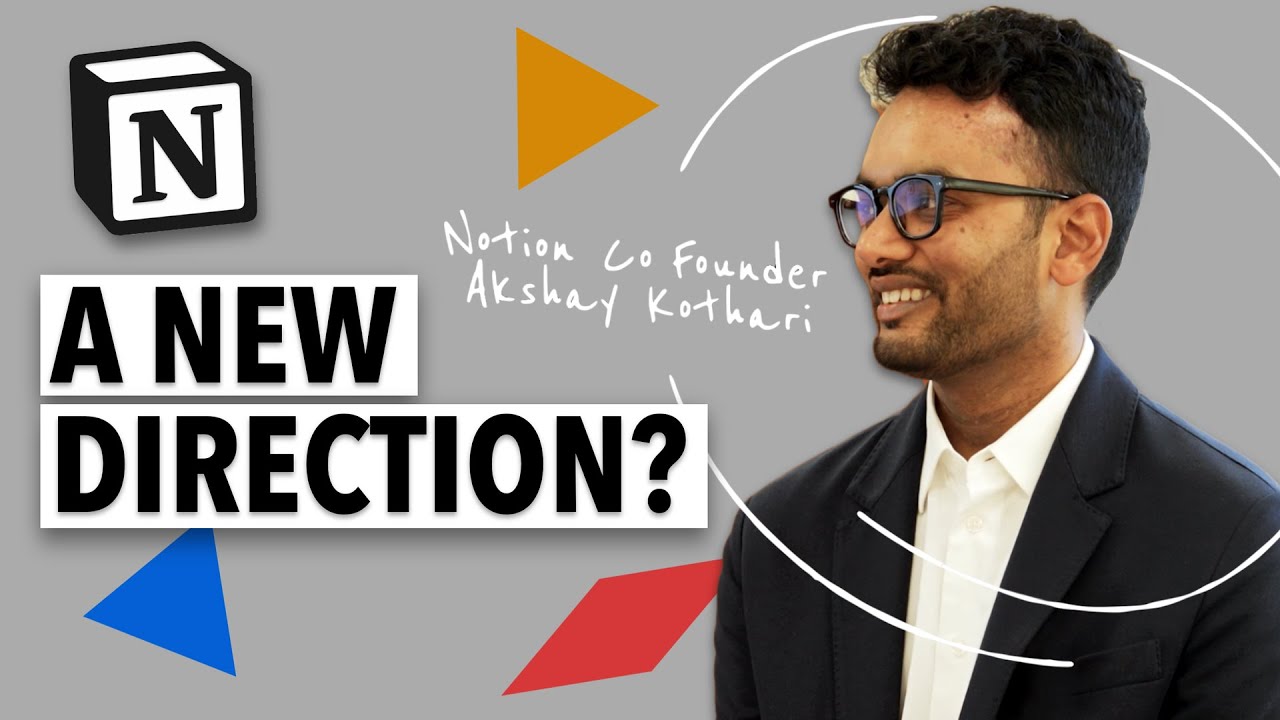
In this interview recorded at Notion’s Dublin offices, host Simon (Speaker A) and a second interviewer (Speaker C) sit down with Notion co‑founder Akshay Kothari to discuss the company’s origins, product philosophy, recent developments, and future direction. Akshay recounts his path from a Stanford engineering master’s student to an early investor and later founding partner of Notion, highlighting his chance meeting with Ivan Zhao in 2011. He explains Notion’s core vision of “software to build software,” a creation‑first mindset that harkens back to early computing pioneers. The conversation delves into Notion’s “building block” metaphor, recent primitives such as charts and the upcoming calendar, and the company’s focus on expanding the ecosystem while keeping the UI simple, performant, and aesthetically minimal. Akshay stresses the need to lower the activation energy for creators, positioning Notion as a front‑end platform that lets users prototype ideas quickly. He also touches on community‑driven growth, the role of templates, and the recent acquisition of Skiff, hinting at future integrated workspace ambitions. The interview concludes with advice for new builders on avoiding overwhelm, starting with simple note‑taking, and fostering a bias toward action.
Chapters
Hi, it's Simon, and today something a little different and a little special. As Notion prepares to host its first ever in-person summit, Make with Notion, in San Francisco in a few weeks, I had the chance to sit down one-to-one for a rare talk with co-founder of Notion, Akshay Kothari, at Notion's offices in Dublin, where he opened up about the past, present, and future of Notion, my personal favorite all-in-one productivity tool. Now in this video, I share that interview along with a little look back at Akshay's amazing co-founder story and some insights into what might be coming. We explore what drives this successful entrepreneur to leave behind a $90 million acquisition and bet everything on a tiny startup with a bold vision that then shapes itself into Notion, the productivity powerhouse it is today. Now if you're interested in the future of Notion, what might be coming next So if you're looking to get into that platform, or simply want to learn from a remarkable founder like Akshay, this is for you.
Best part of the job is to meet you all and learn how you all are building. And we have some exciting, fun things to come to really support that more.
So maybe we could kind of jump straight into what was it about Notion that got you excited?
The most exciting part was clearly Ivan and his passion for it. And if you meet him, I think you you quickly get a sense for how this is his life's work and something that he's been thinking about for so long. And then I think there's the idea itself is oddly like something that has existed for decades. I think you go back to like the '70s and '80s, the original sort of computing pioneers very much thought of computing as this creation device, and yet most people are you know, using it as a consumption thing. This idea of bringing it back to this original idea of enabling creation in the world, enabling everyone in this world, every knowledge worker to essentially create software, was truly like a big idea. Essentially software to build software. I thought that was truly inspiring.
Akshay's story begins at Stanford University where he was pursuing a master's degree in engineering. But then came a pivotal chance meeting with Ivan Zhao that changed everything.
So I met Ivan in 2011. I found him on Hacker News. He has just moved from Canada to the Bay Area, and he was looking for his first job. So I reached out over email, cold email, 'cause I was trying to hire a designer for my first startup, Pulse. And so we interviewed him and we extended an offer. He ended up joining another company, but we stayed in touch. 2 years from then, he was starting Notion, and my previous startup was acquired by LinkedIn. And so I ended up investing in that first round of Notion in 2013.
Initially, Akshay came on board as an investor, recognizing the immense potential of Notion's vision. But it wasn't long before he became a founding partner, drawn by the chance of building something transformative from the ground up. Under Akshay's leadership, Notion Labs has experienced rapid growth. From a small team of engineers and designers, the company has exploded into a major player in Silicon Valley, with millions of users and valuation in the billions. Notion is now used by individuals, small teams, and Fortune 500 companies alike. But the secret to Notion's success isn't just the product, it's the community.
It feels like a collaboration when you first log into Notion. And I think that's what got me really excited is there's that sense of liberating people to do what they want with this ubiquitous set of tools, I think, as it's often described. But what I'd really like to know, first of all, is, is it's been 6 years, it's developed hugely. I know you've rebuilt it, you've done so many things. So looking forward in kind of a few years, what would you love to see Notion be?
In many ways, we're sort of going back to the original goal of sort of enabling this next generation of builders. I also actually think like we took a bit of a detour from that and became more of a focused solution like note-taking or project management or knowledge hub as a way to get people to actually use the product first. Now that we actually have the people, we actually have the ecosystem, we're going back to the original goal. And I think the way we're going to do that is really listen to a lot of builders in terms of the new scaffolding they want or the new primitives they want or the new power they want and really just enabling those primitives, right? We talk a lot about Lego as like, you know, we're sort of like the Lego of software in some ways and we are like the building block company. It's like people will build like castles and cows and houses with it, but there's like always this new functionality that we could introduce as a new building block. I think that part is probably the most exciting part. So for example, this year we launched charts Enchants is such a fun new building block, and we actually spent, I don't know, something like 9 months on it. It's a building block that truly unleashes all the personal use cases. People are like using Notion for their gym tracking or their habit tracking, but then it's also being used inside companies in terms of like task management and visualizing all the different objectives people have inside the company. And so how do you build a primitive that actually like serves both of these different use cases? And does it well. I think the next few years I'm excited about all these different primitives enabling the kinds of things people want to build in this world, and then us providing a platform where these things can be also distributed around the world.
I love this building block term. It's actually used slightly differently in a theater company that I work in, and we talk about building blocks actually as the steps for learning. So I think what I love about Notion is it felt— I felt really at home with it. For the same reasons, because you're enabling people to make what they need or what they might not realize they need, but also that you're helping people up the ladder. I also hear from my users they can easily get overwhelmed with start— with getting started. What would your advice be to start using Notion?
The more building blocks you introduce, the more types of things you can do with it. And at some point, if it's too many building blocks, you start to feel like, wow, like I'm a little bit lost or overwhelmed. Like, what exactly am I supposed to do here? And I think there's a little bit of that in Notion, and I think that's primarily on us. Like, we need to make it easier for you to like learn from like the basics to the, you know, the expert level. In many ways, like the simplest unit of work is taking notes and the medium that, you know, we used to have is just pen and paper. And I hope Notion can be that. Sure, it can do all these different things and it can be used for all these different complex workflows. But the starting point is, you know, really being able to jot down what's on your mind. and do that every day for years and then be able to reflect back and really, you know, make sense of it all. I think a lot of people think of Notion as their second brain, which we love because it should feel like that. It should feel like it's giving you a lift, it's giving you all this power by doing something very simple, which is taking notes every day.
I totally agree. That's what I've really loved about it is that you can just start by adding a title, adding a checkbox, writing something down, adding an image, adding a video, and then when you discover databases, The whole thing transforms, I think, and it suddenly opens up.
I was particularly struck by Akshay's focus on simplifying the user experience and UI in Notion. And despite the platform's broad capabilities, he's emphasised the importance of making the feel and look of this thing as intuitive and accessible as possible.
I've noticed a really interesting shift recently from you. We've started to also see things like Notion Calendar starting to integrate, and I'd really love to hear what your perspective on that is. It seems like there's a focus to offer Beyond the simple starting point of the system, other ways to interact with Notion. Is that a direction that you are taking?
You know, Notion's always been known for its quality and craft and few choices. It's almost like it should be impossible to make something ugly in Notion. It's always been like a philosophy we've had. A push this year has been, you know, really focused on performance. You know, obviously I'm very proud of all the new things we've launched this year. But I'm even prouder of the fact that we've reduced the load speeds, we've reduced the complexity in the product, we've made it simpler to sort of use Notion.
His vision for Notion is not just about adding more features, but about refining the ones that matter, I think, ensuring that users can accomplish more with less effort.
In many ways, the internet has sort of made it so easy for people to create software and distribute software. The part that I think is sort of like made us less productive is that we now live in this like sea of specialized software. I have an app for like, you know, taking my notes. I have an app for this and for that. And so suddenly, even for you as an individual, you don't know where things are. The problem is even worse for companies. And so I think the pendulum has to swing back to fewer tools so that your life is not fragmented in all these different ways. I think we got to go back to like the general purpose software that can actually do many things in one place.
Walking around Notion's offices, it makes a lot of sense why Notion is such a kind of minimalist, essentialist piece of design. And it's really satisfying. Ivan has personally curated every object that goes into the offices. He clearly seems like someone who loves a bit of classic design references from Eames to Wegner, Rams, and a bunch of other timeless tools and design classics were everywhere, I have to admit I felt at home. So let's continue with the interview, but if you are enjoying this video, make sure to press the old like and subscribe button below. If you're interested in taking your Notion journey further as well, make sure you jump over to bettercreating.com and check out my celebrated collection of complete Notion Life OS templates to manage all of your life in one place. And on that note, let's talk about systems. So Akshay also talked about the idea of building an ecosystem. He mentioned this word a couple of times, and to me at least, it seems like Notion might be broadening its toolset in a way that could be closer to challenging tech giants like Google and Microsoft.
We still want most of the software consolidated into the core Notion product, but, but we're also realizing there's these new surfaces like the calendar and and other areas that I think we can probably invest in over the next 5, 10 years. We hope that these products will also be like deeply integrated with each other that you're not able to find with the current productivity suite.
Well, there's a cheeky question. I noticed that you acquired Skiff. Is there anything you can say about that?
Yeah, super excited. I think there's a 12-person team. Skiff, Andrew and Jason were the founders. They essentially built like the whole suite and they did it in, in in a very elegant way. It was actually the product— I used to use the product quite a bit and was always a big fan. And they've been hard at work working on something new internally. Can't tell you what exactly it is, but essentially we start from scratch and build something new internally inside the company. And we're excited to roll it out to everyone.
That's exciting. It's nice to hear you. And, you know, you mentioned ecosystem, and it does feel like that is growing a little bit.
So look, I have to say, all this leads me to speculate personally that we could soon see Notion pushing into new areas of productivity software, creating a more integrated workspace where users can handle everything from maybe document creation, project management, to, I don't know, email and communications even, all tailored into the unique needs. What do you think? Could it come?
I guess my, my last question is, what have you learned that you would share as advice to someone else starting? To make something.
One of the things that I'm hoping that we can enable in the world is actually just reduce the activation energy to do that. Many people have all these different ideas in their mind, but there's this like almost like a barrier to do something about it. Like, how do you have this bias towards action where I'm not just thinking about it in my head, but I'm actually doing something? I'm creating a prototype. One of my dreams for Notion is to essentially become this like front-end platform where you can just come in with your idea and you don't have to think about anything else because we give you all the building blocks and you can essentially put it all together and create something that's working in a matter of minutes. Now you may still choose to build your own product separately, but hopefully we can give you enough building blocks to at least prototype what that is. Maybe you get enough feedback back to sort of figure out if you want to take the next step. And so hopefully Notion really sort of enables enables you to take more bias towards, you know, action for some of these ideas you have in your head. And if we can make even a small dent there, that would be incredible forward.
Well, thank you so much for spending time. Maybe in a couple of years we'll have different things to talk about.
Of course. Thank you. Amazing.
So look, I'm clearly biased. I'm a big fan of the software, and I'm really enjoying having a little bit of a say in where it's going. It was great to meet some of the developers in Dublin that week. The speed of Notion's rise is nothing short of extraordinary. From the beginning, Akshay and Ivan have focused on making Notion feel accessible, friendly, and human, and they've cultivated a global network of users who aren't just customers but collaborators sharing templates, workflows, and ideas on how to make the most of the platform. This approach has fostered a really inclusive and creative culture that puts people like you and me first for the software. So I hope you enjoyed this unique insight into Notion and its future, and make sure to get subscribed and comment below with your reaction to all of this. And if you want to get started or even jump the learning curve a little further with your Notion setup, check out these videos here to tour how I'm using Notion daily to simplify my life. And do make sure you get over to bettercreating.com for my full template collection and download something. Maybe I'll see you on the next one.
Bye!
More from Akshay
"AI Should Bring Us Closer Together, Not Make Us More Lonely" | Akshay Kothari Co-Founder of Notion


Business used to be go karting. Now it's Formula 1 | Akshay Kothari (Co-founder of Notion)


Akshay Kothari: How Notion Has More Money Than Ever & Why Startup Fundraising is Broken | E1203
