From the Founder | Alain Readman Valiquette, CEO of Accelerator App
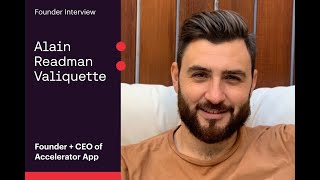
Alain Readman Valiquette built Accelerator App to automate the work accelerators do managing startups. He talks about the product's data integration features and why he started the company to solve problems he saw firsthand.
How did the problem become obvious to you?
Yeah, yeah, sure. So I used to run an accelerator in Montreal, Canada. And so, you know, pretty classic stuff. You experience a problem firsthand, you try to find a solution that exists. Can't find it, and so you build it. Yeah, yeah. So that's how I became obvious. You've got people that need tools because they don't know how to do it and the tools sort of help them in that process. Right. So it's part tool, but it's also templates and you know what's important and all that stuff. The other interesting one is often the ones that are going to be in for second, third year, where they're ramping up, they're starting to feel the pain a bit more acutely and now they're thinking about how can I scale my operations? Well, there's a bunch of stuff I do all the time. How can I just have a tool that allows it to repeat itself without me having to rebuild everything from scratch? Or when it comes a time where they're thinking of scaling up their operations and therefore they need more financing and then financing will require more reporting. And reporting is hard to get from the previous sources of data where, you know, things were in Airtable and Excel spreadsheets and this and that. And so, you know, that's, these are more moments in the growth of these organizations that sparked a need. And so we foremost, you know, first and foremost sort of try to look for those moments. Rather than incubator or this is an accelerator, this is a university incubator, or this is CD accelerator, this is know we try to find that sort of sweet spot in terms of targeting.
Like what do you find that killer feature for your product is compared to just like the cobbled together experience that people are already doing.
Yeah, I mean there's, there's two answers to that because our tool is really thought about in two different ways, like the ATS portion and then the portfolio portion, although we sell them together. But the for the ATS perspective is because it's just really fully automated. Like they get design entire funnel of how they're going to select those candidates and then they can pick on the, you know, what happened at each of the funnel, who's involved to evaluate what with what kind of evaluation form and what kind of scorings and the weights and the da da da da. And then once that funnel is all built, they can also create, you know, the custom email process that let people know each of the rounds. And then once they go through this, then you Know, it's basically chasing emails and remembering communications or whatnot versus well, there's a reminder that's already been sent and I'm aware that it's been sent, you know, so. So that's an easy, huge utility gain. There's also some value gain out of that that are more based on insights. Because we get data or we organize data in a more effective way, they can use that data better once they start the acceleration or incubation process. So all of the information that was gathered throughout the selection process is usually just for selection. And then once people start and that's it. Whereas we take all of that data and we aggregate in a way where the coach, when they start with the startup that have been accepted, they'll have all that insights to begin with. And so that leverages that, that data and that information in a more effective manner. As a previous startup coach, I would never have suggested that anybody does that. The sort of one app that do many things is so hard to pull off because you got to do so many things right. And it's just a lot of product for the same clientele, but it does yield a significant amount of benefit. Definitely is hard to execute. You know, it makes our life harder to do it that way. But when the startups have access to the resources in the same place that they have access to the mentor, that they have the same access to the curriculum of what they need to do and so on as the same place they need to report on data, well, it makes them for a better integrated experience. And that is definitely another reasons why people come to us and why people stick with us. Well, from the beginning, I always thought, and still think that the real value that we're creating is, you know, in the aggregation is the connection between different people and different organizations and different startups and different people within the community. I mean, Angelus was definitely a big influence in the original concept of it all. And so I guess from the get go, if I wanted to ever be able to achieve that, then I needed to build it that way.
So I'd love to go back a little bit to the beginning here. Before you started the company was being kind of a founder starting a software company. Kind of like the goal or is it kind of the problem became so apparent that you were like, I got to go do this.
Yeah, I hadn't, I had done that before and just was really passionate about it for a very long time about.
Being a founder, about doing the. What were you passionate about?
Sorry, yeah, yeah, it's A Web Products SaaS was really just my passion. I had another company before in the personal training industry and other software and medical hardware company as well. And so sort of knew a little bit better what I wanted. It was web oriented. So, you know, I was, I was working with a lot of startups, helping them in that accelerator. And so, you know, I wanted to get back into it. You know, I'm hearing founders or people like, and their problems and, and how to solve them over and over again for many years. I got frankly tired of like just not doing it myself, you know, like giving advice. I just, I just wanted to like, okay, this is not working. Okay, let's fix it, let's fix it together. Like I want to, I want to be part of that. I want to, I want to do things, not just give advice. And so I had the motivation to get back into being a founder, I guess through that. And this was a problem that I really understood and was niche, I knew, but sort of still believe in the niche. And so that's how I got started yelling what? What about?
Being a founder was kind of Drew versus just kind of getting a job or you know, like working for somebody else. Working for a small company or a big company.
Yeah, well that's, that's the only thing I've ever done or just about. So I started first company, I was 19 and then I went 20 and another 122 and then I just kept on doing that with a few gigs here and there, working for other people and roles that gave me a lot of freedom where allowed me to at least feel like I was part of founding team. So yeah, that wasn't really much of a choice. It just happened. I talked to a lot of different computers and accelerators, had the opportunity to have a pretty good relationship with one specifically that had that problem that we're about to spend a particular.