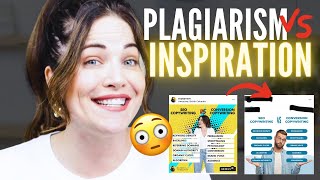
In this YouTube video, Alex Cattoni addresses the growing problem of plagiarism among online creators, especially on Instagram. She begins by welcoming new viewers and outlining her channel’s focus on copywriting and digital marketing. Alex defines the clear distinction between taking creative inspiration—using only the underlying idea while expressing it in one’s own words—and outright plagiarism, which involves copying exact wording, structure, or visual elements. She provides multiple concrete Instagram examples where her own posts were duplicated word‑for‑word, including graphics, captions, emojis, and even her tagline. Alex also examines subtler cases where content is merely reworded or slightly altered but still constitutes plagiarism. To illustrate legal risks, she recounts the Obama “HOPE” poster copyright lawsuit, highlighting the court’s ruling against the artist. Alex then offers practical guidelines: always credit the original creator, tag them when calling out theft, and view credit‑giving as relationship‑building that enhances authority. She encourages the community (“the Posse”) to call out plagiarists, emphasizing that collective vigilance can curb the normalization of content theft. The video ends with a call‑to‑action for viewers to subscribe, watch the next video, and a teaser about her secret copywriting process.
Chapters
Let's talk about plagiarism on the Internet, shall we? Hey Posse, what's up? It's Alex coming at you this week with a hot and a little bit spicy if I'm being honest. Video for you fresh off the Posse Press. Plagiarism versus creative inspiration. What's the difference and where do you draw the line? But first, if you're new to the crew, welcome. Right here on my channel you'll find hundreds of in depth tutorials on copywriting, social media, digital marketing and more. So be sure to stick around and hit subscribe below. And don't forget to hit that bell to be notified when my next video goes live. Now I've been meaning to talk about this for a while now because it really grinds my gears and I've seen it happening more and more to creatives I know, myself included. Yes, I am talking about plagiarism. Or in other words, when people blatantly steal other creators work and then try to pass it off as their own. Here, here at the Posse, we have long stood against things like plagiarism, scammy marketing, misleading claims and unethical tactics and practices. Basically all forms of Internet douchery. And I am fierce as hell about speaking out against it. Especially. Especially when it affects me, my students, or fellow creators who bust their asses day and night to create quality content for their audiences. Sadly, we've all gotten to a point where swiping content has become a normal thing, especially on social media. It has happened to me multiple you know who you are, and it's happened to countless other hardworking entrepreneurs that I know. To me, there is a very clear distinction between stealing someone else's content and taking inspiration from it. But here's the thing. For every single blatant douche pirate out there that's intentionally stealing someone else's work, I know that there are tons and tons more people who genuinely don't think that they're doing anything wrong. It seems like many people simply don't understand where to draw the line. So here I am to set the record straight. So let's talk about creative inspiration. Taking creative inspiration is when the only thing you're using is the idea behind the content. What you write and how you write it must be completely different from the original work. In other words, it's written in your words, not someone else's. But here's the thing. Topics and techniques can be very similar, especially within a specific industry or niche. And let's be honest, there aren't a whole hell of a lot of genuinely brand new, never seen or done before ideas out there. Still, true originality is a tall mission. Just about everything we do, say or think these days is based on something that came before us, whether we realize it or not. Sure, there's the occasional unicorn idea that might gallop in and that really might be truly one of a kind, but even then, it's likely that it was inspired by something or someone else. So if you find a topic or technique or subject that someone else is posting about online and it really inspires you to create something similar and share your thoughts on it, then go for it. But do it in your own way, using your own words, your own style, your own opinion, and your own creative flair. Now, let's talk about the shadiness of stealing content. So stealing or swiping content is when you're using more than just the idea. In other words, you're directly copying the exact words, language, or structure of someone else's thoughts and opinions. Which, by the way, is highly illegal. So let me give you some examples of full blown content stealing that has happened to me recently over on the Copy Posse Instagram page. Now, I am blurring out the Instagram handles here because truly my goal is not to publicly shame anyone. It is to call out one of the biggest issues in the online world today and hopefully educate some people on the right way to take and share creative inspiration. So let's look at this guy. Not him in the photo. That's a stock photo. But the person who posted this recreated one of my Instagram posts. Word for word. I mean, come on, are you freaking serious? And then there is this gem of a human who also stole my content word for word. So you can see the graphic is using literally the exact same words. But it gets better. Look at the caption. Yep, the exact same. The same words, the same formatting, the same freaking emojis, for crying out loud. There is no room for debate here. This content was blatantly stolen. Oh, and he doesn't stop there. This particular person swiped many more of my posts word for word. Like this one, my content stolen content. And this one, my content stolen content. And this one, my content stolen content. The language used in both the graphics and the captions were absolutely identical, word for word. And he did this multiple times. And when I approached him about this blatant plagiarism, he denied it completely, saying he what? I didn't copy you. I got it from other sources. Please. Oh my gosh, it's almost comical if it didn't make me so, so mad. He even swiped my tagline learn, write, and ignite. Yeah. Now, obviously, it goes without saying that that was clear plagiarism. I mean, there is no denying it. But what about the times when it's not so cut and dry? Well, I've got some of those examples for you, too. So, this was a post that I found on Instagram Less than one week after I published a YouTube video and Instagram post on the difference between SEO copywriting and conversion copywriting. You can see that the captions here are not identical and neither are the graphics. So this passes the plagiarism test, right? Wrong. If you were to watch that video, you would see that what I say in the video is exactly what this person has written on their graphic. Conversion copywriting versus SEO copywriting. What's the difference and why does it matter? Yep. And her caption is basically just a bunch of slightly reworded lines taken directly from that video. Yeah, not cool. And here's another example from the same person again. This post was created less than one week after my original post on common copywriter misconceptions. My post's opening line is being a writer isn't a real career. Her graphic being a writer isn't a real career. Then she goes on to say almost the exact same thing by just slightly rewording my caption. I said, writing isn't a career, it's a hobby. She said, writing is a hobby, not a career. What? Like, nice try, but are you kidding me? She even formatted the caption almost the exact same. So if you ask me, she took way more than just creative inspiration for this post. She reworded my exact caption and literally added nothing new. So while this form of plagiarism might be a little bit more blurry, it is still textbook plagiarism, you guys, and it is highly illegal. Does anyone remember the copyright lawsuit that resulted from the iconic Hope poster used during Barack Obama's 2008 presidential campaign? So the original photo on the left was taken by a journalist for the Associated Press. The poster on the right was created by an artist who initially tried to deny that they had taken any inspiration from that photo. The journalist argued that the artist who created the poster violated its copyright. And? And the artist argued his work was protected by fair use laws. So who was right? Well, the court ultimately ruled in favor of the journalist. While the artist didn't go to jail or anything, they did have to agree not to use any photos from the Associated Press without obtaining a license first share the rights and profits of their HOPE poster campaign with the journalist. And while the other additional financial terms were not released publicly, you can bet he had to pay some money. So if this case teaches us anything, it's always better to be safe than sorry. So, as a general rule, anytime you take creative inspiration from another source, always give credit to the original creator, even if you're not directly copying or swiping it. If someone inspired your content, mention that. I reference my mentors, coaches, and fellow entrepreneurs in my content all of the time. This is relationship building 101. When you give credit to those who inspire you, they're more likely to trust you, commit, communicate with you, and maybe even work with you. And it builds your authority too. If your audience knows that you're learning from some of these mentors and you're crediting them in your work, you get authority through association. And lastly, I want to give a huge shout out to you, the posse who called out these content stealers and tagged me in their post so that I could see what was going on. So if you see someone plagiarizing another creative's work, always tag the original creator to bring it to their attention because it is seriously not cool. And the more we turn a blind eye to this and normalize and accept this behavior, the more commonplace it will become. All right, thanks, posse. I appreciate you for being here and for watching my videos week after week. I can't wait to see you next week with a brand new video. Until then, I'm Alex. Ciao for now. All right, guys, if you enjoyed that video, make sure to check out the next one from me right here. And you can click right here to get a free gift. Hey guys, what's up? It's Alex. And in this video, I'm going to let you in on a little behind the scenes action on my secret copywriting process.