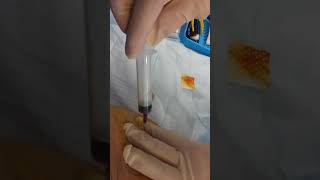
The video records Dr. Chow performing an aspiration of a patient’s hip bursa while the patient (Speaker A) is being filmed. Over the course of the procedure they remove a large volume of bloody fluid—up to 72 ml across six 12 ml syringes—indicating a chronic hemorrhagic effusion that has been recurring for about two years. Dr. Chow notes the presence of both old and new blood, hypothesizes micro‑trauma as a source, and observes that the patient’s seated position improves fluid yield and changes needle angle. The patient reports immediate relief in the hip and lower back, despite mild discomfort during aspiration. The discussion links the large fluid loss to iron deficiency (requiring transfusion), elevated inflammatory markers, and anticipates that definitive hip surgery will address the underlying bleed. Throughout, the clinicians comment on anatomical size of the bursa, its communication with adjacent bursae, and the technical aspects of aspiration.
Chapters
Dr. Chow, we're videoing this. We're live. So there you go, exciting stuff. Oh, another one. This is about, I'd say, the 15th or 16th aspiration. Oh, it's nice and bloody again. This has been going on for the last, I think, 2 years. Blood's been coming out of it. Oh, actually, the first aspiration wasn't too bad. It was clearish with a little bit of blood, but the last year it's just become bloodier and bloodier and bloodier.
That's 15ml of old blood. Old blood. And possibly some new blood because it's just— it's just It's oozing out under some pressure.
Yeah.
And just the amount, the ease of aspiration shows that it's very deeply—
Mm-hmm. Ah, ah.
I'm sorry.
That's right.
Whoa. Shows that the blood's been there leaking, leeching from some area for some time.
And that's what we can't figure out what it is, So there could be, as you said, a microtrauma to the bursa that's causing it to bleed.
That's another— This position seems to allow more.
Mm-hm.
It must be getting—
So it's fair to assume that this is a pretty big bursa, and as we know, it's communicating with the other bursa. On the inner side of the inner thigh. And so it's pretty big. It's pretty much going around the whole hip joint, we could maybe assume.
That's already 30—
Right.
33mm in this position.
Wow. So this is actually the best position.
This position is probably better.
'Cause it's actually— I'm sitting, so it's putting pressure.
So it's pushing it up from other areas.
Mm-hm.
Yes, I haven't actually aspirated this much before.
No.
But I think it's because it's been forced up into— Yeah. From inside the joint.
Yeah.
I think maybe that's—
Mm-hmm. Maybe it's coming to a— We've got this pocket. Yeah.
Sorry, I— It's alright. I'm just going to move it a tiny little bit.
You know me, go for it. Short-term pain, long-term gain.
There's still more there. Yeah.
In another section.
That's 43.
Mm-hmm. 43. That's a lot.
Probably more 44, 44, I'd say. Let me apply a little bit more.
It's all right, is it?
You're still reasonably comfortable?
No worries. Obviously I can feel it and, you know, there's a bit of a, ooh, thud, but that's okay, it's bearable. Given that we're getting some results and getting the blood out, it's great. I said that when you do this, the relief I get in the hip and even in the back is just wonderful. I just can't explain what relief it is when this comes out.
That's 50.
Wow.
50. Getting up to 62, 4, 6, 8. And you can see the angle of the needle has changed, which means that how the, um, the, the sort of tension in the muscles and everything has changed. Sitting is obviously a way to compress it out of the—
Absolutely.
—the joint. I can't believe I've gotten so much.
Absolutely, because this is like, they're still coming easily.
It's not even, yeah, it's not like I'm even not having to try that hard. Yeah. That's got to be a source of loss of— Yeah. —loss of iron.
Absolutely.
Especially if you're not very— You're not a meat eater and— Yes. I think that's 6 now. Wow, 6 tubes. 6 x 12, 60ml. No, 72. Oh, 6 x 12, 72. Yes, yes, sorry.
Sorry, I was very good at arithmetic. I think that was my best subject. I loved it. Alright, maybe we have—
just put a little bit more pressure here. I think maybe— Maybe that's—
we've come to a bit of a—
60ml. Ooh. 70. 70.
Sorry, Roberta. Sorry to correct you, Bertha. But, you know, I do know my maths. Short-term memory loss on my part. That's all right. No, you're busy, so it's OK. It's good. 72ml. 72ml. That's a fair bit, isn't it? OK. It's interesting. Wow. And that's, again, that's the source of the bleed. That must be causing the iron— The low iron? Pain. Yeah, a little bit of pain. That's OK. And that's why I've had to have an iron transfusion to try to get my iron levels right back up. And there is a lot of— the inflammation markers have gone right up as well, so hopefully they'll be reduced and we'll be able to see that in the blood test tomorrow, which I'm taking today. Thanks, Roberta. Very good. Oh, relief already.
So in terms of the downness— Uh-huh. In terms of the— swelling that you've been at. Yes. Because usually when you get up and change position, it seems to move the fluid back up.
That's right. Exactly.
It's probably the best way of doing it.
Yeah, of doing it. Well, hopefully, as I say, once they go in and do the hip, they're going to find all the blood in there and all the pockets and they'll be able to sort it out and, you know, Bob's your uncle and then we can, you know, it'll be a-okay. Thank you. Alright. Magic.