Ali Partovi: Betting on People & Embracing Risk
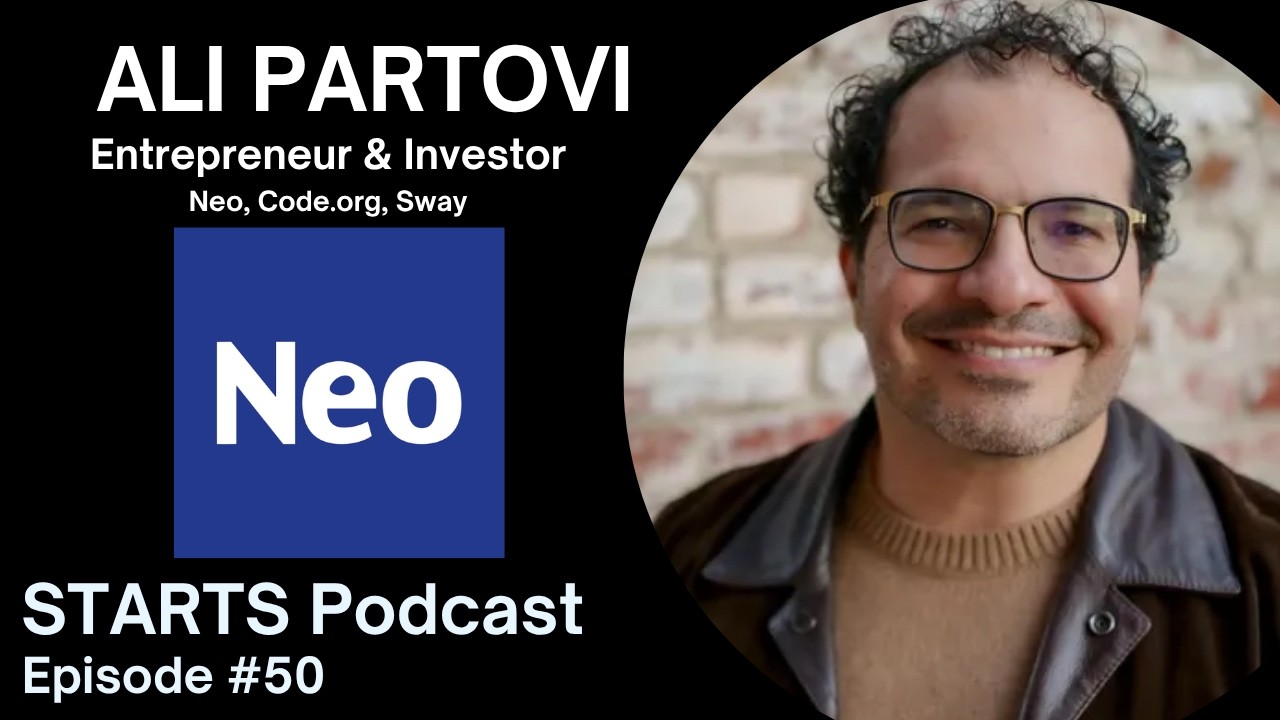
In this hour‑long Starts Podcast interview, Ali Partovi reflects on his journey from a 9‑year‑old coding on a Commodore 64 in war‑torn Iran to becoming a serial founder, early‑stage investor, and mentor at Neo. He discusses the mindset of efficiency cultivated by limited hardware, the shift from low‑level coding to today’s agentic tools, and how scarcity shaped his problem‑solving approach. Partovi shares vivid anecdotes – sleeping under his desk before a pitch to Mike Moritz, the chaotic first meeting that secured lead investment, and the missed early opportunity with Airbnb – to illustrate the outsized impact a single individual can have in a team. He explains his “bet on people” philosophy, emphasizing magnetic founders, humility, and the surprising performance of younger, less‑experienced hires over seasoned veterans. The conversation moves to the unique entrepreneurial culture at Stanford, the value of working in larger companies to learn before founding, and the importance of relentless customer obsession and feedback loops. Partovi also offers hot takes on risk (de‑risking as surviving a risk), the non‑linear payoff of high‑risk ventures, and the future of education disrupted by AI, arguing that human connection must remain central. Throughout, he weaves lessons from his time at LinkExchange, Microsoft, and investments in Kalshi, PayPal, Google, and Dropbox, providing practical advice for founders, investors, and aspiring technologists.
Chapters
together with trying to do it efficiently, meaning like write code that runs fast and does not consume a lot of resources.
Yeah.
And, you know, in that case, the entire computer had 64K.
Yeah.
First time we pitched legendary VC Mike Moritz, who ended up being our lead investor. Um, so I remember this one morning, I'm like sleeping under my desk, and one of our employees like Waking me up, being like, Ali, wake up, I think someone's here to see you. The single most surprising thing I've really learned in my whole career is the difference that a single individual can make. I was at a restaurant talking to somebody else, and Brian Chesky happened to be seated next to me, and at the time— The greater the risk, the greater the reward, and Kalshe, from the very beginning, was attractive to me because it had such a low chance of success.
Hi everybody, my name is Jagad and welcome back to another episode of the Starts Podcast.
And my name is Janek.
And today we're very pleased to be joined by Ali, who really needs no introduction. So we'll begin jump— we'll begin jumping into our first question. You began coding when you were about 9 years old when you first received a Commodore 64 after your father came back from a physics conference. What exactly was that moment for you and how did it define sort of your first perception of software? You know, compared to today where you have maybe ChatGPT or all these agentic tools, which might be the first introduction for a 9-year-old today, how do you think that rather simpler exposure to software influenced your journey as an engineer, founder, and investor?
Oh, it's a great question. First of all, thank you for inviting me here, Jagath and Janak. It's a pleasure. Well, when you, when you brought that up, I'll tell you the first things that went through my mind are the things that I don't think have changed to this day, which was just how much I loved spending time with my dad and with my twin brother. You know, it could have been doing anything, you know, but like the just having my dad being engaged and this like excitement of discovery of something I'd never done before together with him was a huge part of it. So I think that's the same.
Yeah.
And I'd say like the, um, I hope that even with whatever it is, ChatGPT or other tools, it's still something that young people learning today get to experience the joy of doing it together with someone else. For me, I had the added aspect that we were living in Iran. It was during a war and a revolution, so the outside world was quite scary and unpredictable. So coding provided actually a comfort zone of like a very predictable world that followed the rules.
Yeah.
And, you know, and so my brother and I quickly fell in love and became kind of addicts, you could say. But addicts in the sense that this was a place of comfort for us in a world that was otherwise kind of scary. So I don't think— I don't know if this is where you were getting at, but now talking about the actual technological difference, you know, coding then was really like much more low level, I guess, compared to now. And, you know, like, if you missed a colon or whatever, like, if you didn't get it exactly right, things would break. It was more fragile than it is now. And you had to basically learn a whole new language in order to give instructions to the computer, whereas now it's more and more just like English language.
Right.
Yeah, of course. I would say as far as the sort of educational, um, like rigor of helping, helping someone's mind develop. Um, learning really structured syntax, I think, actually is a very good practice, even if you're not— even if you then learn how to, you know, prompt engineer and so on.
Right.
I think the, um, the, uh, exercise of learning it helps your brain a lot. This is the same reason we teach Latin in schools, even though no one speaks Latin. It's a really good language to learn because it's so structured. And, um, so, um, yeah, so, um, I guess I'm trying to think what was— what else was like, what's similar and what's different. Um, the, um, Having that, the Commodore 64, like from a very early age, at like, for me, programming is tightly, um, tightly bound together with trying to do it efficiently, meaning like write code that runs fast and does not consume a lot of resources.
Yeah.
And, you know, in that case, the entire computer had 64K. Yeah, yeah, yeah, 64 kilobytes. So today, like, one GIF is bigger than, like, the entire computer's storage. But I guess I'd say this, like, promoted a mindset of how to do more with less.
Yeah.
You know, like, what is the most efficient way to get something done? And that cuts both ways. I think it's good to have that ability, but it's also— it can be sometimes bad if you have too much of a scarcity mindset. Like today, at least as far as storage goes, there's incredible abundance. And, you know, if you're like too miserly, I guess, in how you're like planning a project or algorithm, you may not realize, oh, you could just get it done by thinking bigger, essentially.
Yeah. Yeah, no, I definitely agree. I think in today's era of, you know, from Cursor to like Claude Code, the activation energy of what you can build has drastically increased. And I think, you know, like when I'm using Claude Code, for instance, or Cursor, a lot of it is, I think, understanding how do I convey the exact vision that I have in mind in terms of what I want to code. But also the, as you mentioned, the part of truly understanding, you know, what you're writing and why you're writing it the way you are. as well as like if it's optimizing for speed or complexity instead of just accomplishing the mere idea. So I guess a quick follow-up question would be, in today's era of, you know, there's so many gen-tech tools that people can use to build websites or even applications overnight, do you think that the current sort of startup ecosystem is over-indexing on maybe using these tools to build products as opposed to actually truly understanding more so critical problems within those fields. And I say that primarily because of the sheer number of startups we're seeing, even on campus or in other schools. You know, the word startup, especially as a freshman to now a sophomore, has like exponentially increased, like hearing it every single day. But I'm curious to hear your thoughts in terms of how you think founders should navigate using these tools, but also being able to ensure they're using them towards a in a sense, novel sense towards truly making a difference in the field as opposed to just building a product that can be sort of more easily navigated with agentic tools.
Well, you guys go to a unique university. Stanford is probably the single most entrepreneurial perhaps place on Earth, but certainly amongst universities. I don't know of any other university in North America that's even, you know, like remotely as entrepreneurial. And so I don't know if it's quite the same thing almost at any other university.
Something nice.
What's that? Yeah. So I've spent much of the last 10 years visiting campuses all over North America encouraging entrepreneurship and trying to give young people more courage to just imagine doing something yourself and stop doubting, just start doing it.
Yeah.
Stanford might be the one place where it might be appropriate, actually the opposite direction. Not so much discourage entrepreneurship, but encourage, you could also get a job, and that's not a failure if, you know, like graduating and working for somebody else for a few years.
Yeah.
Is not something to be ashamed of, or is not at all like a mark of being inferior. And so I guess I would say at Stanford uniquely, I sometimes worry that the peer pressure and just sort of culture of everybody has their own startup has reached such a pitch that it is perhaps kind of preventing students from some very valuable development and learning they can get from working elsewhere.
Yeah.
And it's actually this whole discussion also, like the true irony of it, if you imagine you started a startup, let's say, and let's say you dropped out, you raised a bunch of money, and now 6 months later you guys are the co-founders of this great startup and you're looking to hire some employees. Wouldn't you like to hire some of your smartest friends from Stanford? Or, you know, and, and by the way, wouldn't they learn a lot from doing that for a year or half a year even, like, um, before they start their own?
Yeah.
Yet I feel like a lot of the culture here is, it's like so much of everybody thinking, I'm, you know, I'm the top and I'm not going to be subordinate to anyone. And it sort of like makes the ecosystem a little bit less healthy. And yeah, so one thing I'll say is I think everybody should be— I mean, you started the question from like these tools have made it so easy to build. I think building stuff all the time is a great idea. Whether or not it turns into a startup, just constantly be creating products.
Yeah.
That's sort of like exercising your muscles. It's like going to the gym, like practicing the craft of creativity, you know, of building. So I would never say not to build stuff.
Yeah.
But in terms of thinking like, you know, what is your progression and your, you know, your path, I would say also be open to getting a job. and like alternating these different practice, different forms of practice. And specifically the way you asked kind of implied this question of like not all things are worth building or like what to build.
Right, yeah.
You know, you might gain more insight from spending time at an internship or a full-time job at another company. You'll have a much better sense of, oh gosh, Look how inefficient the real world is in this whole domain. Like, it's so behind, and you'll see the obvious things that could be built, you know, in a way that if you haven't had that real-world work experience, it's sort of like you're, you know, one hand tied behind your back in terms of figuring out what to build.
Yeah, definitely. I also think that when it comes to building, there's often the category of building things to— or building solutions to problems that don't quite exist and then actually building interesting solutions.
Right.
And I've always found the right pre-training for me at least has always just been to explore a field completely heads down in a rabbit hole or working at a startup, as you mentioned, and firsthand being in the field of constant, for lack of better words, chaos, urgency, and just reacting very quickly to existing trends. I don't know if you have any thoughts in terms of—
Yeah, I don't know, it's interesting because this reminds me a lot of a class that I'm currently TAing. It's called CS153. I'm sure you've heard of it. Yeah. And the project for the class is like a one-person frontier lab where students are essentially like using all AI tools to build something, if it's research or a product. And I think this rises, like, brings up a lot of questions on how currently at least I think we're approaching like building and development from a very And this is not for everybody, but like a rather top-down approach where you build something, then you understand exactly how it works after the fact. And that definitely contrasts with how you mentioned, you know, like building things from scratch and your story behind like Commodore 64. And I was curious to know like what tacit skills or knowledge would you recommend students— like how should students approach these AI tools nowadays in a more responsible way where they're not only picking up how to like leverage these tools, but also— think why they should use certain tools for certain use cases and not only how to be a builder, but develop that taste or intuition behind what goes behind building things.
Yeah, I guess there's also the quote from Naval, if you can learn to build and sell, you'll be unstoppable. And I definitely think that in being a founder, you would need, of course, both the technical, but also, or maybe a technical vision or taste, but also the ability to communicate your ideas. So I guess like to that end also, if you think the current sort of maybe education system even is teaching young founders to adequately also distill their ideas or convey it to an audience.
Yeah, I mean, communication in general is good, but selling is a unique type of communication, which is about persuasion. It's almost a form of performance art. I would say it's, yeah, it's interesting because you want to always be honest, but there's still a wide range in how to lead the other person into having the feelings that I love what this person is selling, you know.
Right.
And that's very much about, you know, listening and empathy and all sorts of skills beyond just communication. So that's certainly something I think is very, very important to develop. I don't know if that's taught in any sort of school nearly as much as just practice.
Yeah.
It's interesting, you know, and so that quote you mentioned, you learn how to build, learn how to sell, that makes you unstoppable. I'd say there's another element of like what is worth building and selling, which is I think what you were leaning towards of like having those abilities is great. Those are like really, you know, important, you know, building blocks. Uh, but then also learning the decisions of which direction to steer, you know, where to apply those skills is, is also important. And I'd say that's— and all the above you can gain as much from working elsewhere, you know, versus just being in school and then going straight to starting your own thing. So I mean, the advice I give young people in general is, you know, kind of do all the above, right?
Yeah.
Do some of your own projects, do some stuff, some work that puts you in a position of selling, and do some work for other people, you know, whether it's internships or when you graduate full-time or take taking a gap year, all of these things help you towards becoming a stronger founder.
Yeah. I want to shift away and talk more about LinkExchange, which you worked with Tony and Sanjay on. And I know you developed like an internet advertising network for businesses, and eventually the startup was acquired by Microsoft. And you were a project manager for MSN Keywords. Can you walk us through like what you learned, like starting as You know, both as just like working on the exchange and then also being like a project manager and maybe some of the philosophies or like skills that you developed along the way.
So the time, the time at Microsoft, I'd say mostly it was quite frustrating for me. And I'm— I think I'd say I mostly learned that I like working at smaller companies and I'm not very good at working in big companies. And there's very valid skills in how to be successful in a big company, but I just realized that I don't have those skills and maybe don't even want to.
What would you say those skills are?
Just learning how to, how to build consensus across different organizations, how to navigate politics, how to, you know, how to like overcome internal obstacles. Basically, I learned I have no patience for that. I, I love overcoming obstacles, but when those obstacles are like part of the company I'm in, it's super frustrating. I would much rather be in a small company where you face external obstacles, you know. Like, when I mean an external obstacle, our product sucks and nobody wants it. Fuck, we have to fix it. Or we lost this big sale, we need to— this customer is unhappy, we need to make them happy. Those are challenges that get me really excited, even if they're really difficult and tough, you know. Those are exciting to me. Whereas the other department is blocking us from doing our strategy, they won't let us build what we are building unless we convince them.
Yeah.
Those to me are just incredibly demotivating. And, uh, like, like I said, it's valid skills.
Yeah.
That for, for someone, you know, in fact, if you want to build a massive corporation, you actually should develop those skills. I've just always been happiest at the early, early stage where that's less relevant. Um, the link exchange days though, you know, that, that Company grew from, you know, a few people to about 100 before we got acquired. And by far the biggest learning and lesson that has kind of defined the whole arc of my career since then was the importance of people, the importance of betting on people. I'd say the single most surprising thing I've really learned in my whole career is the difference that a single individual can make.
Mm-hmm.
It's really shocking in a very large organization how much of a difference one person can make. And not necessarily just the founder, you know. And the— for people outside the tech industry, they see this manifested in other domains that are like where you can see how the whole team operates. When I say team, spectator sports. If you watch a soccer team or basketball team, it's very obvious that one person can make all the difference. You can take a team with one superstar and they can be a championship team, and then remove that person and they go to last place in the whole league.
Is this a Steph Curry pitch?
This is true across lots of sports. The individual can do so much. And in sports, since it— since you can watch the whole thing, no one's surprised by that.
Yeah.
But I'd say this is equally true in teams that are building, you know, software. And, um, and I hadn't fully appreciated this one, you know, until kind of seeing over time how certain superstars emerged at LinkExchange. And, and then I'd say To go further, I also particularly learned the importance of betting on younger people, you know, and having the humility to bet on people younger than myself to grow into being bigger than myself. But also for various roles, it's funny, for the engineering roles, since I was myself an awesome engineer, I had no trouble betting on my peers.
Yeah.
who were also awesome engineers, I kind of, I knew what we were good at. But for the non-engineering roles like sales or finance that were kind of like foreign to myself, I had this feeling, the conceit I had was we have to hire experienced people, presumably older than us, who know how to do those things. And it would be like irresponsible to let some young person do something without that experience. And so early on as a founder, I brought to it this very, like, you know, like, belief that we should bring on experienced people for anything that I myself don't know how to do. Now, I do think experience is valuable. And being an old guy today, I'm not trying to denigrate my own experience or wisdom. But I would say I consistently kept seeing over and over situations where the younger person with less experience outperformed the more experienced people by drastic amounts. So for example, our sales team, we hired multiple people who were— I want to say old, they were like 30, which—
Yeah.
At the time, me being 23 or 24 seemed old. So we had these older 30 or 35-year-old salespeople who had years of experience. But then we also hired like Denise and Kevin who were basically our age. And for, you know, like over a period of, you know, a year consistently every quarter our number 1 and number 2 sales performers were Denise and Kevin.
Wow.
It was like sometimes Kevin, sometimes Denise, but they were like the best sellers, even though they had none of the experience or contacts that the others that we brought on.
Yeah.
And I saw this in other parts of the company. So that's definitely like you can trace from those learnings all the way to what I do today at Neo. It's very much about trying to have an eye for superstars and betting on younger people.
This reminds me a lot of your story with Russell Kaplan from Cognition at Coho, when you were interviewing him or asking him to solve a coding question. And then he asks you to solve a coding question.
Yeah.
And then he went home and like, I think at night you were able to solve it after like 1 AM or something.
Yeah.
I guess to that end, what do you look for like in Neo or even beyond? generally based upon your past experiences, what has been that specific maybe— I think you touched upon the element of mischief, but not too much mischief maybe.
Yes.
In terms of defying the norm, especially when you mentioned in bigger companies, this sort of lingo of, oh, we can't build this. For me personally, whenever I hear you can't build something, it inspires me or just fuels me to build it and to challenge the norm of You know, why not? So I'm more so curious in terms of when you're looking at young founders, what exactly do you think is probably the most convincing signal that most people tend to overlook? And do you think that signal might change in the era of the developing skill set of AI? Or do you think it's still a hunger, scrappy, sort of mischievous— I think it's a mix. element that will persist.
Oh, well, you said a lot of things there, and you're, you're referencing comments that I've made in other settings. I don't know how much the, the people listening to this podcast would, would have the full context, but, um, you know, the Russell Kaplan story was from, uh, almost 10 years ago, like the first round of interviewing college students when I was starting Neo. Neo is a mentorship community, and we, we have an investment fund whose thesis is entirely around betting on people and the idea that you can identify future superstars when they're still in college. So, and so, like, even before I closed the fund, I was spending like 1,000+ hours that year interviewing college students to identify what we called Neo Scholars that were like people that we would invest in whatever they do in the future. I guess I would say back then I, you know, I was giving college students coding tests, um, like paper and pen coding exercises or like algorithm solving questions or like riddles or tasks to assess their problem-solving ability and technical You know, aptitude. And when I would— back then, for sure, I had people saying this is kind of weird or a waste of time, and I had people who thought it didn't make sense. I think it, in hindsight, has worked, so I believe it did make sense. But I think it might today be contrarian to still believe in this stuff because— Algorithms obviously can be done by Claude Code, or, you know, like LLMs can do a lot of the type of problem solving and coding things that, that you wouldn't— it would be like asking someone to do long division when they can do it, use a calculator, right? I guess my view is that it's still a good way to to assess people, even though that person is not going to be doing any algorithm type, uh, like work, presumably, um, in their career necessarily. They might just be able to have an LLM do it. I think it's, it's a way of assessing their problem-solving ability, their structured thinking, you know, And just assessing how much practice that they've had building, which is relevant. And then the thing about mischief that was from a—
Yeah.
I imagine from a talk or podcast I've given in the past. I wouldn't say that that's the main thing I look for. The main thing that I look for in terms of personality or the non-technical aspect, I look for essentially, I guess I would say leadership, but the word I tend to use is I try to ask myself how magnetic is this person. And specifically what I mean by that is how likely are they, if they start something, how likely are their friends to want to follow them? Whether that's starting a company or starting a college club. starting a podcast, you know, like basically there are some people where they just have some, you know, it's like a je ne sais quoi, like ability to attract others to want to follow them.
Yeah.
And I, I do want to say that I, this can manifest in very different ways amongst different people. So I try not to have a single template and say you must have this specific personality traits. Like, some people are really flamboyant and charismatic, others might be really quiet and almost shy, yet you can have both, both people be magnetic in different ways, so to speak.
Yeah, I kind of want to flip tables and, or like, and see the other perspective and say, like, perhaps when you were building early on with Hadi as well, uh, what would you say is perhaps Like a skill or personality that you felt that investors might have overlooked inside of you and Hadi, or something you felt like people evaluating you from the outside didn't really pick up?
Because I'd have to look so far back. And I mean, the challenges of fundraising, whether for the very first startup or at different points of time, and maybe I'm not very self-aware, but I never felt like anyone was underestimating me as a person. Yeah, I think There were challenges that they didn't believe in the idea or something like that. Yeah.
Yeah, I was mainly curious to see if perhaps prior experiences on the other side of the relationship where people may have evaluated you kind of influenced the mental model and kind of things you fit in when you evaluate other people. But yeah, I guess we can talk more about your investments and I know there's like a lot of interesting stories.
Actually, can I?
Yeah.
I don't know if this is answering your question, but it's a fun story that I was thinking like, where was the gap between what I thought investors would want and what actually might have, you know, might have worked, so to speak. This is such a funny story of the—
I'd be down.
What's that?
I'm down for a fun story.
The first time we pitched legendary VC Mike Moritz, who ended up being our lead investor. So for a little bit of context, we— this was actually— it was slightly different context. We were in discussions to potentially be acquired by a public company that he was on the board of. And so he was kind of sent to meet us on behalf, you know, on behalf of them. And, and we were, we were still a pretty small company. I think we were like 13 people or so. We had not raised any VC money. And this was super important to us. It was, you know, we didn't have an offer yet, but like the sense we had was that Like, this could be a big enough deal to make us all have more money than we ever wanted. So we were— it was very important to us. But at the same time, we were also like a lean startup working late nights every single day, day and night. There was just so much work to do. And our main priority was like building, selling, dealing with customers. There just was so much going on. And, um, but this was a time period where, um, you know, like essentially I was working so such hard hours that I commonly would just sleep at the office. I had like a sleeping bag and I would literally work until I couldn't stay awake and I would just, you know, brush my teeth and then like sleep in a sleeping bag right under my desk and wake up and go back to work. And so, so I remember this One morning, I'm like sleeping under my desk and one of our employees like waking me up, being like, Ali, wake up, I think someone's here to see you. And I'm like yawning, like, what time is it? And my desk was basically not far from the entry door. And so I'm like, who's here to see me? Grab my glasses. I'm like, oh shit, it's Mike Moritz.
Yeah.
Fuck, I forgot he's coming early or whatever. I think it was not that early. It was like 9 AM.
Yeah.
But I was like, I wonder if he sees me here. I need to go to the bathroom and come back. And I had to go and like also wake up Tony and Sanjay, who were also like asleep, and be like, you guys, Mike Moritz is here. So we all had to like literally wake up, you know, like go to the bathroom and come back and then be like, oh, Mike, thank you for visiting. And like, you know, try to make it a little more professional. And we go into, you know, the meeting room, which I recall was facing the sunrise. So there was like sun coming in, kind of like a warm room. And during the meeting, Sanjay fell back asleep, like literally fully asleep.
Yeah.
And we had to like wake him up. And I, I don't recall almost anything else from the meeting other than this shame of like, falling asleep and all this stuff. But I'm bringing it up because I'm pretty sure that Moritz had decided within the first 3 minutes, we want these guys, you know, not because of any due diligence or like anything else, but just the fact that this many people here are working such hard hours and the energy of like, you know, like the founders are so obsessed with their work. that they're, you know, like barely have time to meet him.
Yeah.
You know, and so I'm bringing this up because at the time I thought, oh my gosh, this was such a fail. We messed up. We were unprofessional, weren't whatever, dressed nicely or so on. Whereas in fact, I'm pretty sure knowing what I know now that like literally almost before the meeting had begun, He might have decided, like, positively. And yeah, and that acquisition fell through. It was like some period of time passed, and then he contacted us and said, let's talk. And he ended up becoming our lead investor.
So he knew from beforehand that you guys were—
Well, yeah, at the time he was evaluating us for acquisition by Yahoo. We actually turned down the acquisition offer. Yeah, it was a very good acquisition offer, but we We turned it down. And he waited some period of time and got their permission to then, like, come to us directly to invest.
Yeah. How did you figure out what was the right, you know, being so young and you're so obsessed with the mission of what you're building, how did you figure out what was the most optimal sort of acquisition or investor relationship?
You used the word optimal, and I will say one of my general learnings is I'm not sure that anything is optimal, or I'm not sure that that's—
Yeah.
I think like a lot of decisions, you just have to take risks, and if it was wrong, you learn it was wrong and hopefully develop better instincts for the next decision. So, um, Yeah, I think it would be, um, perhaps with hindsight I could pretend as if we knew for everything what was the optimal path, but I'm pretty sure I would say the, the true answer is that we were doing a lot of things by the seat of our pants or based on what felt right.
Yeah.
And, um, you know, including a lot of mistakes. And just, but each time you make a mistake, you develop Better intuition for next time.
Yeah. Yeah.
I will say now, with that big disclaimer, we generally applied the mindset of, um, uh, who should we put first? And I'd say when I was, um, just starting out, I was pretty financially insecure and like really cared about making money and having enough to buy my parents a house and different things like this. So this was a hard switch for me. I started realizing the right way to decide things is like, what will this mean for our customers? So rather than what it means for me or our shareholders was like, you know, if this— if a combination would truly be celebrated by our customers, then it feels like a 1+ 1= 3 type, something that will make things grow faster. Yeah. There's probably enough value to be right for everybody else as well. Whereas if it's not good for them, then it means we're somehow, like, not getting our full value either. So, yeah, so that was, that was definitely kind of a weird, or I should say unexpected way to evaluate deals like this.
Yeah.
But it's like, but I do think the purpose of business is to serve the customers. That's like the North Star. And that's where you should kind of like center a lot of decisions.
And you build that over time, I feel like, through instinct of just simply learning by doing and taking an action, observing sort of the outcome, and then I guess building a—
Yeah, but I would also say just having contact with customers. It is a magical thing. You know, like when you are, if you're a college student building stuff, in the abstract and you're like, someday presumably users will use this. But if you never actually experience putting it out there and having people use it and so on, then it's all kind of this— you're— it's absent that feedback loop. Whereas once you put stuff out there, people tell you, ah, yeah, this sucks, or I, I got bored with it, or I stopped using it, or, you know, like, or I loved it, or this one thing I hated.
Yeah.
You know, that feedback loop is really valuable. And if this were a startup, you actually stay in touch with them, you know, or even once you have a whole team whose job is to do customer support, you know, like let's say a healthy startup, the founders are always having a finger on the pulse of what are customers saying, how are customers feeling. And I would actually say you should, developed some like just zeal, almost addiction for hearing from the customer. You know, I, yeah, I, you know, think like life would actually be kind of empty without that, you know.
Yeah.
And what I do now, the customer, I guess, are the college students or the founders that we serve. And I love nothing more than spending time with college students. and founders.
Yeah.
One question I had in particular, and this might kind of jump back to what we talked about earlier, on the note of founders engaging with customers, you mentioned this idea where with LinkExchange and being at Microsoft, there's of course these industrial obstacles. And I'm curious if you've been able to pinpoint when it comes to evaluating founders, why we see a large number of people nowadays kind of adopting this philosophy of being at the top, or like not in a negative connotation, but more so like a lot of people nowadays are kind of founding things of their own as opposed to pursuing rather like, you know, joining an initiative. Would you say that's partly due to this notion of like obstacles in big tech or industries, or what would you say is like the real rationale why we see like a lot of independent ownership when it comes to founding things? And How do you distinguish that from being attributed to founders who really want to engage with customers versus founders who are pursuing, let's say, like the startup route for rather like extrinsic reasons from like pursuing this instead of that?
Yeah. So I mean, again, I'd say I feel like there's a unique thing going on at Stanford University that's not everywhere. I'd say a lot of these behaviors are mimetic, meaning like on a campus, the student who arrives as a first year is like looking around, how does everyone else behave? And by senior year, they're like behaving kind of the same as what they've seen from all the other students. Got it, yeah. And Stanford campus definitely has like this self-reinforcing loop where everyone is, you know, I'm going to be the next Sam Altman or you know, insert, you know, famous founder. There's, I would say it's a positive that everyone here is so ambitious and everyone at Stanford is, well, so gifted to begin with and fearless. Those are very positive things. You know, many other universities, including some of the highest performing universities in the world, where literally you could have been the same student. Like, You know, and you guys are twins. If one of you had gone here and one had gone to the other place, you know, it's being surrounded by what the culture is of other students is what influences what you decide to do. And there are other campuses where the prestigious normal thing is getting a job at McKinsey or at Jane Street or so on.
Yes.
percentage of the student body is really aspiring to that. And if that's what you see everyone around you aspiring to, that's, you know, that's what makes people cool. That's what the people that get invited to the places you want to be all seem to be doing X, you start doing X as well. And in fact, there's a lot of campuses where young people are who want to do startups have to overcome a stigma. I'm not looking for a yada yada career path. So I will say it's surprisingly not this. It's not uniform. I do think, though, that taking a step back, I feel like over the past, like the long arc, we've over more than a decade, just I'd say the world is trending more towards entrepreneurship as a whole in every respect.
Yeah.
Even if you look at the, like, Uber drivers and Airbnb hosts, those are entrepreneurial ways of making money, right? Being an Airbnb host means, like, I'm creating my own job where I'm, you know, making a building suitable for travelers and maybe getting enough income to buy a second property. And, you know, I'm setting my own hours and deciding my own tasks, and I get the revenue from— The Airbnb or whatever. And whether those— those are, you know, those are not exactly startups, but those are still entrepreneurial ways of making money. To, you know, I guess I'd say there's a much greater likelihood of thinking, hey, I could just build my own thing rather than just getting a job at a big tech company.
Yeah.
Overall, I think this is a very good trend to see. Yeah, I don't know if this answered your question.
I think it's, it's quite interesting because I think it points to like a broader microcosm of how the world works. And like, I think at different stages, even like youth, a lot of like the things we pursue and like the ideologies we adopt are like inspired, of course, by the community we're in.
I think the one thing I'd say that is— I wish would be valuable is for young people to have some balance of fearlessness as well as humility.
Yeah.
Meaning like humility being like, there are things out there for me to learn from people who are even just 1 or 2 years ahead of me, you know, that, you know, or that I could learn, you know, making mistakes with lower stakes before I do my own startup where the stakes are—
Yeah.
Kind of feel existential, you know?
Yeah.
So, yeah.
This is, I mean, a big part of why I recommend people experience getting a job before starting a startup is so you can kind of see how it's done. And also if there are any mistakes that you make or others make, it's not your company. And learn in a sandbox that's a bit safer, I guess, before you do the next stage of hopefully building your own.
Yeah.
And a quick follow-up in terms of the sort of overall landscape of founding a company. We've seen companies that are focusing on agenda coding tools or even maybe more medical applications. And I was very, very inspired by Kalshi exploring a domain that has been for a long time not explored. And I think the idea of trading on pretty much everything, as the name implies, has been really fascinating. So I'm more so curious to hear your sort of vision in terms of what was Kalshi like in the very first time of meeting Luana and Tariq? And also, how have you sort of seen the company evolve over time? And do you think there are— I know I'm kind of packing a lot of questions in here. I guess, do you think there are also still untapped areas that people are yet to explore? And to that end, also, how should they go about exploring that?
For sure, there's untapped areas.
Yeah.
And I would even say I'm willing to commit that there will always be untapped areas. So the— what's interesting though, I think, is that the, generally speaking, the greater the risk, the greater the reward. And KALSHI from the very beginning was attractive to me because it had such a low chance of success. You know, kind of hand in hand with that was such a high reward if they did succeed. And, you know, so, you know, yeah, there might be some investors who might pretend, oh yeah, I knew from the minute I saw this, this would be a huge success. That's definitely not— I don't think that's how anyone looked at Kalshi. Everyone looked at it, including the founders, being like, this is a very, like, you know, Because the existential risk was whether it would be approved by the government. So it was just like this risk beyond our control. And, you know, as I remember, Tarek and Luana weren't at all saying it's guaranteed to become approved, but it was more that there is nothing that would stop them from trying, you know, and that they were, you know, You know, like, other than if it was proven to them that it is illegal. And I can go into that a little bit more if you would like, but I'm drawn to the types of ideas where it will probably fail, but if it succeeds, it would be huge and be something that redefines, you know, like—
Yeah.
A sector or creates a sector. And what was there, You know, like, with this sort of, like, balancing this looming legal question of will it be approved by the government was this very just intrinsic gut feeling that if it is legal, everybody would want to do it, you know, because almost anyone has experienced this feeling of like, Yeah. I bet X or Y is gonna happen on all sorts of topics, right? Like, I bet it'll be bad weather tomorrow, or I bet this, you know, political thing is gonna go this way or that way. And the desire to take your instincts and, like, bet on them, I think, is a pretty widespread one. And especially so for people who work in Wall Street, which is where Tariq and Luana had spent time there. And just saw, like, at lunch, the, the people whose day job was trading were also making side bets with each other about, like, stuff that they couldn't trade on legally. And they're like, what if you could do that legally also? You know?
Yeah.
So, uh, yeah, so I guess I would say the— there was an inherent knowledge that people want this. So there was never once a question of do people want this? We just knew that if it was built, it would be very big. And I'd say the founders definitely had that conviction.
Yeah.
And I shared that conviction from the very beginning. The interesting thing on the legal side that I do want to double-click in, there was Never once a sense that, that Tarek or Luana would consider doing anything illegal. They approach it as, hey, we've spent a lot of time learning the laws, reading the federal code, reading the Supreme Court decisions, like reading the entirety of, you know, uh, legal landscape, and we have found a path that Complies with all the laws to do, you know, to build something, you know, like using a, you know, if we apply for a DCM and structure it as a futures trading contract comparable to commodities futures, that would comply with all the laws. So I would say it was almost like a discovery of having discovered a legal path that was fully compliant with all the laws, and that was more The process, which took 2 years, was merely to prove to the government that in fact it does comply, you know, that they're, you know, overcome any obstacle the government might provide to be like, no, actually, like, proving that this discovery does comply. So, you know, and I'm bringing this up because there's definitely companies that try things that are non-compliant or that are in regulatory gray zones.
But what was—
it really drew me to them that these 2 had such an encyclopedic knowledge of the legal landscape. And the legal part was what had caused other efforts in this domain to fail in different ways. And they were taking a different path. Sort of like if you were scaling a mountain and you'd found a new path that no one had tried before. You know, so, um, yeah, yeah.
It reminds me quite a bit of a quote that I think Andrej Karpathy recently retweeted, um, kind of like how you can sort of outsource— or it was previously from a different user, I think called Yossine, but Andrej retweeted it— and it was, you can outsource your thinking, but you can't quite outsource your understanding. Um, so in the sense that, you know, you see all these ideas, but as you mentioned, truly questioning the the precedent of what's been done before and finding that unconventional path really is the key to understanding everything from first principles. I think Kalshi, of course, is a beautiful example of that. Yeah, I don't know if you have any thoughts in terms of—
Yeah, I think the regulatory landscape is quite interesting. And the whole time during the conversation, I was thinking a lot about healthcare, just because I think it's one of the most, like, at least regulatory speaking, bottlenecked domains when it comes to healthcare data. And it seems that we're shifting towards this paradigm where even like Frontier Labs are caring a lot about healthcare and life sciences.
Of course.
And a lot of that depends on access to patient data. And it seems like there's going to be a lot of questions in the next few years on privacy of patient data, how exactly it's being fed to models. We already have people like sequencing their own genomes and feeding them to models, but I think this is just like scratching the surface of it.
Yeah, yeah.
I'm gonna move on to hot takes, and I'll let you—
yeah, I guess we'll start off with the most obvious question. What are some rather like non-contrarian or hot takes that you have, either when it comes to investing or just broadly about the world and your own philosophies?
Yeah, I'll start by saying I always— I never know how to answer these questions because I always would say the things that I believe in. They might seem obvious to me, so I'm not sure how hot a take it is. But I guess I'll say, especially when I speak to young people and give advice to young people, I try to convince them that risk is good. And I— so I guess the hot take is try to pursue risk. Like, and there's such a— I'd say that the natural tendency for most people myself included, is like to be afraid of risk and to, you know, there's the word de-risk, which, you know, I don't know if you've heard that. It's like sort of like, I guess, I don't know if it's a business school word or what, but I think some people think the word de-risk means to, you know, reduce the risk, to kind of feel safer. I actually don't think that's the right definition. If you actually like look at how it's the proper usage. De-risk means there was a risk, we took it, and after having taken the risk, we survived. So we de-risked that risk, you know. So I guess I would— the general thing is I would say whatever path is the riskiest, that's the optimal path, you know, to use your earlier word.
Yeah.
And to avoid trying to figure out the path that has like a guaranteed optimal outcome, you know. Uh, generally speaking, I guess I should say this derives from what about— what I've experienced is that usually our fears are exaggerated.
Yeah.
And, and also the payoff doesn't just increase linearly with risk. Usually the payoff increases faster than the risk. So when you when you pursue the choices that are, um, you know, feel more risky, um, there's less competition. You're doing something other people are afraid to do. In particular, less competition from bigger companies.
Mm-hmm.
So if you're steering a startup doing some crazy risky thing, at least you can be sure that the big guys aren't gonna do that too because You know, or at least probably not because they can't afford to. They have something to lose. The bigger companies tend to be way more conservative and let somebody else, you know, like walk across that minefield first before, you know, following them. And then third, most importantly, is when you're tackling something that's uncertain and risky, it's actually easier to attract smart people to join you. Like, if you think of— if you guys started a company and were trying to tell your smartest friends to join you, if what you were doing was guaranteed to succeed, it would actually be less inspiring than if you said, we're doing this almost impossible thing, you know, that we probably won't succeed. Only people incredible like you helping us could make it possibly succeed.
Yeah.
It actually draws other smart people to want to join you. And the irony there is then it increases the chance of success because of the people.
A lot of psychology. A lot of psychology.
Yeah, I definitely also feel like the words risk or fear or failure always have like a very—
Yeah, inherently negative.
Yeah, negative connotation, or too scared to even remotely get close to it. But what I found, at least in my journey, has been just like in itself, I've kind of primed my brain to almost like view hard or risky as the incentive to do it. Because I've always found it so rewarding to actually see, you know, to do something that your mind often might limit you from doing. I think a very simple example is like running. Like, I enjoy running a lot.
Yeah.
And whenever I'm running on the treadmill, there's always like this game between like me and my mind where my mind is like, oh, if you can make it to X amount of miles, then— or like, oh, let's see if you can make it to this target. And then I've also noticed that when I'm just simply focused and running, before I know it, I'm like double the target. And I guess the point being is that our mind, I feel like, often limits us a lot more than we think.
For sure.
And yeah, I don't know.
Yeah. Yeah. Well, what would you say, or like, I know we talked about Kalshe, but what would you say, or rather, it's hard to, maybe not hard, but like it's rather obvious to say this in hindsight or retrospective perspectives. But what would you say are like companies that were also took on like a de-risking approach that you were able to see on in the early days, uh, apart from Callsheet?
Um, I think what you mean is companies that seemed impossible, right?
Um, yeah.
I mean, this was a company I invested in, but after passing the first time, um, actually I don't even know if I'd say it was a pass. But I think I had a chance to invest in Airbnb when it was really early. And it wasn't— I say I'm not sure it was a pass because this wasn't a traditional pitch. I was at a restaurant talking to somebody else, and Brian Chesky happened to be seated next to me. And at the time, I don't know the exact date, but I think it was like Airbnb's kind of like pre-seed or seed stage, you know, and it was definitely not a famous company.
Yeah.
And somehow we ended up talking. I mean, I'm— I was sitting with somebody else who I thought was much more important also, I should say. And somehow we ended up talking to the guy at the other table. I was like, who is this guy? And Brian started describing Airbnb to us. And I was partially annoyed because I wanted to get back to the important conversation I was in. And partially thought this idea is just so crazy because at the time it was not considered normal to like go stay at someone else's house when you're traveling. You know, people stayed in hotels and, and he pitched it as, you know, just imagine if everybody, wherever they went, could just always go stay at a stranger's house. And I think he even described it as like hundreds of years ago, before hotels, that was actually— if you were traveling, you know, in the Middle Ages, you'd just find someone and stay in their house for a while, you know. And, um, uh, that this is not an unusual behavior. What if the world could be like that? I'm bringing it up because at the time he was describing it, it took a real leap of imagination to believe that, like, psychologically people are willing to do this on both sides. As the traveler, it's a bit scary. And as the host inviting stranger in. Yeah, I— it wasn't— he wasn't raising money, so there wasn't like an opportunity for me to pass or not. But I certainly regret that I didn't pursue investing. I for sure remembered it. You know, like he gave me his card, business cards back when you had that.
Yeah.
And yeah, and I, you know, in hindsight should have been like pursuing it. What I definitely loved from the very beginning, from that first pitch, was just how bold it was. And it had this contour of this is crazy. It probably won't make it, but if it does, it would be like potentially huge. And I should say as a comparison point, in that same timeframe, I remember other people pitching me ideas that were much more incremental for the hospitality industry, like software that will help hotels, you know, improve their bookings by 5%.
Yeah.
You know, like compared to those type of pitches, which I also would see, this was like, we will replace the concept of a hotel altogether. And, um, yeah, so I generally like ideas that require enormous imagination and leaps of faith because usually they also come with large payoffs.
Yeah, yeah. I know online you've also described your— some of your investments, Dropbox, and how you missed, I think, PayPal and Google.
Yeah, so many negative ones. No, I, I have many more as well.
Yeah.
Would you say there's any unique, like, Things you picked up from those, like, misses compared to the Airbnb story, for example?
Oh, for sure.
Yeah.
I mean, PayPal and Google, I believe, were both started in 1999, which was— I was, you know, just turned 26 and I had just sold my first company. And the— I think really candidly, I was kind of an arrogant 26-year-old, perhaps understandably. I had just, for a minute, I was the most successful person from my class at Harvard, and, and I, you know, felt like on top of the world. And when I say arrogant, you know, there's this— I had learned so much about business over the, you know, 3 years of doing the startup, and you know, felt like I'd learned so much, and I'd never been an investor before. In fact, I never even, I never had any money to invest, nor imagined being an investor. So what I, I started, I guess, kind of doing what I thought an investor's job must be, which is to use my superior business intellect to evaluate other people's ideas.
Yeah.
And, you know, and so like, This is an idea. Let me use my immense experience and wisdom to judge whether the idea is good or bad. And, um, it turns out that even if the idea is absolute shit, if the founder is incredible, especially if the founder is smarter than I am, it's a good investment. And I would say I knew that Max Levchin was probably smarter than I am. I'm saying probably because I didn't know him that well. He was, I think, 22. And he wasn't an employee. He was a contractor of ours. So I didn't see him every day. But there was a general acknowledgment that this was one of the smartest people in our orbit. And, you know, Had today, if someone of Max's caliber started a company, I would just be like, let me invest. I don't, I don't even need to know what the idea is. Whereas back then, there was this element of like focusing on the idea rather than on the person.
Mm-hmm.
And the original concept for Confinity, it wasn't even called PayPal, was pretty terrible. I'm pretty sure Max himself would say, yeah, that was a dumb idea. You know, but the main investing, like, learning for me was to try not to focus on the idea so much as on the team. And, you know, great teams can either change the idea or succeed even with an idea that seems foolish. You know, and Google, I would say, is a great idea. I was actually a huge believer in search. huge, but it seemed utterly foolish for like a handful of, you know, like students to be able to start from scratch and take down the multiple public companies that were already entrenched in search. You know, this would be comparable to if you said, I'm going to start a car company or a Frontier Lab today.
Yeah.
But I've since then realized that in fact, 2 people coming out of college could start something and take down a much bigger company. And again, it goes back to the people.
Yeah, I want to close by talking about sort of in the ideation phase of questioning what has been done before and whether it's making, you know, the opportunity to trade in anything or making, you know, a new car company. I always found that education or being able to prototype and simply experiment has been a pretty strong catalyst, at least for both of us. And I think, of course, Code.org, thank you to both you and Hadi for creating Code.org. It genuinely, I think for us, when we were very little, the idea of building my own simple movie recommendation application— Those little blocks. By dragging and dropping it and experimenting with backend code, frontend code.
You guys learned on Code.org?
Yeah, yeah. We did in our high school as well. And even watching, I think it was like the internet video of like the internet protocol, DNS.
DNS, yeah.
I think it was like Vincent speaking and sort of the blue background, like everything I still vividly remember. I was more so curious, you know, that that's of course played a very deep influence in my own journey. I was wondering, you know, in today's world of making ideas that are either the way I guess I would phrase it, it would be like contributing to the existing field versus maybe being so daring and defiant that you make your own very strong and rebellious vision. Maybe it's the next Google, the next Tesla, or the next even like Kalshi, or Kalshi for that matter. Do you think to that end, the current sort of education landscape is sort of approaching that, I guess, space of opportunities?
Oh, for sure.
Okay.
Your question is, is there opportunity to make a big business in education?
Yeah. Or I guess effectively, that would be like a subpart of the question, but also do you think that in this space of what students are being taught, how can students in some sense sort of take the initiative to sort of go like n steps outside of what's being taught in school or even the existing sort of domains to really question the boundaries of what's been done before?
Yeah, so I mean, I'll, I'll say it's hard for me to declare I know what it's going to look like, but I feel quite confident that 10 or 15 years from now education will look completely different than it looks today.
Yeah.
Um, you know, I love education, I love learning, I love teaching, but I think the current education system kind of sucks, and it just falls short in many ways of its potential, and it's also like not adapting fast enough for all the ways that the world has already shifted. So it's just way behind.
Yeah.
And there is— you could look at that either like in a negative way or positive. Like, to me, I'd say I'm just— I think there's so much opportunity.
Yeah.
Every single assumption is up for questioning in education, starting with like, why?
Why?
What's the purpose of education? Like, you can literally argue over almost every single aspect of it. Um, you know, uh, what should people be learning? Why are they learning it? How do they learn it? From soup to nuts, all the way from like preschool to university and beyond, I'd say is all up for reimagining. And to me that just means there's an enormous amount of opportunity. Now most VCs don't like investing in edtech. And if I define edtech narrowly in terms of like build software and sell it to the public schools, That's a difficult way to make money. Not because education is bad or software is bad, but because selling to governments is difficult and bad. And so I would say I'm most excited about education ideas where you imagine a world 20 years from now where like all of it could be different, including the government's role.
Yeah.
in the same way that Brian, instead of selling software to hotels, was just like—
Reinventing.
Let's imagine a world without hotels. So to me, I'd say perhaps there'll still be schools, but that's a question mark to be debated. And I find that very both frightening but also super exciting. And I would say education, might be the biggest, uh, like, uh, industry or domain to be disrupted by AI. Um, it's, you know, most people don't think of it as an industry. I was pausing whether to use that word because obviously it's about children and it's, you know, it's about helping people in a way that you don't want to think of it as just for profit. But it is a vast, vast amount of money. that is currently spent, you know, mostly in the form of public funding, of taxing and so on. But it's an insanely large amount of money spent, whether in the United States or just globally, on education. And I would say it's very inefficiently spent. And even a tiny fraction of that would be the type of TAM that would, you know, make a venture-scale opportunity. Well, I will say it's also that, to me, it's also the space that young people are in the best position to rethink.
Yeah, yeah.
Because even a few years after college, you'll kind of forget some of the things that you— you develop nostalgia for the best memories, and you forget the details of what was stupid or inefficient or so on. as you're going through it, it's so obvious every single thing that feels frustrating or imperfect.
Yeah, it's interesting because I— not to hold you back too long, but Andrej came to campus and spoke, and somebody asked him about his views on education since he founded Eureka Labs. And one thing that he mentioned that stuck with me since then is the notion of kind of pumping your brain muscles as much as you can, no matter what exactly you're doing, but as long as you're reinforcing your brain muscles. And he recommended at least math and physics as like the domains where those are like the areas where you can challenge your thinking and at least like project that thinking, whatever it might be, like after college. So I think that's a good perspective that I've also like— I agree with. Yeah.
I, I've always loved math and science, but I, I don't want to put down humanities. I just think everything could be learned in new ways and different ways. You know, like, I think I've learned more about American history from Hamilton, from the Hamilton soundtrack. And also my kids could tell you, you know, what was the Second Cabinet Battle about? They know that for sure, you know.
Mm-hmm.
And it just shows you that it's like taught a certain way, people can absorb, get interested in, and like want to discuss like all these things depending on how it's taught. And to me, it's just— I bring that example up because most kids currently go through like high school just kind of bored or disinterested, or, you know, you find some subject you like but others you don't like.
Mm-hmm.
And, um, I just feel like the gap between where we are today and where we could be Yes. So huge, you know? Imagine if people loved all of learning as much as they love listening to Hamilton, you know? And just thinking outside the box of how to teach everything. Yeah, definitely.
Yeah, I would say like for me personally at least, I signed up for theater by accident as like a rising 7th grader, and then like pursuing it for like roughly 10 years now, like directing or acting and everything. really did, you know, being on the stage and acting and also sitting in the audience and watching my friends—
Yeah.
Shape my perception, shape my passion for psychology. And like, how do I, you know, react to my surroundings? And also, how does the script, the character, the story influence this whole idea of human connection? Which also ultimately influenced my passion for like embodying machines with these similar qualities of empathy, reasoning, or even human connection. And I think that's one— definitely the mission of the podcast starts STEM in the Arts. to really get people to sort of maybe from one domain sort of appreciate the other domain and vice versa. As I definitely think there's quite a bit to appreciate in terms of like policy, art, science, literature, and maybe even Hamilton and computer science and broadly STEM as well.
Well, it's certainly a great theme to close on. I mean, the one thing I'm going to say is I hope no one takes away this idea that the computer should replace the human connection, right? I mean, even when I set questions about rethinking education, I would say like the human connection is an incredibly indispensable part of—
Of course.
Like, in fact, the one most important reason why you probably should still have some form of school is for the human connection.
Yeah, definitely.
Hanging out with other kids, learning how to interact with adults, you know, and, um, Yeah, so it's pretty clear that's important to you, but I felt like it does need to be said. Technology is here to serve us as humans.
Yeah, in our place.
I've always thought of it sort of as a tool to facilitate.
Exactly, and to connect us, or to, you know, or to save our time so we have more time for human connection. Yeah, of course.
Well, thank you very much, Ali. It really does mean a lot to us.
Thank you so much.
Really enjoyed the conversation.
Likewise, likewise.
Thank you.
My pleasure.
Take care.
Take care.
More from Ali

“You need more empathy.” The feedback Satya Nadella didn’t expect in his Microsoft job interview


Microsoft Chairman and CEO Satya Nadella on Empathy and Lessons He Learned the Hard Way

Uber CEO Dara Khosrowshahi on Leaving Iran, Hitting Rock Bottom, and a Costly Mistake at Expedia