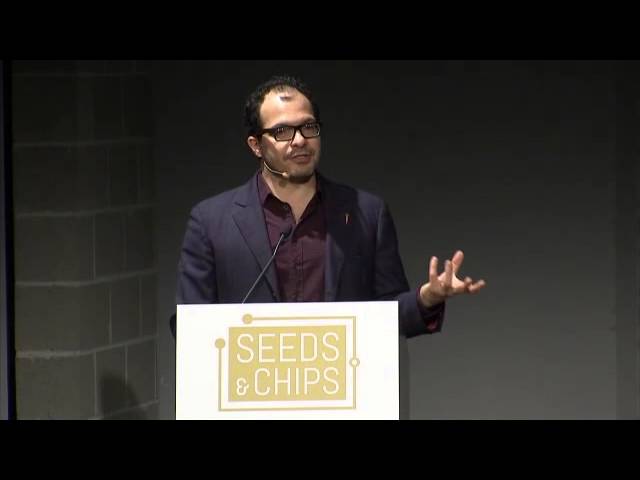
In this opening talk at the Seeds&Chips conference, Ali Partovi frames the food system as a convergence of two historically opposing world‑views: an industrial, chemical‑heavy model that seeks to feed a growing global population, and an ecological, organic model that prioritises sustainability and natural efficiencies. He argues that both perspectives are valid and that the real challenge is to feed a rising demand for animal protein while meeting a rapidly expanding consumer conscience about environmental impact. Partovi highlights major inefficiencies in the current system—particularly nutrient loss, over‑use of fertilizers, and wasteful animal agriculture—and outlines how emerging technologies can address them. He discusses precision agriculture (robots that apply inputs only where needed), data‑driven soil and crop‑rotation optimization, transparent food distribution platforms, and software that reduces middle‑men. He also examines the disruptive potential of plant‑based meat substitutes (Impossible Foods, Hampton Creek) and the role of livestock in nutrient recycling, noting that technology can optimise grazing to maximise ecological benefits. Finally, he points to the shift in agribusiness from chemical solutions to information technology, exemplified by Monsanto’s acquisition of Climate Corporation, and stresses that embracing the complexity of food systems through data, software, and biotechnology is essential for a sustainable future.
Chapters
Amo l'Italia. Sono molto felice di essere qui. And that's the only Italian I'm going to say today. So when I think about food and technology, usually when we talk about food and technology, we become aware that there are actually 2 worlds or 2 different views of the world. There is an industrial movement in food over the past 50 years of making food more industrialized, more chemical, more processed, more artificial. And the people who support this movement tell us about how challenging it will be to feed the growing population as it grows to 9 billion. But more importantly, as developing countries like China become more affluent and consume more meat, it's going to place enormous strain on our planet's resources. And the idea is that we need more technology to be able to produce enough food to feed that growing demand for meat. But there's a different view of the world as well, which is more ecological, more natural, and organic and that believes that there are efficiencies in nature that can actually be perhaps more productive. And this view has concerns about not just nature but sustainability and the environment. The reality is there's really one world and both points of view are correct. And you have to view it as we have one very complex challenge. We have a growing population. This is true. And there is a growing demand for animal protein in places like China. But at the same time, there is also a very equally valid and very large growing interest in eating conscientiously. eating in a way that is conscientious towards the environment and towards sustainability. In the United States, this is— the measure for this is the market for organic food. Today, the organic food market in the United States is still fairly small, but it represents a very large percentage of the population. Roughly 1 out of every 4 Americans are devoted organic shoppers, and the growth of the organic category in America has been very rapid. And the devoted organic shoppers are not just the— not just the rich people. They're representative of the general population in America. 1 out of 4 rich people is a devoted organic shopper, 1 out of 4 poor people, regardless of where they shop, or the color of their skin, 1 out of 4 Americans is passionate about buying organic food. And this represents the fact that ordinary people do care about our planet. They do care about not just the quantity of the food that they eat, but the quality and how it was produced. And this trend is not just an American trend. The organic sector is a very rapidly growing sector in places like China. And so the problem that we need to think about is not just how to produce more food, it's how to produce more food for a growing population, a population that has a growing demand for animal protein, but also a growing concern for the environment and a growing level of conscience and awareness of how their food is produced, and a growing desire to have that food be produced more naturally. This is a much more difficult problem and more complex. And I think the good news is that there's a lot of room for the food system to be more efficient. And I think the solution— part of that solution is going to be technology. The food system today, I think, is extremely wasteful and on many different levels. We could speak for hours about it, but just to give you a few examples, One of the biggest areas of waste is in the way— is nutrients. We all learned in school that things like carbon and nitrogen go in cycles. They're supposed to come from the ground, go through a plant, go into the body of the animal or our body, and then go back into the ground. Yet the way that the agriculture in a more and larger part of the world is now run, Nutrients are being produced via very energy-intensive chemical processes. They're mined in Morocco and then shipped across the Atlantic to America, and they're sprayed on the fields in a very wasteful way. They end up mostly washing away and ending up in the ocean, and it's not a cycle, and it's extremely wasteful. There are two different ways to approach this. One is from the industrial method is to apply chemicals and apply nutrients, but to do so with more precision so that there's less waste, applying the right amount only where it's needed rather than spraying it excessively. Or the other approach is to use ecology and find ways to eliminate chemicals and reduce the waste by recycling nutrients or by finding synergies between different crops or crops and livestock. Both of these solutions are part of making the system more efficient, and both can benefit from technology. An example of precision agriculture is robots. There are companies developing robots that can go into fields where tractors can't go. So, for example, when growing corn or soy, after the plant has raised above a certain height, You can't bring a tractor onto the land anymore. And that means today when farmers want to apply fertilizer, they have to apply it all at the beginning of the season, and so they have to apply extra because they need it to last for the whole season. So they waste a lot of chemicals there. And then if it turns out that there is a pest or disease on their crop, they can't use a tractor to apply chemicals They use an airplane and fly over, and they spray not just their own field but the whole region. So there are startups developing smaller robots that can go in between the plants and apply extra fertilizer later in the season, reducing the total amount of fertilizer application, or to apply pesticides or herbicides only to the plants that need them, not to the entire field. In terms of ecological techniques, there's enormous synergies to be had between rotating different crops as well as rotating crops and livestock. You know, generally speaking, crop rotation is not a new technology at all. It's one of the oldest technologies in agriculture, but there's still ways to make it more efficient using soil measurement to find out exactly what the nutrient content or the soil composition is in a field and calculate what is the best crop rotation to match that exact soil and how to make it so that each crop leaves the soil better for the next crop. Another area of enormous potential is in food distribution, and food distribution is already fairly efficient, but especially in the world of the future where more and more consumers want to have both more convenience and more transparency and more knowledge about exactly where their food came from. And these are all areas where technology is going to play a huge role. Technology replaces capital in a lot of ways, and we've seen in other industries, just as Airbnb has disrupted the hotel industry and Uber is disrupting the taxi industry. There are a lot of middlemen in the food business which can be more efficient by embracing technology or maybe disrupted by technology. And the process of connecting the consumer to the producers of their food is a very complex one and it's becoming more complex. And the new software that's available enables us to do so in a more complex way than we've ever been able to do before. And then I think one of the biggest areas of waste in the food system is frankly animal agriculture. Animal protein is extremely wasteful, and if you walk into the exhibit for National Geographic, they have some graphs and statistics there to show how wasteful it is. You know, every kilogram of meat is coming from a much larger amount of plants used to produce that meat, not to mention water. And there are again different approaches in which technology can reduce this waste. One, as we already heard, is there's new startups like Impossible Foods and Hampton Creek that are looking for ways to substitute animal protein with something that's made from plants. This is not a new idea, but the approach that these companies have is new, and it reflects a Silicon Valley mentality. They're not just producing some kind of low-quality meat substitute just for vegetarian people. They're trying to produce substitutes that are so high quality that you wouldn't— that ordinary consumers would not be able to tell the difference. And that, that might be impossible, and that's why one of these companies is named Impossible Foods. But they are trying to do it anyway. And if it succeeds, this could be an enormous, enormous disruption. So that's on one side. The other approach is to maintain the animal agriculture but try to maximize its synergy and maximize its ecological value so that the waste is minimized. And animals do play a very important ecological role in agriculture. For sure. for recycling nutrients. And I would say that even if humans did not eat any meat, it would still be valuable to include animals on our farms because of the ecological role that they play. And that ecological role can be maximized using technology. So for example, there are startups developing technology to help farmers know where to move their sheep or their cattle to maximize the productivity of the land. If you have too many animals on your land, you end up overgrazing and eventually the land becomes less productive and eventually can become barren. If you have too few animals on your land, you're essentially not getting the most value from your land. And so there is an optimization to be done and part of the optimization is to keep the animals frequently moving so that the grass that they're eating can grow back at the maximum rate. These are things that software can help a farmer do at the optimal point. And so there's many different ways that software and technology can be involved. It's more complex, and that's, I would say, one of the— one of the things that's new in the current movement of— the current meeting of food and technology. Thank you. Technology and food. This is not the first time that technology has been involved in food. I would say that technology has been part of food and agriculture since the very beginning, since the invention of the plow. And what's new though is that there is a new focus on sustainability and there's also a new face to the technology that is more complex. The best example of this change is to look at the change within Monsanto. Monsanto is a company historically that produces chemicals, and a little bit more than a year ago, a year and a half ago, they acquired a Silicon Valley startup named Climate Corporation. Climate Corporation is a software company that helps— that uses satellite data and other data sources to predict weather and all sorts of things, and it uses software and information to help farmers be more efficient so that they will use fewer chemicals. And this was an almost billion-dollar, billion-dollar acquisition by Monsanto, reflecting that they see the future is in software. The technology that we've had in food for the past several decades is focused on industrializing the food system. Often taking, you know, trying to oversimplify systems and using chemical technology and monocrops, monocultures, whereas the new face of technology in food is embracing the complexity of the food system. It's much more complex. Rather than trying to simplify it, it's realizing that to get the maximum efficiency, we need to understand that ecological systems are complex. connecting people to the producers is complex. And the new technology is not chemical technology, but it's information technology using data and software or biotechnology. And so I think it's a very exciting new realm, and I think we're only at the very, very beginning of it. And I'm very excited to see what the future is going to bring. Thank you very much.