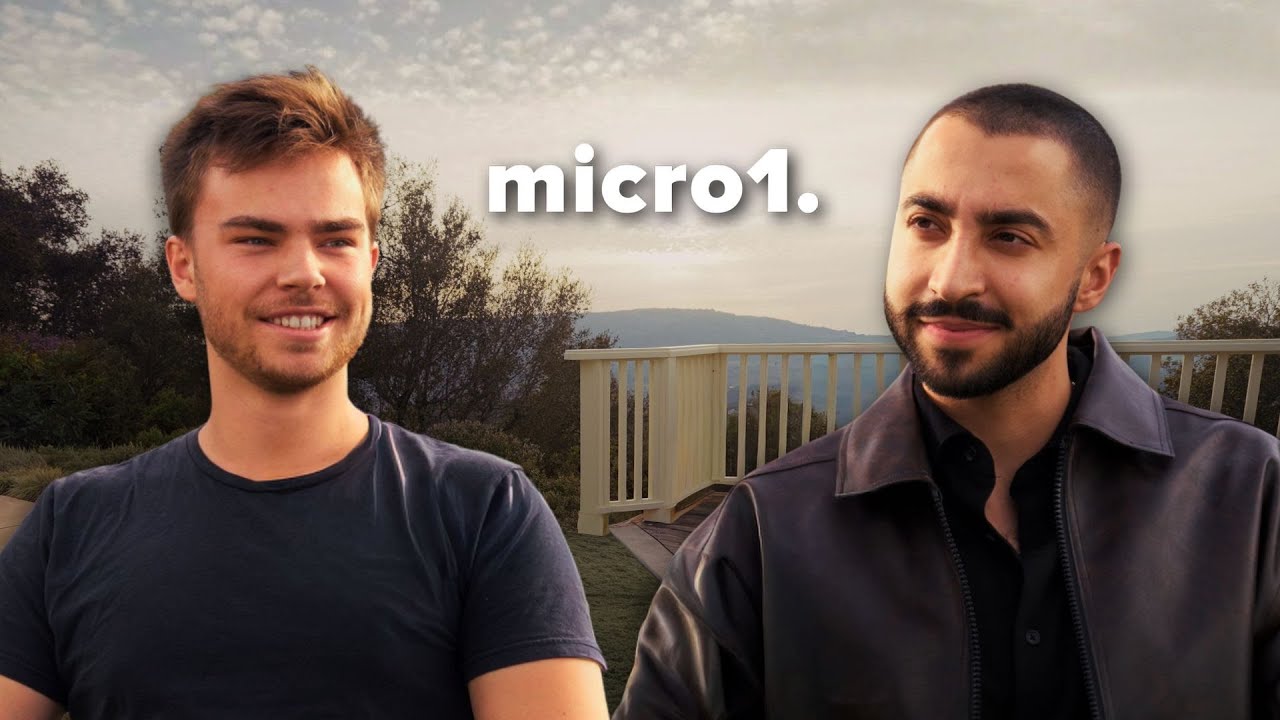
micro1: The Next Multi-Billion Dollar AI Startup (Founder Interview with Ali Ansari)

Ali Ansari, founder of MicroOne, discusses how his company pivoted from AI recruitment to supplying post-training data for large language models. MicroOne grew from $8M to over $150M in revenue in a year by providing high-quality data that has become the real bottleneck in AI progress, not compute.
Chapters
What up, HyperChange? Welcome to another episode. Today we've got an exclusive interview with one of my favorite founders who happens to be at the epicenter of the AI space. We've got Ali Ansari from microone.ai coming on the show. Ali, before I give you one of the most epic intros ever, welcome to the show. How are you doing today?
I'm doing good. Really excited to be here.
Awesome. So I wanna fill everyone in 'cause we're in for a big treat today. Ali right now, he just got written up in Forbes. They're talking about Ali as one of the youngest self-made billionaires in America, potentially because his company Micro One has gone from eight mil to a hundred mil in revenue this year. They've kind of exploded. They do. They're in the AI training space, working with all the major AI labs. So I'm I'm pumped to get a front row seat at what's going on in the AI space. And what people don't know is HyperGwap has been investing in Micro One. We've tripled down for years now, and we've seen Ali build. this from the trenches. It's truly like an amazing and epic success story. Um, so I'm, I'm just really fired up because we've been working on this behind the scenes and now Ali's like crushing it, ready to go out to the world. So Ali, tell us, what does Micro One do right now? What, what business are you in that is so on fire that is putting you at the center of the AI revolution?
Yeah, well, first of all, Gali, I'm, I'm never gonna forget the sugarfish dinner that we had years ago and, and, uh, you know, multiple dinners that came after where you guys followed on. So appreciate you guys' early support. But yeah, what we do at MicroOne is we're, we're building the AI platform for human intelligence. So what that means is we vet highly skilled people, mainly PhDs, professors, and industry experts, and we help train frontier LLMs. Um, so there's kind of 2 pillars to our data engine product. The first is our AI recruitment engine, which we call Zara. That essentially helps source and vet experts in different fields for any given AI training job. And then we have a data platform where, you know, it's where the experts essentially create data. We have a bunch of review mechanisms built in, and then it's ultimately where we deliver the post-training data to our customers. And right now we're very grateful to be working with most, you know, most of the frontier labs, the Max 7 and other really awesome customers.
And so tell us, like, what do you actually do? Because you're the human part of AI in some ways, which I think is a little bit counterintuitive. But one of— maybe for people that don't know, fill them in on what's going on behind the scenes here. One of the fastest growing parts of this AI sector is like you actually hiring humans to correct the AI. So I kind of have a few follow-ups there because I'm wondering, on one hand, is this the start of a massive new industry that's going to be, you know, that we're witnessing? Or is this just a stepping stone to a true sort of AGI world? So I'm kind of curious how you think about that.
Yeah. So the best way to think about it is the first step of training models, LLM specifically, is, um, you know, pre-training where you take really large datasets, the internet and other equivalent large datasets, and you get the models to be generally knowledgeable. And then after that, you know, you sort of run out of these large datasets. And if you take any, any other very, um, large dataset, the quality of it is kind of similar to internet data. And so you're not going to get any kind of major improvements on model capability. So the way that AI labs now improve their models and, you know, across many domains is, is in this phase of post-training, which is the researchers essentially come up with data structures that they think is useful to improve model capabilities and that are also like emergent in nature. So if they want to improve in finance, let's say they want to make sure the model improves beyond finance and like there's some general improvements as well. And they, and what this requires is basically net new data. And that net new data comes from human experts that are, like you said, you know, correcting the models. They're essentially trying to stomp the models on very difficult requests. And once the models are not able to answer these requests, they essentially create the, you know, the data that corrects that. And so the labs, you consume all this data from MicroOne to train their multi-capabilities across finance, medical, legal, and other domains.
And what do you say to the people who are kind of like me, like not confused, but like I feel like whenever you have a big new industry, it almost like you feel like it could be a flash in the pan because it wasn't here before, but that's how every great new thing starts. And it could be, so how do you view, you're at the forefront of this interaction between humans and AI. How do you view that? Are we in a, you know, a 5 to 10 year window? of still needing to kind of train these models constantly and constantly be refining them? No.
So the way we look at it is human data will be forever. And there's a few reasons. One is human values, rules, and overall kind of judgments change over time. And we need to continue aligning models with society at large, right? The second reason is There is no limit to improving models. You can improve them in so many different domains and so many different environments. And the way that we sort of look at AGI at MicroOne is that it's not going to be this like binary thing where we reach it. It's more of this like continuous improvement of capabilities where a lot of, you know, the state of a lot of jobs change to, from like a lot of tedious work to managing an agent that does the tedious parts on your behalf. And we have to, we have to, you know, improve the models across all of these domains, which is, uh, there's an infinite, uh, combination of subdomains that exist. Now, if you extrapolate that to, so, so that, that's frontier evals for LLMs, right? And the way to think about that is it's a very subset of, of the world, right? It's just, it exists within the laptop and that is obviously a very small part of the world. So now you can imagine what, what happens when we, when we start training physical, physically intelligent models, which is, which is happening now with like humanoid robots and so forth.
Wow.
And those systems need to be trained on even more environments that represent the physical world itself. And that data demand is just now starting. And the phase that we're in for physical intelligence is very much like pre-training where we have like generalists creating very basic videos of themselves doing things and training models on those. And it'll take many years for that data to eventually get to expert-level data where you can imagine like Experts doing things in the real world for the purpose of training these, these robots. So the, the, the, I think that the way that I would conclude this is you, we will continuously strive towards modeling the world itself, but we will never, never be able to fully model the world. And until we're able to fully model the world, we will need human data. And that's an infinite continuous strive that will, that will, that will never achieve, but we'll continuously strive towards it. Yeah.
Interesting. And one of my favorite things about you as a founder is the adaptability, because I feel like this Micro One wasn't even in this business. You guys have had a few different businesses since we've been following the company, but you've been in this kind of frontier, you know, cutting edge of AI. And so my bet is kind of like, okay, Ollie's in this space. I feel like there's just, it's kind of like a sandbox with so much potential. And now you've started to see like that actual traction hit, you know, $8 million to $100 million in less than a year of revenue growth. like you're over $100 million revenue rate. Like, that's insane. And I will add, I don't know, we can cut this if you want, but you're also like kind of profitable. Like, it's not like you're like OpenAI burning gazillions. Like, this is actually one of the best models. This is more looking like Nvidia-style model in terms of AI. So at least for now. So the business is on fire. So I wanna ask you a little bit about what's it like been, you know, the past year at Micro One, kind of going from, I don't wanna say on nobody's radar, but you know, when we first invested in you, kind of on no one's radar to now like getting written up in Forbes, Must be scaling incredible with employees and customers. So give us a little bit of behind the scenes of what that's like to be at like one of the world's fastest growing startups.
Yeah, so, uh, exclusive to, to HyperChange, we'll confirm that we are profitable. And, and, and, and we've been actually, it's funny, last month we, we became, or maybe like 2 months ago, we became, uh, net profitable all, all for all of 2025. And And historically, historically at MicroOne, we've lost less than $1 million now. So it's been a, you know, it's been an incredibly capital efficient journey, which is kind of the, you know, the way that we like to run things, very lean in terms of team and very lean in terms of like softwares and so forth. But yeah, I mean, I think the, this year, like you said, we started at, you know, less than $7 million run rate. And if you take end of December, we're actually at like $4 million run rate. And now we're well above $100 million. The $100 million was a bit old, reported a few weeks ago. We're now surpassing $150 million. And so, you know, it's been a really nice 25+X this year. And I think that the cool part is like we've tried to keep the team very lean while doing that. We started the year with like 35 people or so. And now, you know, obviously we've grown a good amount, but we're still only at around 80. So, you know, there isn't, it's definitely not proportional to like the revenue growth, which has been fun. And hopefully we keep it this way.
That's awesome. Okay, well congrats on all the big year. What do you think about the applications for AI? If I'm talking about, you know, OpenAI's got a trillion in commitments, Is it bubble talk or is SpaceX IPO with data centers in space kind of showing us that the people in the know are saying we're just scratching the surface on this data center buildout and the capabilities of AI? You know, what's your take on this AI is in a bubble, bubble talk?
I don't think we're in a bubble. I think the way I look at it is like there's 3 fundamental limiting factors to AI improvements. And those are compute, data, and algorithms. And data is like, compute is very much emphasized. Like there's a lot of spend on compute. And I think rightfully so, like we need a lot of compute for training, pre-training, post-training, and then of course inference. Algorithms is one that kind of just requires like great talent and it's It's one that you can't really like scale. It's more so researchers, you know, researching and coming up with more efficient ways to train. But I think that the limiting factor that has been underrated actually is data. And it's really like the bloodline of AI. The way that AI models learn anything is just by getting really good data in any function that they're trying to learn. Um, and so I look at the next phase of AI and like how we really get production usage in enterprise, um, through more data. And, and one example I'll give you is, um, you know, I think 2025 was like supposed to be the year of agents and it like sort of wasn't.
I almost forgot about that, but I'm like, you're right. It was like, but it still didn't come out yet. Right.
So, you know, there's, there's obviously like a lot of good use cases in terms of like coding, customer support, and like These use cases are clearly, um, you know, improving productivity and so forth in like very material ways in the economy. But, but I think that where the reason why we actually have not seen very widespread production usage of agents across enterprises is actually because of data and specifically because of what I would categorize as contextual evals, which is—
Ooh.
The simple way to put it is like enterprises need to Very, very closely measure the capabilities they want in any given niche agent they're building within their workflows. And to do so, they need a lot of evals, a lot of eval data. And I think it's an area where enterprises have not yet really invested in. And what I predict will happen in 2026 is essentially evals for enterprises will become like a very normal part of their product lifecycles, like it'll become a very material percentage of their product budgets. And I think that will result in AI being used like truly in production within these enterprise workflows.
Wow. And so what are you seeing as the kind of like hot areas of AI adoption where it's really changing the game and pushing it, you know, where you're seeing the most experts kind of really dabble? Like, is there any particular areas of AI that excite you that are moving fast?
Yeah, I think the 3 domains where we see the most demand are finance, medical, and legal broadly. And within each, there's some niches that are very much emphasized based on market demand. But one example is like enterprise law is a very good use case for AI. And we see a lot of our customers building agents very specifically for enterprise law. So we have a lot of I think we have over either close to or over 1,000 lawyers that are working at MicroOne that are just, you know, creating data for these use cases to improve models.
And so it would be a company who's trying to build an AI lawyer essentially that would be hiring you to find those legal experts?
Yeah, so it's either that, it's either like an AI application company that's building, you know, some some tools for lawyers, or it's the foundational model companies that are improving their models in the area of legal. And those are like, there's a lot of overlap there, but the specific legal domain improvements is where most of the human data demand is growing.
So how do you feel like this is going to evolve a little bit, like on the broader AI landscape? Like you're seeing, you know, OpenAI raise at $800 billion or whatever, like Are you bullish on that, or do you think people are assigning too much of a winner-take-all to these kind of OpenAI, Gemini, Grok, and there's gonna be sort of these smaller mid-tier of AI companies emerge, or the big company's gonna squash everybody?
So I think generally bullish on that, but I do think the caveat is, We, what we're sort of seeing is that the way to improve models generally is you simply have to improve them in every single niche domain. And the combination of all those niche domains results in general intelligence. So I think what that means is that there will have to eventually be a sort of a focus of these like big foundational model companies where Of course they are building general intelligence, but they will sort of have to emphasize a few domains that they want to kind of mainly improve in. So I think, you know, what that results in and what you can infer from that is there is going to be smaller model companies that just focus on specific domains. And that's why I'm also partly bullish on open source because if you take, you know, the recent NVIDIA model that was released as the open source model they just released. You can essentially take like a very nice, smaller, pre-trained model that understands, you know, English and like general kind of has general knowledge. And then you can focus your post-training efforts just on one domain. And I think there's going to be a lot of that that happens. And, you know, there, I think it's called like NeoLabs or something, or like the smaller labs that have these very niche focuses. And I'm I'm quite bullish on that.
Interesting. I feel like it's such a, like, there's, it's changing so fast, the landscape. So when you're at Micro One, what do you think of as like your core competency as a company? You know, when I think about Tesla, it's like, well, their ability to build batteries, their software engineering team, their manufacturing, their in-house chip team. So, you know, if you think about kind of if Micro One was like, I don't wanna say a Pokémon or something, but what would your strong moves and like powers kind of be that you think about as like, oh, this is a thing that Micro One's good at that Is a core competency that's gonna have value in this new AI landscape?
Yeah, it's a great question. I think I would probably point at 2 main things. Um, one is our vetting capabilities, vetting talent skill sets. This is probably the most important part of all that we do. When a data request comes in, We need to be able to deeply vet the talent at a very large scale in a very quick manner, um, you know, through our AI vetting engine. So I would say broadly, the fact that we can kind of predict the performance on, uh, of talent on any given role, um, is, is a core capability of ours. Um, and, and I think the, the fact that we're involved in the very involved in like the overall data pipelines and like what happens on these AI training jobs. We're able to collect a lot of ground truth performance data on the actual job, which helps us train our vetting model. So it's a very nice kind of like feedback loop that, that exists.
Interesting data, a bit of a data flywheel going on here.
Exactly. Exactly. And I think that the second thing I would say is, um, like data pipeline design and operations. Um, you know, we have, uh, obviously the data platform where experts, you know, create the data. There's a bunch of review mechanisms built in. And so we have this like unique ability of knowing what data the labs will need and like kind of proactively creating those datasets as well, which sort of leads us to like MicroOne Intelligence platform where we want to create a bunch of like RL environments to basically sell to labs.
Okay, so what you mentioned just there is super interesting because now something's clicking of like you're helping AI learn. That's kind of the technology that you have, which there should be no limit to because like We go into space, we hit some new planet with all these new, you know, minerals on it. It's like, well, now the AI is gonna have to learn and start training. And that whole system of the data and how it trains is kind of like the learning of AI itself. So talk to us a little bit about what you just mentioned there, where MicroOne's headed with these kind of future RL environments, because I think that's, that just made it click for me a little bit more of like what MicroAI is really doing.
Yeah. Yeah. Yeah. So it's, um, I think ultimately our goal is to really build the data infrastructure for AGI and that, that's in a, you know, in a, in a physical sense as well as in a, you know, LLM sense. And the, I think the way that we're doing it is through what we call the MicroOne Intelligence Platform, which, which is essentially the, the, the long, the current state of the intelligence platform is we're creating A lot of data that we believe will be useful to labs proactively, and the labs are buying those non-exclusively from us. Um, and you know, there's sort of like a catalog of, of RL environments and datasets that exist that labs can, you know, purchase from. But I think that the, the, the, the, the long-term vision for this is we, we want to essentially create what's called reward models that come out of these datasets and, and RL environments, which is basically the the model that the policy models, which are the foundational models, train on. So they sort of like, eventually the policy models will be able to connect to our API, which are, which are these reward models across many different domains and kind of like depend on our API for improvements in that domain that they've connected to. So that's like the, that's the vision of like the data infrastructure that we want to build.
Wow. So that could, MicroOne sees itself as not as really a key stack. Of the future of AI. Super cool.
Exactly.
I wanna dive into your background, but before we do that, I want a hot take. I have a hot take question on— I'm a Tesla investor, obviously, and I'm bullish on Optimus, extremely bullish on Optimus. What's your take on what's going on with the Optimus program? You know, you give us a little bit of flavor of the robotics in real life, AI in real life. That's kind of an— which is awesome, an entirely new Sector for you to focus on. Behind the laptop's one thing, real world's another. So you're, you're at the cutting edge of like Figure robot, Tesla Optimus, these humanoids. So give us a little, give us a little something, you know, like is, how close is Tesla to, cuz I think they're gonna build a few thousand of these bots and get them working in the factory on some very easy tasks. That'll be like the little slice that starts, and then they're gonna start adding more and more tasks. But give us a little flavor of that kind of humanoid. Are you excited about that? Do you think the market kind of understands how big of a deal that's going to be for the economy?
Yeah, I think that the market does not fully take into account how much of an impact truly intelligent physical systems will have. I think that in the fullness of time, these systems will Completely automates all the tedious parts of every job and humans will kind of like operate these machines and humans will be able to choose the fun parts of their job and just do the fun parts. I think there's a similar analogy that's happening in like AI agents, you know, within the laptop. And that's, you know, like if you take an example of like a Recruiters, like obviously we have an AI recruiter agent is like one concrete example, which is our recruiters no longer take interviews, which is like a very tedious part of a recruiter's job. And they do the very creative strategic parts of their job now, which is like, how do I actually get this right talent to sign up? And that's like a very fun thing for, it's a much more creative part of recruiter's job. Now you can, you can apply the same analogy to like every other job, like coding and customer support and so forth. And then now imagine physical intelligence where it's not just digital jobs, but literally every job. So I think the impact is going to be large. And I think when Elon says every job will be displaced in the future, I think—
Like work's optional kind of.
Exactly. Like every job will be displaced and work will be optional. I think that's a beautiful thing because humans will be able to do the fun parts of all the jobs. That's one. I think the second thing is, um, the, the data need for physically intelligent systems will be very large, like orders of magnitude larger than, than what LLMs need. I think the reason is simple. I mean, there's just like many more dimensions to, to physical intelligence and you need to train on, on those extra dimensions. And so, you know, what, what, what we're seeing is like, there's like 2 main kind of like data types, um, that we're also collecting data on. One is. Tedal operation data, where you essentially have humans like operate robots and you have the humans kind of make the robots do optimal actions in a bunch of different settings. And then you take those and you then train the robotic brain on. And then the other, which we're, we're, we're, which we're really bullish on is like human demonstration data, which is like humans doing things in the real world and like recording themselves doing those things. And then, uh, and then having the robots train on the human videos, basically. So that's like, I think that latter pipeline is like what we're super bullish on because you can really scale that to very large amounts.
With a VR headset or something? Like, do people need to be wearing Meta glasses or something? Exactly.
Some hardware like that, or even like an iPhone with a strap and kind of like a first-person view. And then we take those videos and annotate them with like real actions for VLA models.
Okay. See, that was interesting, but I want a hint more gossip on Is it, is it soon though? Like, you know, the timing, because you're really at the cutting edge of the learning.
I don't think it's soon at all, frankly. Uh, there's, um, there's going to be a pretty long, uh, learning curve for, for what I would categorize like generalist pre-training data for robotics. Like robots are, are not yet good at anything is the truth. Like they can, you know, they can barely walk and we have to first get them to walk and do like very basic tasks. And I think that'll still be a couple of years until robots can do these like very basic things. And once they can learn these like very basic things, I think in, you know, I would say probably a 5 to 10 year horizon, we will start this like sort of like post-training phase of robots doing actually useful things, which will be more than like the generalist data that will be required. So I think we're quite far still is my view, but of course, yeah. A good, good, good alpha vest.
So lot, lot of guap for Micro One to make in the meantime is what I'm hearing. But, um, uh, okay, so let, let's rewind a little bit because how did we get here? Micro One being at the, the epicenter of how to train your Tesla bot, but also when we invested in it, it was, you were sort of like connecting, it was still kind of the same business, but different. It was connecting smart people, helping manage remote workers. So tell us like the story of Micro One. Like what did it start out as? Why did you start the company? You know, take us back.
Yeah, so I started the company when I was in university through like a personal need for one of my previous companies. I had this software development agency where it was like a very service-oriented, you know, kind of like build websites and apps for other companies. Nothing special. But one of the living factors of the company was I had to, Every time a project would come in, I had to basically assign new engineers to that project. And therefore I had to like interview a bunch of engineers all day. And like a lot of my time was spent interviewing people. And so I developed this, um, it's like AI screener a few years ago using one of the early GPTs to help me interview engineers essentially. And that AI screener was a, it's like, you know, conversational system that talks to the engineers and they gave me a report on how they did. And then I would, you know, interview the good ones and hire them. And this essentially became, um, MicroOne. Um, like long story short, I basically decided to focus on this product, um, instead of the agency and like basically shut down the agency. And initially MicroOne was this, um, you know, it's like AI recruitment engine only where we sold the software. Um, companies used it to source and vet talent. And then we also had a marketplace of basically hiring engineers and other product people for for all these like development roles. And then eventually we saw, you know, within like a year or so into the company, we basically saw that this world of human data and post-training really requires experts. And because it requires experts, there's this new kind of limiting factor, which is the recruitment of those experts. And so our AI recruitment product ended up being a really good use case for this application. And so we decided to kind of go all in on it and just serve this human data world. And now, you know, we're building the infra for data basically.
And so how do you know when to disrupt and pivot and change your business? Like you're following this intuition that keeps leading you to bigger businesses. So how do you, what is your north star when you think about why you're doing what you're doing? where, like, where this is all heading? Or like, are you kind of just in it seeing what has value? Like, I don't know, it seems like you're always one step ahead. So I wonder what that North Star is that allows you to kind of stay nimble.
Yeah, I think the main thing is like, we're heavily product first. We, you know, we build, we try to build the best product possible and we listen to the customer. Um, deeply and, you know, listening to the customer kind of results in these iterations essentially. And I think one of the, one of the things that we noticed, like, you know, early on is that our biggest customer and customers like very quickly became these, these labs and it outgrew the rest of the business by like a large amount. And we, we naturally decided, okay, we need to, um, kind of iterate our product to basically only focused on this customer base because it, it, it like became quickly like 90% of our revenue. So that's, um, you know, we, we sort of adapt to, to the market that way while staying very product focused, uh, in terms of like the AI recruitment product building as well as the, the rest.
And have you always had this entrepreneurship, you know, uh, itch in you? Or tell us a little bit about your story. I know you came to the US at a young age. You know, let's hear a little bit about, about little Ali back in the day.
Yes. So yeah, I did come to the US when I was 10 years old from Iran. And I kind of look at it as I got pretty lucky by just kind of randomly starting the entrepreneurial journey early on. There was like a very, really like random story of like my mom basically telling me Hey, like you're on your phone a lot. You should try to make money as you're, as you're on a phone. And I was like, I was like 12 or something. And I was like, yeah, like, let me, let me try it. It sounds, sounds good. And the first thing I did is I basically went on eBay and, um, I started to sell actually like my dad's shoes and like my dad's stuff on eBay. And like the first, the first sale I made was my, uh, like some loafers that my dad had basically. And then I, uh, I remember I like very much like undersold the, the, the, the shoes and like it sold very quickly because of that. And I went to my dad and I was like, look, like I just made money. Like I just made like $80 or something. And he's like, what the hell? Like selling my shoes? Like don't, don't sell my shit. And then, and then my mom was like, wow, that's great. Like keep doing that. So, I mean, obviously I quickly realized that, um, we can't like, I need inventory. I can't just like sell everything in the house. So I, I started to, um, I started to like go to like garage sales and like buy stuff and resell them, uh, on eBay and Amazon and so forth. And then I, um, I found like a niche in, in my garage sale, you know, endeavors of, of textbooks. Um, and the reason for the niche was actually like a pretty funny reason. I just, um, I would bike to garage sales and I would take a backpack and like what would fit well in the backpack was textbooks. So I was like, all right, let me just like only buy textbooks.
This is our focus.
Yeah, exactly. So, so I started to buy and like, you know, resell textbooks and I was, um, I was basically going to garage sales, Goodwills, et cetera, you know, flipping, flipping books. And I was trying to think of ways to basically like, like scale this operation, quote unquote. And so I, I developed this, um, this website called Cashbooks Now, which basically, um, allowed college students to sell back their textbooks when they were done with it. So it was kind of like the garage sales were coming to me in a way where colleges go on the website, they would enter the ISBN number of their textbook, they would get an instant quote of how much we'd pay for the textbook. And then I would take those books and basically, um, you know, resell them on Amazon. So that was my first, like, you know, entrepreneurial journey. And then it kind of became, uh, there's like this, like, nice, like, feedback loop that started early, which I feel like very, like, lucky for because it was kind of like randomly started early. And then I just like kept going, uh, you know, the entrepreneur path.
Nice. And then you went to Berkeley. Did you, are you a dropout or did you finish Berkeley? Because you're only 24 now, right? Like you, you started this in college.
Yeah. Yeah. I, I was, I was about to drop out, um, my, my third year. Um, but instead of dropping out, I, uh, I was, I was, I was doing CS and math, but, but I, I decided to just, uh, drop math and just finish with CS one year early. So I was like, yeah, this is a good compromise.
Crushing it.
Okay.
So that was, that's some good flavor on the past. What about, what about the future of Micro One here? If we fast forward to 2030, you know, looking ahead, Micro One's red hot right now. I'm always thinking of like, you know, as a Micro One investor, I'm always like, you can't stay red hot forever. Like it's just, you can't. But then Micro One seems like it just keeps getting, it keeps, you know, and now understanding the business today, I'm like, damn, like this whole humanoid physical robot intelligence. I didn't think of that as a massive new growth engine for MicroOne, but I'm kind of seeing it. And you did the website rebrand, you put out this super cool video, kind of like giving us a flavor of like sci-fi weird future like that. But yeah, give us a little bit about where your head's at with, you know, where the future of MicroOne's gonna be.
Yeah, so I think we're focused on 3 main categories of data. The first is, of course, frontier evals for, for foundational model companies, that's going to continue being a really big part of our business. And what, you know, what we hear from, you know, what we sort of see in the market is that, um, this spend from the labs, that's like roughly $10 to $15 billion a year right now, is going to double probably every year or so, maybe even less than every year.
So, and that's $10 to $15 billion they're spending on your kind of business, basically.
Exactly. On just, uh, on just human data for post-training. So. That market is gonna continue to expand. And that's gonna be, you know, continue to be a big market for us. The second is enterprise AI, kind of similar to what we were saying earlier, which is contextual evals, which is not really a market yet because these enterprises don't yet spend on human data. But I believe next year this will be either equal to what the labs spend on human data or maybe even more. And the reason for it is because there's There's like, you know, the Fortune 1000 broadly has to basically spend on human data. And there's obviously, there's 1,000 of them versus like, you know, 10 labs and they're each going to spend way less, but there's simply a lot more. And so that's, that's an area that we're very excited about that we were kind of, you know, we were getting into heavily. And then the third is physical intelligence, as you said. And there's one main pipeline that we're very bullish on, which is the human demonstration pipeline. And we have almost 1,000 people actually creating data for that currently. All around the world, like 20 different countries, uh, of folks basically recording themselves do things that they already, uh, do at their home, getting paid for it. And, and, uh, and to train a, eventually a robot that'll help them do those tasks in the future. So that's—
Wow. That's, I'm like, I want to get into, I'm going to start doing tea. I love making tea. I'd be so good at training a robot to make tea. I'm just throwing that out there.
Yeah. So that's, uh, you know, that, that's sort of how we see the, the the next 2 phases of Micro One of like these enterprise evals and then physical intelligence. Wow.
Okay. I'm just riffing, but I'm like, I don't wanna say Harvard for robots, 'cause I feel like Harvard's been losing its swag, but like learn, you know, robot education or like robot improvement. Like I feel like Micro One is kind of in the sweet spot of this new emerging industry. What do you say to the rumors of your, the $500 mil seed round? Or valuation seed round. So now you're on the door of unicorn company. Forbes is putting out these rumors of a $2.5 billion valuation round upcoming. What do you say to the people in the press who are all wondering about MicroOne, you know, this, you know, the valuation buzzwords?
Yeah, yeah. Well, you know, I could say that we're not taking any offers at $2.5. We are gonna raise soon, but You know, it'll be well above that value is how we're thinking about it. And I think we'll raise in the next like quarter or 2. We wanna kind of hit some revenue milestones first and then we'll go to the market and raise. Wow.
This is just, Kainani, but how do you stay like kind of rational in this era where everyone's throwing money at you? Even people email me and Aiden being like, will you guys, will HyperGuap sell its Micro One stock? And it's like, I'm like, what, dude, we're getting it. You must be getting these emails nonstop. So how How do you stay focused and disciplined here? Because on one hand, the valuation's awesome, but on the other hand, it doesn't really mean anything. You know, you're on a long road here and it's, I've seen companies fizzle, hit a few billion from, you know, a couple million and fizzle. But also, so how are you kind of staying focused and humble here?
Yeah, so I think, you know, we're obviously really grateful to have interest in terms of investments. But we, we sort of look at it as we need to take those calls when the time is right, um, just to not waste like the investor time as well. Um, so we kind of do it in a very short window where we're about to start raising. And, you know, even though, even though we've been like very capital efficient, this market is very, very capital intensive at the same time, especially with the MicroOne intelligence platform, our goals to spend, frankly, like millions of dollars per RL environment. And it's a sort of a continuous spend that needs to happen for the reward model to keep improving. And so, you know, we want to have cash in the bank to be able to kind of invest in these areas.
Thank you so much for your time, Ollie. This is like epic. You're one of my favorite founders and homies. It's great to catch up with you. So I hope everyone enjoyed it because this is a treat. to hear from someone who's so in the trenches at the cutting edge of AI. So thanks a lot for joining, and, uh, we'll keep rooting you on and, and hope to have you on again soon.
Amazing. Thank you for having me.
Yeah, thanks, Ali.