WEBINAR—Learning in the age of AI - Alin Vrancila
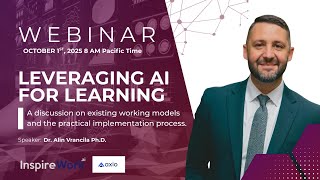
Alin Vrancila argues that using AI as a replacement rather than a partner in education creates cognitive debt, weakening neural engagement and skill development. He presents Neogoji, a five-principle pedagogy, and an AI-first learning platform that pilots reported 90–96% learning-success metrics.
And I must admit, I'm completely confused. I don't know what to do. I don't know which solution to go with. I'm very, very lucky in that Alan is one of the best friends that I have. Okay. I'm delighted that he's been able to join us today and give us his perspective on AI and what's happening in the world. Alan has, has got an exemplary career. He's one of the leading voices in the field of AI implementation and transformation across schools, university publishers, and corporate learning. He's consistently two steps ahead of the rest of us. In my case, probably about 200 steps ahead of me, which is why I have invited him to join us today. He holds a PhD in Artificial Intelligence in higher education, has done doctoral research at Oxford in online learning, and today he's studying how AI shapes the future of education. In this webinar, he'll talk through tested models, look at practical frameworks, and give us real world insights. Enough of me. I'll hand over to the person that we've all come to listen to. So thank you for joining us, Alan, and over to you.
I see that my mom sent my accomplishments to Paul.
She did, she did.
Paul. Very excited. Thank you to my mom for reaching Paul.
It sends some photos as well, but I've chosen not to.
Relentless in finding people my accomplishments. So welcome. Welcome everyone. I, I truly am honored. I think the room here has more experience than I will ever have. And I am truly humbled to be in front of you to maybe not as much contribute with knowledge because I really think quite a lot of you have already wrestled with maybe the thoughts that I'm giving, but maybe just spark the conversation among us to figure out what is really happening in, in the world or what in the world is happening and especially what are changes happening around us have to do with the field of education. I have invested now a significant chunk of my adult life into higher education. I'm going on 15 years out of my 20, and this is, this is now becoming a life passion, a lifelong passion for me to figure out how do we educate better? What happens. I came into the field of online learning when it was ashamed to say that you're teaching online. Anybody remember those days? It's like 12 years ago. And if you taught online, you would never admit, hey, I work for this university, I'm an adjunct faculty. But you would never admit to your mom or to anybody else that you're teaching online because he was ashamed. And then in my lifetime, we went from that not being a thing to that exploding and being a significant thing. And then still in my lifetime I'm now going through the second revolution in education and that is going from, from online to AI. And what I'm signaling to the group already is the concern that I have is that we've actually not learned a lot of lessons from our first revolution. And I feel like we're repeating some of the same cycle and we're now forcing faculty to teach with AI and I could hear the echo of the words of us forcing them to teach online so we're not learning much. And that's why I've made a complete vow, a personal vow. I'm sorry that you actually supporting the consequences of my personal vow that I will not do the same and I will not make mistake mistakes as long as it depends of my area of influence. I want us to do things completely different and learn from, from our experience there. So let me, let me share just a few really quick thoughts. I am going to share my screen and I apologize for that and I want to walk you through just a few things that, that I've observed and then I will end in. So I want to take 10, 15 minutes in this and then I will want to take you to the practical sol we have developed. Implementing. Implementing. Let me move away from seeing my face on the screen. Implementing a different solution. I would say a completely different solution than everything I'm seeing on the market right now when it comes to AI. And then I want to open us, open the floor for conversations for us to have a conversation about this. So let's, let's have a quick conversation right now. What I can tell you is first of all I want to say good morning and good evening to all of you from wherever you are in the world and outside of us, everywhere in the world. We, we might be touching on quite a few continents here. So I'm excited. I believe that we are living through the largest uncontrolled experiment in human cognitive development in history. This is, this is a huge statement. This is a strong statement. Every day millions of students and professionals are using development, are using AI tools to think. This is the concerning part for me. Write, solve problems and learn. Here's what's remarkable. We are conducting this experiment so widespread adoption without understanding long term consequences. Potential. The early, early research is already showing a potential. Actually, did I, did I share my screen? Do you see my screen? Okay, perfect. The early research is already showing potential, potential permanent changes to the neural pathways the way we think. Right? So early research is already there the research is clear. We're conducting the largest uncontrolled experiment in human cognitive history. The defining paradox of our time. I can produce better work than ever, but feel dumber than ever. One of the most powerful statements I've seen recently is AI democratize the feeling of knowing without the burden of understanding. And reality will provide feedback shortly. And what, what I, what I want to highlight here is if you've, if you're an educator, and if you've been an educator for the last two years in the field of education, one thing that you've observed and you've seen is students producing outstanding work. But if you ask them a question about their work and if you just say, okay, everybody close your computers, close your thing now. Let me ask you a question about the paper that you just wrote. You wrote it. This is your name right here. Here's your name. You wrote this paper. Now let's have a conversation about your paper because it's really PhD level work. Fantastic. And you're in high school, so let's have a conversation about this. And there's a massive discrepancy between the work that is being produced and the knowledge or the thing. So I really like this. The feeling of knowing without truly the burden of understanding. So higher quality outputs, but reduce cognitive engagement, disconnection from one's own work. And that for me, I think, has way more implications than we believe. And the hollow feeling after AI assisted tasks. The rapid rise of AI and learning 50% of US colleges students enroll in online courses in 2022 and in 2025. I can tell you this, this, there's 20% growth by 2030 in online learning. The rapid adoption of AI and education is driven by demand of flexible, affordable learning options. It's almost the same, the same thing we've done with online learning. Increasing comfort with digital learning environment. Institutional investment in AI power tools. Student expectations for personalized, personalized experiences. Here's something I want to highlight to you that I think is really important. I picked this up from quite a few articles. The rapid rise. The rapid rise in of AI in coding and computer coding. In 2024, AI models ranked around 10,000 globally in coding competitions. This is in 2024. In 2025, it placed second place. It moved from the 10,000 place to being ranked second in coding competitions. Meanwhile, coding has become AI's most popular use case. GitHub reports 90% of developers now use AI tools. Stanford's data shows that AI solved 4.4% of coding problems in 2023 by 2024 that number jumped to 71% and SIHO, SIHO, Siho, however you want to name him is he beat AI OpenAI in coding competition. He humanity, humanity has prevailed. He will be potentially the last person to beat OpenAI in a coding competition. He said I'm completely exhausted. I figured I had 10 hours of sleep in the last three days and I am barely alive. 600 hours of coding and this is the last person I would say alive on earth that will ever be artificial intelligence in a coding competition. And he said I am barely alive. I mean it's a significant thing. But for me the jump here from 20, from, from 23 to 24 of 60 to 70% jump in coding immediately, immediately. When I saw the statistics, immediately my heart went to the impact of education. If we think that this does not have an impact in education, that Facebook and Meta has fired most of their mid level programmers and already replaced them with AI. I really think we need to pay attention to this. So the cognitive blind spot. Why can we trust our own perceptions about AI? The Meter Research Team 2025 made a statement that was powerful and said the persistent overestimation of AI benefits may reflect cognitive biases similar to those to those observed in the studies of intoxicated drivers where the very thing that impairs judgment also impairs the ability to recognize that judgment is impaired. Basically, to put it in non academic terms, you're drunk. Like you don't know you're drunk because you're drunk. We have now fully accepted and we're overestimated. We're overestimating the impact of AI and I believe in higher education we're underestimating the impact of AI. So we, we're completely biased in the way we think about artificial intelligence. We feel more productive with AI despite evidence. Right now the evidence is the contrary and I, I want to put, I'm going to give some data why I think the evidence is contrary based on everything I'm reading and I'm is. And I would say the caveat is here because the wrong use of AI because AI is, is used so wrongly, so poorly right now that we're overestimating its, its impact. And yet the research contradicts that. The immediate rewards are obvious and tangible. The cognitive costs are invisible and delayed. We don't notice our neural pathways weakening. So looking inside the brain MIT Media Study Lab they present the first comprehensive neurological examination of AI's impact on brain function during learning tasks. They use 54 participants age 18 to 39. The EEG monitored across 32 brain regions and they did essay writing tasks under conditions using ChatGPT, Google search, working without digital tools. And the key question how does AI assistance affect neural, neural engagement and cognitive processing at the most fundamental level? So here's, here's the evidence. MIT's Media Lab EG study reduced brain connectivity charged up the users exhibited the weakest connection patterns across all measured brain regions, weaker memory formation and progressive neural degradation. So this is, this is even more important than that. And they termed, so MIT's team, they coined the term cognitive debt. I really love this term. I actually think it's a very powerful term. We have to use it, we have to think about it because the cognitive, that is the accumulated cognitive cost that results from outsourcing mental processes to AI systems. Unlike technical debt, cognitive debt appears to compound over time. This is a very powerful thing that I want to highlight here. Potentially leading to permanent changes in how individuals approach learning and problem solving. I don't know if you see my screen really quick here on the side. I don't know if you, if anybody sees me. So if you move away from, from the presentation to my screen. So please don't think I'm fancy or rich. Please don't think both of both of those of me. I, my phone broke so I had to upgrade to iPhone 17. IPhone 17 just came out in September and trust me when I tell you it's a scam, don't do it. They didn't add much to it. It's not worth, it's not worth buying and paying a lot of money. But here's what they did. They actually added a button on the phone specifically only for AI. So on the side, right here on the side there's a button and if you press, you can take a picture of anything and instantly go to AI and AI will explain the picture for you. You can instantly go to chat GPT and you can have a conversation. And the moment I saw that button I realized, instantly realized that now my brain is not in my head, is in my pocket. So now I'm outsourcing my thinking, most of my thinking not to, not to my, my brain. I'm not processing things, I'm not thinking deeper to things. I'm not going to high order thinking. It's easy for me to press a button now outsource my thinking to my phone almost in every area. It will even interpret a picture what I'm actually seeing in front of my eyes. It will say this is what you're seeing and I'm like thank you so much chatgpt. I owe you so much. I really appreciate you helping me figure out what I'm saying. So the cognitive debt technical debt can be addressed through through refactoring and optimization but cognitive debt compounds over time and it actually may be difficult to reverse Powerful, powerful concept that we need to actually really pay attention to. So really quick the hidden cost research reveals a fundamental convenience cognition trade off between immediate benefits and long term cognitive costs. Immediate benefits tasks completed quickly reduce stress and cognitive load Sophisticated outputs feeling of productivity the hidden cost weakened neural pathways eroded critical thinking diminished creativity dependency on AI assistance were evolved to seek efficiency and avoid unnecessary effort. When AI tools offer a less a path of less cognitive resistance our brain naturally gravity towards them. The immediate rewards are obvious and tangible but the costs are invisible and delayed. And I do believe as educators we do carry a strong responsibility to really look into this. So beyond individual performance teacher evaluating essays produced with AI assistance that's not. That's not a thing, right? I don't know about you, but I don't think students for the last two years have been writing AI papers. But teachers evaluating these hypothetical papers written with AI describe them as soulless and noted a homogen homogenization of output. Basically the same voice they're talking to a computer where student work became remarkably similar lacking individual voice and original thinking. 65% of teachers concerned about plagiarism in essay work, 62% worried about reduced human interaction in learning 42% concerned about data privacy and security and 100% of them have graded online AI papers is 100%. Now my problem is as educators is the easiest thing to blame the students. One of my favorite statements is I would be a great teacher if it wasn't for the students. But what I want to say is the concerning trend that I've seen is faculty using AI to grade the papers. So here we are. Congratulations. We have achieved utopia. Now AI is talking to AI, AI is writing the paper and AI is grading the paper. We're doing great. We're doing fantastic. So the productiv illusion in corporate training the cognitive debt phenomenon has significant implications for workplace learning and development. Short term efficiency, which versus long term capability. What was powerful is the research that I read recently is that programmers that used AI inefficiently and in the wrong way they thought they're being more efficient and they actually were less efficient by 25 to 35% and false sense of accomplishment. AI tools may create a false sense of accomplishment of progress that marks that mask actual performance performance degrading critical skills at risk. The Microsoft Research survey found that knowledge worker reported decreased confidence in their own thinking abilities over time when they regularly use AI tools. What I want to mention here is my like I'm looking at myself. I don't have a problem writing a paper. I have absolutely no problem like writing an email. And these days I have this question in my mind like should I just run it through ChatGPT to see how I sound? Some people use it just to be like do I sound passive aggressive? Because I don't want to tell this co worker that I'm passive aggressive. So ChatGPT, can you just clean it up? And I'm outsourcing more and more this validation. I'm validating my work using that so that that is a thing that I want to mention. So why current frameworks are inadequate I I can spend we we have launched together with a brilliant group of people and some of them are in this meeting, some of them are out there continuing the work. We have launched a new pedagogy called Neogoji and you can read more about it at Neogoji. I have a slide here and it's coming from Pedagogy. Traditional pedagogy models are increasingly insufficient for 21st century learning needs. Andrew Goji presents a generic adult learner with no regard for cultural social background. Huda Goji requires high level of self direction and motivation that might be unrealistic for learners. We need a new Goji and we have launched Pedagogy for the the case for a new approach. Pedagogy is called Neogoji. The reason we launched this is because I believe the wrong pedagogy produces the wrong kind of students for the next generation. We are teaching students yesterday's information and they are completely unprepared for tomorrow's world. Completely unprepared for that. So Neogoji presents an integrated framework responsive to contemporary global information, social, economic reality. Content is not king anymore and the professor is not the sage on the stage anymore. Doesn't matter how much we we run that doesn't matter how much we grieve that that is the reality. A recognition of AIs. I'm sorry, we have another person that's coming in. Let me. Let me just. Okay, perfect. So a recognition of AI's ubiquity in the decentralization of knowledge and a balance between technological enhancement and human cognition. I don't. If we don't find a good way to balance what we use AI for and what we value and place the human in what position we place the human. If we don't really advance in that conversation, I think we are contributing to cognitive debt. We are contributing to really moving away from how we can actually benefit of this massive development of artificial intelligence. So it's built on five core principles. Flexibility, integration, collaboration, outcome orientation and affordability. What I want to say about this is this is not a theoretical framework, this is not just a theory, this is not just a story. For the last year we have actually implemented this at a university level and I had a chance to witness with my own eyes a 90 to 96% increase in learning efficiency and pass rate and people engaging with learning in the most meaningful way. And I'm going to show you in the next 10 minutes I want to show you a little bit of that. So the critical distinction, the key insights from research and distinction between two approaches of to AI learning. AI as a replacement Cognitive offloading, dependency formation, reduce neural engagement, focus on task completion Whoever canvas blackboard D2L Moodle There are two things that Neogi or our approach to learning has taken on. One is all online learning. I've spent Lisa Beatty is here and a lot of people that have done a lot of work as pioneers in online learning in the United States of America. If I've learned something is for the last 20 years all learning management system have become sloppy. They are just project management tools with a sprinkle of pedagogy and they are inhibiting learning instead of unleashing learning. And they're not aligned with where the world is right now. And yet online learning is growing and some people are just getting into the online learning world which is fascinating to me. But what I really believe is that on the left hand side here, what you, what you have here is that type of learning that learning, the online learning and the lecture based learning in the classroom, these produced zero brain activity and zero preparation for the next world. It does a cognitive offload and they're using AI inappropriately and inefficiently which now I would be so upset as a traditional faculty member to grade an AI paper and to realize that I have not graded one original work in the last year. It would be quite significant. And I don't believe they can actually kill this with policy. Nobody can convince me that any amount of policy in any university or school right now will actually be able to fight this off. AI is a collaborative partner. It actually in enhances the thinking cognitive enhancement, skill development, maintain brain connectivity at any time and focus on learning outcomes. We're teaching students to recognize when they're thinking versus when they're consuming AI generated thoughts. We cannot stop developing thinkers we need. That is our world. That is what we do. Two more slides. The crossroad moment Future of education with AI. The future of human thinking isn't predetermined. It's being written right now in classrooms and research labs, in policy meetings and personal decisions. I think even just in the zoom meeting all the people are in this rooming, all the influencers, all the people that are making decisions at the decision level that you are, wherever you are, whether you're in the classroom, in policy meeting. We are the ones that we're actually determining how the next generation is going to be shaped by this technology or not. On path to diminishment. Uncritical AI adoption. Cognitive offloading as default. Prioritizing convenience over learning. Accumulating cognitive debt. And what I would like to see with the partners, with the people that were here. Intentional AI integration Wise AI integration. Preserving cognitive engagement, Human AI partnership and new pedagogical frameworks. So here, let me go really quick, this place. Sorry for throwing so many numbers at you. From research to reality. And then I'm just going to put this. I have the PowerPoint for you. I can share all the resource, all the, the research that I have there. So before I put the, this tool that we have developed and, and basically show you an alternative model, I would say to what has been created. Now let me open the floor for conversation. Let me stop this. You can actually, you know, wash your eyes a little bit from the PowerPoint and let's see if anybody wants to just ask some questions while before we go into the, into the demo of the real life environment, any questions, you can either put them in the chat or just open up anything that kind of stuck with you in the numbers or in the idea, the cognitive, that anything.
Wouldn'T be better. Wouldn't it be better if you present your alternative model so that we can compare, compare and contrast and then ask questions.
We can do that. I just wanted to make sure. And I actually like that. Thank you so much, Mr. Honey. I wanted to, I don't know if somebody was really itching, they saw something that they fundamentally disagreed with and they wanted to, or they agreed with and they wanted to, to say something. So if there's anybody that actually wants to ask questions now just at the, the theoretical framework, please, please, please feel free to ask your questions.
It's not a question, it's just an observation really. Alan, It's Just I mentioned at the start, I come at this from a parent and that cognitive debt and offloading is a huge, a huge issue and worry of mine. My daughter's 14 and she's getting work done and then I ask her anything about it, she hasn't got a clue. So from a parent's perspective, it's an issue. From a school's perspective, it's an issue. I also come from a background where I used to work for Edmonton who used to produce courseware, so online courseware and digital curriculum that a student would use and indeed adaptive diagnostic assessments with learning paths. And you think, well, what's the future for that? Because I'm convinced that AI will be able to do all of that and 10 times better because it's dynamic and not static. So everything that you've been, everything that you've said so far has hit multiple layers in my life, essentially. So thank you very, very much. So.
Thank you. Thank you so much, Paul. Anybody else? Just one more, one more question or.
Observation, Mr. Joseph Joseph here, if I may, please. No, everything sort of what you've presented so far is making, you know, some logical sense. But I'm just, you know, thinking about the, the, the, the sort of the, the core principles that you had there. Collaboration, flexibility, all of that. Right. I mean, with the progress rate of AI, I think everybody on this call, I think, sees that things are evolving so fast and a lot of things. So I'm just wondering in terms of, I'm curious to see, but I'm just thinking some of these sort of critical thinking and the ability of thinking and cognitive engagement, how will those things be different? I guess in a platform? Because I'm just, I mean, that's what is, I mean, I'm trying to understand when you say, yeah, the pedagogical approach has changed, I agree. But if you think about in a broad spectrum, I mean, for us, as in our group of schools, collaboration we see as the biggest key because all the sort of the heavy lifting in terms of the modeling, the analysis, all of that stuff is going to be automated. But the point is, how do you come up with ideas? How do you monetize that? How do you really create new. And what are the new skills that these students and how do we define that? Because things are changing so fast. I mean, like, you know, I mean, to me, I'm thinking five to 10 years, who knows, you might have BCI interfaces, like brain computer interfaces. And like, you're going to be like, when you say offloading, thinking it's going to get even more. I mean, today I just came about. I came to know about the whole AI actress now who's going to be there, like, you know, like in Hollywood, they're going to have an agent. And so, I mean, things are evolving so fast. So I'm just kind of grappling with some of the things that you said. I mean, just my own thinking and I don't know if you have any thoughts and I'm more curious to know about what kind of skills are we looking to develop, you know, that sort of thing.
Mr. Joseph, that's why I'm happy you're asking this question. And Dr. Beatty, I'm coming to you in one second. The reason I'm happy that you're voicing this is because I think it's hard for people to imagine that there are solutions to tackle this massive problem. And what together with my friends, some of the friends on the call here, and some of the people that I really think we're actually tackling this face. The way I see all the learning management systems and the classroom right now face in the face of AI is somebody trying to fix a car with a rock, Right? You have. You need to have the proper tools. They're sitting there with the rock in their hand and trying to fix the engine and it's not working. It's not. They're not facing the real problem and they're not providing real solutions to the problem that you have with the engine. And that's why I want to put this in front of you. And I'm happy that you're mentioning this because I really believe we completely need to change the tools that we're using to. To see if we can have a solution that enhances thinking instead of inhibiting the thinking of the students. It's our responsibility. So the way we do that is with the tool that actually puts primary the collaboration, the conversation uses Socratic method of learning and then gives the student the ability to correct their learning in real time, to correct their thinking in real time. Instead of waiting for seven days after they wrote a paper to get feedback on an issue that is already outdated. Right? So that model has to be taken on. That model is broken. It's close to our heart, but we just have to say, it's dead, I'm sorry, we need to mourn it. We need to go to the funeral and say that model is completely dead in the water, doesn't exist, doesn't work anymore. We now need to demand different solutions.
Dr. Beatty, just really briefly, I was going to comment on the fact that. So my area is quality assurance from an accreditor standpoint. So think about this whole thing more broadly from the perspective of how, how are we going to demonstrate academic quality of institutions in light of what you just described is happening in the classroom? And so, and to do that in a context in which, you know, for accreditors, things don't move really quickly. You're dealing with regulatory agencies. And so how do we develop strategies and procedures for being able to accurately evaluate the learning of students in the sort of broad range of approaches that institutions are taking? So I am here because we have an institution that is considering this actual model. And so just trying to get in on the ground floor and say, okay, how do we, as a quality assurance agency view the academic, the cognitive development and academic quality of, of an institution using this kind of model?
Dr. Beatty, I am the greatest supporter and the harshest critic of accrediting bodies. And I can afford to be the harshest critic because I'm the greatest supporter. So they cancel each other. And I'm also a member of the Office of Degree Authorization in Oregon. And I attended a meeting recently, and they said, motion to pass this new legislation to move us to 2015.
To.
Update the policy and to make it current. 2015. And I was sitting there thinking, it must be a typo. So let me put my head down. I'm not going to vote on this. And they're like, no, I know it's. It seems outdated, but we can move to 2025. We need to approve it for 2015. And I'm thinking, okay, so accrediting bodies, their responsibility is to actually not trail behind the institutions. But my expectation of every accrediting body in America is that they are ahead of the institutions, providing a pathway for institutions instead of the last year, I've had to go through multiple accrediting agencies and actually provide consulting in the area of, hey, AI is here. Like, no way. No, it's here. I promise it's here. And answering questions. And I'm thinking like, no, no, no. And these are the reg bodies that are actually saying, this is good and this is bad, right? So I, I'm, I'm the, I'm, I'm pushing a lot. I'm putting a lot of pressure on accrediting bodies to say, you need to unleash the institutions of learning to really keep up with how. Where the students are instead of putting regulatory pressure on us to be. To limit us. Right? So I'm really happy you're here. And let me go to what the solution that we've created. I could spend anywhere between four to six hours, promise I'm not going to do that this morning, but I could spend any four to six hours unlocking the features that we've developed and the things that are happening in this new CRM SIS Learning Management System. I want to give you just a few quick highlights of the things that I think are very powerful and then I'm just going to open up the floor for conversation. So let me share my screen and please signal to me any form when you actually see my screen. Anybody. You see my screen, you see the. Okay, perfect. So here we go. The solution that we have, it's, it's the, the platform that we're working with. Inspire Work AI and AspireLearn AI are two concepts. Inspire Work AI works with corporate training and Aspire Learning. And Aspire Learn is actually the, the brand that works with higher education institutions uses a platform called Axio. And Axio is a fully AI based learning management system that uses Neogoji as the pedagogical framework for how it's doing education. And you have a lot of tools here. So from managing courses, let me actually first go to a course when you log into your dashboard. As a student, what we were able to do is dream of an ideal learning management system with the student in mind, period. We have stripped away every form of noise, any thing that is just not wise, not good to put in front of the student. So when a student comes into the class, the first thing that into the learning management, the first thing they see is their last course where they are continue your learning. You don't have to, you don't have to think of anything else. They see their, they see their class, they can resume their activity. They see the courses they're invested in, they see their grades and then they see recommended courses. Because educators do a very poor job of cross selling all the things that they offer. So we're actually pushing and saying here's the courses that you've never considered. You should take that. The learning and the AI agent from day one of their education always knows and goes before them, knows what they need to progress their education. And in courses, for example, they see all their courses, they get to see the courses and let me go to your student page. They get to see the courses that they do and I want to show you how the learning management system works and then give you a quick, quick overview of what I consider to be the, the feedback, the analysis from learning from the Most benign type of education which is just the conversation back and forth. So let me choose a course. AI Strategy, AI Project Management, Artificial Intelligence for beginners. I don't want to offend anybody, just the course that I'm choosing randomly for to, to show this right. So I come to the course. I see, I see the, the applications. I, I come to my modules. This, these, this is a module and these are the lessons. And here's where the learning starts. So I am, I am now in my classroom. I am now in my learning environment. And what happens here is loading your personalized learning experience. It knows everything that it needs to know about me. It knows my learning style. It knows what I'm trying to accomplish. It knows that I want to become a VP or I want to become a CEO. It already, this is a personalized tutor that knows everything that needs to know about me already. And there's a, there's a, there's an instant learning assessment that happens on the left hand side that the learner can actually figure out immediately what. Welcome to the course AI in Autonomous Vehicles. Can everybody hear that offers an exciting look at how artificial intelligence. I am a novice to this, this is the first time that I'm doing this. So please help me understand. Artificial intelligence is the three areas here that you need to see is the novice, intermediate and advanced pioneer. The moment I, I say that, the moment I actually portray myself as one of these, the system will move. We'll start with the basics. You're about to learn how AI technologies help autonomous vehicles like self driving cars move and make decisions on their own. Here's what you'll be learning now. You'll need to identify and understand. I'm ready to start. Let's go. Let's not waste time. And if you look on the left hand side, if you look right now on the left hand side, what has happened with me saying like I'm ready to go for this. It's now officially starting to assess my learning. So it's moving from just progress tracker to assessment. If you see it already step by step, let me actually. Artificial intel. Stop. Let me, let me actually stop the, the sound. So what it's doing right now is it's actually giving me the rubric by which I'm being, I'm being assessed. It's giving me and telling me this is what's happening in this rubric and it's teaching me. And I will not be able to move away from this module until I can prove and demonstrate knowledge. Every accrediting body in America should high five each other and jump up and down with the fact that for the first time in a learning management system I can actually prove, I can provide actual proof that every single lesson objective and course objective has been met by actual knowledge and skill development. Every single one. Because it's easy to prove they cannot move forward unless they actually demonstrate knowledge. So here, and I'm having a full on conversation. Can you imagine how computer vision might help a car dealer deal with different situations on, on, on the road? And it's giving me very practical cases and I can say can we switch to Spanish please? And it's going to give me a hard time a little bit and I can actually tell like no, no, no, I really want to, I want to switch to Spanish and it's going to, it's going to teach me in any language on earth and it actually can even talk to me about this. So I can put. We have stock taking continuous tasks.
Leading to the sense.
Thank you. Don't embarrass me in front of my friends. So it actually can teach you in any language, in any language on earth and you can, you can move in one module from a different language to another. If your English is not your, your heart language, you want to understand some, some hard concepts in this, it actually will, will switch to that and then you can switch back to English so you can learn in any language. It can, you can have a conversation back and forth. You can be in your car and just do a module of your learning and be like okay, let's talk about it, let's have a conversation. Or you can do text based or it has different modelings that you can do. There's a lot of features that I'm not going to bore you with. But you're now understanding the concept. Instead of you sitting there and writing a passive paper on any subject, you are now engaged intellectually. So when we launched this, we had a pilot program with 20 students and the learning success was 90 to 96%. One of the things that was interesting is I on purposely wanted to cheat my way through it. I'm like, okay, let me copy from Chad GPT and give an answer here. And I want to cheat my way through the whole class. I want to see if I can break it. And halfway through me cheating it gave me such a good question. It hit me with such a good question that I just found myself halfway through the sentence responding to the question. I'm like, what am I doing? I want to cheat. I'm intentionally want to cheat. Why Am I drawn into the conversation? And I said, if it's going to. That's the moment where I had my aha moment. If this is going to draw into conversation somebody that knows, behind the scenes, somebody that wants to cheat, just to see they can improve it. If he can draw me into the conversation with such a practical question that it was exciting for me to answer, then it's going to revolutionize learning for undergraduate students, for corporate training, for, for any form of low level learning, for high level learning, where it's going to engage in a very important conversation. Now, the faculty has a tremendous role in this. The faculty gets to see, and I want to show you really quickly, what is the type of information that we get to see. So just from this benign conversation, right? We're going back and forth in any language on earth and we're having a conversation which is a majority of our learning style. Everything I know right now is conversation. This webinar, this conversation has moved you light years ahead in areas that you might have never considered. This conversation is powerful for us and we sometimes minimize the power of a conversation, even though we learn so much from it. But just from that conversation, just so you know, this is, this is what I've seen consistently in the way that in, in how things have, have happened. Does everybody see this line over your screen or no? Is it just me? I think I did it with, with zoom. So I apologize for that. I'm not going to spend time debugging it right now because clearly tech is not my expertise. So. So what, what you see here is the success points in the type of learning that we have is 646 success points and 14 points of confusion in any student, in any pilot, any type of program. We've launched this from undergrad to grad to certificates. We have certificates in this from every type of learning we've had. The success points are in the 90 to 95% and the confusion points. So I want to show you really quick. For example, this is the type of data that we see from a student. So when you go to see what is student, how is the student learning? Here's the type of data that we're collecting on the back end of the student to show the progress and how they're doing. So for example, they have in this course, specifically in this course, this student. The course is AI for learning for legal professionals. The student has had 300 points of success, 10 points of confusion. Their engagement metric was success, distraction, interaction and questions, and very low on confusion. We are now also Building a map for skills. The same thing that you have a sentiment map. Sentiment map. You have a skill map with the skills that you're inputting either for corporate training or for higher education. You're saying these are the five skills. I want them to be great communicators. I want the, this, this worker or this student to have empathy. I want them to have knowledge. I want these are the skills and we're going to map down. So I want to show you. If you go to the class itself, you see all the modules in the class, everything they've done, everything they've learned and there are here there's two confusion points they've had in emerging AI technologies. And as a faculty member I see this and I'm coming and saying okay, I want to see where our students getting confused. So for example, when you see the summary the student learn about the applications of AI in legal research specifically in natural language processing. All these, they related these AI applications to similar tools. The sentiment was neutral. It tells you if it's negative sentiment. It tells you if it's positive sentiment. It tells you if what where is the student in terms of their their sentiment towards learning. It tells you if the student was original or not. So they can copy paste from anywhere they want but we can catch them right. If they trip on the eleven commandment thou shall not be caught, this is where it's going to show up. And also it shows you the AI response is one second the students response so you can see how fast somebody actually learns or not right? How fast they respond to a conversation. And the confusion point was truly not a confusion point. The student was distracted by background noise and seemed to have technology related issues which may have led to a lack of deep engagement at times. I am now able to see tremendous amount of information like let's take a different confusion point AI for case management. Let's see what were they confused about. As an educator to see only the highlights of where students are struggling. So here it's positive. The students responsive was mostly original incorporate a theme. The student provided unique insights examples especially in discussing the potential of AI. This is how long they took the response so it's much longer. And confusion points predictive portion difficulties particularly unknown unknown unknowns in data prediction. So they had a problem with this. Out of all the lectures I now can have a conversation with the student just on this and I am not wasting my time with 80% of class management. I now open the floor for conversation. I see all the students in the class. You're Struggling with this. Let's have a conversation about why you were confused about this specific point. For me, this is very, very powerful. So this is the type of data and information that we can create, we have about anything. So I want to show you one more thing before I open again. There are many, many features, but let's do an exercise of adding a course together. So anybody on the chat or anywhere, can you share with me a topic of interest, something that you're passionate about, Any subject. Unmute any subject that you're passionate about?
Physics.
Let's.
Let's talk physics. Physics, yeah.
Okay. And I'm intentionally misspelling this just so you know. So all these people are watching this and being like, oh my goodness, what did we, what did we join? But I'm intentionally telling this, right? Just so you can see. I want to show you the power of the tool. Because the number one question, from accrediting bodies here to anybody that you should be here, the number one question you have is, how do we create courses? How is this different than ChatGPT? Right? So a lot of people ask this question. I want to answer that question. So I'm misspelling this intentionally. And I'm not going to choose a degree and I'm. I'm not going to include here a course description or course objective or who the student course is for. But if you, for example, had this knowledge, and because we are in the prompt engineering age, the more information you put here, the more output you get. So if you add a lot of course description, your course is going to be much better. If you add objectives, very specific objectives, the course is going to be more robust. But for the sake of this exercise, I'm not going to do it.
Okay.
And.
Put the standards for any course, for any A level gcse, any qualification at all, we can pop in there.
Yeah, that's perfect, Paul. You can actually add any standard that you want. You can actually educate the AI agent to whatever standard, whatever things you have in your country or your area. And then I am going to come to manage course. I'm going to. And I want to say. So I have the. I have the ability to actually create the course from scratch by myself, as a faculty member, with my own hands or. Dr. Beatty, can you close your eyes for a minute, please? Because I'm going to generate the course with AI. Please don't share this with any accrediting body. Thank you so much, I really appreciate it. So I can generate the course, right? And I can say I want modules, I want Three modules and activities. The module is a week and the activity is the lesson. So I'm going to say I want three modules, so three weeks worth. And now the system will generate a course, a college level course from scratch. And I have not given it, giving it almost any type of information, but if I were to give it that information, if I wanted to give it contextual alignment of language, what language they should use, what type of Arabic, what type of flavor of Arabic. Because if anybody knows, one of my favorite languages on earth is Arabic. It's like a mountain, right? It has many, many layers and many levels and you can look at it from different angles and you find a different side of that mountain and you can actually drop 250000 words of contextual alignment and say this is the type of Arabic I want. This is who I am as an institution. This is how I teach. This is how I want you to, this is, I don't want you to talk about anything else that is outside of the scope. This is the excerpt of my text. You can drop anything in there and you're educating your AI agent and it will never leave that place. So now because I just gave it fundamental of physics, it's already creating the course it gave me already created the fundamental of physics classical mechanics and electromagnetic, electric, magnetical waves. And if I go back to course here, it's now saying it's creating the course course information. Let me actually go back the course really quick and I want to show you how, how it already created a really, really robust course. Give me one second please. Manage edit course content the course is ready and now I can actually have it ready for view. It created the fundamental of physics, classical mechanics and, and I actually can put my own things and start the modules. The fundamental of physics understanding units and I'm already in learning. It took me less than a minute to create and generate a course and it can actually reduce your generation of content significantly and you can drop all your content, all you are and it's, it now teaches the student all the basics, all the high level thinking and you can, you can actually design and say I wanted to teach 80 of the content and I will do the rest just for these very highlighted personal things. So quick things again, I don't, I don't want to share too many, too many things here, but I wanted to give you that. This, for me, this new learning neogy will be focusing on how AI models are trained for these purposes particularly. It's a context with learning and teaching. So it's now, okay, here we go. That was, that was the presentation. That was what I wanted to share with you. The tool is called, it's Inspire Work AI. So if you go to Inspire Work AI and Aspire Learn is coming really soon. This is where we have actually launched this new modality of learning called neogi, where students can learn in real time, any subject, it doesn't matter. You can actually in the STEM field, it truly actually in the STEM field, it's absolutely excellent. In other fields, I would always want to have a high heavy faculty presence, but I have seen it do massive miracles in the STEM field. So that's my presentation. That's my topic. Please, please, please open up the floor. If you're not comfortable speaking in front of such a large group of people, I would love for you to use the chat and let's have a conversation.
Nora's got a question. Nora, do you want to come on and talk us through the question?
Thank you, Paul, for this opportunity and for keeping just following up with me. It's really interesting and I'm so happy to join you. I have a couple of questions, actually. I'm from Lebanon and our clients are not only in Lebanon, they are also in the Middle east area and the gcc. Most of the universities and colleges here, they are looking for customized AI courses depending on the subjects that they have at the universities because we have the gap between the courses that they are providing in the universities and the market and the need of the market. So they are looking for a company or a tool that can help the instructors and the professors to develop their own depending on the culture, depending on the specific area that they belong to. This is one second regarding the academic port, regarding the schools. Most of the schools are focusing on the personality of the students and how they can help these students to know the career and to just not only to figure out the career planning for them ahead of time, but also to challenge them in order to have multidisciplinary skills not only focusing on one area. So I would like to know if you have any answers for, for my questions because I'm really interested on what you presented right now. Thank you so much.
Thank you so much for this question and I am going to be here. Whoever wants to hang out in the zoom and just talk about this, please stay. I know that we're going to be at the hour and four minutes, so please feel free to check out because I know people have meetings. But Nora, the reason I really am thankful for your question is because one thing that we've noticed is with any other learning management system they, they really jump and don't even care about the remedial work or the skill gaps or the knowledge gaps that the student have coming in. They're assuming there's a massive assumption of the level of knowledge that the student comes with in this. Because the AI agent is available for you to ask any question you want. You can do any type of remedial work. You can start from scratch and saying, I don't know anything about this. Can you bring me up to speed? And you can, you can yourself. Now your question is very powerful here to say we want engineers to also know poetry because it's important and we want them to be human, not just robots. Right. I like that. What you can do is you're designing the learning so you can actually have a model of saying, okay, let's practice our concepts of the quantum physics on how will this impact the field of literature, for example, right in you're designing that rich environment. But what's powerful and that's democratized in this that I really like? The student can also ask that question. If I've missed it as an educator, then the student can say can you connect for me how why would poetry be important for this? And in two seconds they already have a very robust answer that is very particular to their need right there. And then as a faculty member, I can see the conversation. I can see where they were confused or not, where they took the conversation. And I can now adapt my learning to that. So you can do any form of remedial work. You can do any type of micro credentialing where you can say I'm going to build 20 or 60 certificates that lead into an associate, that lead into an undergrad elite and you can craft their entire educational journey past completing your training or anything. There are many, many tools that, that I, that we've built in Axio, but one of them is career development where learning is already intersected with a career already in the same time. So they can actually every skill they learn, they can apply it to a resume and saying this is the job I want to go for. And in actually the learning tutor will always ask how is this connected to what your, your goal to what you're trying to accomplish? I hope this this answered. Yeah.
And I wish if, if we have other questions while because I would like to discover it by my. And if I have any other inquiry, if you can share. I don't know if there is a way to communicate and share with you our questions. It's gonna be perfect.
Yes, I am dropping my email in.
Amazing.
And unfortunately, Zoom does not let you share, but it does not let you copy anymore. So it's not your computer's problem that you can't copy from chat. Zoom has limited that. So please just, you can, you can easily copy that. It's alien at Inspire. Work that AI. And I think you're connected to Paul or to Jenny. If you're connected to Paul, please reach out. He will. He'll give you my information. But for everybody on the call, there's a lot of people that we've not heard from in this call. Please, please, please unmute. Share a thought. Share. You don't have to share a question. I would love to learn from you. What are you seeing? How are you contributing to this? Anything?
Hello. Hello. Hi, good evening. I'm really sorry I came late because I did have another meeting, but apparently this was a very informative session. Actually, I do work as a director of an IB World school in Lebanon, and I'm really interested in learning more about the system. But here, my question to you is, supposedly, you know, we're going into the PYP as well, beside the diploma program. Supposedly you want to use this AI application and to create modules for the pyp. You know, the pyp, you don't have, like, specific books. You work with the interdisciplinary themes. And we'd like to upload the. Not, not through prompt engineering only. Just we need to attach the documents and see how we have interdisciplinary links with different subjects. My two questions here is, are we able to do that? I mean, how can we upload the documents that we need to translate and change and specifically when it comes to project building, so can it create ideas about the projects that relate to this? And my second question to you, is there any problem when it comes to plagiarism issues or, you know, copyright stuff? Because I'm uploading documents that relate to the ib, whether PYP or diploma program. So just for clarification, thank you very much.
Alan.
Is it Nibal?
Yes, yes.
Thank you so much for the question. I'm really excited about that. Two things. It functions very much like a learning management system. So you have the ability to add a project, you have the ability to add a document. You have the ability to still function exactly with the tools that you have within a learning management system that you use, whether it's canvas or blackboard or whatever you use. So it still has that ability. 2. There is. So this is SOC2 audited system. And on top of the fact that it's, it's these terms that I don't understand, but apparently they're fancy to say that we don't share the data with anyone. The AI tutor does not use your data to train the ChatGPT or the OpenAI LLM. It does not use that. It actually only uses to train your own proprietary system. So you're not breaching any intellectual property data. You're basically using as an education institution. You're uploading a document the same way that you uploaded to, to Canvas or anywhere and say, I want students to read this or to see this. There is a, there is a potential. You have to be careful with that. If you're basically doing that not in the learning management system, but an interactive AI tutor, if you're copying all the text and you're saying, AI, I want you to teach this text, the law is blurry on that right now. You don't, there's just, there's a law that was passed recently that was fascinating to me and said that you can actually write a, a book with the help of AI and if you've contributed even 2 to 3% to that book, it's your book. You can actually own that work and say, hey, that's my work, because I wrote three sentences in the book. And you can now copyright 80, 90% of AI work and 10% of your, whatever thoughts you had about AI work. And now you can copyright that. So I think that only, that only complexifies the conversation of intellectual property and the textbooks that we can use. I tell you, at the institution where I, where I worked, we replaced all of the textbooks in the entire undergraduate program with open source materials. We have not used one textbook and we didn't have to. There's so much material out there right now that we decided, and this is a university in America, highly regulated by accrediting bodies in the federal government. And I live to make Dr. Beatty smile, just so you know, like that. That's, that's, that's a joy whenever I mention the accrediting bodies. But truthfully, it's a highly regulated space and we're able to replace every single textbook in the entire undergraduate program with open source materials just to not get into that field. So I would have to see specifically exactly the type, the document that you have. Are there open resources you can use so you don't even have to worry about it? And then you can actually use the power of the AI Socratic method of learning.
Thank you very much. Thank you.
Of course, of course.
Alan.
Alan, I want to ask question. You know, in order to optimize between the education process and the labor market requirements. Yani. We need to. Yani. Make two buses for development for the students, the academic and the professional.
Yes.
How can the system coordinate that? Based on that we can make psychometric tests for early ages. And based on that to draw the two buses in the same time to be benefit from the professional. Besides the academic.
Great question. There are not two buses anymore. It's one long bus. We have now combined the buses. We don't have to drive two buses. That was the big problem of higher education models is that they were in one bus and the jobs were in another bus and. And you had to figure out how to go from one bus to another. Great, great metaphor. I want you to know. But what we've done with this learning management system is that we have created one location where they can do professional training, higher learning training. I think the next era of higher education will be very, very connected to the marketplace. You're not going to be able to launch programs that are not going to put people into an actual job. Nobody's going to come to you anymore if you cannot provide direct access to the marketplace. Which means that your learning management system should accommodate the dance between learning and. And the professional learning.
Oh, amazing. I'm very happy to hear that because this is. Will solve the big problem in our area of Middle East. Many thanks for you Alan.
Many thanks for you. Thank you so much for being here.
Alan, can I ask you a question please? Would you be able to. Would you be able to give us an example through your any lesson class lesson AI tutor how it will really show the neogogy neon egogy and show the impact on reasoning cognitive skills that the normal LMS and the normal pedagogy doesn't show. Can you, can you show us something of that?
So yes. Oh, this is. This is such a good question. I'm very thankful that you asked that question. And again I want to let you know I don't want you to be held hostage here. I know we're past the time. If you still have the time, I would love for you to continue the conversation. Ask me any question. I usually defer to Paul and Jenny for any of the answers. They're very gracious with me today to let me answer the questions. But one of the things that we've seen is the moment we ask the students to write a paper and to to postpone their thinking and the response, the assessment is not in real time. This is where learning is not truly happening in real time and the students get confused also when I, what I've seen in, in the traditional pedagogy that we've seen is that learning is linear. So I'm, I'm asking you, this is your task, Perform your task and I give you feedback next week. And then I'm not coming back to that paper. I am now moved on. We're week two. What happened in week one? It's your problem. You didn't make it. You didn't make it. You're going to have a less score. Well, that's not how learning happened. If that's how my parents taught me. It was like, sorry, we're not, you're, you're in year two. I'm not going to teach you something that you should have learned in year one.
Right.
This is not how learning happens naturally. So that's why Neogoji is saying learning by any more, any, any form of imagination is iterative. It's cyclical. We have to be able to go back and be okay. I didn't understand that. Can you, can we go back to that? That the ability to do that is one of the most powerful things that I've seen with having an AI tutor that adapts to how you learn in real time. Instead of a very linear week one, you have to learn this. Week two, you have to learn this. And if you didn't, that's on you. That's your problem. We're not going back there because now we're already week two of homework. Right. So this, this is the most powerful example. And then the Socratic discussion back and forth for me is, is really very important. Flexible, adaptable, also outcome oriented. You cannot move forward until you actually demonstrated learning. If you want to take two weeks here, take two weeks here. That, that's your, you really want to grasp the knowledge, that's fine. But sometimes you're going to take 2:20 minutes there and you're fine. You don't have to spend a whole week on that learning. Right, Jenny? Paul, do you want to add something? This is such a great question, Jenny, please.
Paul.
Thank you.
Yeah, I think, I think the, one of the biggest pieces is, I'm like coming alongside teams that are now developing courses and grappling with how they can actually use this in place. I think one of my favorites has been around, you know, something as simple as within a SaaS product that might run on machine learning and you're in a math domain and a student gets something right and it goes a bit more difficult and they get it wrong and then it comes back. The challenge in that is that they don't really know where they got that question wrong in this space. It can actually take apart the entire problem and show that, like, oh, actually did get the first two or three steps correct. It was the last part that you were stuck on. And I think that if we find ways in which, that we can really leverage AI for learning rather than using AI to replace our own learning, then we'll be in a position that we are able to be really successful as we roll these types of tools out.
Very nice. Thank you.
From my perspective, it's to do with assessment, really, Alan, and it's one of the biggest issues for schools at the moment, or anybody is assessing the authenticity of work. And this seems to be able to do it because you're having dialogue. You can't cheat with this. We couldn't go to ChatGPT and stick an answer in. The system would know straight away. It would immediately know those things.
You're muted.
That's such a 2020 mistake. I'm sorry. It's. It will know instantly if you actually plagiarized because it's, it's. It's fairly easy for this system. Every, every sentence used by AI is predictable. It uses the same sequence of words and that's how they, they catch some of them. But if you go to human, if you wash it across seven AI tools, it becomes very, very difficult to. To detect. But this system actually will detect your tone because it knows the way you've talked throughout the entire time and it will compare it to your own voice.
So, I mean, again, correct me if I'm wrong, but essentially you've got a personalized learning path for any standard, for any curriculum in any language around the.
World, in essence, in any field, on any fit.
Taya and I had a huge experience about three or four years ago where we were trying to do something with the Qatar Ministry and they needed something in Arabic. One of it needed to be Common Core standards. Another thing needed to be to common European Framework standards. Another thing, maths in Arab.
Those are 12 solutions.
This does it now at the touch of a button.
Those used to be 12 platforms. Now you can do anymore.
Yes. Okay, perfect. Thank you.
Anybody else?
Yeah. Hi, Ellen. Thank you so much for this. In fact, I have several questions, but please, I'll be brief as much as possible. First, like I think you were talking about this. LMS is, is currently used for, like, graduates or undergraduates, like in the university level. If you go to k to 12, for example. I think the mentality of the students is a little bit different. In what way? Yes, you have to bring their interest into the course so that they will learn while in the university. For example, they have to study because they chose this major and they will lose money if they fail their course and so on. The students in the game K to 12, for example, some of them are not interested in. Why not? Because they're not smart, but because they are not. So if I took for example, like the subject, like the general. Because you generated physics.
Yes.
There are some students who are like geniuses if you show them the way. So if I come for example, to the LMS and you generate a course of physics course for me, which honestly can do, because like you said, there are like hundreds and thousands of books online. They can bring it in and put it there. But the real challenge is how you can adapt to me as a student, as an individual, and make me interested in the topic that I'm learning. Does your LMS do something like that?
So unfortunately it doesn't have magic powers. I wish it did. To actually get somebody to be interested in learning. But if they come to, if they come to the learning management system and they start learning, I can tell you that right now, with all the tools that I've seen, all the learning management says that I've seen, I have not found one to be more engaging, especially for Gen Z's. This tool is much better for high schoolers than for college students that are. Sometimes they need, they think they need a little bit more independence and yet they still need hand holding through their learning. But for right now, so I do, I do youth work in my, in my hometown. I, I work with 100 kids on every week. Every single one of them is in chat GPT, having full conversations with Chad GPT about all kinds of things. And that concerns me, Mr. Badgery. The reason it concerns me is because that's generative AI that actually hallucinates on any topic at any time. And I'm not comfortable then having unsupervised conversations with an AI that can tell them everything. We've already had a few cases of suicide where the AI agent said you should just terminate your life because it's fine. Right? That's. Or they have AI girlfriends, which is another world. Right. So they're already living in that world. For me, the reason this is powerful is that you, you as an educator are in the control of actually creating the learning. So if you want to create it really exciting, you can Create a course that is so exciting. From first, from the first module, you can be like, let's test your knowledge and everything. And you can just have a conversation back and forth. And then from the skill gaps, you can actually just create a course. You, you can design the learning to be so effective. But now you have the tool to generate a back and forth conversation instead of Online Learning for K12, I think is the worst, where it's just the project management of like, these are the things that you need to complete. Right. They're not excited about that. Where I can tell you that this can go all the way down to the fifth grade. Right now, this system, I would not use anything under fifth grade because that's where the learning shifts from teaching how to learn instead of teaching content or teaching information or already knowing that they're functioning on that. So from fifth grade up, this for me is a very efficient type of learning.
Ellen, can I step in here real quick to Brady's question? I think it's an excellent question, Brady, that I've also been wrestling with. I'm in the K through 12 space, and I think that one of the things that the platform has the potential for is that it goes back to what Alan was saying, this idea of design. It's like the people that are designing the experience for the student have the ability of integrating some of these things that you're mentioning regarding motivating the student. I'm currently working on some of that. I consider that actually my expertise. And so it's really going to be based on the design of the course. And I think, you know, so. Yeah, so I guess that's all I'll say it really. I mean, the platform is there and it's really a matter of how the educator is going to utilize it.
So.
Yeah, but that's a tough challenge.
Yeah. Yeah. Thank you.
Okay, thank you. Like, if, for example, I design a course, I have different abilities in my classroom and I see like one student is struggling with a certain concept.
Okay.
And can I, for example, assign the AI engine, for example, to follow with what the student is asking and show like something that the student is interested in? For example, some students, if, if you just like throw like a, like a physics formula, for example, example, teach them how to solve it, they will not learn. But for example, if you show them a graph or an animation, for example, they will be, they will get, they will be more interested and then the, the AI tool can take it from there, for example, and build on it. Like, I can give you one example I was teaching my daughter for example, like last week. And then one, one teacher, she told my, my daughter log inverse, for example, there is no log inverse. But the teacher insisted that there is log inverse. And my, my daughter asked me is there log inverse? I said there is no log inverse. Let's try deep SEQ and see if what he will say.
So put.
Did you know about for example, better is a new theorem about lock inverse and deep seek started like, you know, thinking oh, there might be something like this. I don't think so. There is something like that. And we saw that it, it became confused. Then we said no, we're joking with you Better it doesn't know anything about, about math. And suddenly this started joking with us saying oh, you know, he starts throwing jokes at us and stuff like that. So my, my daughter get excited because of this and she started learning, you know, because even AI for example, he, it took the joke and because it's learning, you know. And this is something interesting that I learned also about the AI engines, you know. But this was like an opening for my daughter to get excited about the topic and she started learning. So this is one thing like for example, I'm, I'm interested in with AI if I'm a teacher of a course, for example, I know my students and then I, I can instruct AI, for example, take care of the student if they ask this question, show them more pictures because I know how they learn. For example, give them more and more simple questions, for example, so that they will get excited because yes, there is no interest or motivation they will not love.
You don't even have to do that. That's the power of this. Your role is to develop a course that is really factual, very strong, that it actually provides all the framework that you want to make sure that it's not, you know, intellectually not engaging and it's accurate. And once you do that, the system will adapt to every student to make sure they progress through the class. For some it's going to require to like get a joke in there and do something. For some it's going to be like, I see you just want to be task oriented. It adapts to every learning style for every student to make sure they complete it. That for me is the power of this. Jenny.
Okay, one more question. Thank you. Alan, please. You mentioned something like accurate. For example, when we were learning using ChatGPT, which is deep SEQ is better in mathematics and stuff anyway. And then you give a problem like from past paper and say solve this problem for me. Like in details. And then they give you a wrong answer and then you show them, you tell them no, the market scheme says that this is the answer. Then say, ah, oh, sorry. Okay. And there was. So how. How do we make sure that the. The generated course, for example, is authentic and 100% error free?
So yeah, please, Jenny, I was gonna. Well, we've got.
You can. You can interact with course development in three different ways. Right?
So the.
When Alan started, he jumped on and basically generated a course with AI which you can do. You can actually take static content that you have that has already been developed and then drop it in exactly as it is. And then all the AI is going to do is wrap around that content right on the backdrop of anything that you develop. You also have the ability to prompt the system to ensure that it stays within certain guidelines, that it doesn't go out of certain standards, or that you can give it an amazing amount of background on how you like to teach, what types of experiences that you want your students to have. And that stays constantly training on the interactions that you and your students are having at the same time that you are interacting with different courses. So I think it's one just thinking about the different types of AI and right now I think on top of mind, a lot of times this generative AI and this is just going to be a bit different because you actually will have the confines of being able to take content that you have and then just making that come alive for your students in very different ways.
Yes, yes, thank you, thank you.
Sorry. If I can add something here concerning designing curricula using the platform to design courses for K to 12 students. This is very interesting to us. My question first, like for the prompts that we can add, we can put to generate the course, we can be s. Free to choose. Let's say I need the first module to have six E's, forward thinking strategies, whatever. I mean, I can play around to make sure that the course is interactive. As Mr. Bedu was saying, it wants to ensure interactivity among students. But my question about coding and programming courses, let's say if I. Because now we are in the process of developing special coding courses for the middle and secondary students because, you know, every year things change and keep updating so that you cannot use books all the time. So you have to stay, you know, change things or every year. So the question is how accurate it can be when I want them, for example, to give me with answer keys because I have to have like, you know, know, you know, like teacher's Guide because not all teachers would know exactly what we're talking about. Let's say you are. Project one is about building an autonomous car, for example, and you have to use like six, five sensors along with, you know, all the codes that come along with it. So will your platform be able to create this course for me? If I do give him very precise and accurate prompts, would it be able to give me the answers as well and the correct codes for the, you know, the, the building of the projects?
Two answers for this number one, the, the easiest answer is yes. It also, it will also create a lesson plan for you. So once it generates the. If you want to generate it from scratch, and my, my strong suggestion for anything in the STEM field is that you generate the course, don't create it because the content is so well designed, but you can, again, if you have the curriculum, you can create a course from scratch, but once you do, it creates a lesson plan for you so you can actually download as a PDF and see the class yourself. So you see exactly what's being taught because you don't know what the AI agent will say. You can actually see that. And two, we have worked with one of my favorite people on planet Earth. He's also one of the most humble people I've ever met. He's one of the founding fathers of the Internet, Dr. Ed Rice. And he created 300 tech certificates in this environment, all of them heavy on programming, database, everything. And he has tested the system and it's actually like he was really, really excited for the way it worked. So when it comes to programming, when it comes to all this, in my perspective, this is the best environment for you to learn how to code and how to program because it will give you feedback instantly. You can put your code in here and it will, it will debug it for you. It will tell you how your logic worked or it didn't work. And you don't have to wait for anybody to give you any code or any answer. You're actually learning how to code in real time. So it requires. The reason we launch pedagogy, a new pedagogy. So the neogoji is to give educators permission to think differently. You don't have to come on the front, front face of this with your lesson plan. You actually have to unleash the learning, but you're in full control of the type of learning that is happening. So the version was. Yes.
Can I ask a quick question? What's, what's the role of lecture? Yeah. How is that Transition. You've been using this in the, across a university for a year. So what's the role of the teacher, the lecturer? How are they changing? How are they working with AI to deliver learning?
Yeah, great question. So I will say that every single institution will have to figure out for themselves where they want to position the, the, the, the learn the teacher and the faculty. Where I saw working the best is for faculty. General Stanley McChrystal wrote a book called Team of Teams and he launched the concept of leading. As a gardener, you're not the sage on the stage. You're not the captain, you're not the ruler. You're not in the class anymore. You are now the gardener. Creating a radical environment of growth. The tomato will grow whether you yell at it or not. Your responsibility is to water it and to create an environment of such radical growth. So for me, I would position the, the faculty just at the higher level learning, where you want to assess that the learning is happening. You have, you want to have the, the human touch of sparking that knowledge. Exactly like Mr. Baji was saying today. Can it motivate? I think the faculty's role is to actually spark that, especially in K12, spark the desire of learning, spark that desire of, of knowledge and growth. So at the front end of this and at the back end and let the AI tutor do the brunt of the teaching of the content, because that shouldn't be it. It emulates so much of the learning style. And If I have 20 students in my classroom, I'm already overwhelmed. Clearly I'm not going to be able to be able to provide. I only talk to four or five people in the first rows that I'm not giving a robust learning to everybody in the class. So I will position. But that for professional learning, this is different. For, for corporate training, this is different. You have to figure out. But what, what I want you to hear me very loud and clear is to say this does not replace the human. This enhances the ability of the human driver. It's a co pilot, never the pilot. And I say this out loud and very loud as much as I can.
Perfect. Thank you. One other question from my perspective now. I think most of the people on the call like me, are interested in the learning and the curriculum and the design of it. But I'm assuming across a big entity like a university, there are administrative cost savings and all sorts of things from using this. Could you just sort of elaborate upon those for us as well?
I'm sorry, can you, can you repeat that question?
Paul Yeah. I think most of us on the call come from the perspective of curriculum development, learning, and that's where we are really strong and that's how we see it's used. Well, I'm assuming there's also administrative savings that can be made by using this as an LMS across an organization as well.
I was so focused on the LMS that I didn't even present the CRM and the sis. So it has a customer relationship management side that has agentic. AI with AI agents. I have seen it lower the. I was. I have seen it lower the cost of an institution by 60 to 70%. It's. It truly is revolutionary. There's just no discussion about it. Yes.
Alan, Sorry. What about, for example, if the lms, for example, lacks statistics for me as a teacher, for example, in class.
Yes.
Can it, can it, for example, suggest for me that if the students are failing in a certain topic, like in general, can it suggest for me like a PD session for me or certain course that I can take to. To improve the students in that topic?
Yes. There's a tool that I think is very powerful. We all. We already have an oral exam ability. So you. Every. For every module of the class, you can actually say, I want them to take an oral exam. And the system will administer an oral exam. It will ask oral question, be like, let me ask you 10 questions. If they miss three or four questions, the learning management system will actually develop an another module with content just for the questions they miss.
I'm talking. Sorry about me as a teacher, for example. I have some teachers in the school.
Yes.
And they're like teaching. And I can see, as an administrator, I collect this information, these statistics. And I can see that this teacher in particular, for example, somehow is failing his students in a certain topic. So can the system, for example, generate for me a certain like course that I asked the teacher to take, for example?
Well, we have to see exactly how that happens. But you have the ability to generate courses in any direction that you want. This is a very specific procedural question from your own process. I would have to assess to see. Okay, what would be the best route to get there. But you, you have a lot of freedom and a lot of power to do, really, to adjust to your system.
Thank you.
Thank you. Yes. Well, I want to thank everyone. Paul, microphone, back to you. You started this, this movement. And I will let you wrap it, but I want to thank every single one of you, especially the ones that have stayed all the way to the end. Thank you. This is now an hour and a half of conversation. And thank you for the ones that were here and thank you for the ones that are watching online long after we've posted this. So, Paul, back to you.
Well, thank you very, very much, Alan, for your time and for everybody else who's attended. I've learned a huge amount from this session and I'm sure everybody else who has attended as well. If you want to follow up with with Alan, his his emails there, I think many of you know me or you know Hanny. So follow up through us as well. Okay.
Thank you. Have a wonderful. Thank you very much.
Many thanks for this amazing webinar. Paul and Alim, many thanks for you.
Mash. Thank you. Thank you so much.
Thank you.