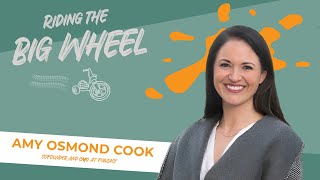
Amy Osmond Cook, who led fully remote teams at Simplest and later at Infosys, says relationships matter more to her now than changing the world. She credits hiring responsible people and trusting employees, and warns early-career workers that hard work and deep passion still can't be replaced.
Chapters
Okay, so Amy, here we are at the World at Work conference, and it's— how's it been so far?
It's been amazing. It's so fun to get together with colleagues and people that I've known for a while, people that I'm just meeting, and talk about sales compensation. It's, it's a really fun topic, and there's a lot happening.
There is a lot happening. So today I want to talk to you a little bit about work and the workplace. And, you know, since the pandemic, people have really changed. Well, a couple of things have happened. Employers and expectations have changed. Employees and their expectations and what they want out of work has changed. And I just would love to get from your perspective, just what is it that you value out of work and your career and how has that or maybe has not changed over the past, call it, 5 years, and what would you want an employer to know that you most value?
I love that question. And I think for me it has changed over time. So I'm in my late 40s, you know, I have older children who are getting into the workforce now, and I remember when I was their age and I wanted to change the world. I wanted to absolutely just change the whole thing and, and, you know, You know, many of us want to do that, especially in our 20s, right? And then, you know, you get into your 30s and you have— maybe you have children, or, or maybe you have people to take care of, and then, you know, the money becomes important. And now that I'm in my late 40s, um, what is the most important to me right now are truly the relationships that I'm developing with people, because you start to realize that business is just about people. It's about you know, trying to help people out. It's about trying to help people grow, and, and you grow a lot yourself in the process.
That's pretty interesting. So I understand that you all work remote, although you— and you do travel a lot.
I do, I travel, but we do work remotely. We have a fully remote workforce, and we did that at Simplest when we scaled Simplest from I was there from 2017 to 2020 when it was acquired by Infosys, and we did it the whole time remotely. And so we're doing it again remotely. And I know that there's a lot of, there's a lot of talk about it, whether it works and whether it doesn't work and the pros and cons. A lot of technology companies are going back to the office at least 3 days a week. You know, for us, remote seems to work really well. And I think that there are some things that we have in place, like a lot of people are very— first of all, you have to hire great people who are very responsible. And we also have some things in place where, you know, people will log their time and we just trust, and it's worked really well for us.
That's great. So one of the things that I have heard— so Scott Kaywood is the CEO of World at Work, the conference where we are today. And he was talking about this whole new work exchange and how there does have to be a trust factor and an agreement really between employer and employee as we rethink how people are going to work. So let me ask you, you mentioned that relationships are very important to you, and how do you maintain that in a, a remote work environment? Like, what, what things would you tell other people about how you build relationships, and frankly, how you continue to build what's important to you in your career.
I think that for me, the most important part of building relationships is having a little dose of humility and recognizing that— in fact, I just, right before this podcast, I was having a conversation with a close colleague of mine that I've worked with for over 10 years, and I was like, where's the content calendar? And I don't see the boosted posts. And where is— it was 100% 100% my fault. I was looking in the wrong place. And she was like, "All right, Amy, here it is." And you know, if I had not had that level of trust with her and a little dose of humility that maybe I was the one in the wrong, you know, things, especially when you're remote, can get escalated, like with texting and with slacking and emailing. But that personal connection, if you can get on the phone, if you can get on video and you can recognize the humanity in other people, oftentimes you realize that you're the one that needs to change.
That's pretty well said. So what would you say to young people new in their career, um, in this new work world that we have today, how they can own and take ownership of their own career development and get the things that they want out of work in, let's say, a hybrid or remote type of work environment?
You know, this is a— I take a contrarian standpoint in a lot of ways in this because for me there is no substitution for hard work. There just isn't. And there has been a very strong movement about work-life balance and doing as little as possible to get the job done and the 4-hour work week and the You know, there's a lot going on and we definitely want people to be balanced. But when you're young, you've got to be hungry. You've got to find what you're passionate about and go all in and do something that you love enough to do all of your— spend all of your time on and really dive in deep. And if you can do that and if you can build that work ethic, it will serve you so well in the future.
Amy, I just love that. Thank you so much for sharing time with us today and enjoy the rest of the conference.
Thank you so much, I appreciate it. Run toward the unknown. When you're riding the big wheel, you're not alone.