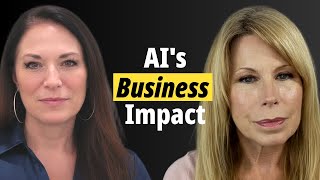
In this Business Roundup interview, host Melissa Bell talks with Dr. Amy Osman Cook, co‑founder and CMO of Fullcast and co‑author of The RevOps Advantage. Cook outlines her 25‑year background in communication, academia, and marketing, leading to the creation of Fullcast amid what she calls the "great go‑to‑market reset" driven by AI. She explains why revenue operations (RevOps) has become a strategic C‑suite asset, likening it to the engine room that can reshape business models. The conversation covers current industry trends: post‑COVID tech over‑investment, a contraction in spend except for AI, and the resulting burnout as companies scramble to implement the right tools. Cook emphasizes that effective RevOps aligns departments, centralizes data, and maintains control over technology, noting that firms with strong RevOps see about 30% higher growth. She describes the practical, framework‑rich content of The RevOps Advantage, which includes checklists, org charts, and guidance for businesses of all sizes. The interview then details Fullcast’s four‑module suite—Plan (AI‑enabled territory and quota management), Pay (commission platform), Perform (deal intelligence and forecasting), and Pulse (BI dashboards)—and confirms its global availability, especially in North America and Europe. Listeners are directed to fullcast.com and Cook’s LinkedIn for more information.
Chapters
Hi, I'm Melissa Bell, and welcome to The Business Roundup, where we catch up with the movers and shakers in the business world. Today joining me is Amy Oz— Dr. Amy Osman Cook. She's a co-founder and chief marketing officer at Fulcast. She's also a co-author of The RevOps Advantage. Thank you so much for joining me today.
Thank you so much for having me, Melissa. It's a pleasure to be here.
So AI is definitely making its way in pretty much every industry, and a lot of companies are trying to scramble to keep up and, you know, know which ones to use, which platforms, you know, it's kind of like, uh, it's causing like problems for some companies trying to navigate through this. So I thought maybe as we begin, can you start off by talking a little bit about your background and then also the company?
Sure. Yes. Um, my background is in communication. Actually, I received a PhD from the University of Utah. I was a professor intermittently for about 25 years, and then I also founded a marketing agency that I ran for 15 years, just barely sold it last year, um, and started Fullcast. I see there's just been so much change with sales and marketing and go-to-market in the past 15 years. Um, while I was in the marketing space, I was a fractional CMO, and so we helped 3 different companies go from Series A through acquisition in that time. And so we, it was really exciting to be part of fast-growing, fast-moving companies. One was in technology, one was in healthcare, and then one was in real estate. And so it was, it was very, very exciting. And then, you know, my old boss at Simplus, which was the Salesforce partner organization that helped, that was acquired by Infosys. I worked there from 2017 to 2020, and then from Infosys, 2020 to 2023. He contacted me and was like, hey, let's do this again. There's so much movement and let's, let's go take go-to-market by storm. And I was so excited to join and be part of this movement. In some ways, I don't know if you're hearing this term a lot, but there are a few of us that are starting to call this the great go-to-market reset. Because there are so many companies that are going to grow quickly. There are so many companies that are going to fail quickly. And with AI, that is just accelerating the movement in each of these companies. One of the reasons I'm so excited about this industry is because of the AI acceleration and also because revenue operations as a as an ecosystem and as a job description has the opportunity to really make or break a business on the go-to-market side.
So, this is going to be important as we move forward. And now, why RevOps and why now? Why is this important?
So, RevOps, revenue operations, to me, a lot of times people will see RevOps as the Scotty behind the James Kirk. The guy in the engine room versus the guy in the, you know, on the bridge, the guy in the pit crew versus the person driving the car. And what I see is, in my opinion, this is, we're seeing a more fundamental business shift. So back in the Industrial Revolution 150 years ago, And this was part of my PhD studies. My degree was in organizational communication. Businesses were siloed for a purpose. They scaled for growth. And the way that they were able to do that was by deliberately creating silos, by deliberately scaling with department budgets. And as we have hit the digital transformation era, that has been completely upended. And the person who is largely responsible for sinking silos is the revenue operations person. And so this person is a strategic asset to the C-suite that if they do their job well, fundamentally change a business model. And to me, that is so exciting. And I don't think a lot of people even understand how pivotal this operations, um, person is within an organization. So that's why I think it's very, very exciting.
And now what are some of the things, the trends that you're seeing in the industry overall?
Right now we're seeing, you know, after COVID, everybody needed to go digital, right? There was pretty much no other option if you wanted to stay in business. Everyone bought a ton of tech in 2021 and 2022. Now everyone's looking at their tech and saying, what do we do with all this tech? And CFOs are saying, you got to decrease it by 20%. So So we are seeing a contraction in the technology landscape, except in the case of AI. The funding, the budgets, and the interest are all going into AI because of the transformative capabilities. So I was actually just talking to a professor at the University of Utah today about AI trends. He hosts a podcast called AI Diatribe, and his theory on AI is that it is absolutely going to really changed macroeconomic conditions because never before have there been, has there been a situation where both blue-collar jobs and white-collar jobs have been affected so profoundly at the same time. And never before has there been a transformation in the business ecosystem as quickly as AI is innovating. So I think that we're, you know, trying to adapt as quickly as we can, and this revenue operations position is vital to being able to do that and helping businesses pivot.
That's why I also heard too is like kind of like a burnout where there's so much, so many choices, companies are kind of like burning out. They don't know what to implement. They don't know how to do it effectively. Even with AI, employees are like kind of getting frustrated. So that's gonna be really important, like shaping as we go down the road, I'm sure.
Yeah, absolutely right. So if we think about it, if we think, you know, is there someone who can help us navigate through AI? Is there someone who can help us change our business model to something that is more transformative? Where we can pivot and, and win in this ecosystem. It is a revenue operations strategic head. Companies who are doing this are finding 30% more growth on average. And so the, you know, it's not a new function, but it's a very, very fast-growing function. In fact, it's the fastest-growing job title in a company right now.
And that kind of leads me to the one question: what are some of the key ways to successfully streamline operations and maximize sales and marketing performance? Performances, like through AI? Is it going to be— that's going to be a key component, I'm sure.
It absolutely is. You know, one of the, one of the areas is, you know, to make sure that departments are aligned. Another one is to make sure that all of your data is centralized. Another is to make sure that there is a real focus on technology. And a bigger focus on revenue because technology is— sometimes when we implement a bunch of technology, we start being disciplined by the technology and we start being controlled by it rather than us controlling it. And we always need to keep that framework that we control the technology. The machines don't control us yet. We control the machines still. Right.
We don't want that happening. Exactly.
None of that.
So that, and that's true. I, people were saying the adaptability is going to be key to, you know, and I think that's one thing, not all of the younger generation, but I know even I'm older and I had to really kind of step it up as far as like learning how to engage with AI and where the younger generation, they just are kind of like, it's like natural to them, you know, they're kind of born into that.
But so true. My children are 14 to 26, and even my younger kids that are 14, 17, and 18, are so much more natural with their use of technology and with their use of social media specifically than even my older kids that are just 5 and 7 years older. So it's really fascinating to me to see how quickly we're having to adapt. I never thought I would say it, but I am that mom now that my kids are like, "Hey, Boomer, let me help you with what's with your tech." And I'm like, "Wait, no, I can figure this out. I'm in tech." But it just doesn't come as naturally to me as it does to the next generation. You're absolutely right.
That is true. And now I know you coauthored the book. What are some of the things we're going to find in the book? What are the key takeaways?
Oh, this is really good. We designed it to be very practical. So there are tons of frameworks. We have 16 contributors from the best revenue operations people from the best companies in the world, really. The very largest companies have contributed to this book to help inform everyone's perspectives. You'll also find some frameworks that work for small businesses and medium businesses, large enterprises. You'll find org charts. You'll find frameworks. You'll find philosophies. You'll find checklists. It's really designed to be a how-to manual with a little bit of strategic thought in there too, in order to make it all work together.
And now what are some of the services that Fullcast offers? We didn't really get into all of them.
Well, thank you for asking. I appreciate that. We consider ourselves a full sales performance management suite. So we have basically our Fullcast plan is territory and quota management, and that's AI enabled. Our Fullcast Pay is commissions, a commissions platform. Our Fullcast Perform is deal intelligence and forecasting, and our Fullcast Pulse is our out-of-the-box BI dashboards to make sure that everything is humming and working together and really giving you the, the growth and the, the strategic advantage that we need.
And now, is this on a national level or is even global? Like, who do you cater to?
Yes, that's right. So we have— it's on a global scale right now. It's the easiest just because of our small team. It's the easiest for us to implement in North America and in Europe. We have an office in London as well, but we are happy to serve any company and we're very excited about the opportunity to be part of this great go-to-market reset. It's an exciting time and we're very thrilled to be part of it.
And now if people wanted more information about the company or the book and they wanted to check out the book or buy it, where would they go?
Uh, if you wanna go to fullcast.com, it's right there front and center. And, um, it's just one of the tabs on the website, uh, F-U-L-L-C-A-S-T.com. Um, my name is Amy Cook. You can find me on LinkedIn. I'm very responsive there as well.
Awesome. Well, I really appreciate you joining us today and catching up, and hopefully we can have you on again down the road and talk to you about some of the trends we're seeing in the industry.
I'd love that, Melissa.
Thank you for joining the Business Roundup, where we always try to bring you interviews with some of the leading people in business, whether it be technology, finance, or energy. I hope you tune in. I hope you subscribe. Subscribe and listen, and we'll give you updates for new interviews that are coming up. Until next time, I'm Melissa Bell.