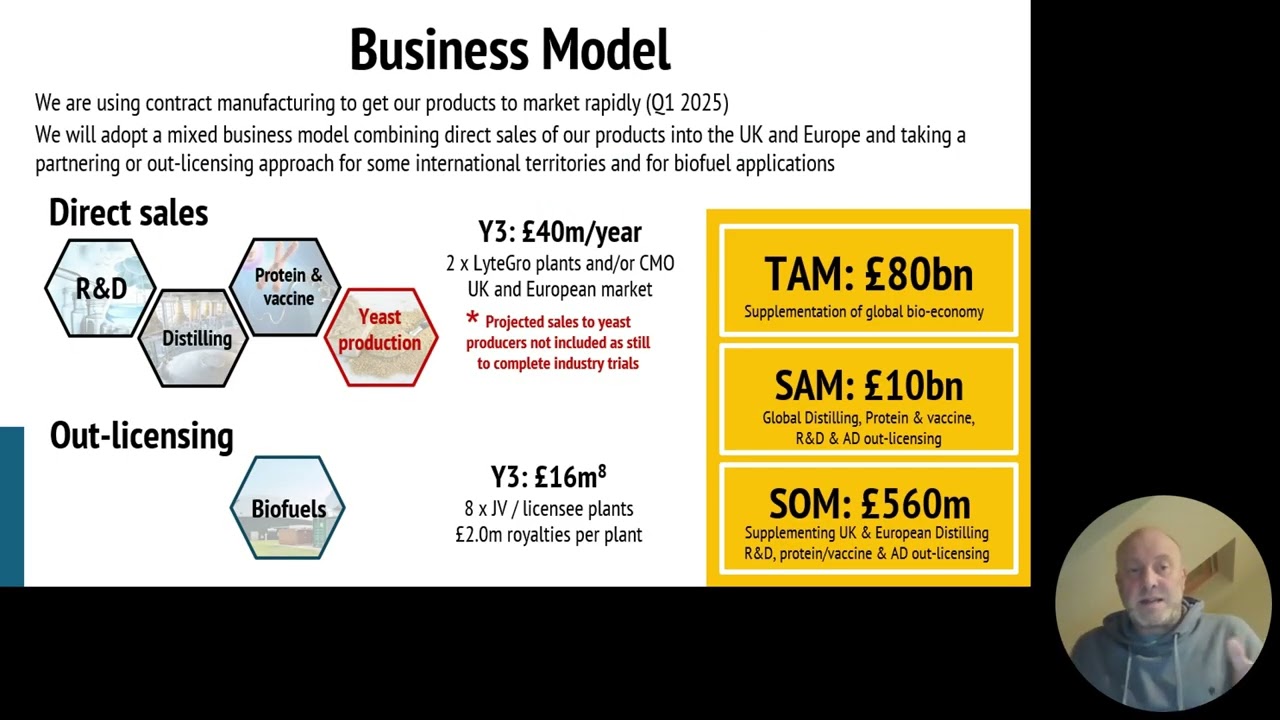
In this three‑minute pitch, Andrew Lee, CEO of Lightgro, presents a solution to the global problem of waste bananas—about 30 million tonnes annually that generate roughly 400 million tonnes of CO₂ and leave farmers uncompensated. Lightgro converts the pulp of these discarded bananas into a product called Backlight, a microbial growth enhancer produced through water addition, centrifugation, filtration, and concentration. A 1 % supplement of Backlight on agar plates dramatically accelerates and amplifies bacterial and yeast growth, enabling faster, higher‑yield microbial processes across industries such as distilling, protein and vaccine production, and yeast manufacturing. The company’s business model starts with contract manufacturing and will expand to direct sales in four target markets and out‑licensing to biofuels. Lightgro already has traction in Indonesia and Australia and is in discussions across India, Costa Rica, Ecuador, Barbados, and Uganda, aiming for a global rollout covering all banana‑producing regions. Financially, the firm projects roughly £300 million in revenue by the end of 2028, alongside significant emissions reductions and job creation. Lee concludes with an invitation to investors to join the mission of converting banana waste into a sustainable, profitable bio‑economy catalyst.
Chapters
Hi, my name is Andrew Lee and I'm CEO of Lightgro, a company that's turbocharging the bioeconomy with waste bananas. Everyone loves bananas. There's 120 million tonnes of bananas grown globally each year. Unfortunately, around 30 million tonnes ends up in landfill where it rots and gives off the equivalent of 400 million tonnes of CO2. There's a social problem as well because banana farmers aren't paid for their rejected crops. And with climate change, we're seeing an ever-increasing portion rejected. Now, we aim to turn this waste into a massive global opportunity. And the way we do this is we convert the pulp of waste bananas into Backlight, which is a microbial growth enhancer. We essentially, we add water, and then we do some clever centrifugation, filtering, and concentration steps. Now, this is a hugely profitable process. Each ton of waste bananas can make over 30,000 pounds of our product. Now, our product acts like steroids for microbes, and as you'll see from this video on the right-hand side, there's just 1% supplementation of an agar plate with our extract. So you'll see from the video that we're able to grow bacteria and yeast as well. We can grow them quicker, we can grow more of them, and they grow better. Now, the more microbes you have, more productivity, and this results can increase yields and shorter process times. So huge industries rely on microbes. Here are some examples, and we can supercharge them. This saves feedstock, it saves water, and it saves these industries time. This increases profitability but also sustainability too, and it allows these companies to increase the output of their plants without CapEx spend on equipment. So our business model We're essentially using contract manufacture to get our products to market first, and then we will adopt a mixed business model which essentially combines direct sales into 4 initial markets: the R&D market, distilling, protein and vaccine production, and yeast production. And then we're out-licensing into the biofuel sector. There's a huge market for these products because of the efficiencies that they can enable. So we plan to expand globally through joint ventures, and we've actually seen some really good traction in Indonesia and Australia already. And we've got discussions underway in India, Costa Rica, Ecuador, Barbados, and Uganda. So covering every continent where bananas are grown. Global rollout will have a huge impact, not just economically, but after— at the end of 2028, we're expected to bring in close to £300 million of revenue. But there's huge environmental and social benefits in terms of reduction of emissions and jobs created. So we'd like to invite you to help us change the world with banana smoothies. Thank you.