Precedent Driven Innovation
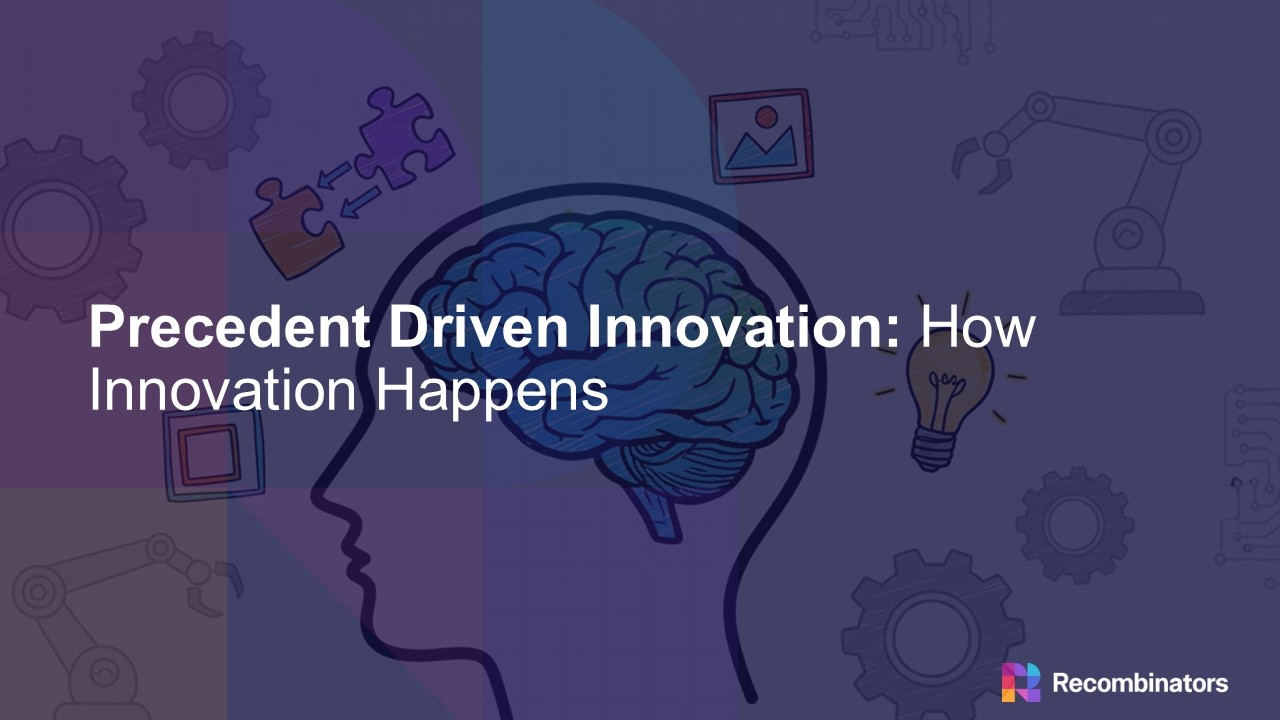
Andrey Meshcheryakov presents Precedent-Driven Innovation, a three-phase method that finds breakthrough ideas by searching for solutions in unrelated industries rather than brainstorming within your own. An oncology drug regained market share by borrowing the FOMO concept from consumer psychology. AI handles the search; humans provide judgment and ethics.
Chapters
You know, every single company out there wants to innovate. It's the only way to survive, to grow, to stay in the game. But for most of us, it feels— well, it feels like a total mystery, right? Like you're just waiting for a lightning bolt of genius to strike. But what if I told you that was a total myth? What if innovation isn't about luck at all, but about having the right playbook? Let's dive into a framework that actually turns this art into a science. So here's the paradox: we all know we need these big breakthrough ideas, but the way we usually go about it, you know, the classic brainstorming session, it just keeps us trapped. We end up looking for inspiration inside our own four walls, within our own industry. And that's kinda like trying to discover a new continent by only looking at a map of your hometown. You're just stuck in an echo chamber. The one and only Albert Einstein totally nailed the secret to breaking out of that echo chamber. See, the key to finding better solutions isn't always about finding brand new answers. It's about asking way better questions. It's about completely reframing the problem you're trying to solve in the first place. And this brings us to a framework called Precedent-Driven Innovation, or PDI for short. It's this really structured methodology designed to turn innovation from a random, hit-or-miss art form into a repeatable science. And guess what? It all starts with that exact principle of reframing the problem in its very first phase, which they call Frame. Now, the big idea behind PDI is something called recombination. Think of it like this: the best innovators are basically matchmakers. They don't just invent stuff out of thin air. No, they creatively combine existing ideas, often from totally unexpected places, to create something brand new and incredibly powerful. So, this is the first fundamental reality, the absolute bedrock of the whole thing. The PD process is built on this foundation: that if you can just frame your challenge differently, you unlock a completely new path to creative thinking. This is where we stop guessing and start actually diagnosing the problem. And in the Frame phase, you do that diagnosis in a really systematic way. You go out and gather all these different perspectives. From customers, staff, executives. You ground yourself in the cold, hard facts of the market and your business. You define the real-world limits you have to work with, like time and money. And then, you prioritize. The goal here isn't 100 vague ideas. It's to come out with one single, super well-defined strategic innovation challenge. Okay, so once you have that crystal clear challenge, you're ready for the next phase: Create. And this is the fun part. This is where you deliberately step outside of your industry to find inspiration and start connecting the dots in a whole new way. You know, Steve Jobs said it perfectly: Creativity isn't some magical spark that only a few people have. It's just about connecting things, seeing a connection that nobody else has seen before. And the Create Phase is designed to help you systematically find those connections by looking for what are called strategic analogues and precedents. The Create Phase follows this really clear 4-step process. First, you deconstruct your challenge. You break it down into its core pieces. Then, and this is key, you deliberately disassociate it from your industry. You generalize it. You ask, has anyone, anywhere ever solved a piece of this puzzle? Then you search for those precedents and recombine the best ideas you find into something new for your business. And check this out. This is a fantastic real-world example. An oncology drug was really struggling. It was just seen as another option on the market. So by looking outside of pharma for how to overcome that kind of skepticism, the team found a super powerful precedent: the psychology of fear of missing out, or FOMO. They actually applied that concept to their strategy and completely revitalized the brand. How brilliant is that? So, finding a breakthrough idea is one thing. Awesome. But turning it into a real-world result that actually makes an impact? Well, that's a whole different ballgame. And that brings us to the final phase of the PDI process, called Prime, which is all about execution. As the great technologist Guy Kawasaki reminds us, this is where most innovation just falls apart, right? You can have the best idea in the world, but if you don't have a clear path to make it happen, it's just gonna sit on a shelf. The Prime phase is designed to solve exactly that problem. So the Prime phase is what grounds those amazing creative ideas in reality. You figure out the market opportunity, you make sure the idea actually fits with what your company can do, you develop a detailed multi-year roadmap, and then you pilot, Launch and learn with clear ways to measure success. This is what turns a brilliant concept into a real, tangible competitive advantage. So that's the PDI framework, a really powerful human-centric process. But I know what you might be thinking. In an age where AI is changing literally everything, is this still relevant? Well, the answer is not only yes, but it turns out they're the perfect partners. In an age of automation, the ability to innovate, you know, to think critically, to reframe problems and make those creative creative connections is being called the last human skill. Seriously, it's a critical, future-proof skill. While AI can automate all sorts of tasks, this kind of strategic thinking is still uniquely human. And look, the pressure is on. A recent study from the Canadian Management Centre found that more than half of all employees feel like they are falling behind on AI. This creates a massive opportunity for anyone who can master a structured innovation process like PDI. Just look at how fast things are changing. This chart is wild. The number of employees getting AI training jumped 7 times in just one year. As AI becomes a standard tool, the thing that will make you stand out won't be using AI, but how you use it to power these higher-level human skills, like strategic innovation. And this is the hybrid model that works so well. PDI uses AI-powered tools and huge databases to speed up the search for precedents. That's something machines are amazing at. But it relies on us, the human innovators, for the critical thinking that AI just can't do—understanding context, applying emotional intelligence, and making those tough ethical judgments. So when you put it all together, how does precedent-driven innovation really stack up against the methods we're all more familiar with? Let's take a look at a final comparison that makes it super clear. This table honestly says it all. Traditional brainstorming? It relies on what you already know, which is super high risk. Design thinking is better, for sure, 'cause it validates with users. But PDI is totally unique. Its ideas come from cross-industry analogues, from things that have already worked somewhere else. This systematically lowers the risk of innovation while actually helping you generate more novel ideas. And it gives you a concrete plan to get it done. So as we wrap this up, I wanna turn it back to you with this question: Thinking about your own challenges, in your own industry, what precedents could you look for? Which insights from this whole structured approach have sparked a new way of thinking for you? Because that right there, that's the first step to your next breakthrough.
More from Andrey


Solving the Microlearning Conundrum: Why Your Microlearning Isn't Working (And How to Fix It)