Machine Learners by monostate E02: Talking About Palantir
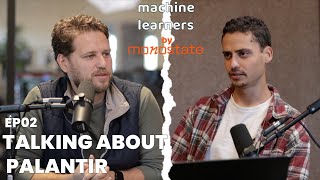
Andrew and Omar break down Palantir's $30 million ImmigrationOS contract with ICE, its 150x price-to-sales ratio, and the opacity of its data pipelines. They explain why Monostate is building R2, a competing product launching September 2025 that gives entrepreneurs control over their own data and models.
Chapters
Let's talk today about Palantir. Palantir has been all over the news. Controversial company, a great CEO, the recipe for success. Yeah, let's dive right in.
So Andrew, we've been hearing some time now that Palantir has a negative light surrounded it. People don't really understand what it does. And as I understood, because of its ties with the government, people see it as even maybe a government company, and they have some negative thoughts about it.
Yeah, yeah, that's right. We even— we are comparing ourselves to Palantir. Yeah, we are doing a new Palantir, Palantir for the masses.
Palantir for the poor.
Yeah, that's an internal joke. Um, yeah, and the fun thing is that we even email an investor and we talk to him and he's saying, yeah, are you sure you should be comparing yourselves and talking about Palantir? Because Palantir is not so great and there's all the, the things about it online. And yeah, we, we love Palantir. We love you, Alex. We love the vision. Palantir is a great company. And yeah, it's so great that we want to bring this kind of technology to any company, to the masses. So this is what MoneyState is doing. And we actually discovered that along the way.
Yeah.
We didn't start out like, let's build a new palette.
No, not at all.
Not at all. We started doing model training, different kinds of models. You can create your own models with describing what you need, discovering data, doing normalization of data. So a bunch of things. And we found out that's basically a big point, a big thing that Palantir also does. It comes into companies, get data there, helps those leaders to understand their company, how their data relations work, to make useful workflows with it and with models as well. Yeah, so Palantir launched this project called AIP. It's online, everyone can check it. And yeah, we found that along the way. To reply the question, what is Palantir doing? Why it's getting all these hits? Yeah, it's, uh, we don't know. We don't know a lot about it. I think the kinds of scares people.
Yeah, the unknown scares people because we don't really know how our our information is getting processed by them. We just know that it has a lot of data. It's probably being exposed to all the personal data that the US government has, and it analyzes the data to give the decision makers better view, better understanding of it. We don't exactly understand who are the decision makers, what is the data, but it's a lot of data that reflects in their market capital, right?
Yeah, Palantir is surprisingly— we didn't know that before, but apparently is one of the highest price-to-sale ratio on the stock market today. I was researching here, I'm not a big stock guy, But apparently there are not any other companies with a higher ratio. Apparently they're doing like 150 times their last year's sales to market capitalization. So that's huge.
Yeah.
Like just for comparison and to add some numbers, their revenue in 2024 was $2.87 billion. And currently their market capitalization, so what the market is valuing their company, is $430 billion. That amounts to exactly, I did the calculation, 153 times.
That is a lot of times.
That's a lot of times. And Tesla, to give you an example, their last 2024 sales was $97 billion. And their current market cap is $1.36 trillion. So roughly 12 times, just to add some comparison. NVIDIA, I think, is 20 times. So Palantir is in another level. Like, the market is believing in Palantir and putting a lot of money. And yeah, maybe I think as all the research we did, From 2010 to now, they've been more open, more exposed to the media, posting things online. You can go to Palantir Docs and find everything that they do, their techniques about ontology, how they see data, how they work with data to make it useful for companies. Great resources. And I think from this shift, 2010 to now, What happened in 2010? Yeah, apparently they started going after enterprises.
Yeah.
So it's pretty, pretty popular and known that they started after 9/11 and everything that was happening in the early 2000s in America. Yeah, they spent like 10 years doing that and working with agencies. There is a great podcast by Y Combinator that just came out. With one of the earliest Palantir employees. It's great. He talks a little bit about this. And after that, 2010, they started going after enterprises and applying all that knowledge, everything that they learned from working with gigantic monstrous amounts of data that government has and has to process. And they brought that to enterprises. So— big companies working. We can talk about companies later, but basically what Palantir is doing is getting to those companies and working with their data to build workflows, to build automations, and things that resemble something that is reliable. Yeah, I think the keyword is reliable.
Yes, and also it makes accessible gives accessibility to all these companies to make their decisions based on data because you've got a lot of data and sometimes you don't know the— you don't know what to do with it and how to process it, especially in today's modern world where a company has millions and sometimes billions of users. So, It just apparently makes their life a lot easier on their company and makes it more, um, abstract. Abstract, yeah, makes it more abstract to them to make decisions. So I think that everyone, even in the personal life, need some kind of a tool like that to determine what path they will take. Like Your opinion is biased at the end of it. You can't really see the full picture. And it seems that Palantir helps you to see the full picture.
Yeah, that's a, that's a great hook. Bias is something that is really important for data scientists.
Yeah.
And which Palantir is built upon of in the end of the day. And yeah, in the business world, people are not very aware of this.
But even—
Existing paradigm of bias. Like we talked yesterday to engineers from a hospital, they are very aware of how bias works in the health system, for example. So you can't use certain specific data to extrapolate to different patients because they are all different demographics and things. Yeah. But in the business world, people are not very aware of all of that, differently from defense and differently from government, because there's so many data people already know that there's a lot of bias in it. Yeah, it's great to mention, to give, to to get you the Palantir news and why they might be getting some hits. I got here an example. Palantir got a contract for $30 million to build the government platform called ImmigrationOS. So ICE is getting a lot of hits here, especially in, in Democrats' states. Yeah, and ISIS, it's getting a lot of hits and protests everywhere. And yeah, Palantir is serving that, serving the government and doing that. And yeah, so they are getting a lot of criticism from a lot of people, but the market is speaking. They are really valuable for the market.
Yeah, and they just went public in 2020. So within 5 years, they made a huge jump.
Huge jump.
Yeah.
Yeah. Palantir is— I don't see it as a black box. I think all the documents online, they shed a lot of light and we can learn a lot about how they work. But for sure, in their government affairs and everything that they do for intelligence agencies and defense, Yeah, of course we can't access that. We don't know. We know how they process. We know how Palantir works.
We don't know what they process.
Yeah, we don't know and we shouldn't know. There's lots of things that goes into defense and counterterrorism and stuff that we know that they've been on it. And yeah, it's not public information for a reason, right?
Yeah.
Yeah. So let's talk about real quick about the platforms at Palantir. You can check that out yourself on their website. They posted about all their projects. So they're doing Gophn. Gophn is an operating system for defense authorized at IL-5, used for counterterrorism. Better fuel intelligence and mission planning. They also have Foundry. Foundry is a commercial counterpart built on an ontology that models data and business objects. Example: Airbus improved aircraft deliveries by 33%. Apollo. Apollo continuous deployment engine across cloud, on-premises, and air gap classify networks. AIP, which is the one that we like a lot. So AI layer enabling secure LLM integration with governance, workflow automation, and autonomous agents. Deploy from Ukraine's battlefields to Walgreens' 4,000-store rollouts. So those are the, at least the public, their standard off-the-shelf products. They're probably building upon that a lot of different things and they are getting government contracts to build new software like the, the immigration OS, other OSs. And Palantir is a great software house. They, they, they've been leading and doing very influential things like the, for deployed engineer. Ideas, which is something that they started and now all, basically all startups are doing. It's an idea of deploying, getting an engineer to be working in implementation with those clients so you can improve client satisfaction. You can actually get the implementation to work And you can have an engineer up there, not just like a sales guy talking to those people. So it's an interesting approach to building software for very specific use cases that need a lot of hands-on things, needs a lot of, yeah, being side by side and talking like, what's your needs? What are things that can really move the tick in your company? Things that can really change and be implemented? Because a lot of times when companies get those contracts and do this stuff, when these companies come in, they face some kind of resistance. From internals, all process are difficult to change, or all, everything is so difficult to do. And when you deploy their engineer there, it's, everything is better. But anyways, so Palantir is very influential in all of that, in software as a general, and they are kind of a software house, I guess, building upon a lot of primitives, abstractions that they probably have. And yeah, that's great. That's what Palantir does.
The personal data of probably all the citizens going into the, into the hands of a private company that is Palantir. And the question is, how, how can the government give them such a power and how moral it is for a private company to handle private data, government's data.
Yeah, we, we don't really know how far their access and, and reach is, right?
They're claiming, they claim that they're just, um, providing the tools and the government does with it whatever it wants. Um, but you know, like Yeah, it's complicated.
What we do know is that there are cloud contracts like with Azure. I guess only Azure right now that has the level of security that government agencies are requiring. And yeah, so if they're deploying things to the cloud, not using private personal government servers, Yeah, probably people are getting access. We just don't know who and how all of that data is being handled.
Yeah.
Because everything is so fuzzy. And that's the things that scares people, scares the population. And yeah, Palantir is right in the midst of it. So we don't really know. What is going on inside. We do know how they process data. We know their ideology. We know that they help with counterterrorism. We just don't know how everything intertwines and, yeah, what exactly and where exactly all the data is going. Like for these immigration things, it's really problematic. What is the government doing? And yeah, there's this private company, actually it's not private company, it's a public traded company, but it's a company doing, helping this government maybe do surveillance, maybe getting into I don't know what of those, of those people that might be deported. Yeah. So yeah, that, that is a gray area for sure.
Yeah, it's the classical philosophical question of how far can we waive our privacy rights so that our society will be protected? You need to know everyone's information in order to know who is going to be the next terrorist.
Yeah, that's a great, that's a great area. Should the government respect up until what point? And there is free speech also. Palantir, kudos to you guys. It's definitely a tough spot to be in. And yeah, we at Mono Estate, we are doing things differently. We are doing things for the open market. Our product is going online next week, this September 2025. And yeah, our objective is to get this kind of technology and pipelines to any company so they can and they should be able to control and see their data do the trainings, use multiple AI models, not only LLMs, not only generative AI, and build workflows with it. So that's the Palantir recipe. We are bringing that to the open market. We are bringing that to everyday entrepreneurs, startups. And so you can just use reliable tools and really organize your data into something useful. That's our objective. That's, that's what we, we want. And we expect R2 to be used for good things, for research, research purposes, discovering new science, doing cancer research, training models for all kinds of things. And this is our, our ideal. This is where our hope lies. This is what we are building Monostate for. And hopefully we can make a dent. We can make our mark in the world. We can change stuff. And yeah, let anybody be able to create AI models and do advanced workflows with it.
Thank you for joining us on this episode of Palantir. We hope you learned something new. If you want to follow us, follow us on Instagram @monastate.ai. We are Omar and Andrew here from San Francisco at Fort Mason Founders Inc.
Right.
And, um, it was a pleasure. See you next episode.
Right. Yeah, guys, it's really important to say everything, uh said and done here today. It's our opinions, it's our own. So if you don't like it, or if you have your own opinions, that's great. That's what a democracy is. And, uh, yeah, Palantir can do what it does, we can do what we will do. And yeah, the world is great, the world is bright. This is a, this is a great time to be alive. And, uh, we wish every success to Palantir, We are following you. We are following you guys and seeing where all of this leads. Thanks for listening to our podcast today. This was a great episode to record. Hope you liked it. If you have any questions, please do not hesitate to contact us. We are andrew@monestate.ai and omer@monestate.ai. Just check it out. Talk to us. Comment here as well. Whatever you need, what you think we should record next. See you next time.
More from Andrew







Você paga caro pelo lead, mas ele esfria antes mesmo do seu time dar um ‘oi’?

Seu time de vendas se esforça, mas o resultado não vem? entre em contato com a gente!