Machine Learners by monostate EP01: AI models other than LLMs
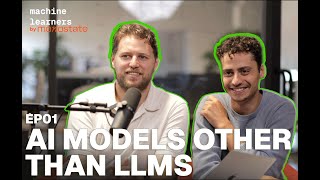
Andrés Domínguez and Omer introduce Monostate, a no-code platform for building machine-learning models beyond LLMs. They explain why large language models hallucinate and lack numeric reasoning, then show how combining specialized models like regression, time-series, and vision models in a pipeline beats relying on a single LLM for most business problems.
Chapters
Hello, my name is Andrew.
And I'm Omer.
We are Monostate and this podcast is AI for non-machine learners.
No program knowledge needed. So, and we're discussing about AI topics. We're explaining what LLMs are. Explaining what regression, progression, I don't know, time series sequence.
Yeah. All kinds of non-generative AIs. Yeah.
So even if you don't want our product, just listen to us.
Follow along. We'll be posting these regularly. And yeah, that's Monostate Podcast at monostate.ai. Hey, we are here at the Founders Inc. At Farmason in San Francisco. We are here for a few weeks working with the guys here, and today's episode is our first episode. We are recording in, in their studio, and we are going to introduce machine learning, what is vibe training, and language models, regression models.
Yeah, we're also gonna present our product and how we want to make a better world using AI without relying on the generic AIs right now that is ChatGPT-like. We're going to introduce their cons and our pros.
Yeah, all the pros.
Yeah.
How language models are professional rizzers. They just want to rizz you.
Right.
Okay. We are developing Monasteries at Two. To help people create any AI models. We handle the datasets and you can build workflows with it. So it's kind of what Palantir does for the last, for the past 20 years. And we are building upon that and bringing that to researchers, to business owners, to startups so people can actually use and make the most out of small models, regression models, math, and being able to actually make AI. There is not only generative AI out there, there is other kinds of AI out there, and we are bringing that to people again so they can use it, they can do it without code, real, real easily, really fast, and make machine learning great again.
Create Your Own AI.
Yeah, let's create your own AI.
Big words. What does that even mean?
Yeah, that means that we want to help people create machine learning models, not only LLMs, so language models. There is other kinds of models out there that people are not aware of, and we are changing that. We want to help people create vibe training, vibe creating data that they can use for their use cases and, yeah, make wonderful things, discover new sciences, do things with machine learning that wasn't possible before now.
Yeah, so I can drag and drop, no coding needed, my list of favorite movies or a 10 terabyte hard drive full of my research data. And it'll analyze it and predict patterns?
Yeah. So how does it work? There is all kinds of different models. Machine learning is a big field. It's a field being— that is around like since forever. And basically is all these different ways to make useful things with your computer. Predictions, analyzing things. Comparing things, creating new things, doing calculations. And what we're doing at Monistay is that we are handling the discovery part. So you don't have to know anything about machine learning. You just have to have data, or if you don't even have data, we can create that for you. We can do synthetic data as well. We can do augmentation of data. Which means we get your data and we make it bigger and more coverage, meaning that the training will be better. And we get all of that and we choose what kinds of models you need for your specific goal. That means that you don't need to know machine learning. You don't have to be a machine learning engineer now to be and to do AI training. You can just ask, ah, I want to recommend movies. I want to recommend things. "Or I want to learn about all those research papers. What can we do?" And then our AI trainer will figure that out. We'll figure out what kinds of models you need to achieve your goals.
That sounds like a game changer.
Yeah, I, I think it is. It is a game changer. A lot of people are really interested in it. It's kind of the moment for Vibe Training, like what Vibe Coding has been doing for the past year.
Yeah.
Enabling people to create apps without code. So they have like, what vibe coding is, all right? Vibe coding, you just ask AI to create some app for you and the AI will go there, will try to figure out things, will do the coding. And yeah, it's great. A lot of people are using. And, but what we are seeing now with vibe coding is that more and more companies, they are building guidelines, rails, and ways to control and to make the outputs, make the results from those trainers, from those AIs that creates the code, make that better. So a lot is being said about security. So vibecoding brings problems with security, databases. AI didn't learn a lot about like security apparently. In their training. So what people are doing to, to fix that is creating rails, creating strategies that will control these workflows, these pipelines. And yeah, that works, that, that provides better solutions. But we at Monistate, doing the Vibe training, doing training of machine learning models without code, we are already starting with that. So we are not doing the same mistakes that have been done when, when Vibe coding started. We are starting, starting with proper rails, proper pipelines and ways that work, ways that are proven to work and they will produce results that can be actually useful for researchers, for companies, for individuals. That means that you don't need to know machine learning and we actually train our own model And we are building a lot of pipelines and internal workflows and servers that can protect, predict, and create the correct workflow and models for your use case. So we are doing a lot of work in the, in the backstage to create the correct pipeline. So Vibe training is actually useful. It's not like, um, just creating models that don't work or they are just overfitting, which means they are just like outputting same things over and over again. So we are trying to make it really useful, really, yeah, really great.
So you don't need any computer science knowledge, but you also don't need the most powerful computer. You could choose do it on your own GPU, right, if you wanted data to stay in in your computer, but we're offering cloud services.
[Speaker:ANDRES DOMINGUEZ] Yeah, exactly. So in the start, we started thinking about doing that only in your computer as an open source project. And we will release that soon. But we also realized that most computers— a lot of people do have good computers right now that they can't do the training and they will be able to do that soon. But also a lot of people want to just start training on the cloud. So I can strive from my phone, I can use any computer and this computer won't be jammed while the training is going. And that's why we develop cloud solutions and servers. And so you don't have to manage anything in the pipeline. We will manage all of that on the fly. We choose the datasets, augment the data, normalize the data, choose the models. We create the right training jobs and we start GPUs on the cloud so your training can work and can happen. And then all the trained model goes to an inference endpoint so you can actually talk to it.
Yeah. So in other words, we're just enabling anyone to have create their own specialist on a certain field. They don't need any knowledge of AI or CS. They just need to trust the product and they'll have their own expert on a certain field.
Yeah, exactly. There is all kinds of models. A lot's been said recently about the breakthroughs on generative AI. So language models, LLMs, and it's the trend of the moment. There's all kinds of models, different things in the field.
Yeah.
That can do math, that can do all these kinds of things.
Doing math is a huge leap to stock market. We could analyze stock market trends.
Yeah. And actually that is very interesting to talk about because people are realizing now the LLMs, language models, GPT and stuff, they are not really reliable for production, for real use case scenarios. Like let's say I want to do an automation to approve refunds on my website or I want to do some automations to make investments. And yeah, you can do that with a language model and there is some things that, are good in generative AI. You can really analyze all the context that is being fed into it. So that is the basics. That's how it works. But the thing is that it will only predict and use patterns. So it's massively big, massively difficult to understand and to predict. And as you're not actually doing any math, the outputs will be just repetitions, will be just like exactly what it saw in the training before. So there is no creation, there is no calculation. So let's say you wanted to invest in Tesla, let's say, and you wanna, you wanted your GPT, your language model to analyze that. If this model don't go online, don't check, it will probably give you overconfident, probably positive because Tesla is doing great and will be, you will continue, you continue to do great. But it will probably just output things for you being confident, saying you are absolutely right. And yeah, you won't, you won't check things, you won't do any calculations. And that's a bit of a problem. And when you actually need to rely on AI.
Yeah, but even if it does go online and these are simple tests that most of the AI models do, they go online, they just can't analyze the data in a sufficient way for us to rely on them.
Yes.
They don't, as you said, they don't make math. And they don't make predictions. They are basing their answers on precedents. So what if there is no precedent? Like, what if there is no data? Yeah, what if there is no data? You have to have the power to see to the future, not just to the past.
Yeah, exactly. And you, you gotta know, uh, when you don't know. So if there is no—
yeah, you gotta know. Don't be sure of yourself. You can't have an AI model that is so sure about its answers when it doesn't have a backup to it.
Yeah.
Yeah.
Yeah, exactly. So the funny thing about talking about investment and financial workflows is that it's really easy to understand from that what orchestration or workflows of machine learning models are. Because what an LLM is, is a language model is trained to output language. Its output is literally talking to you. Its training is about that. Its rewards is about that. And but sometimes you don't want that. You don't want just outputs. You don't want just similarity. You want actually thinking and you want to actually summarize things and then you want to do another step and then you want to do a second, a third, a fourth step, right?
Yeah.
And there is all kinds of techniques that you can do that. Obviously you can create apps, you can create a lot of business logic. This business logic will get this, we summarize, we do an API call to GPT, to OpenAI, and it gets back, and then we do another calculation, all coded, all hardcoded.
Yeah.
And then we do this and then we do that and then we consume another thing. And yeah, that's all great, that works, uh, up until certain point because, um, hard coding business logic is not scalable. Uh, things are changing now so fast. Companies are moving, companies are, um, getting up and down every day. That I believe that if you continue just hard coding all your business logic into your app and stuff, you can adapt. You can do new things on the fly, right? And that's something to be said about using an orchestration of machine learning models. Because it's so flexible that you can poke around and do different things. And you don't have to actually create a lot of business logic. You just have to create a workflow between them, right? So the data comes in and we run it through a summarization model and then we run it to a regression model and then we do this and that, right? Because those especially models, they are capable of doing math. They learn a lot of things on how to do math. So you don't have to teach it. You don't have to code. How do you calculate 2 2?
Yeah.
Right? Because obviously it was already trained to know how to identify that pattern and be able to calculate that. So what I mean is that using multiple models for building a workflow, which is exactly what we wanted to empower, is really useful. You can cut a lot of problems along the way, a lot of debugging, and use powerful small models that can do your things, create better outcomes for your company, for your research. So it's really useful. Most big companies are using them. They are not like trying to hard code how to do recommendations. Let's say Spotify, for example. There is a number that, that is online that says something about I guess 600 million users and 100 million songs, something like that. And it would be impossible to run all of that through GPT or trying to do that all through coding, do all that recommendation and on the fly creating new types, new features every day, right? About new patterns that you see. So that's how and where machine learning models really shine. You can create new things really easily.
So let's say I've created my own trained model on a certain data and it's really successful. Like, I think that other people could use it and maybe I could even do make money off of it? What are we doing now? Like, how can we monetize?
Right. So that's a really great thing that we were thinking about. And we want to enable a creator economy of machine learning engineers and regular people that have ideas.
Machine engineers, regular people. Yeah.
No, but That's the thing with Monistate, you can create, you don't have to be a machine learning engineer. Yeah. So having the ideas is the most important thing.
Yeah.
Right?
You just need to have the idea, we'll give you the platform, don't worry about it.
Yeah, exactly. So let's say you have some idea, we received the feedback from a user saying that it's a woman, she said, yeah, I would like to have some some kind of model that helps and, and search and do all kinds of things to help me find schools in the neighborhood for, for my kid and stuff like that. So that is a really interesting use case because it's a day-to-day, it's a normal thing. Yeah, it's a very specific thing for a certain amount of people that go through that. And yeah, that, that, that person can do this model can do this orchestration of models that will probably involve multiple things like getting rating for things, getting these calculations, and passing off through some workflow that can actually output predictable things and reliable things that you can trust. And then she can just like sell it, sell this model, monetize it, and we are enabling that with our model library.
And as you said, this school example is a really good example because most of the people will go to ChatGPT and just ask it, what school should you think is the— do you think is the best? And it'll give us a best answer and it'll be super confident in itself. But with what data? Yeah, with data online. Yeah, just language. No analyzing and no understanding of it. So it can communicate very well, as you said, with words. It's trained on words. It's a words machine, but just can't trust it. You can't trust its word when it comes to being precise.
Exactly.
That's where we come in.
Yeah, exactly. Being precise is really important for a lot of use cases, even day-to-day use cases. You don't want to do your financial family planning and relying on advice from a language model where this model can be trained on data that you don't know about. Right. That's the thing. You don't know. You just don't know what is going on inside and you don't know what data you went through. Because there is a really interesting thing to say that I've heard. That all these models that we see, even what is called open source, they are not actually open source. They are open weights, which is different because open weights is when we can use the model. It's open there. We can get it and we can run on our servers. Uh-huh. But it's not open source because we don't know how it was trained. We don't know the algorithms. We don't know the, the methodologies, all the data that went through. So there's a really important thing to say where for, especially for commercial models such as GPT, Claude, and other models that we highly value for their advice and for their training. So that's why we are paying those big companies.
Yeah.
We are paying for their hard work into training, into making a really useful big model for us to use. And, but we actually don't know what is fed to it. We don't know what kind of data, right? So yeah, it can be biased into anything. So yeah, are you relying on biased information for taking whatever important decision, uh, you have to take, right?
And you could try it yourself when you undermine this ChatGPT's answer and you say to it, it's wrong. You need to do it multiple times and then the chat will tell you, all right, yeah, you're right, I'm wrong, sorry about that. Let's start from the beginning. And all right, so it admitted it was wrong, but you could make huge decisions based on wrong information.
Yeah.
So come on.
Yeah, exactly. And there are a lot of companies, um, they are trying to jump on this opportunity of AI. AI is so great, so this is the, the time of, uh, opportunity. And creating differentiation among competitors. But the fun thing is that it's just a language model. So you're trusting your product, you're trusting your customers' data and stuff and decisions. Yeah. To those language models. And obviously having to create a lot of business logic around it to protect and to make it useful. But actually, there are other better ways. Yeah, there are ways that you can actually do calculations.
Yeah, when I'm thinking about it, we could even pose it as that the general AI, the generic AI, the one that is an LLM and got away with words, it's just like a slick, cool guy that knows what you want to hear. Yeah, and he says it with such confidence and with his glasses and Like, you like this guy, you want to trust him.
Yeah, but he's a cool guy.
He's a cool guy. Yeah, he wants your, your best. But sometimes all you really need is the nerd sitting in front of the computer that really like maybe doesn't have a huge, um, social, social skill, like doesn't have social skills but knows exactly what you need. And it cares more about your data than how it's being conveyed to you.
Yes, yes, exactly. So that's a great example. Language models, they are trying to raise you.
So yeah, perfect. That's a great answer. I love you so much, Omar. You're a cool guy.
Yeah, you're so smart. Yeah, define laws of physics. Yeah, let's, let's fix gravity.
Yeah, yeah, yeah, exactly. Your question was You're so on spot, man. You're the smartest man on earth. No, we don't want that bullshit. We want something that actually cares about us. And something that cares about us, it doesn't really need to be expressed with words. It needs to be expressed with reliability, with analyzing.
That's deep.
Yeah.
That's great.
That's great.
Yeah.
And we have that.
Yeah, reliability. So, um, there's all kinds of ways to build reliability, and we strongly believe that using different models, different orchestration of things, and not having to hardcode everything, every single rule is the way to go. Uh, that means that your development is faster, is more reliable. You can do the calculations on scale because those models, those small models, they can do thousands, sometimes millions of calculations a second, right? Because it's different from generative AI, it's different from LLM that gets all the things and has to look at it all all at the same time and do the 4 passes and like a gigantic model that costs a lot of GPUs and a lot of money to run. Those small models, they are cheaper, they are smaller, they are effective. So, uh, yeah, tell us about the library thing that you like.
Yes, so yeah, we like this library analogy. This, these huge LLMs have So many data out there. It's like a huge library. You get into the library and you want this certain topic, your certain field of research, certain, I don't know, interest, and you'll find it. You will. The language model won't tell you, we don't have it. But what precisement when you search in a huge library with data you don't even know where it came from? We're offering you a small library. And it's small, it's not big, so it might sound a bit less than a huge library, but it's a small library customized to your needs. It has only your books, only your data, and it doesn't waste energy to skim through all of these— you want physics, but it doesn't have to skim through movies first. Like, yeah, that's perfect. Yeah, that's a great analogy.
That's exactly what happens with LLMs.
We want physics, we'll have a physics model. That's it. That's our expert, that's our specialist, with no bullshit. It just says, analyzes our data and predicting future patterns, and our personal assistant.
Yes, that's great. That's a great analogy, Omer. Um, it's really I think it's fitting to explain a little bit about how LLMs work. So why is it so great? Why, why can talk so, so nicely with us and help us think beyond our skills and do things so fast? So there's a bunch of, as I said, machine learning has been around for a while. But recently, especially with the advancement of GPUs, so those graphic cards that we can do a lot of computations at the same time, and some really smart people started to getting the points together and trying to connect things. And yeah, what if we just get all the things that you want to say or query and just show it instead of sequentially, we just show it all at once. So yeah, we have a phrase, um, how much is, uh, I don't know, how much is coffee, I don't know, uh, is coffee good, whatever. And then, uh, instead of showing to this model, so this is the one of the big breakthroughs. So instead of showing what and then is and then the, we show it all at once. And then internally in the model, the model start doing a lot of computations to trying to find similarities. So what is related to what kinds of other words? Coffee is related to what? And then you start, you get that and we start doing that hundreds, thousands of times until you get to— because it's layers. So that's why it calls 4 passes because it literally is trying to go through all the books, all the things in the knowledge, in the weights. So what are the weights? The weights are just the books. So we got a lot of books there. We got to pass through, skim through.
The books in our tiny library. Yeah. Yeah.
And you got to skim through all of them and search and calculate all of that. And what the model is trying to do is basically calculating probabilities. So there is cosine probabilities and stuff. But it's basically in plain words, it's calculating probabilities and checking if this is related to what you want to relate it, right? But how it can calculate that it's related? It can calculate what is related because it saw those relation. It saw. It saw these relations in the training. So it saw a bunch of phrases talking about coffee. You saw that before? Yeah, probably. Let's say the trainers, the guys that— the machine learning engineers that trained that model, they really liked coffee and they want this specific model to only output good things about coffee. Yeah, coffee is great. Coffee is great for your health, right? So this model will pass through all of that knowledge, to all of those books. And in the end, when it has to come up with an answer, it will get the probabilities. So yeah, I got that. What is this? And coffee is that? And the relations. And we'll try to come up with coherent phrasing to output to you. And during all those probabilities, you will choose. You have to choose because it has to do an output. Yeah, it's, it's compelled to output things. Yeah. And yeah, this analogy is great because it makes clear what bias is, right? So all the training bias the outputs. That's how it works. So in this specific case, you will probably get some good rating, good words about coffee. Yeah. Because these trainers liked coffee. And that's how a language model works. You get what you need, you show it to the model, it calculates a gazillion times the thing. So it's really resource intensive, really resource intense. It needs a lot of GPUs, it needs a lot of electricity to work. And yeah, and what is the output? The output is more language, right? And that can help. That can be something you need for a lot of things. It can help much better than the human mind sometimes correlate things. Yeah, you have so much, so many, so much knowledge there. Um, yeah, and you will like try to correlate all of that throughout all the 4 passes and with a gazillion, uh, probabilities. So the human mind can't comprehend that. Yeah, I can't do that math, but The human mind shines and do all those other different things.
The human mind builds AI.
Yeah. And they can think creatively with different mindsets, different types of things can change the way of thinking throughout your life, throughout your day sometimes. So all of that language models can do because it was trained, it was biased. By someone. And yeah, that's how LLMs work.
We talked about the hallucination stuff, right? So generic AI, we've seen it in the past that can quote quotes that were never written and state facts that didn't happen. How can we overcome that in our model? Because we're talking about precisement and we want to make sure that our AI doesn't just make things up. We want to make sure that if it doesn't know something, it'll tell us, "I don't know." Yeah.
So there are some ways to do that. We actually just published a paper on it, on hallucination and reasoning on smaller models. So let's get— let's first start with language models. So there's a lot of people working on that because that's one of the biggest language models challenges. And one really cool and easy way to understand and to start to overcome that is in our paper that we just published, Entropy-Guided Loop is the name. And this paper tells us something really useful and simple. Those models, when they do the 4 passes, they do something that is called log of probabilities, log probs. So they calculate all the probabilities for those tokens, right? So what's the next token? What token is related to this.
Yeah.
And they log all of that. We got that information. And, uh, the thing is that, uh, we— when we have to choose what to output to the user, all of those probabilities, they are thrown out. We don't use it. So, um, if the model were— was only like, uh, 60% sure that this was the correct answer or this was the correct word to use, now it's 100%. Now it's 100% because it just outputs you as a certainty. So when we can actually see that and compute that and work with those probabilities, we can start steering the model. We can get all of that and just feed it back. So that's what we wrote in the paper.
Being transparent.
Yeah. So in the paper we got that and we asked the same language model, Hey, you wasn't really sure. You already did this and you wasn't sure. Please think about this again, right? And this is a simple loop that we can do. So it's really simple.
Yeah.
And, uh, it's really effective.
Think twice before you act.
Yeah.
Yeah.
Think a little bit harder. And, uh, that works. And there is all kinds of different, uh, techniques that you can go about that, uh, more complex techniques as well. And what we are trying to do on research is getting to the bottom of this, right? How can we solve this at the calculation, the neurons, right? So we can do stuff about that. So there are some ideas, we are working on them. Maybe we will publish still this year, trying to do computations on different uncertainty measurements inside the model. Instead of just outside of it. So that's like trying to get to the bottom of hallucinations and wrong and positive and yeah, all those kinds of things that we don't want from language models. But all of that doesn't change the fact that the architecture, how language models work, is not meant to be for calculation, is not meant to be for precise and structured outputs. Yeah. So that's a really important feature.
It's trained on words.
Yeah, it's trained on words and it really shines on them. And we are trying to make it output JSON. We are trying to make it output code and all of those things. And it can learn that because it's all language, it's all words and meaning and spaces. But it's kind of not efficient all the time, right? So we now have to go to smaller models and different architecture ideas. So how, let's say, a regression model works, right? So there are all kinds of different models that we are working with. Regression, diffusion, VLMs, time series. There's several different models that we are working on to make available on Monistate platform. And we can talk about like how regression works. So, well, regression is we are trying to regress from something. To get you a result. So it's kind of the same thing like an LLM. We are asking something and we still want something back, right? So let's say you want to calculate how much a coffee bean is worth. Let's say, yeah, let's say like that. How much coffee is worth? And If we show in training to this model, to this regression model, how to calculate that, what data points we need to calculate that, right? Later, when you need to redo these calculations, you can. You don't have to code that because the model can do the calculation inside. Right? So there is a fine example. There is with 2+2. There's a classical one. So what our regression model learns, how to do 2 2. So it learns that 2 2 is x x, right? So it's just a sum of two numbers.
Yeah.
Right? And we can do that calculation. And we can do, so it's x x, so the model learns and how to solve that x x. x x is equal to— and you can just rephrase that, right? And how can you rephrase that? You can do a multiplication because 2 2 is equal to 4, right?
Right.
And 2 times 2 equals 4.
Yeah.
So the model learns that x x is the same thing as 2, which is the first number, times x. Uh-huh. Right? So it's, so let's say 5 5, right? It's a bit easier to understand. Different number than 2. 5 5 is x by x. x x. And you want to calculate that into some other way. So this model can actually do this calculation, learn how to do that. And yeah, multiplication is really easy for the model. And we can just change 5 5 is equal to the same thing as 2 times 5.
Mm-hmm. Right?
So because, yeah, there's two numbers and it's a really easy way to do this calculation. In this regression model, you'll learn how to do that. You won't have to code it. It's learned. It's the basic arithmetic mathematics that this model will learn. And that's a little example that we can really see how a language model would do it and how a proper regression model or other kinds of models as well, like time series and other kinds of models, they will actually do the math. That is required. We won't just like, oh, I saw somewhere in some book that 2 2 4.
Yeah.
But actually I don't know how to calculate that.
Yeah, it will actively try to calculate— it will actively calculate it.
Yeah.
Yeah, because we will teach it how to calculate.
Yeah, exactly.
Yeah.
So there's, uh, what we are trying to do is provide a really easy platform that you can do an orchestration of all these different models, including LLMs, to achieve goals. So this is the same thing that Palantir does. Palantir, um, Palantir has been doing this for a number of years, and they, they go to the government, they go to all these kinds of agencies, and now more recently enterprises, and it's really expensive. And what they do, they get your data, they work with your data to create apps to help you out, and you can create workflows with all of that. So there is ontology, which is organizing the data into ways that make sense, into sufficiently, uh, defensible ways. For that data and you create applications with that. And we are providing exactly that, but for any company. So that means that you can do the exactly same thing that Palantir does for the CIA, for anyone. So you can input data, you can create your ontology, you create all your schemas and how this data relates and you can feed that into models, and you can train those models into very specific use cases and things, and you create— can create workflows with all of that data and, and specialized models and business logic as well, and just do those really advanced workflows that are needed for, um, creating real business value.
Yeah, and we didn't invent the wheel. Like, we didn't start from the beginning thinking, all right, we're going to mimic Palantir. But as we move forward with our work, we understood that, hey, that's exactly what Palantir does. And we didn't drop it off because what Palantir does is important, and it's so important that any company could use it. Any company need to use Palantir services, but not any company like, no company can reach them and pay them. But it's not that expensive at the end of it.
Like, yeah, you can just do, you can just create things. And now with generative AI, it's really easy. So you're using, uh, models to do that. Uh, so this model can help you create all of that. We'll create your data pipelines, we'll create all the models that you need, create those workflows, and just, just like that, we'll make it work. That's our objective, really making it painfully crazy easy. So you just imagine like, oh my God, why this didn't happen, this didn't show up before. That's our objective, making it so easy to use machine learning and data pipelines that, yeah, it just blows your mind.
I think that's great. Yeah, create your own AI.
[MUSIC] [MUSIC]
More from Andrew






Você paga caro pelo lead, mas ele esfria antes mesmo do seu time dar um ‘oi’?

Seu time de vendas se esforça, mas o resultado não vem? entre em contato com a gente!